

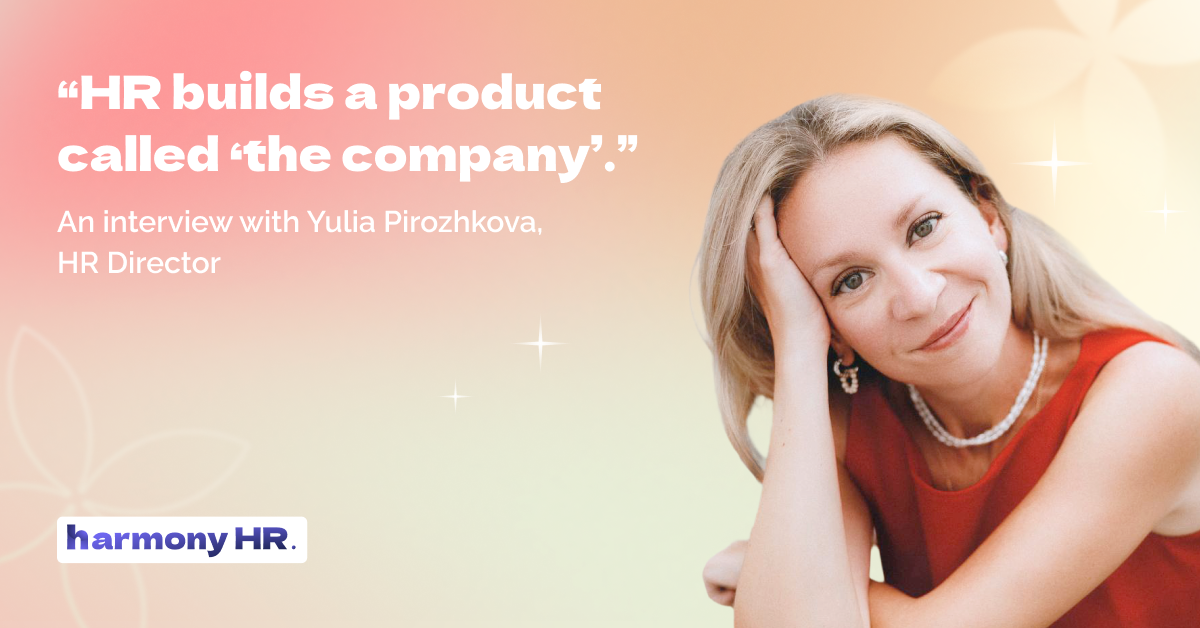
We spoke with Yulia Pirozhkova, an HR Director with 12+ years at Acronis, Segmento, Wallarm, Samokat, and Nexters (GDEV). She has built HR teams from scratch, scaled R&D groups, implemented HR systems, led transformations in the US, Russia, and Cyprus, and helped organizations recover during crises.
If you're searching for how to increase offer acceptance, build a data-driven HR strategy, use AI in recruiting, or fix weak management without just adding headcount, this interview gives concrete playbooks you can use this quarter.
Why most "HR strategy" fails (and how to fix it)
1. You've worked in all kinds of companies: fast-moving startups, large international corporations, and established businesses. Which is harder—building HR from scratch or fixing problems in an existing company?
Honestly, fixing chaos in a mature company is much tougher.
Starting from zero in a startup is challenging, yes. You have no processes, no policies, and often no strategy. You are the "first adult in the room." But this is constructive pain. You are creating. The culture is still forming, so people are open to change. They're willing to try new things because the company is still finding its way
In a mature company with long-standing issues, the challenges are more emotional and political. The problems are often held together by the knowledge of just a few people, not by clear rules. Everyone is formally "happy" with the status quo because they've learned to survive in it. When you try to introduce things like performance reviews, clear goals, or salary transparency, you're not just adding a process; you're shaking up their sense of security. You end up acting as a psychologist, a crisis manager, and sometimes the "bad guy."
Building from scratch is hard work, but fixing old problems is like doing surgery without painkillers. Still, fixing these issues can have the biggest impact on a company's long-term success.
If you run distributed teams, align rituals and documentation with our guide: How to Manage Remote Teams in 2026: A Practical Guide for HR Leaders.
How to Increase Offer Acceptance Rate to 90%
Offer Acceptance Rate Benchmarks (2026)
– < 60% – high risk zone: expectation mismatch, weak employer brand, or compensation issues
– 70–85% – average range for most tech and product companies
– 90%+ – best-in-class with strong role framing, recruiter–manager alignment, and high management quality
Most companies never look at their offer acceptance rate as a core hiring metric — they just feel that "candidates keep disappearing at the finish line."
2. You mentioned reaching a 90% offer-acceptance rate in a previous job. That's impressive. What's the secret sauce?
It comes down to two things: being completely honest and treating recruiters as partners, not just as a service.
Candidates don't turn down offers; they turn down jobs that don't match what they were told. They notice when there's a gap between what was promised and what's real. We changed our approach:
1. We stopped selling an idealized version of the job. If the role was mostly routine work with only a little R&D, we stated that. Surprisingly, this led to more people accepting offers because those who wanted stability stayed, and those looking for something else left early. When your process consistently "sells reality", you naturally increase offer acceptance and see fewer last-minute declines.
2. Recruiters became true partners. They had the authority to tell hiring managers, "This candidate is strong, but they won't thrive with your management style."
3. Managers learned how to present the team in an honest manner. We trained them to have real conversations about the team, the work environment, and the challenges, instead of treating interviews like tests.
Track offer acceptance, fix first-90-days attrition
HarmonyHR helps you centralize offers, standardize post-offer handoffs, and automate 30/60/90 onboarding with audit trails and reports — so you can systematically increase offer acceptance without just raising salaries.
See HarmonyHR offer management in action
Data-Driven HR: When You Think You Need Headcount
3. You believe in data-driven HR strategy. Can you share an example where data changed a big decision?
We had a classic request: "The team is drowning, we need to hire 5–7 more people immediately."
Before adding headcount, we looked closely at the data: speed, workload, employee feedback, and performance. The results were eye-opening. The data showed we didn't have a capacity problem; we had a management problem. Tasks were assigned randomly, the manager was a bottleneck, and manual work was taking up too much time.
If we had hired more people, we would have just made the chaos bigger. Instead, we automated tasks, reassigned roles, and helped the manager improve. We didn't hire anyone, but the team's output went up. That is the power of analytics—it saves you from spending money on the wrong solution.
If you're just starting with a basic HR analytics stack, focus on time-to-hire, rework, and manager throughput — we break these down in 8 key HR metrics every manager must track in 2026.
4. You've used some creative ways to find candidates. What was the most unusual?
I once used an expat forum focused on housing and bureaucracy in Russia to find rare bilingual specialists.
Regular job boards had no leads. I realized I needed to go where these people spent their time, not just where they looked for jobs. I started posting in threads about visas and apartments, and it worked because that's where the community was.
The takeaway: Don't look for a "magic source." Go where your candidates spend time as people, not just as professionals.
Weak Management: The Silent Killer of Offer Acceptance
5. What hurts a company more: a toxic founder, weak management, or employee sabotage?
Weak management.
A toxic founder is a big problem, but it's usually obvious and gets addressed quickly. "Polite sabotage" by employees is just a sign of deeper issues.
But weak management is the silent killer. Weak managers hire people who won't challenge them, avoid tough conversations, and don't set clear expectations. This leads to a culture of mediocrity that keeps repeating itself. By the time you notice it, your best people have left, and your culture is diluted.
To reduce churn, combine manager development with measurable onboarding and clear goals. See Employee Turnover in 2026: Benchmarks & 5 Proven Fixes.
6. In a crisis, HR is often told to "keep everyone happy, but cut costs by 30%." How do you handle that?
You have to stop cutting "cookies" and start looking at the business portfolio.
The biggest mistake is trying to save money by cutting a little from every department, like canceling events or training. Real savings come from being honest about which projects or products are no longer working—those that are unprofitable and distracting.
The best thing you can do is close down failing projects, let those employees go with respect and a good severance, and focus resources on the parts of the business that are growing. It's a tough call, but it can save the company.
Where AI Really Helps in Recruiting and HR Ops
7. There's a lot of talk about AI. What is it doing better than recruiters right now?
AI is better at handling the basics of communication.
When recruiters are busy, they make mistakes—forgetting details, writing unclear feedback, or sending generic rejection letters. AI is great for organizing thoughts, checking tone, and summarizing interviews. It can't replace the human touch needed to judge cultural fit, but it makes the process smoother. A recruiter using AI works twice as fast and makes half the errors.
Deep dive: AI in HR 2026 and 2026: Best AI HR Tools, Real Use Cases & Future Trends
8. If you could add any feature to an HR system, what would you choose?
For me, it would be a predictive behavioral engine.
Right now, HR systems just show us separate data points: maybe eNPS drops or sick leave goes up. I want a system that connects these signals into a clear story. For example: "Warning: Employee X has stopped attending optional meetings, their response time has slowed by 20%, and their manager just changed expectations. High risk of burnout."
I want a tool that works like a proactive HR business partner, offering solutions before someone decides to quit.
The Future of HR Function
9. What does the HR function look like in 5 years?
Looking ahead five years, I think the difference between traditional HR and the new approach will be huge.
- Product mindset: HR will shift from being a service function to acting more like product managers for the company.
- Data as a language: Instead of saying "I feel like...", we'll use data to guide decisions: "The data suggests..."
- Focus on management quality: As AI takes over routine tasks, HR's main value will be coaching leaders and shaping how the organization works.
- The Little Prince by Antoine de Saint-Exupéry. It teaches you to look beneath the surface, which is key to understanding people.
- Professionally: "The First 90 Days" by Michael Watkins. It teaches you to understand systems.
- Underrated: Management Quality. (Hard to measure, but impacts everything).
- Overrated: Number of Interviews Conducted. (Activity = Quality).
- Treat your offer acceptance rate as a core health metric of the recruiting funnel. Review it monthly by role and manager.
- Fixing an established company is harder than building a new one. Startup chaos can be productive, but chaos in older companies is often political and tied to old habits.
- Honesty in hiring leads to more accepted offers. When recruiters and managers set clear expectations and "sell reality," acceptance rates go way up.
- Analytics prevents bad hiring decisions. Sometimes the real issue isn't headcount, but workload, management bottlenecks, or broken processes.
- Weak management is the biggest silent killer. It multiplies itself, pushes out strong talent, and slowly corrodes culture and performance.
- In a crisis, cutting benefits does nothing; fixing the portfolio does everything. Closing unprofitable projects is painful but often the only strategic decision that saves the company.
- AI won't replace recruiters, but it will take over repetitive tasks. Recruiters who use AI work faster, cleaner, and more consistently.
- The HR function of the future looks like product management. HR will design systems, enable leadership, and act as architects of the company-as-a-product.
- Culture is built by managers, not posters. 90% of HR problems disappear when managerial quality improves.
The HarmonyHR blitz
⚡ Three words to describe a bad HR Director: Misalignment. Incompetence. Inflexibility.
⚡ A book that changed your approach:
⚡ What is there too much of in the HR sphere right now? Activity for the sake of activity. Too many initiatives look good on LinkedIn but don't solve real business problems.
⚡ What still inspires you about people? Their capacity to create. I never get tired of watching people come up with ideas and solutions that didn't exist before.
⚡ Most underrated vs. overrated metric:
Key Takeaways: From 70% to 90% Offer Acceptance
FAQ
What is a good offer acceptance rate?

Anything 70–85% is a common offer acceptance rate. 90% is achievable with honest role framing, recruiter–manager alignment, and a structured post-offer experience.
How do you increase offer acceptance without raising salary?
Set expectations early (work mix, manager style, metrics), show a 6–12-month growth plan, standardize post-offer comms, and reduce time-to-start. Track Offer Acceptance Rate monthly.
Why do candidates reject offers after positive interviews?
Expectation mismatch. Fix with consistent messaging across recruiter, manager, and interviewers; share the real constraints and success criteria.
What data should HR analyze before adding headcount?
Lead time, WIP, manual-work ratio, manager throughput, rework/defects, and employee feedback. Often the fix is process + management, not hiring.
Where does AI actually help in recruiting?
Summarizing interviews, drafting clear feedback and rejection letters, and structuring onboarding/offer comms. Keep humans in the loop.