

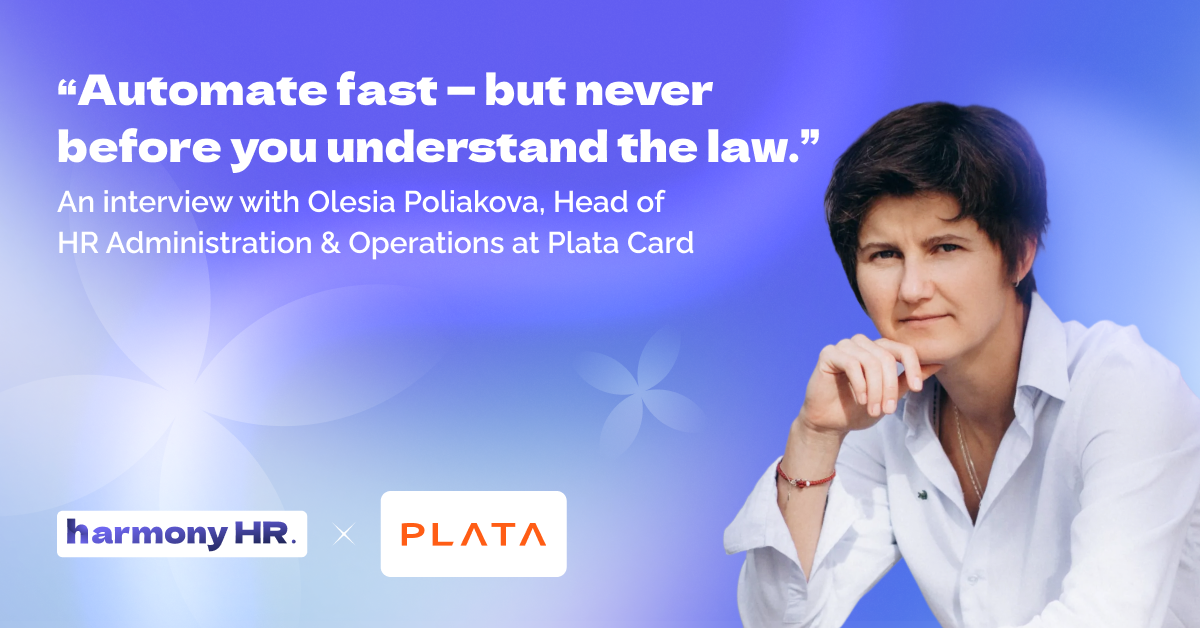
Olesia Poliakova, Head of HR Administration at Plata Card, shares what actually works when you need global HR compliance, pay transparency, audit readiness, and AI in HR that helps instead of getting in the way.
If you're searching for how to open legal entities with HR in the loop, HR admin, or AI in HR operations for documentation, you'll find concrete, field-tested practices and mistakes to avoid.
Olesia, your role covers a lot — over 900 employees and several countries. What are the biggest operational challenges you face in FinTech?
The main challenge is the tension between speed and scalability. We are growing incredibly fast, so the instinct is to automate everything immediately to keep up.
However, the hardest part is the legal groundwork. We operate in diverse jurisdictions like Cyprus, Kazakhstan, Mexico, Colombia, and you have to master the local labor laws and nuances before you build the system. If you don't have a solid legal foundation, you end up automating your mistakes.
So, the challenge is learning the local rules fast, applying them, and only then automating the process.
"If you don't have a solid legal foundation, you end up automating your mistakes."
You must rely a lot on automation. When you need to ask for an automation budget, what arguments work with the CFO?
Honestly, automation isn't something we have to fight for here. At Plata Card, it's not viewed as a "cost"—it's a priority. Automation is prioritised as part of standard operational planning.
My focus isn't on convincing the CFO, but on clearly defining the need so our dedicated automation team can execute it. We work together to spot bottlenecks or risks, and they take it into development. It's a collaboration, not a negotiation.
"Automation isn't something we have to fight for here. At Plata Card, it's not viewed as a 'cost' — it's a priority."
You've integrated AI into your daily ops. Is it actually useful, or just a gimmick?
It is definitely not a toy for us; it's a practical tool. We've found three specific areas where it adds real value:
- Drafting & structure: We use ChatGPT daily to draft communications and structure complex information. It removes the "blank page" problem and speeds up routine tasks.
- High-stakes documentation: We use AI tools that support documentation accuracy in complex projects and external partners. When opening a new entity in a new country, you cannot afford to miss a single detail regarding deadlines or legal nuances. AI captures everything so we can review it later.
- Internal process: For repetitive tasks involving large datasets, AI brings order and speed.
- initial CV screening and part of sourcing (with an important caveat: human review will still be needed, because AI can already filter out strong candidates by mistake),
- reviewing and grading standard test assignments,
- a large share of administrative routine: auto-filling documents, reconciliations, reminders, basic reporting, and issuing standard certificates.
However, we have a strict rule: AI is the assistant, not the decision-maker. We always keep a human in the loop for final review.
In a rapidly scaling environment, how do you keep HR processes from collapsing?
Stability doesn't come from things staying the same; it comes from our ability to change together without losing the system.
We don't work in a vacuum. My HR Admin team is constantly synced with People Partners, C&B, and Legal. When a new variable appears—a new country launch, a regulator change, or a new contract type—we swarm it together. We pool our expertise, assign responsibilities, and "ground" the new requirement into a clear procedure. That cross-functional support is what keeps the ship steady.
HR Admins are often invisible until something breaks. How do you make the value of your function visible to leadership?
You're right, "invisible" is the default state, so I make the value visible proactively through two channels: Speed and Risk.
First, I show the metrics: How fast are we preparing documents? Are we hitting onboarding deadlines for new countries? What is our case-closure rate?
Second, I highlight risk mitigation. In FinTech, the cost of an error is massive. I regularly report on the legal and operational risks we have prevented—whether that's audit readiness, contract compliance, or labor law adherence.
"'Invisible' is the default state, so I make the value visible proactively through two channels: Speed and Risk."
Some people say the HR Admin job is boring. Does it really affect employee retention and the employer brand?
That is a massive stereotype. HR Admin is actually one of the most dynamic areas in the business.
First, you are constantly exposed to new cultures. Managing onboarding and offboarding across locations — say, in Mexico versus Cyprus — teaches you how the world works. You are literally learning international law and culture every day.
Second, the impact is immediate. If Admin works well, the whole company feels safe. It builds trust. For me, it's not "boring routine"—it's the zone where you build high-level professional expertise that actually improves employees' lives.
"If Admin works well, the whole company feels safe. It builds trust."
How does your team fit into the Onboarding and Employee Experience?
We own the "Road to Day 1."
We are responsible for everything before Day 1: pre-onboarding, documentation, NDA signing, and explaining key policies — so the employee joins fully prepared. On the first working day, we transition the new hire to the appropriate team stakeholders, and then support selectively if any non-standard or complex cases arise.
If you had to bet, which HR processes will be completely gone in 5 years thanks to AI?
If I had to bet, I'd say this: AI won't "eliminate HR," but it will significantly reduce routine processes.
The areas most likely to disappear almost completely are tasks built around repetitive actions and first-level information processing:
But everything that requires context, trust, and real human interaction, supporting employees and managers, handling complex situations, and making decisions at the intersection of people and business, will stay with HR. AI will be a powerful assistant, not a replacement.
"Everything that requires context, trust, and real human interaction will stay with HR."
One piece of advice for your fellow HR Ops colleagues for the next year?
Community intelligence. The external environment is changing too fast for any one person to track.
Next year, focus on exchanging cases, process solutions, and practical hacks with peers in other companies. Obviously, you respect NDAs and confidentiality, but sharing how you solve problems helps the whole industry move faster and make fewer mistakes.
What's the one tool you wish existed on the HR Tech market right now?
I want the "Holy Grail" of International Admin.
Imagine a single dashboard that aggregates real-time labor and migration laws for every country. It would have ready-made checklists, timelines, and templates that update automatically when laws change. I'd love to be able to upload a specific complex case and get an instant analysis citing relevant case law and specific legal articles. That is the dream.
Last question. Your job requires a lot of attention to detail. What's your personal lifehack for staying organized?
My system is a mix of digital and analog.
Digitally, I rely on a mix of digital task-management and communication tools. I have a rule to record agreements immediately, never "later."
But my favorite habit is analog: the morning paper list. Every morning, I write my to-do list by hand on paper. There is something psychologically satisfying about physically crossing items off as I finish them. It gives me a tangible sense of progress.