

Fractional HRD (Fractional HR Director) is quickly becoming the top choice for startups and small businesses that need senior HR leadership but can’t justify the cost of a full-time executive. So what does a Fractional HR Director actually do each day? And when do basic HR tools like Excel start causing more problems than they solve?
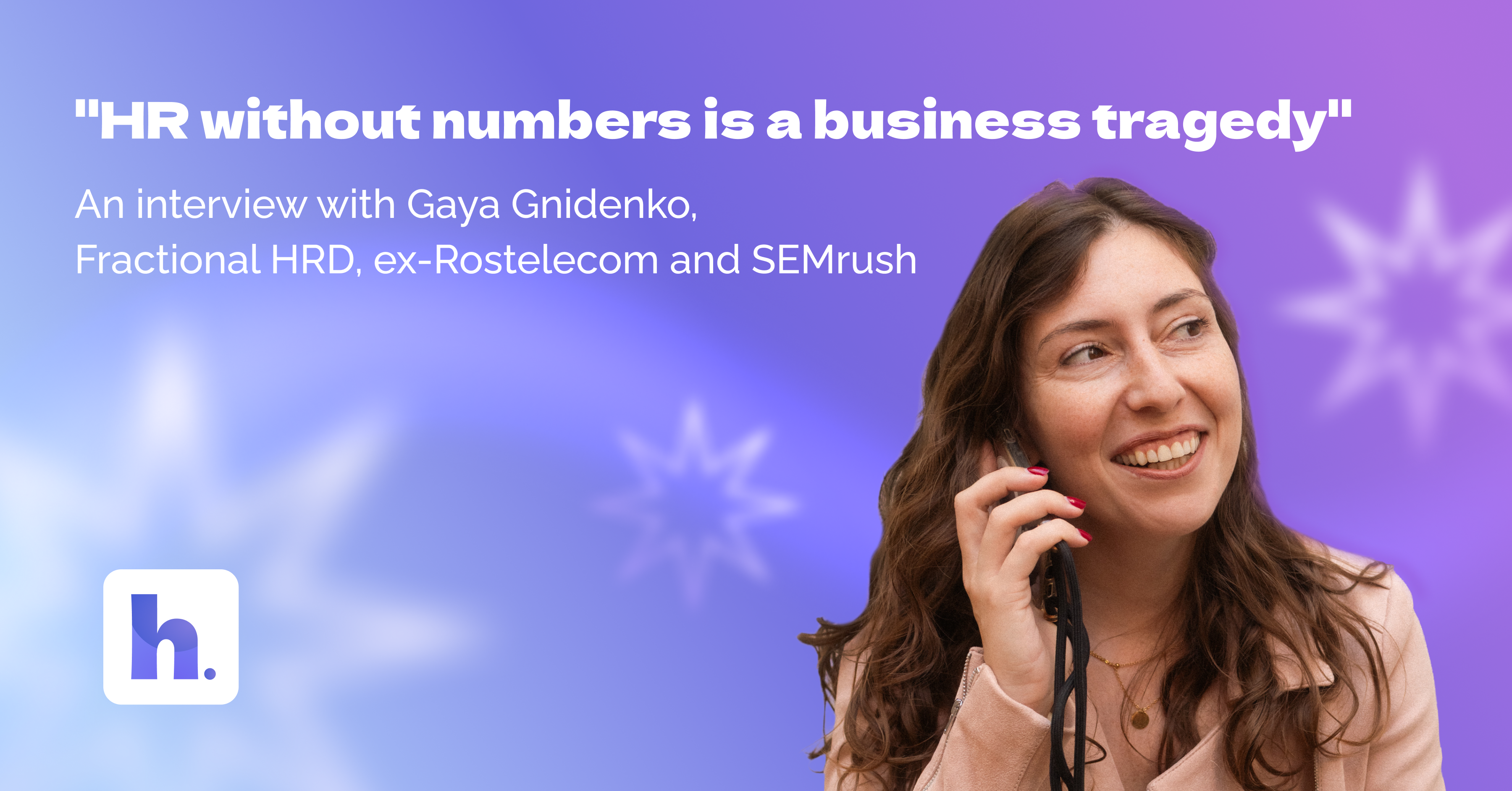
In this interview, Gaya Gnidenko, who previously worked at Rostelecom (120,000 employees) and SEMrush (about 2,000), and is now building “Healthy HR” in Barcelona, shares her practical take on performance management in 2026, why most L&D programs fail, and what to automate first when your team is still under 50 people.
If you’re growing a team, managing spreadsheets, or looking to replace annual reviews with a system that really works, this is for you.
Key takeaways (1-minute read)
- Fractional HRD vs consultant: the KPI and implementation difference that matters in small teams
- When Excel breaks HR: the “second management layer” moment where spreadsheets turn into chaos
- Performance management in 2026: why annual reviews are fading, but clarity and feedback are not
- Why L&D often fails: the “South Park black box” problem (training → ??? → results)
- What to automate first under 50 employees: the survival kit that prevents “process obesity”
- Collect underpants
- ? (Black Box)
- Profit
- DiSC.
- MBTI.
- From Manual HR to HRIS: Why Smart Companies Choose HarmonyHR
- What is an HRIS? 21 must-have features & benefits (2026 guide)
- HR System Guide 2026: Definition, Features, Pricing + Checklist
- Toxic high performer: fire or rehabilitate?
- Key skill for an HRD in 2026?
- What’s worse: HR without empathy or HR without numbers?
- Any advice for HR professionals who want to go fractional?
Healthy HR in Barcelona: from tech giants to building systems from scratch
1. Going from big companies to real estate in sunny Barcelona sounds like a downshifter dream—was it, or is small business actually more “firefighting”?
"Downshifter’s dream" sounds appealing, but I wouldn’t call myself a downshifter. If you look at company size, then yes, over the last six years, the scale has gone down. I went from 120,000 employees at Rostelecom to nearly 2,000 at SEMrush, and now I’m the HRD of a small real estate agency.
Honestly, I love it. We’re not just building square meters; we’re building a lifestyle. For me, it’s a unique chance to start from scratch—using what worked in big tech, leaving behind what didn’t, and creating what I call "Healthy HR."
L&D that works: fixing the “South Park” training problem
2. What made you realize that training alone doesn’t work without changing the talent management system?
I realized traditional training often doesn’t work back when I was an L&D specialist. The problem was built into the system. For example, people had to attend training on their days off. That’s a recipe for failure—how motivated can someone be if they’re losing their weekend? Even worse, there was no follow-up. Managers didn’t care about what happened after the training.
My biggest disappointment came at a large company where training was gamified. Employees got points for attending sessions, which they could trade for merch or food. Think about it: learning for food. It made education a way to meet basic needs, not a tool for real growth. It was just a quick dopamine hit.
There’s a South Park meme about the Underpants Gnomes. Their business plan was:
For many companies, corporate training is just like that. You do the training, something mysterious happens in the "black box," and you expect results. But the link is missing. You have to design the system starting from business goals. If we need to boost sales margins, we train for that specific skill gap.
Fractional HRD vs consultant: what’s the real difference?
3. Now you’re a Fractional HRD. What’s the main difference between a "Consultant" and a "Fractional HRD"?
Since the Fractional market is still developing, here’s how I see it.
A Fractional HRD is a part-time employee (maybe one-fifth or half of a full role). They are invested in the outcome. They gather information themselves, are responsible for making things happen, and, most importantly, have KPIs.
A Consultant usually works by the hour. They use the information given to them and suggest a solution, but they’re rarely responsible for putting it into practice or for long-term results.
For startups or companies with up to 50 people, a Fractional HRD is often the better option. You can’t afford a full-time executive salary yet, and the return on investment isn’t there. But you need someone to build the system, not just give advice.
Related reading: Why Startups Fail at People Management (2026 Insight)
Performance management across cultures: Spain vs post-Soviet pace
4. You’ve worked in high-pressure Russian companies and now in more laid-back Spain. How did you adapt your performance management style?
The cultural differences are clear. In Spain, people pay more attention to their well-being. They notice burnout sooner and take steps to address it, sometimes by taking sick leave for depression, which is their right.
There’s a constant holiday feeling here with local festivals like Fiesta Mayor, but since I’m used to a different pace, I don’t always join in. Still, I’ve learned that knowing when to stop is important. My Spanish colleagues leave work at 6:00 PM without hesitation. My American or post-Soviet colleagues often keep working until they burn out, and a burnt-out employee doesn’t help the business at all.
When it comes to performance, it’s less about culture and more about having clear goals. The biggest problem is unclear goals and not enough feedback. If the process is open, anyone can speak up if something is wrong, even to a boss. That works everywhere.
Related reading: Remote Team Management in 2026: Tools, Tips & Templates for HR Leaders
5. Is the traditional Performance Review on its way out?
The classic, bureaucratic, annual Performance Review ritual? Yes, it’s fading away. It often wastes everyone’s time.
But Performance Management—a clear system tied to business results—is essential, even for small companies. I don’t like unnecessary formality, but I fully support having a clear system.
Assessment without fear: how to make it useful (not threatening)
6. Assessment is your specialty, but employees often dislike it. How do you make it less intimidating?
Assessment only feels threatening when it’s unclear, or when people think it’s just a step before being fired.
I see assessment as a way to learn about yourself. Now, AI lets us do in minutes what used to take days, like modeling competencies, which saves time and resources. But for employees, the benefit must be obvious: "This helps me understand my strengths and limits."
The hardest part is that people often skip over the "Strengths" section of their report and focus too much on "Areas for Improvement." My view is: does this weakness actually affect your work? If not, don’t worry about it. Perfect managers don’t exist.
7. If you could throw three popular assessment tools into the trash, what would they be?
I won’t count horoscopes, though some HR people use them! So I’d definitely get rid of the first two.
8. What’s your biggest mistake in personnel assessment?
Years ago, I was assessing top talent. In a case study about refrigeration units, I mixed up cubic meters and square meters.
This error led to a participant getting a lower score, and he filed a complaint against me. It was very unpleasant, and I blamed myself for a long time.
But three years later, I found out he was fired anyway. My math was wrong, but the assessment was right!
Talent strategy: hire a star or train a B-player?
9. If you only have the budget for one option—hiring a star or training a B-player—which do you pick?
Both my internal HRD and L&D expert would choose to train the B-player. A star in one company may not shine in a new environment. It’s often safer to invest in someone you already know. Unless you’re building a team around that star, the risk is usually too high.
HR automation for small teams: when Excel becomes the enemy
10. For small companies with fewer than 50 people, what’s the essential automation toolkit? When does Excel become a problem?
Excel starts causing trouble as soon as you have more than one management layer. When several managers are filling out spreadsheets, things quickly get messy.
The best approach is to use your CRM as a simple Human Capital Management system. Keep things straightforward and avoid jumping into complex enterprise software too soon.
Related reading:
11. As a Fractional HRD, what’s the most common issue you see in small companies?
Process obesity. Many small businesses try to act like big corporations by adding too many systems and processes from their previous jobs. This slows them down and makes them less flexible.
Ambition in Europe: different definition of success
12. How does talent management differ between Russia and Europe? How true is the “European stereotype” in your experience?
It’s not a lack of ambition, but it’s really just a different view of success. In Europe, it’s not shameful to stay in the same job for years if you do it well, whether you’re a baker or a bank clerk.
In my experience, ambition used to mean working harder than everyone else to prove yourself—often to get the validation we missed growing up. Now, I don’t see exhaustion as a sign of ambition.
If you’re ready to move off spreadsheets
If Excel is starting to break your HR processes (multiple managers, version chaos, missing approvals), it’s usually time to move to an HRIS with clear ownership, workflows, and audit-ready data.
At HarmonyHR, we help small and mid-market teams replace spreadsheet-based HR with a structured system for employee data, onboarding/offboarding, approvals, and reporting — with on-premise or private cloud options for security-conscious companies.
Book a free 20-minute call with HarmonyHR to map what to automate first for your team size.
Blitz Round
Fire.
Antifragility.
HR without numbers is a disaster for the business.
Learn the numbers. Understand the economy, business models, and financial models.
FAQ
What is a Fractional HR Director (Fractional HRD)?

A Fractional HR Director (also called Fractional HRD) is a part-time HR leader who acts like an internal executive: owns implementation, runs the system, and is accountable for outcomes (often tied to KPIs). Unlike many consultants, they usually stay involved after the strategy phase.
When does Excel become the enemy of HR growth?
According to Gaya, once you have more than one management layer, spreadsheets become chaotic and risky. For more details, see: The hidden price of “free” HR: why Excel and Google Sheets cost you more than you think.
Are annual performance reviews still useful?
The old bureaucratic process is fading, but performance management—setting clear goals, giving feedback, and aligning with the business—remains crucial, especially in small teams where confusion is costly.
What should a small company automate first in HR?
Start with the basics that keep things organized: employee data, onboarding and offboarding steps, time
off, and clear ownership. If you’re trying to figure out what an HR system should include in 2026, check
out: HR System Guide 2026:
Definition, Features, Pricing + Checklist.
Want a simple HR automation checklist for teams under 50?
We can share a practical template (roles, workflows, what to automate first). Book a free 20-minute session with HarmonyHR.