

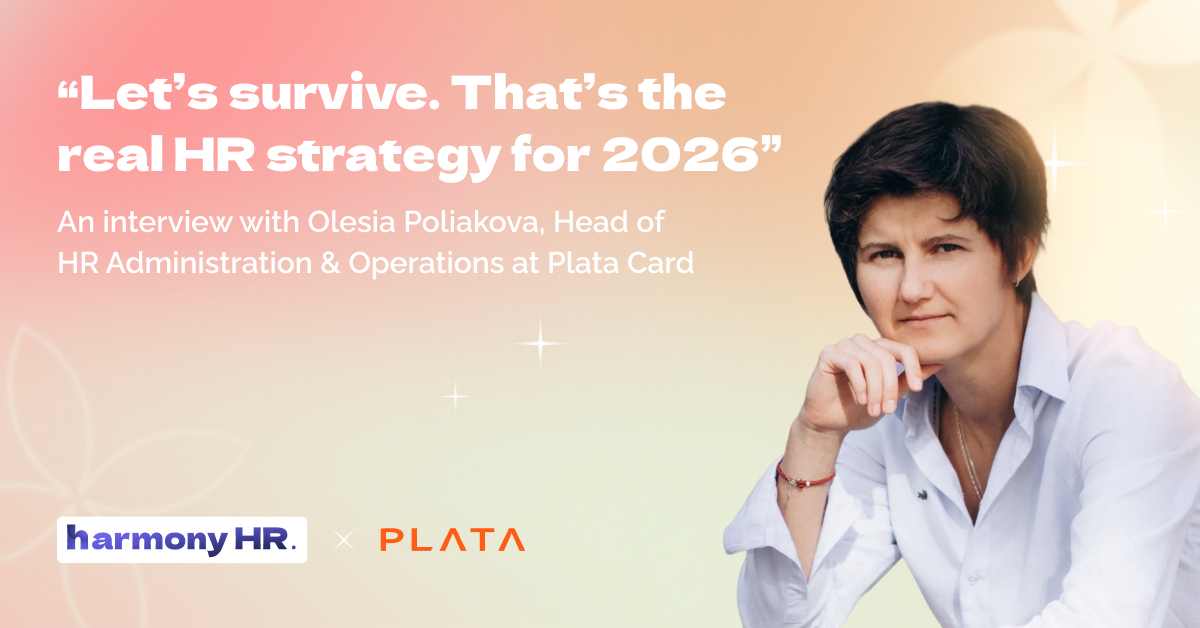
This interview is a real-world look at FinTech HR operations: how Plata Card’s HR operations function supports 800+ employees across LATAM, Cyprus, and Kazakhstan, opens new legal entities in Colombia, Georgia, and Spain, and prepares the company for a 2026 IPO.
Olesia Poliakova, Head of HR Administration & Operations at Plata Card, shares what actually works when you need global HR compliance, pay transparency, CNBV audit readiness, and AI in HR that helps instead of getting in the way.
If you're searching for how to open legal entities with HR in the loop, IPO-ready HR admin, or AI in HR operations for performance reviews and documentation, you'll find concrete, field-tested practices and mistakes to avoid.
FinTech HR Operations: the real challenges at scale
1. Olesia, your role covers a lot—over 800 employeesand several countries. What are the biggest operational challenges you face in FinTech?
It's the speed. Here are the top issues:
- Too much, too fast. Growth is so quick that keeping everyone's paperwork in order is a constant race.
- The IPO. We're shifting from credit to debit and getting ready for an IPO in 2026. That's the biggest challenge.
- Transparency. Europe is pushing for pay transparency, so we have to start building that framework now.
- Legal & compliance: "This will keep us compliant with regulations and reduce our risk." That's always the top concern.
- Cost reduction: "This will save X hours of work per month."
- Process improvement: The "nice-to-have" things, like "this will let us pull any report with one click." Reliable data is crucial, but when we're competing for limited automation resources, these usability and reporting improvements usually come after compliance and cost savings.
For the IPO, my main focus is creating a mountain of policies that can be applied globally but adapted locally for each country's laws.
If you're managing distributed teams, align rituals with our guide: How to Manage Remote Teams in 2025: A Practical Guide for HR Leaders.
Legal entity setup across LATAM & EU
2. With just 3 people, you must rely a lot on automation. When you need to ask for an automation budget, what arguments work with the CFO?
We have a separate automation team, but they're as busy as we are, so you have to fight for a spot in the Jira queue. The arguments that work are always in this order:
AI in HR operations: what works (and what fails)
3. Let's talk about AI. You're not just planning to use it, you're already using it. What's it really like?
Oh, yes. We use it for performance reviews. Some managers have more than 20 direct reports, so AI helps summarize peer feedback and highlight patterns. The manager still reviews the original comments, but the summary makes it easier to focus on the most important themes.
4. And is the AI summary... any good?
It's... okay. Sometimes it's just wrong. The AI might skip a specific example or translate our internal slang literally, and you end up thinking, "What? That's not what we meant." The prompt probably needs more work.
We also use transcription a lot when setting up new legal entities. We meet with local lawyers and vendors, and the AI transcribes everything. Later, we can pull summaries of agreements, deadlines, and legal notices. It's a huge help.
And of course, ChatGPT. I use it every day, especially when I'm frustrated and need to write a polite email. The "polite" version really helps.
5. How "daily" is daily?
I use it all the time. I joke that when the machines take over, I'll be the first target. I'm always saying, "Hey buddy, help me out," or "What is this nonsense? This is all wrong, redo it."
Recently I asked it to combine two long policy documents. It paused and told me it needed more time to process. I laughed and thought, "It's happening, now I'm negotiating deadlines with AI."
When I jokingly said I’d switch to another tool, it suddenly produced the result. It's already acting a bit like a difficult employee who doesn't want to work.
"AI's already acting like a difficult employee who doesn't want to work."
Real examples of performance-review summarization and legal-vendor transcription in our deep dive: AI in HR 2025 and 2026: Best AI HR Tools, Real Use Cases & Future Trends.
Audit & compliance: from ad-hoc docs to audit trails
6. With all this FinTech startup chaos, how do you keep HR processes stable when things are so hectic?
Sometimes you can't. You just have to adapt. If you're not ready for constant change—not just small changes, but "it was one way yesterday and it's different today"—then you can't work in a startup.
If you don't plan ahead, you'll get overwhelmed. I dislike the phrase, "That's how it's always been done." If you work that way, you can't survive in a startup.
"I dislike the phrase, 'That's how it's always been done.' If you work that way, you can't survive in a startup."
Why "boring" HR admin drives retention and employer brand
7. You mentioned "boring" admin work. Does it really affect employee retention and the employer brand?
It's actually the most important part. If an employee's documentation is clean, transparent, and on time, it's a massive plus for trust.
Imagine relocating someone to Cyprus. They arrive with no connections. HR didn't know they were coming. They ask, "What documents do I need?" You send the list. They ask, "What's an 'apostille'?" You explain, "It's a stamp you get in your home country." And they say, "Nobody told me."
Whose fault is it? It's always HR's fault. "HR didn't give me a pink slip," "HR blocked my bank account."
One of my biggest challenges now is making sure the business knows: "Don't open a new legal entity without talking to us first."
"If an employee's documentation is clean, transparent, and on time, it's a massive plus for trust."
IPO readiness: policy stack + measurable onboarding
8. How does your team fit into the Onboarding and Employee Experience?
We handle everything before Day 1. We explain policies, sign the NDA, and help candidates get to know our systems before they officially join. After that, we hand them over to their manager and People Partner.
Our job usually ends there, unless something unexpected happens. I also get involved in complex terminations because of my experience. I'm the one who talks to the employee, explains the situation, and sets boundaries. I also teach managers how to handle goodbyes well.
Make onboarding measurable and visible to leadership with 8 key HR metrics every manager must track in 2025.
Advice, culture, and the future with AI
9. If you had to bet, which HR processes will be completely gone in 5 years thanks to AI
Maybe sourcing, but I'm not convinced. I see our AI now, and sometimes it rejects good candidates just because their CV isn't written perfectly. If everyone starts using AI to write their CVs, the AI will just pick other AI-generated candidates.
Checking test assignments will probably be automated.
Training and Development could change a lot. AI might create interactive, personalized courses, spot your skill gaps, and assign tests.
But People Partners will still be needed. People always need someone to talk to. And Admins? We'll be around as long as there's paperwork and bureaucracy.
10. One piece of advice for your fellow HR Ops colleagues for the next year?
Focus on sustainability for yourself and your team. The work is fast and demanding, but we don't have to burn out to be effective./b>
I also wish we had a global portal to share our tools and tips. I don't like the attitude of keeping good ideas to yourself. We should share more.
We also need to stop thinking HR experience only counts if it's in the same industry. A good HR professional can work anywhere, whether it's with teachers or in FinTech.
11. What's the one tool you wish existed on the HR Tech market right now?
I'd love a global, unified database for HR Admins. I want a tool where I can click on a country, like Colombia, and see everything: labor laws, tax codes, expat legalization steps, required documents for employees and employers, and all reporting rules. And it needs to be accurate, not like GPT, which sometimes makes things up.
12. Last question. Your job requires a lot of attention to detail. What's your personal lifehack for staying organized?
Olesia: I'm old-school. I use a notebook and pen for my to-do list.
I also rely on simple digital tools —Google Calendar, notes on my phone, a shared Notion workspace, and reminders in tools like Slack. If it's not written down somewhere, it doesn't exist for me.
Shared checklists and recurring reminders keep the whole team aligned across time zones.
Key takeaways for HR Ops in high-risk industries
In high-risk industries, recruitment success is decided in the first 90 days. Treat onboarding as part of performance management, not admin. Centralize policies, approvals, and audit trails in your HRIS, and keep HR at the center of legal entity setup.
FAQ
What are the main HR operations challenges in FinTech?

Speed, multi-country legal entities, audit readiness, and pay transparency—handled best when HR owns checklists, policies, and audit trails in one HRIS.
Why should the HR admin be involved before opening a new legal entity?
Because contracts, payroll/tax IDs, data flows, and onboarding policies must be compliant on day one; centralizing them in HR ops prevents expensive rework and fines.
How can AI realistically help HR operations today?
Summarizing peer feedback for large teams and transcribing legal/vendor meetings during entity launches—if prompts are well designed and humans review outputs.
How should HR prepare for an IPO from an operations standpoint?
Build a global policy library with local adaptations, centralize approvals and documentation, and measure 30/60/90 onboarding to reduce early turnover.