Chapter 1. How Managed Recruitment Works
How to use this chapter
A working scenario. A candidate completed an interview on Monday. On Tuesday, the manager said: "Good candidate, but I need to think about it." On Wednesday, the recruiter sent a reminder. On Thursday, a new urgent vacancy appeared and the previous conversation got buried in messages. On Friday, the candidate accepted another offer. At the debrief, people gave correct but useless explanations: the market is fast, the candidate was strong, what a shame. But the real reason was simpler: the next step had no owner.
What actually broke here: not sourcing, not the recruiter's charisma, and not the market. Manageability broke down.
The team could not see where the candidate stood, what decision needed to be made, who was responsible for the deadline, or what data was needed for the next step.
This chapter provides a basic map of managed recruitment: role purpose, stages, owners, criteria, SLA, data, and regular debriefs. It does not teach sourcing in depth — search, channels, Boolean, outreach and long-list belong to a separate systematic sourcing methodology. A full intake and vacancy brief are not unpacked here either — the practical minimum for launching recruitment is covered in Chapter 2.
Remember in one sentence: a process exists only where every next step has an owner.
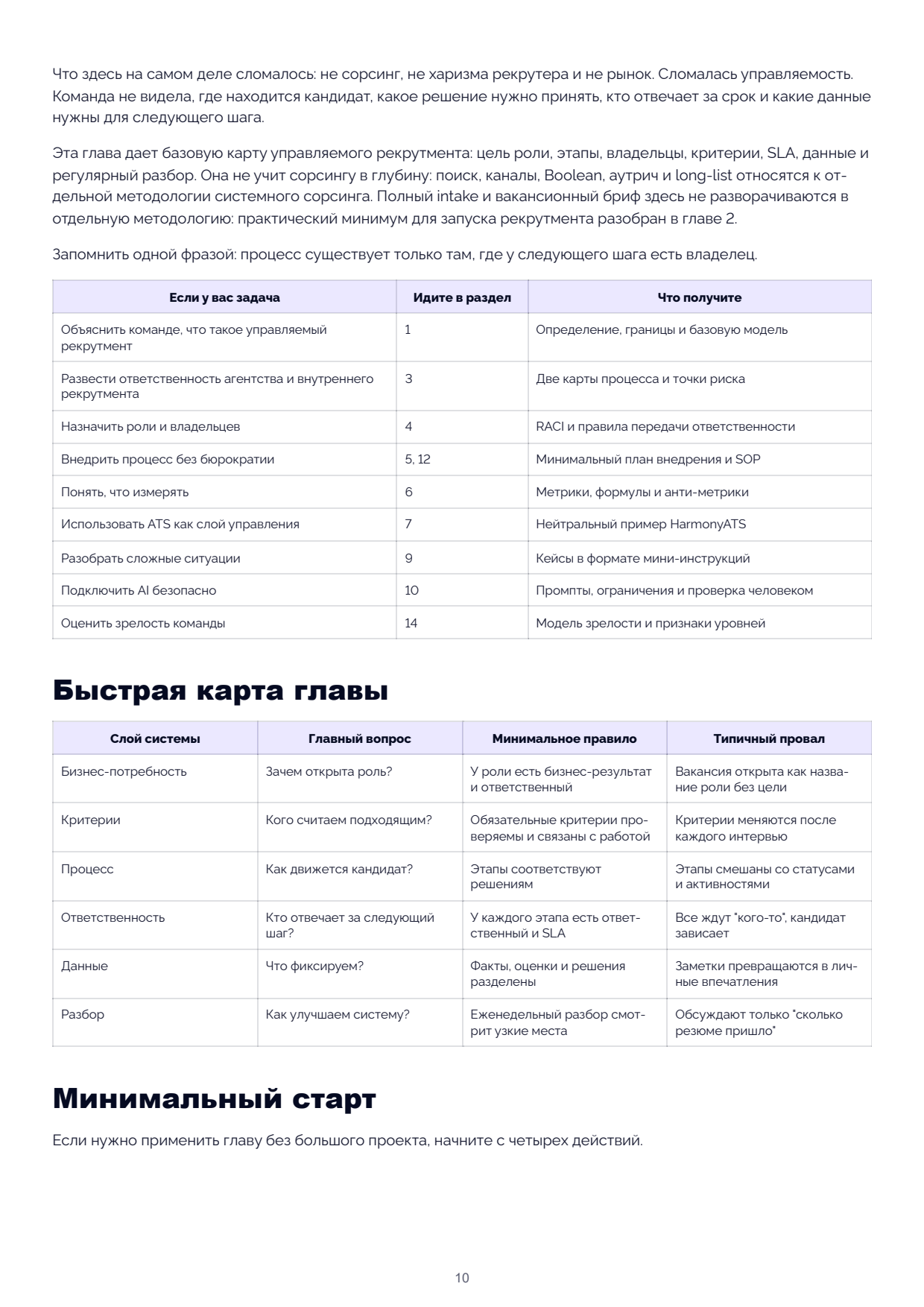
| If your task is | Go to section | What you will get |
|---|---|---|
| Explain to the team what managed recruitment is | 1 | Definition, boundaries and basic model |
| Separate agency and in-house recruitment responsibilities | 3 | Two process maps and risk points |
| Assign roles and owners | 4 | RACI and handover rules |
| Implement a process without bureaucracy | 5, 12 | Minimum implementation plan and SOP |
| Understand what to measure | 6 | Metrics, formulas and anti-metrics |
| Use ATS as a management layer | 7 | Neutral HarmonyATS example |
| Handle complex situations | 9 | Mini-instruction case studies |
| Integrate AI safely | 10 | Prompts, guardrails and human checks |
| Assess team maturity | 14 | Maturity model and level indicators |
Quick chapter map
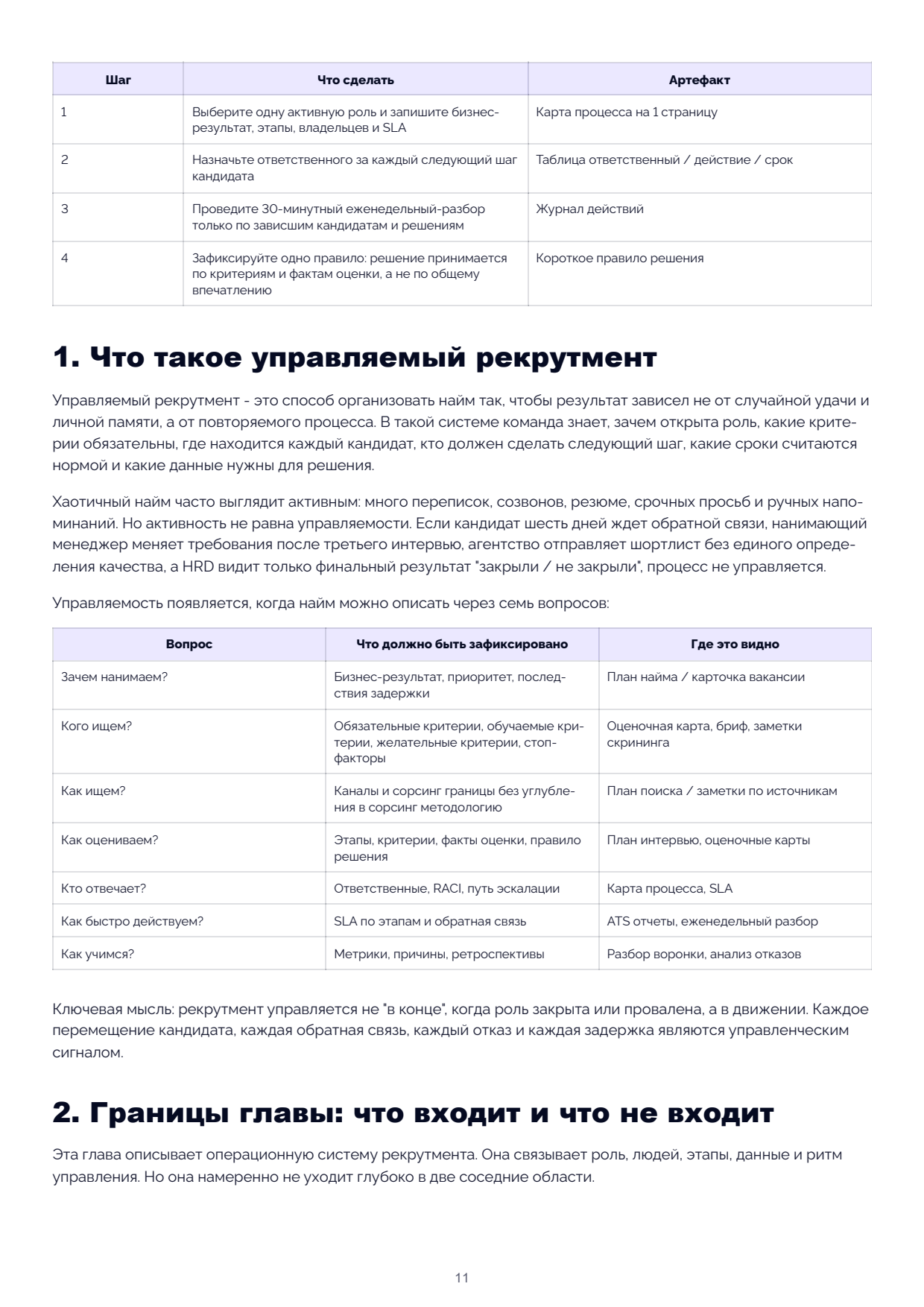
System layer Key question Minimum rule Typical failure
Business need Why is the role open? The role has a business outcome Vacancy opened as a job
and owner title without a purpose
Criteria Who do we consider suitable? Must-have criteria are verified Criteria change after every
and linked to the work of the role interview
Process How does the candidate move? Stages align with decisions Stages are confused with
and activities statuses
Accountability Who owns the next step? Every stage has an owner and SLA Everyone waits, the candidate
stalls
Data What do we record? Facts, assessments and decisions Notes become personal
are separated impressions
Debrief How do we improve the system? Weekly debrief reveals bottlenecks They only discuss "how many
CVs came in"
Minimum start
If you need to apply this chapter without a large project, start with four actions.
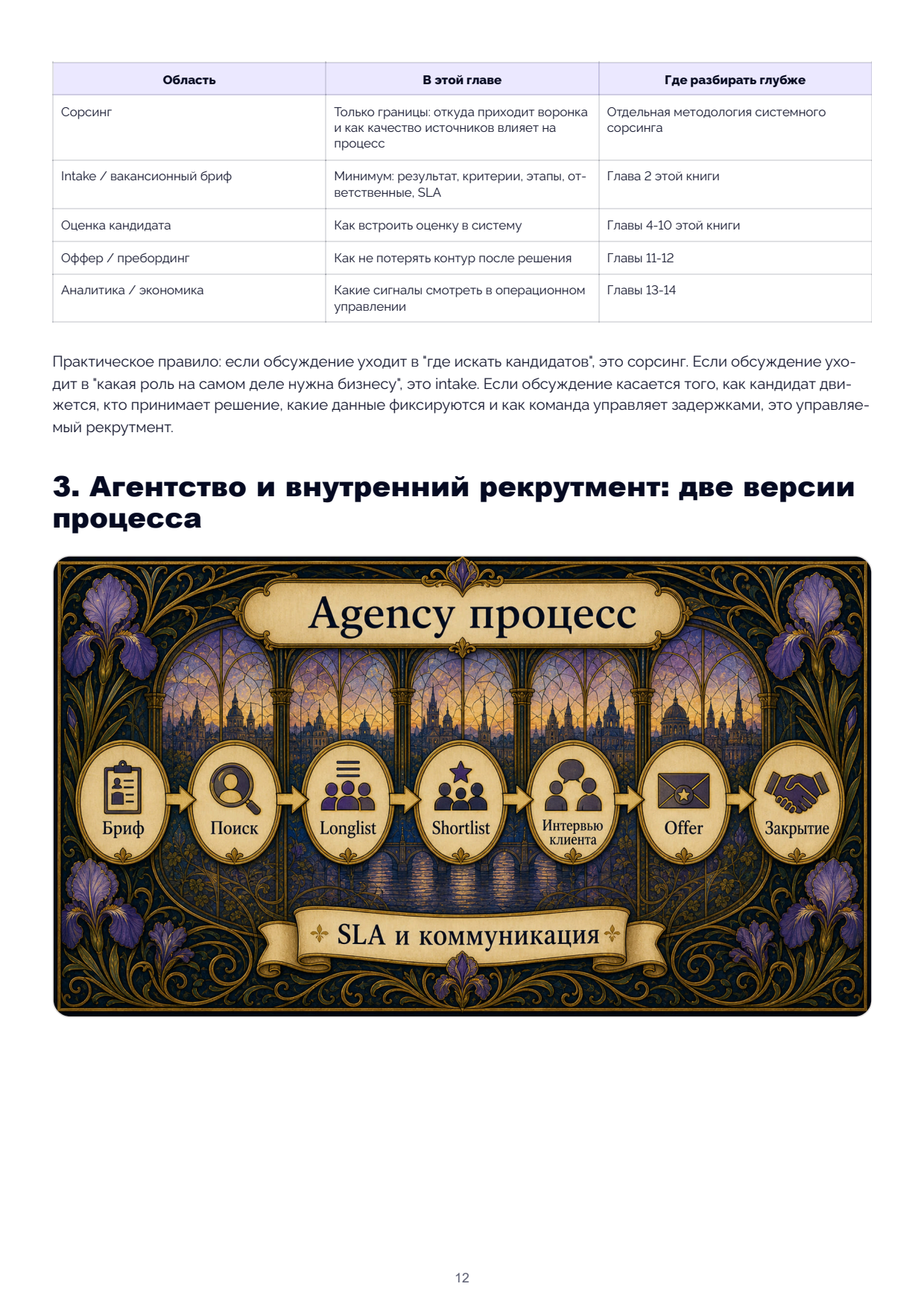
| Step | Action | Artifact |
|---|---|---|
| 1 | Choose one active role and record the business outcome, stages, owners and SLA | One-page process map |
| 2 | Assign an owner for every next candidate action | Owner / action / deadline table |
| 3 | Run a 30-minute weekly debrief focused only on stalled candidates and pending decisions | Action log |
| 4 | Set one rule: decisions are made on criteria and assessment facts, not on general impressions | Short decision rule |
1. What is managed recruitment
Managed recruitment is a way of organising hiring so that results depend not on luck and individual memory, but on a repeatable process. In such a system, the team knows why the role is open, which criteria are mandatory, where each candidate stands, who must take the next step, what deadlines are considered normal, and what data is needed for decisions. Chaotic hiring often looks busy: lots of messages, calls, CVs, urgent requests and manual reminders. But activity does not equal manageability. If a candidate waits six days for feedback, the hiring manager changes requirements after the third interview, the agency sends a shortlist without a single quality definition, and the HR director sees only the final outcome of "filled / not filled", the process is not being managed. Manageability appears when hiring can be described through seven questions:
| Question | What must be documented | Where it shows |
| Why are we hiring? | Business outcome, priority, consequences of delay | Hiring plan / vacancy card |
| Who are we looking for? | Must-have criteria, trainable criteria, nice-to-have criteria, stop-factors | Assessment scorecard, brief, screening notes |
| How do we find them? | Channels and sourcing boundaries without deep-diving into sourcing methodology | Search plan / source notes |
| How do we assess? | Stages, criteria, assessment facts, decision rule | Interview plan, assessment scorecards |
| Who is accountable? | Owners, RACI, escalation path | Process map, SLA |
| How fast do we act? | Stage-level SLA and feedback | ATS reports, weekly debrief |
| How do we learn? | Metrics, root causes, retrospectives | Funnel debrief, rejection analysis |

2. Chapter scope: what is included and what is not
This chapter describes the operating system of recruitment. It connects roles, people, stages, data and the cadence of management. But it deliberately does not go deep into two adjacent areas.
| Area | In this chapter | Where to go deeper |
|---|---|---|
| Sourcing | Boundaries only: where the funnel comes from and how source quality affects the process | Separate systematic sourcing methodology |
| Intake / vacancy brief | Minimum: outcome, criteria, stages, owners, SLA | Chapter 2 of this book |
| Candidate assessment | How to embed assessment into the system | Chapters 4–10 of this book |
| Offer / preboarding | How not to lose momentum after the decision | Chapters 11–12 |
| Analytics / economics | Which signals to monitor in operational management | Chapters 13–14 |
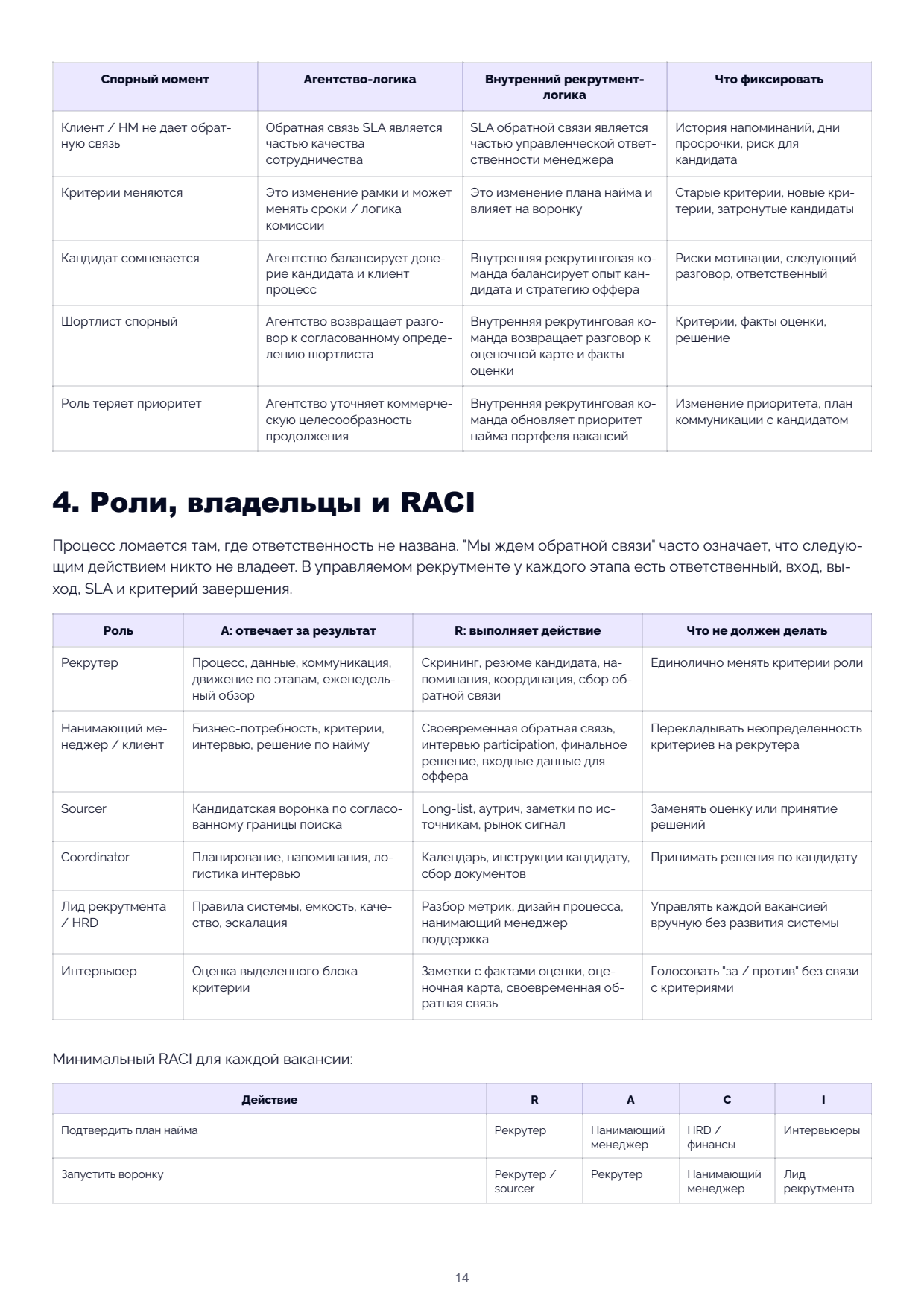
3. Agency and in-house recruitment: two versions
of the process
Agency and in-house recruitment solve a similar problem but depend on different parties. In an agency, the recruiter manages the "client – candidate – agency" triangle and is particularly careful about documenting work boundaries, shortlist definition, presentation consent, feedback SLA and commercial terms. The in-house team manages the "business – candidate – team" triangle and watches the hiring manager's accountability, interview cycle, offer decision and internal resources.
Context Process map Primary responsibility Key risk
Agency Client need –> role brief –> Deliver a relevant shortlist, Client changes criteria, does
In-house recruitment Business need –> hiring plan –> Connect business needs, Vacancy with no owner,
The agency must not become a "CV supplier". Its value lies in managing the market, expectations, shortlist quality and role-closure risk. In-house recruitment must not become an "interview secretariat". Its value lies in managing business capacity, candidate assessment, candidate experience and analytics.
The difference is especially visible in contentious moments. For the agency, it is important to protect work boundaries and not take responsibility for the client's decisions. For the in-house team, it is important not to become a passive executor of business requests when the role is poorly defined or the hiring manager does not do their part of the process.
| Contentious moment | Agency logic | In-house recruitment logic | What to document |
|---|---|---|---|
| Client / HM does not give feedback | Feedback SLA is part of service quality | Feedback SLA is part of the manager's accountability | Reminder history, days overdue, candidate risk |
| Criteria change | This is a scope change and may affect fees / timelines | This is a change to the hiring plan and affects the funnel | Old criteria, new criteria, affected candidates |
| Candidate is uncertain | Agency balances candidate trust and client process | In-house team balances candidate experience and offer strategy | Motivation risks, next conversation, accountable person |
| Shortlist is disputed | Agency returns the conversation to the agreed shortlist definition | In-house team returns the conversation to the assessment scorecard and facts | Criteria, assessment facts, decision |
| Role loses priority | Agency clarifies commercial viability of continuing | In-house team updates hiring priority within the vacancy portfolio | Priority change, candidate communication plan |

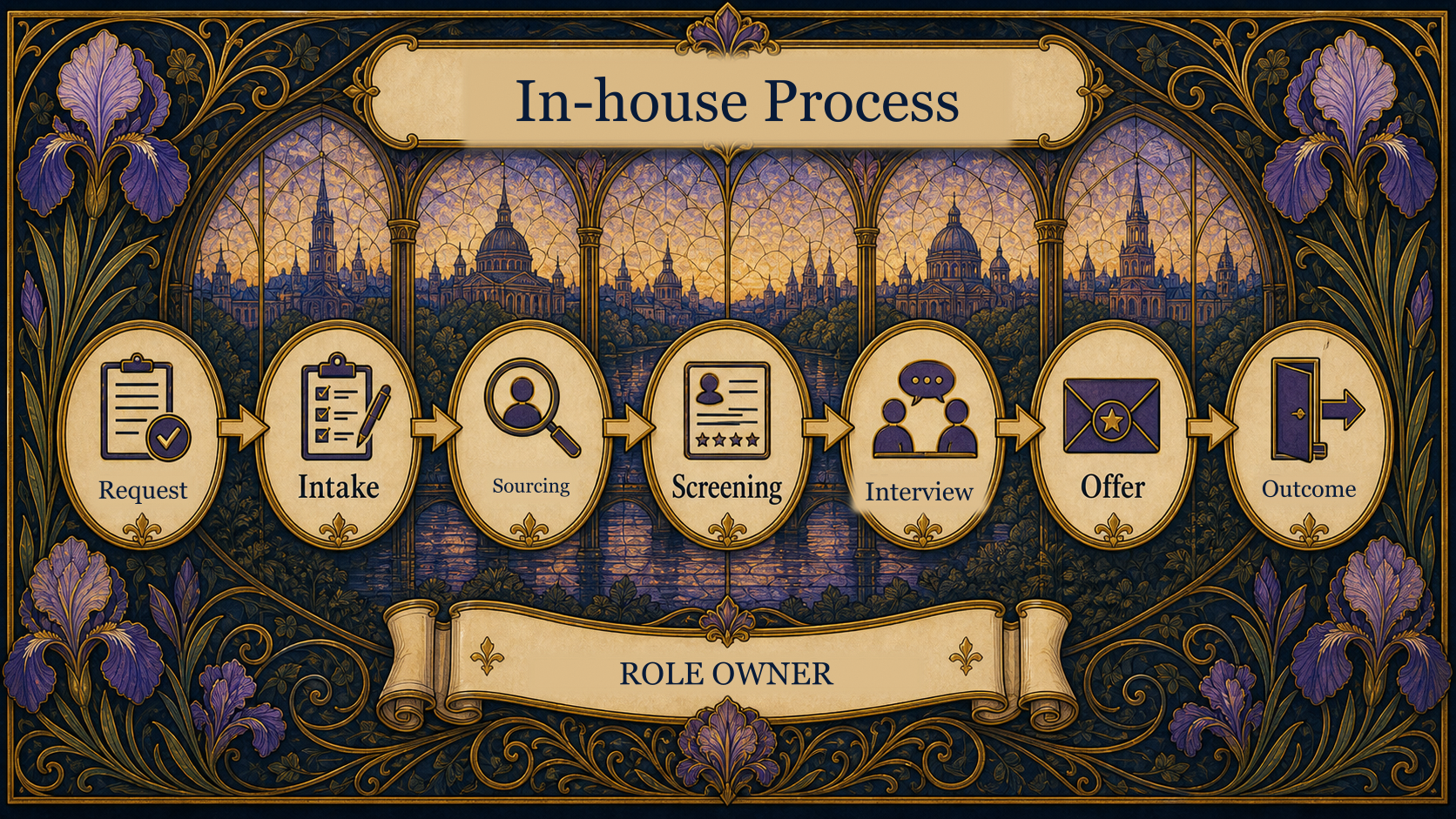
4. Roles, owners and
RACI. The process breaks down where accountability is unnamed. "We are waiting for feedback" usually means nobody owns the next action. In managed recruitment, every stage has an owner, input, output, SLA and completion criterion.
| Role | A: accountable for outcome | R: performs the action | What they must not do | |
| Recruiter | Process, data, communication, stage progression, weekly review | Screening, candidate CV, reminders, coordination, feedback collection | Change role criteria unilaterally | |
| Hiring manager / client | Business need, criteria, interviews, hiring decision | Timely feedback, interview participation, final decision, offer inputs | Shift criteria ambiguity onto the recruiter | |
| Sourcer | Candidate funnel within agreed sourcing boundaries | Long-list, outreach, source notes, market signals | Replace assessment or decision-making | |
| Coordinator | Scheduling, reminders, interview logistics | Calendar, candidate instructions, document collection | Make candidate decisions | |
| Recruitment lead / HRD | System rules, capacity, quality, escalation | Metrics review, process design, hiring manager support | Manage every vacancy manually without developing the system | |
| Interviewer | Assessment of assigned criteria block | Assessment-fact notes, scorecard, timely feedback | Vote "for / against" without linking to criteria | |
| Minimum RACI per vacancy: | ||||
| Action | R | A | C | I |
| Confirm hiring plan | Recruiter | Hiring manager | HRD / Finance | Interviewers |
| Launch funnel | Recruiter / sourcer | Recruiter | Hiring manager | Recruitment lead |
| Action | R | A | C | I |
|---|---|---|---|---|
| Make decision after screening | Recruiter | Recruiter | Hiring manager if uncertain | Candidate |
| Conduct interview | Interviewer | Hiring manager | Recruiter | Candidate |
| Give feedback | Interviewer | Hiring manager | Recruiter | Candidate receives final status |
| Make offer decision | Hiring manager | Hiring manager | Recruiter, HRD, Finance | Candidate |
| Close retrospective | Recruiter | Recruitment lead | Hiring manager | HRD |
5. How to implement a managed process
Implementation does not start with buying a tool. It starts with describing the current reality. If the team cannot map the candidate journey, the ATS will merely transfer chaos into an interface.
| Step | Action | Artifact | Quality check |
| 1. Map current state | Where candidates come from, which stages they pass, where they stall | Process map | No "grey zones" without an owner |
| 2. Select minimum stages | Keep only the points where a new decision is made | Stage list | Stages do not duplicate activity |
| 3. Assign owner and SLA | Define the accountable person and deadline for each stage | SLA table | SLA are realistic for the role and market |
| 4. Separate data | Facts, assessments, decisions, personal data | Notes policy | No assessment labels without assessment facts |
| 5. Introduce weekly debrief | Review bottlenecks, overdue items, conversion, root causes | Agenda | Discussion ends with actions |
| 6. Set up escalation | What to do about delays and criteria changes | Escalation rule | Escalation is not perceived as punishment |
The minimum version works even for a small team: one-page hiring plan, 5–7 stages, an owner for each stage, feedback SLA, rejection reason, and a 30-minute weekly debrief. If the process cannot be sustained during a busy week, it is too heavy.
6. What to measure in managed recruitment
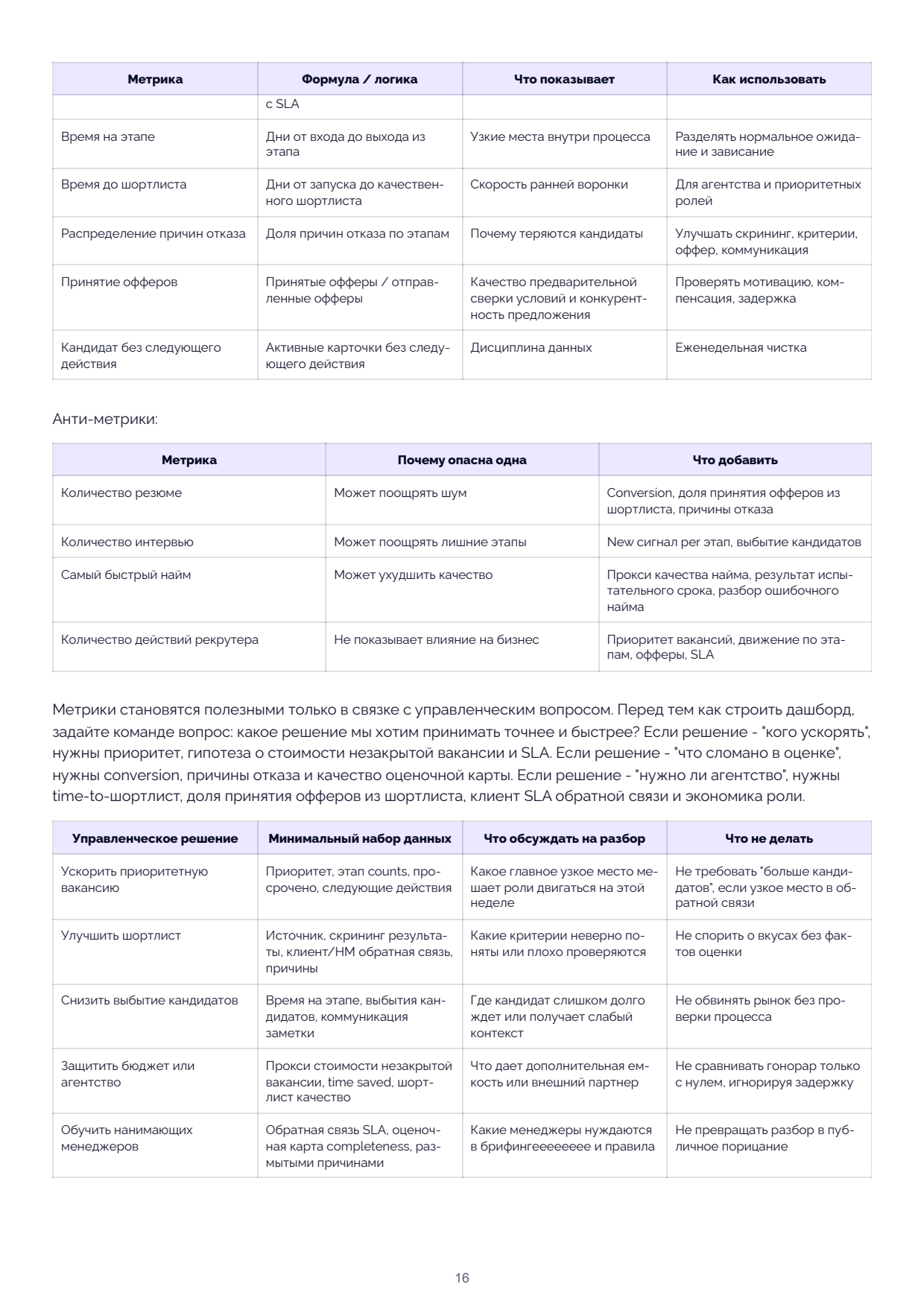
Metrics are needed not to punish recruiters but to manage the system. A single metric almost always lies. The number of candidates added without conversion tells you nothing about quality. Time-to-hire without role priority may push the team towards quick but weak decisions. Offer acceptance without analysing motivation and compensation only reports the symptom.
| Metric | Formula / logic | What it shows | How to use it |
| Stage conversion | Candidates who moved to the next stage / candidates at stage | Where the funnel loses people | Review criteria, source quality, interview design |
| SLA breach rate | Overdue candidates / active candidates at stages | Where the process stalls | Assign action and escalation |
3. Assign owner For each stage, define the SLA table SLA are realistic for the role
and SLA accountable person and deadline and market
4. Separate Facts, assessments, decisions, personal Notes policy No assessment labels without
data data assessment facts
5. Introduce weekly Review bottlenecks, overdue items, Agenda Discussion ends with
debrief conversion, root causes actions
6. Set up What to do about delays and criteria Escalation rule Escalation is not perceived as
escalation changes punishment
The minimum version works even for a small team: one-page hiring plan, 5–7 stages, an owner for each
stage, feedback SLA, rejection reason, and a 30-minute weekly debrief. If the process cannot be sustained
during a busy week, it is too heavy.
6. What to measure in managed recruitment
Metrics are needed not to punish recruiters but to manage the system. A single metric almost always lies.
The number of candidates added without conversion tells you nothing about quality. Time-to-hire without
role priority may push the team towards quick but weak decisions. Offer acceptance without analysing
motivation and compensation only reports the symptom.
Metric Formula / logic What it shows How to use it
Stage conversion Candidates who moved to the Where the funnel loses people Review criteria, source
next stage / candidates at stage quality, interview design
SLA breach rate Overdue candidates / active Where the process stalls Assign action and
candidates at stages escalation
| Metric | Formula / logic | What it shows | How to use it |
|---|---|---|---|
| with SLA | |||
| Time at stage | Days from entry to exit at stage | Bottlenecks within the process | Distinguish normal waiting from stalling |
| Time to shortlist | Days from launch to quality shortlist | Early funnel speed | For agencies and priority roles |
| Rejection reason distribution | Share of rejection reasons by stage | Why candidates are lost | Improve screening, criteria, offers, communication |
| Offer acceptance | Accepted offers / extended offers | Quality of pre-offer alignment and offer competitiveness | Review motivation, compensation, delays |
| Candidate without next action | Active cards without next action | Data discipline | Weekly clean-up |
| Anti-metrics: | |||
| Metric | Why it is dangerous alone | What to add | |
| Number of CVs | May reward noise | Conversion, shortlist acceptance share, rejection reasons | |
| Number of interviews | May reward redundant stages | New signals per stage, candidate drop-off | |
| Fastest hire | May degrade quality | Hiring quality proxy, probation outcome, wrong-hire review | |
| Number of recruiter actions | Does not show business impact | Vacancy priority, stage movement, offers, SLA |
7. HarmonyATS example
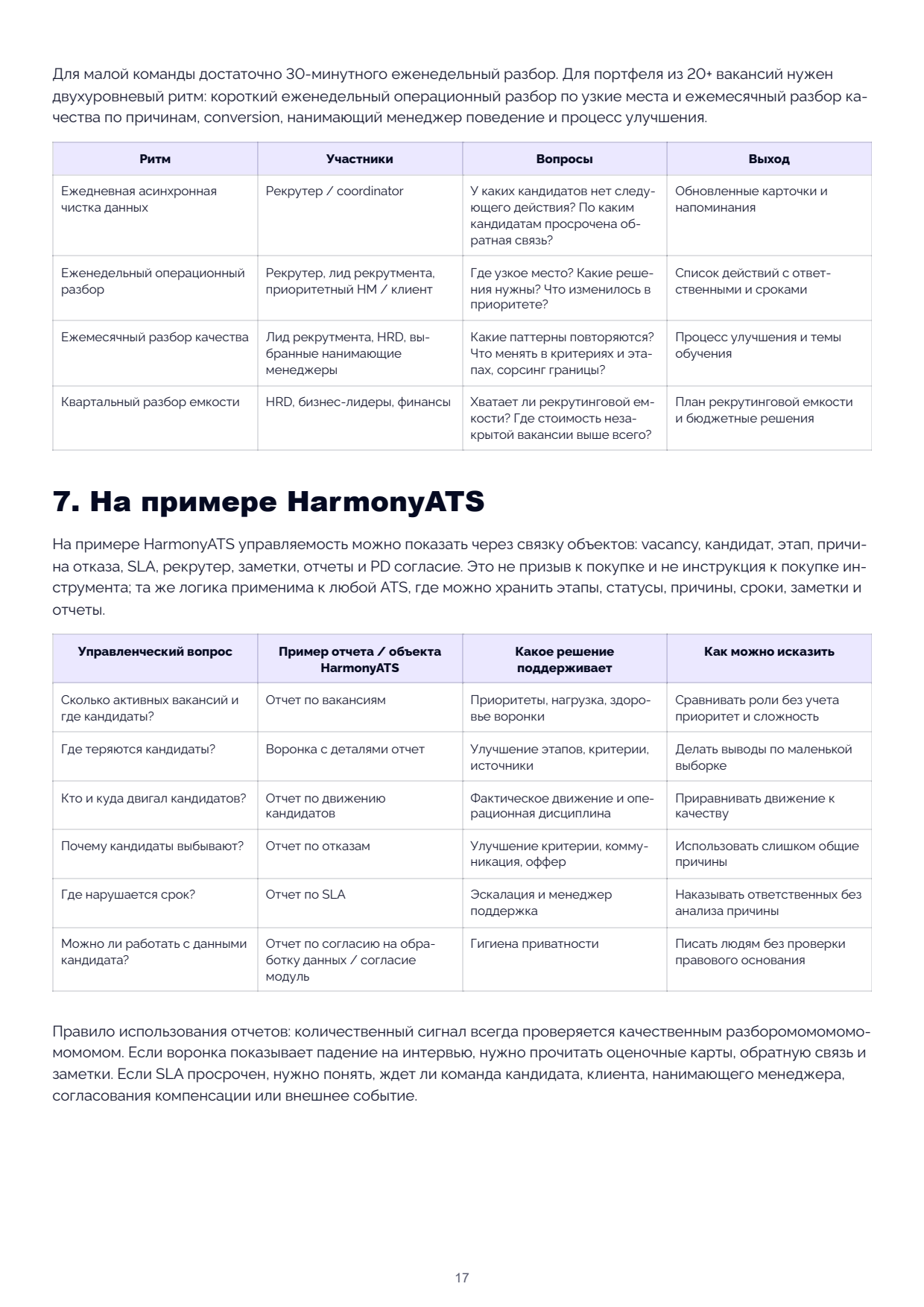
Using HarmonyATS as an example, manageability can be demonstrated through linked objects: vacancy, candidate, stage, rejection reason, SLA, recruiter, notes, reports and PD consent. This is not an endorsement or a purchase guide — the same logic applies to any ATS where you can store stages, statuses, reasons, deadlines, notes and reports.
Management question Report / object example How it helps What could distort it
HarmonyATS supports
How many active vacancies and Vacancy report Priorities, workload, funnel Comparing roles without
where are candidates? health accounting for priority and complexity
Where are candidates lost? Funnel with detail report Improving stages, criteria, Drawing conclusions from small
sources samples
Who moved candidates and where? Candidate movement report Actual movement and Equating movement with
operational discipline quality
Why do candidates drop out? Rejection report Improving criteria, Using overly general
communication, offers reasons
Where is SLA breached? SLA report Escalation and manager Punishing accountable people
support without root-cause analysis
Can we work with the candidate's Data consent report / Privacy hygiene Contacting people without
data? consent module checking the legal basis
Report usage rule: quantitative signals are always checked through qualitative debrief
If the funnel shows a drop at interview, you need to read the assessment scorecards, feedback and notes. If SLA is overdue, you need to understand whether the team is waiting for the candidate, the client, the hiring manager, compensation approval or an external event.
8. Personal data, fair assessment
and ethics
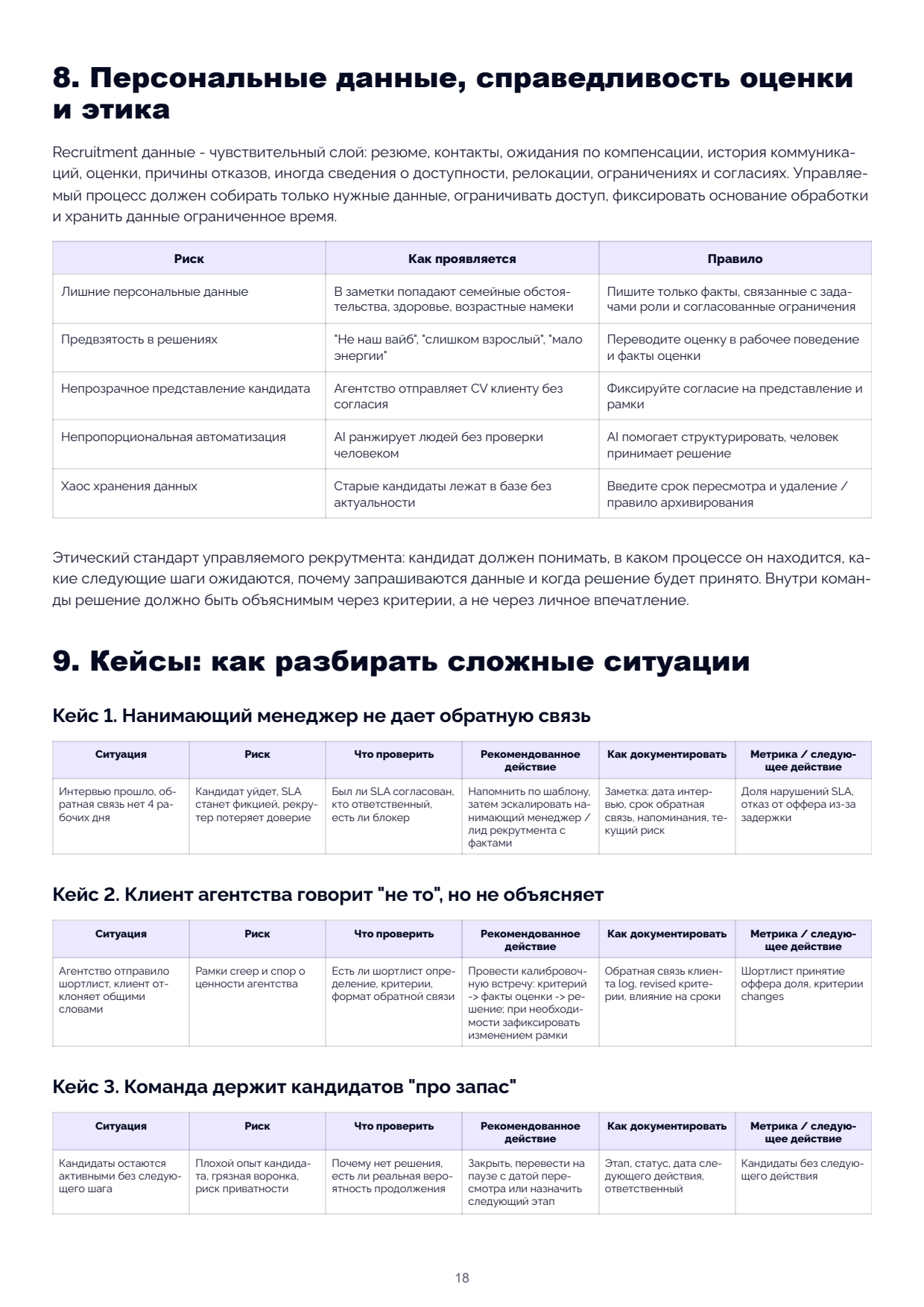
Recruitment data is a sensitive layer: CVs, contact details, compensation expectations, communication history, assessments, rejection reasons, and sometimes information about accessibility, relocation, limitations and consents. A managed process should collect only necessary data, restrict access, document the legal basis for processing, and retain data for a limited period.
Risk How it manifests Rule
Excess personal data Notes contain family circumstances, Write only facts linked to the role's tasks
health, age hints and agreed limitations
Bias in decisions "Not our vibe", "too old", "low Translate assessment into observable
energy" working behaviour and assessment facts
Opaque candidate presentation Agency sends CV to client without Document consent for presentation and
consent scope
Disproportionate automation AI ranks people without human AI helps structure; a human takes the
check decision
Data storage chaos Old candidates sit in the database Introduce review periods and deletion /
without review archival rules
The ethical standard of managed recruitment: a candidate should understand which process they are in, what next steps are expected, why data is being collected, and when a decision will be made. Within the team, a decision must be explainable through criteria, not through personal impressions.
9. Cases: how to handle complex situations
Case 1. The hiring manager does not give feedback
Situation Risk What to check Recommended How to document Metric / next
action action
Interview completed, no Feedback is overdue, SLA Was SLA agreed, who is the Reminder, then escalate Note: interview date, Rejection rate due
feedback after 4 working becomes fiction, recruiter accountable, is there a to the hiring manager / feedback deadline, to delays
days loses trust blocker recruitment lead with facts reminders, current risk
Case 2. The agency client says "not right" but does not explain
Situation Risk What to check Recommended How to document Metric / next
action action
Agency sent a shortlist, Scope creep and value dispute Run a calibration meeting: Client feedback log, Shortlist acceptance
client rejects with generic with the agency Is there a shortlist definition, criteria, format revised criteria, rate, criteria
words criteria, feedback decision; if necessary impact on timelines changes
chain –> assessment facts –> document as a scope
decision change
Case 3. The team keeps candidates "just in case"
Situation Risk What to check Recommended How to document Metric / next
action action
Candidates remain active Poor candidate experience, Why is there no decision, Close, move to pause with Stage, status, next review date Candidates without next
without next action dirty funnel, privacy risk is there a real probability of or assign next stage date or accountable person, action
continuation
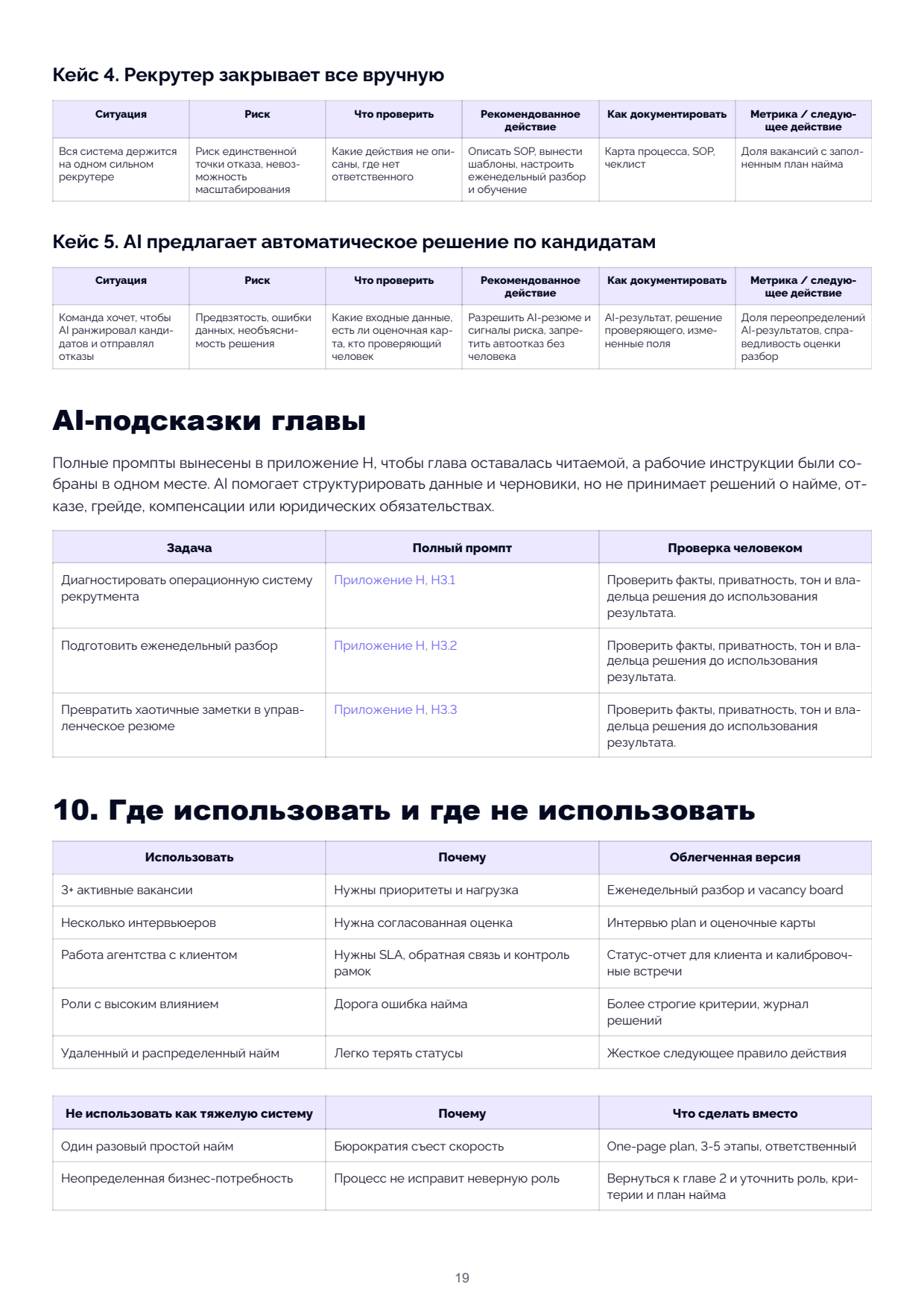
| Case 4. Recruiter closes everything manually | |||||
|---|---|---|---|---|---|
| Situation | Risk | What to check | Recommended action | How to document | Metric / next action |
| The entire system depends on one strong recruiter | Single point of failure, inability to scale | Which actions are undocumented, where there is no owner | Document SOP, create templates, set up weekly debrief and training | Process map, SOP, checklist | Share of vacancies with a completed hiring plan |
| Case 5. AI suggests automatic decisions on candidates | |||||
| Situation | Risk | What to check | Recommended action | How to document | Metric / next action |
| The team wants AI to rank candidates and send rejections | Bias, data errors, unexplainable decisions | What inputs are used, is there an assessment scorecard, who is the human reviewer | Allow AI-generated summaries and risk signals; forbid auto-rejection without a human | AI output, reviewer decision, modified fields | Share of AI results overridden, fair assessment review |
10. When to use and when not to use
Use Why Light version
3+ active vacancies Priorities and workload needed Weekly debrief and vacancy board
Multiple interviewers Aligned assessment needed Interview plan and assessment scorecards
Agency working with a client SLA, feedback and scope control needed Client status report and calibration
meetings
High-impact roles Costly hiring error Stricter criteria, decision log
Remote and distributed hiring Easy to lose status Next-action discipline
Do not use as a heavyweight system Why What to do instead
One-off simple hire Bureaucracy will eat into speed One-page plan, 3–5 stages, owner per stage
Unclear business need Process will not fix a wrong role Go back to Chapter 2 and clarify the role,
criteria and hiring plan
| Do not use as a heavyweight system | Why | What to do instead | |
|---|---|---|---|
| No funnel exists | No funnel material | Go back to sourcing and channel strategy | |
| 11. SOP: managed recruitment procedure fragment. SOP: launching a vacancy | |||
| Step | Rule | Owner | Assessment facts |
| Confirm outcome | Vacancy is launched only with a business outcome | Hiring manager | Hiring plan |
| Confirm criteria | Must-have criteria are verifiable and linked to tasks | Recruiter + hiring manager | Assessment scorecard draft |
| Confirm stages | Every stage provides a new signal | Recruiter | Stage map |
| Confirm SLA | Feedback SLA agreed before the first interview | Hiring manager | SLA table |
| Confirm data rules | Notes, reasons, consent fields are clear | Recruiter | ATS checklist |
| SOP: daily discipline | |||
| Event | Rule | ||
| Candidate moves stage | Stage updated on the day of decision | ||
| Interview completed | Assessment scorecard / feedback completed within SLA | ||
| Rejection made | Reason selected from lookup, comment linked to a criterion | ||
| Next step unknown | Candidate moved to on pause with a review date or closed | ||
| Criteria changed | Scope change recorded and impact on funnel noted | ||
| SOP: weekly debrief | |||
| Agenda block | Question | ||
| Role priority | Which vacancies matter most for the business this week? | ||
| Bottlenecks | Where have candidates stalled beyond SLA? | ||
| Conversion | At which stage are losses higher than expected? | ||
| Root causes | Which rejection reasons keep repeating? | ||
| Decisions | Which decisions are needed from hiring managers / clients? | ||
| Data hygiene | Which cards have no next action, reason or consent status? |
12. Implementation plan: 1 day, 1 week, 1 month
Horizon What to do Result
1 day Choose 3 active vacancies, draw a process Team sees current chaos and first
map, assign owners and next actions delays
1 week Introduce stage list, reasons, SLA, A manageable operational discipline
weekly debrief and feedback template emerges
1 month Gather first conversion, SLA, reasons, Process starts improving on data
time at stage; run a retrospective
| Horizon | What to do | Result |
|---|---|---|
| 1 quarter | Train hiring managers, revise stage taxonomy, connect to economics | Recruitment becomes part of the business operating rhythm |
| 13. Maturity model | ||
| Level | How it looks | Main goal for the next level |
| 1. Chaos | Vacancies in chats, statuses do not match reality, feedback is verbal | Document stages, owners, next action |
| 2. Managed process | Hiring plan, stages, SLA, reasons, weekly debrief | Make data reliable and comparable |
| 3. Data-driven management | Team reviews funnel, SLA, rejections, time-to-hire and takes action | Link metrics to business impact and quality |
| 4. Predictable operations | Capacity, bottlenecks and risks visible in advance | Automate routine without losing human oversight |
| 5. AI-assisted management | AI helps with summaries, audits, prompts, anomaly detection | Verify fair assessment, privacy and input quality |
| What to take from this chapter / where to go next | ||
| What you need | Where to find it | |
| Terms and short definitions | Appendix B. Mini-glossary | |
| Ready-made procedures and SLA | Appendix D. Ready-made procedures and processes | |
| Working templates | Appendix E. Template library | |
| BDM and Backend end-to-end examples | Appendix F. BDM and Backend end-to-end cases | |
| Full AI prompts for this chapter | Appendix H. AI prompt library, section H3. Process diagnostics and operating rhythm |