Chapter 2. Role, Criteria and Hiring Plan


How to use this chapter
A working scenario. The hiring manager writes: "We need a strong salesperson, preferably from fintech." The recruiter opens a vacancy, the agency receives a brief, and sourcing begins. Two weeks later, the shortlist has people on it, but each one is "not quite right": one sells well but has not worked with a long B2B cycle; another knows payments but cannot reach the budget holder and purchase decision-maker; a third looks like a strong BDM, but the company was expecting someone to build the partner channel. The problem did not start in the market. It started in the role, which was never translated into an outcome.
What actually broke here: the team confused a job title with a business task. Managed
hiring begins when it is clear what outcome the role must create, which criteria are truly mandatory, what trade-offs are acceptable, who makes the decision, what stages are needed, and how quickly the team commits to acting.
This chapter provides a practical vacancy brief — enough to launch recruitment: outcome, criteria, hiring plan, assessment scorecard boundaries, SLA, decision rule and operational control. If a deeper engagement with the need, compensation, market and role shaping is required, use this chapter as a starting framework and expand it with internal company rules.
Remember in one sentence: a vacancy only becomes manageable once the job title has been translated into
an expected outcome.
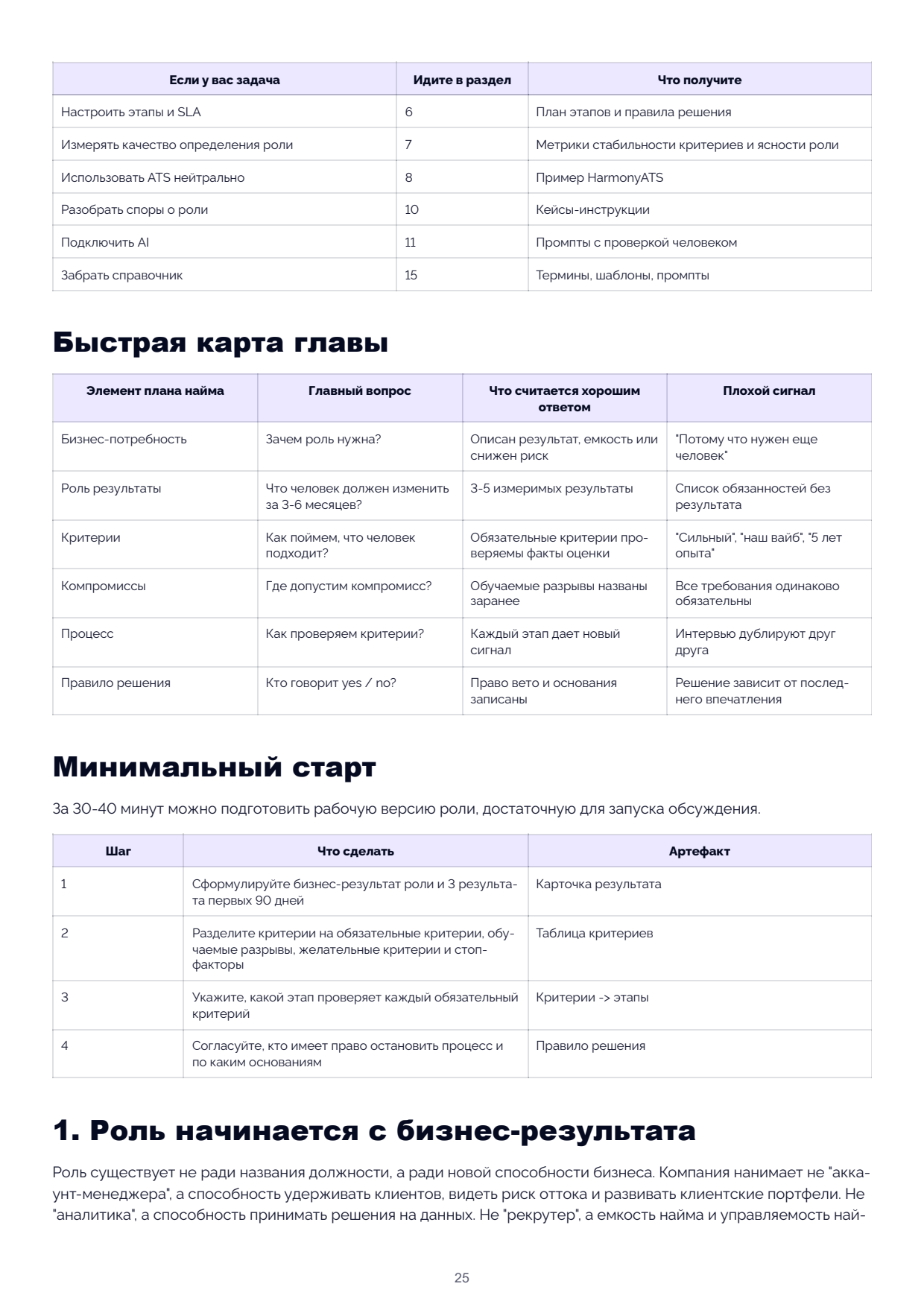
| If your task is | Go to section | What you will get |
|---|---|---|
| Translate a role title into a business task | 1–2 | Outcome model and first 90 days |
| Separate must-have criteria from nice-to-have criteria | 3 | Criteria, stop-factors and trainable gaps |
| Agree the launch with agency or in-house recruitment | 4 | Different responsibilities and documents |
| Create a hiring plan | 5 | Ready-to-use one-pager |
| Set up stages and SLA | 6 | Stage plan and decision rules |
| Measure the quality of role definition | 7 | Metrics for criteria stability and role clarity |
| Use ATS in a neutral way | 8 | HarmonyATS example |
| Handle role disputes | 10 | Case-based instructions |
| Integrate AI | 11 | Prompts with human checks |
| Grab the reference guide | 15 | Terms, templates, prompts |
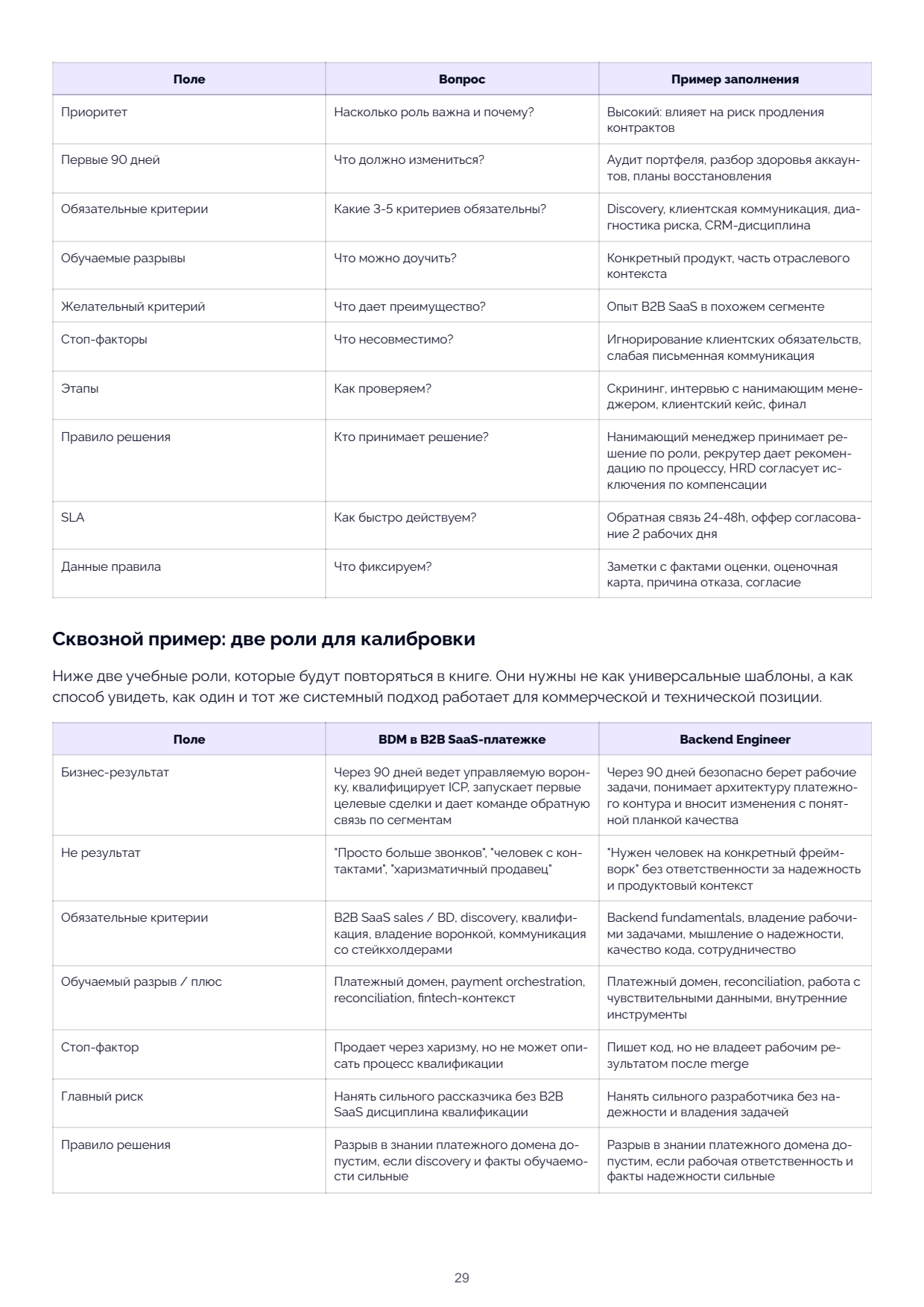
Decision rule: A gap in payments domain knowledge is acceptable if discovery and trainable-facts
are strong A gap in payments domain knowledge is acceptable if work accountability and reliability-facts
are strong
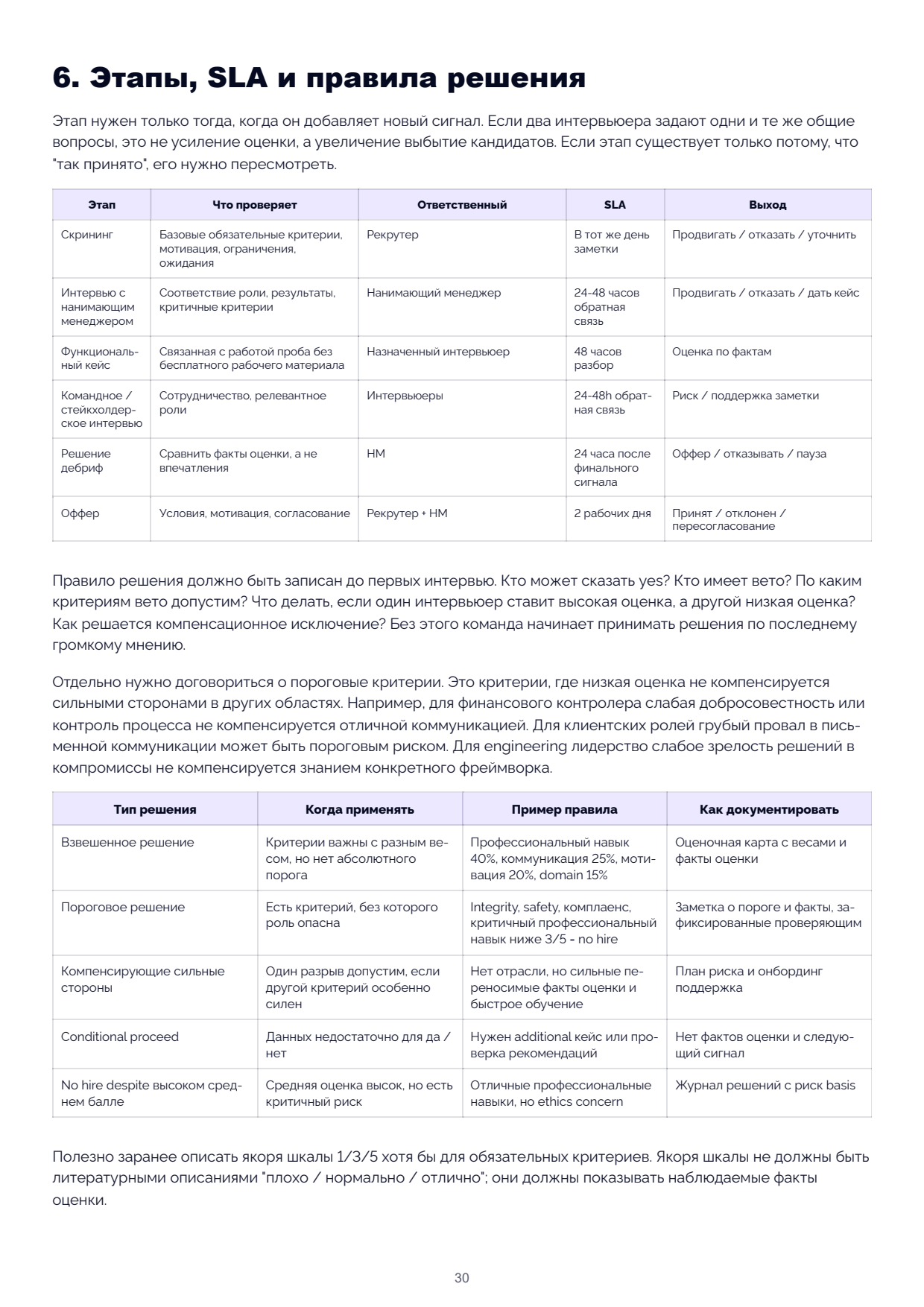
6. Stages, SLA and decision rules
A stage is only needed when it adds a new signal. If two interviewers ask the same generic questions, it does not strengthen assessment — it increases candidate drop-off. If a stage exists only because "that is how it is done", it needs to be reviewed.
Stage What it verifies Owner SLA Output
Screening Basic must-have criteria, Recruiter Same day Advance / reject / clarify
motivation, constraints, notes expectations
Hiring manager interview Role fit, results, critical Hiring manager 24–48 hours Advance / reject / set case
feedback
Functional case Work-related trial without Assigned interviewer 48 hours Assessment by facts
free work material review
Team / stakeholder interview Collaboration, role-relevant Interviewers 24–48h feedback Risk / support notes
Decision debrief Compare assessment facts, not HM 24h after final Offer / reject / pause
impressions signal
Offer Terms, motivation, alignment Recruiter + HM 2 working days Accepted / declined /
renegotiation
The decision rule must be written before the first interviews. Who can say yes? Who has a veto? Under what
criteria is the veto permissible? What happens if one interviewer gives a high score and another a low score? How is a compensation exception handled? Without this, the team starts deciding on the last loud opinion.
Separately, you need to agree threshold criteria. These are criteria where a low score cannot be compensated by strengths in other areas. For example, for a financial controller, weak diligence or process control is not compensated by excellent communication. For client-facing roles, a serious failure in written communication may be a threshold risk. For engineering, immature decision-making on trade-offs is not compensated by knowledge of a specific framework.
Decision type When to apply Example rule How to document
Weighted decision Criteria matter with different Professional skill 40%, Assessment scorecard with
weights but there is no absolute communication 25%, motivation 20%, weights and assessment facts
threshold domain 15%
Threshold decision There is a criterion without Integrity, safety, compliance, Threshold note and facts
which the role is dangerous critical professional skill documented by the reviewer
below 3/5 = no hire
Compensating strengths One gap is acceptable if No industry experience but Risk plan and onboarding
another criterion is especially strong strong transferable assessment support
facts and rapid learning
Conditional proceed Insufficient data for yes / Need an additional case or No assessment facts and next
no recommendation check signal
No hire despite high average High average score but there is Excellent professional skills, Decision log with risk basis
score a critical risk but ethics concern
It is useful to define scale anchors at 1/3/5 for at least the must-have criteria in advance. Scale anchors should not be literary descriptions of "poor / average / excellent" — they should show observable assessment facts.
| Criterion | 1 | 3 | 5 |
|---|---|---|---|
| Client risk diagnostics | Only responds to a client complaint | Spots basic risk signals and proposes obvious actions | Early distinction of adoption, value, stakeholder and commercial risks; builds recovery plan |
| Funnel discipline | Fills CRM after the fact and incompletely | Maintains key fields and next steps | Builds process hygiene, trains the team, finds causes of forecast noise |
| Stakeholder communication | Reports status sporadically | Regularly syncs with stakeholders | Adapts communication to the audience, escalates risks and trade-offs proactively |
| Technical decision maturity | Chooses a familiar option without comparison | Compares obvious alternatives | Shows alternatives, reversibility, ownership cost and risk reduction |
7. How to measure the quality of the role and plan
The quality of a hiring plan is visible not when the document is filled in, but during the process. If criteria keep changing, candidates are rejected for undocumented reasons, interviews are duplicated, and the manager says "I will know it when I see it", the plan is weak.
Metric What it shows How to measure / review Action
Criteria changes after launch How well the role was Number of must-have criteria changes Calibration or re-brief
defined after start
Unclear rejection reasons Ambiguity of criteria Share of "other", "not a fit", "not Update scorecard and
our" rejections taxonomy
Screening-to-HM conversion Does screening meet Passed screening –> HM interview Refine must-have criteria
expectations and questions
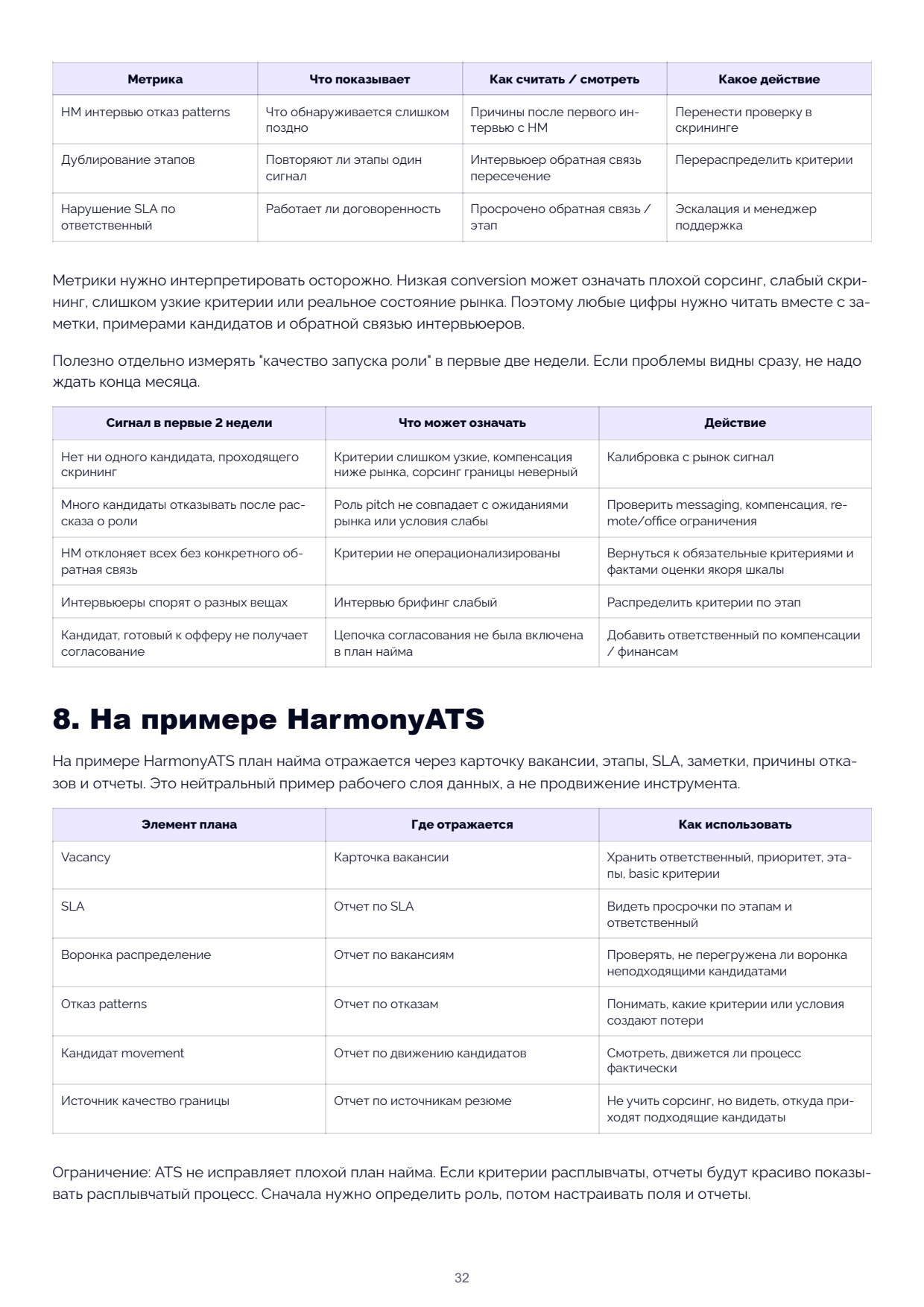
| Metric | What it shows | How to measure / review | Action |
|---|---|---|---|
| HM interview rejection patterns | What is discovered too late | Reasons after first HM interview | Move the check into screening |
| Stage duplication | Do stages repeat one signal? | Interviewer feedback overlap | Redistribute criteria across stages |
| SLA breach by owner | Is the agreement working? | Overdue feedback / stage | Escalation and manager support |
Metrics must be interpreted carefully. Low conversion can mean weak sourcing, poor screening, overly narrow criteria or the real market situation. Therefore, any numbers should be read alongside notes, candidate examples and interviewer feedback. It is useful to separately measure "role launch quality" in the first two weeks. If problems are visible immediately, there is no need to wait until month-end.
| Signal in first 2 weeks | What it may mean | Action |
| No candidates pass screening | Criteria too narrow, compensation below market, wrong sourcing boundaries | Calibration with market signals |
| Many candidates decline after the role pitch | Role pitch does not match market expectations or conditions are weak | Review messaging, compensation, remote/office constraints |
| HM rejects all without specific feedback | Criteria are not operationalised | Return to must-have criteria and assessment-fact scale anchors |
| Interviewers argue about different things | Interview briefing is weak | Distribute criteria across stages |
| Offer-ready candidate does not get approval | Approval chain was not included in the hiring plan | Add compensation / finance owner |
8. HarmonyATS example
Using HarmonyATS as an example, the hiring plan is reflected through the vacancy card, stages, SLA, notes, rejection reasons and reports. This is a neutral example of a working data layer, not a tool endorsement.
| Plan element | Where it is reflected | How to use it |
| Vacancy | Vacancy card | Store owner, priority, stages, basic criteria |
| SLA | SLA report | See overdue items by stage and owner |
| Funnel distribution | Vacancy report | Check whether the funnel is overloaded with unsuitable candidates |
| Rejection patterns | Rejection report | Understand which criteria or conditions cause losses |
| Candidate movement | Candidate movement report | See whether the process is actually moving |
| Source quality boundaries | CV source report | Not to teach sourcing, but to see where suitable candidates come from |
Limitation: ATS does not fix a poor hiring plan. If criteria are vague, reports will beautifully show a vague process. Define the role first, then configure fields and reports.
Offer-ready candidate does not get approval chain was not included in the Add compensation / finance
approval the hiring plan owner
8. HarmonyATS example
Using HarmonyATS as an example, the hiring plan is reflected through the vacancy card, stages, SLA, notes, rejection reasons and reports. This is a neutral example of a working data layer, not a tool endorsement.
Plan element Where it is reflected How to use it
Vacancy Vacancy card Store owner, priority, stages, basic
criteria
SLA SLA report See overdue items by stage and
owner
Funnel distribution Vacancy report Check whether the funnel is
overloaded with unsuitable candidates
Rejection patterns Rejection report Understand which criteria or conditions
cause losses
Candidate movement Candidate movement report See whether the process is
actually moving
Source quality boundaries CV source report Not to teach sourcing, but to see where
suitable candidates come from
Limitation: ATS does not fix a poor hiring plan. If criteria are vague, reports will beautifully show a vague
process. Define the role first, then configure fields and reports.
9. Personal data, fair assessment
and criterion ethics
Criteria must be linked to the work. They must not mask age, gender, marital status, origin, health, appearance, personal communication style or affinity bias. Phrases like "young dynamic team", "energetic", "no family constraints", "our cultural code" are dangerous unless translated into observable work behaviour.
Risk Example How to fix
Age bias "Need someone young and "Need experience working in fast-changing
flexible" environments; assessment facts: examples
of adaptation"
Affinity bias "Not our vibe" "Which work behaviour creates risk? Is it
linked to the role?"
Credential bias "Only from top companies" "What tasks at those companies matter and
how can we verify them directly?"
Privacy over-collection "Let us check family plans" Do not collect data unrelated to work and
the law
Automated bias AI suggests criteria from past hires Human check for linkage to role tasks and
adverse impact risk
Ethical rule for hiring plans: candidates should be assessed on what the work requires, and the team must be able to explain a rejection through a criterion and assessment facts, not through a general impression.
10. Cases: how to handle complex situations
Case 1. CEO asks for a "strong senior", but the team disagrees on what that means
Situation Risk What to check Recommended How to document Metric / next
action action
"Senior" means different Run a calibration: Hiring plan v1, Criteria changes
things to CEO, HM and Candidates will be 90-day tasks, must-have 90-day tasks, must-have after launch
interviewers assessed against different assessed against different criteria, scorecard scale criteria, scorecard scale roles roles anchors, decision rule anchors, decision rule
need assessment facts
Case 2. Agency received a long list of requirements
Situation Risk What to check Recommended How to document Metric / next
action action
Client wants 15 mandatory Unrealistic market, Agree what is a real threshold, what can be Calibration notes, Shortlist acceptance
criteria and a fast shortlist scope creep taught, and what remains a nice-to-have agreed criteria rate, criteria
compromise table feedback quality
Case 3. Hiring manager changes criteria after the first interviews
Situation Risk What to check Recommended How to document Metric / next
action action
After 5 candidates it Time lost, poor Have the business context Document scope change, Criteria changes
emerges the profile needed candidate experience or criteria been revised the funnel, inform pattern after rejection,
was different been unclear affected candidates impact on timelines, updated plan to HM
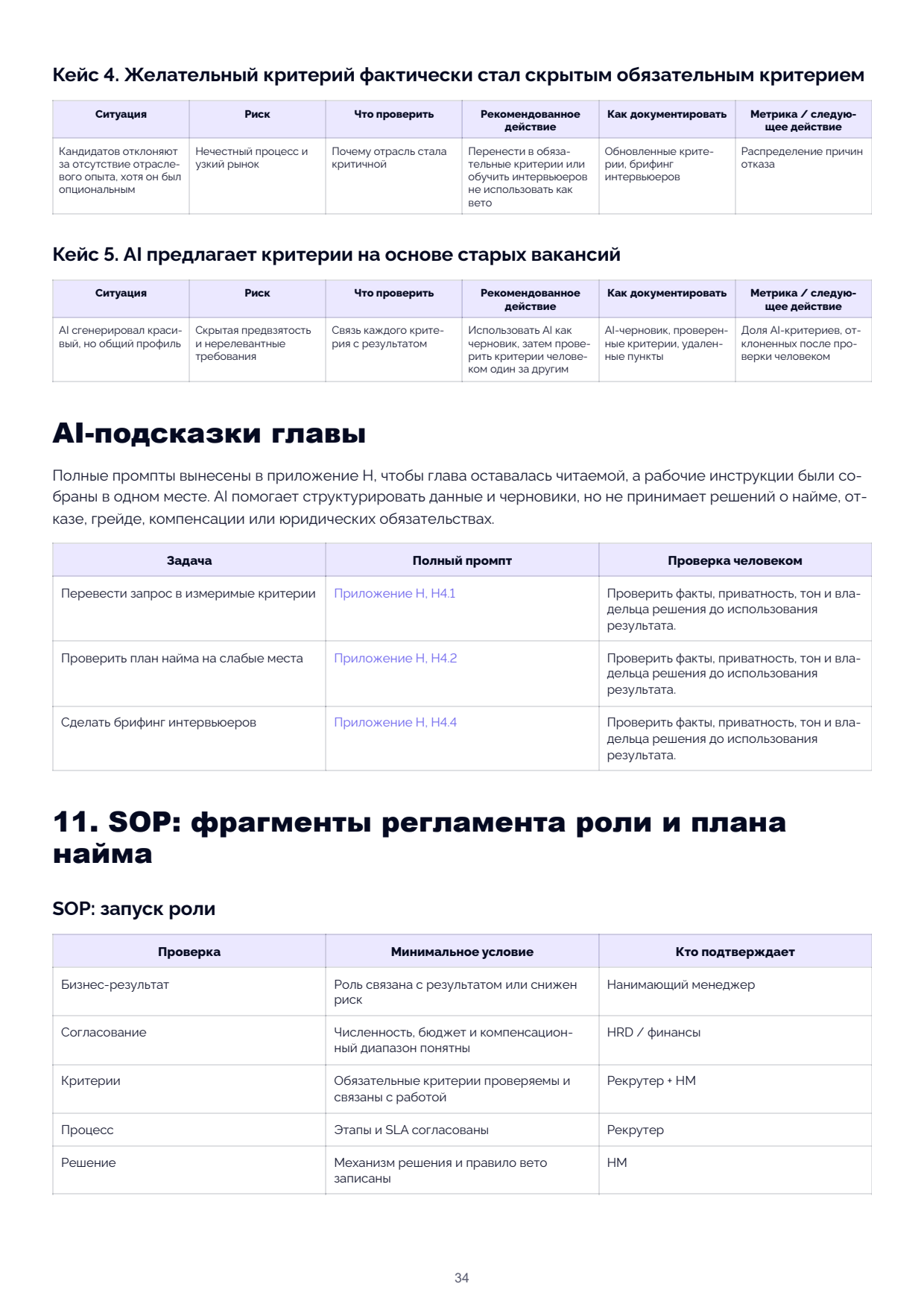
Case 4. Nice-to-have criterion has effectively become a hidden must-have
Situation Risk What to check Recommended How to document Metric / next
action action
Candidates rejected for Unfair process and Why has industry become Move to must-have Updated criteria, Rejection reason
lack of industry narrow market critical? teach interviewers not interviewer briefing distribution
experience, although it to use it as a veto
was optional
Case 5. AI suggests criteria based on old vacancies
Situation Risk What to check Recommended How to document Metric / next
action action
AI generated a polished Hidden bias and Link each criterion to a Use AI as a draft, AI draft, reviewed criteria, Rejection rate after
but generic profile with irrelevant criteria outcome then have a human review criteria with removed items human review
requirements criteria one by one
AI prompts for this chapter
Full prompts are in Appendix H so the chapter remains readable and the working instructions are collected in one place. AI helps structure data and drafts, but does not make hiring, rejection, grading, compensation or legal commitment decisions.
Task Full prompt Human check
Translate a request into measurable criteria Appendix H, H4.1 Check facts, privacy, tone and decision
owner before using the output.
Review the hiring plan for weak spots Appendix H, H4.2 Check facts, privacy, tone and decision
owner before using the output.
Create an interviewer briefing Appendix H, H4.4 Check facts, privacy, tone and decision
owner before using the output.
11. SOP: role and hiring plan
procedure fragments
SOP: launching a role
Check Minimum condition Confirmed by
Business outcome Role linked to an outcome or risk reduced Hiring manager
Headcount approval Headcount, budget and compensation range HRD / Finance
are clear
Criteria Must-have criteria are verifiable and Recruiter + HM
linked to the work
Process Stages and SLA agreed Recruiter
Decision Decision mechanism and veto rule HM
recorded
| Check | Minimum condition | Confirmed by |
|---|---|---|
| Data | Consent, notes and rejection reason rules are clear | Recruiter / ops |
| SOP: changing the role scope | ||
| Event | Action | |
| Must-have criteria changed | Pause new candidate presentations until calibration | |
| Compensation range changed | Revise the funnel and candidate expectations | |
| Role level changed | Update assessment scorecard, stages and sourcing boundaries | |
| Decision mechanism changed | Re-confirm the decision rule | |
| Timelines changed | Inform affected candidates, agency and stakeholders |
| Weak feedback | Why it is not good enough | Assessment-fact-based version |
|---|---|---|
| "Low motivation" | May be an impression | "Could not explain why the role's tasks align with the next career step; risk of misfit" |
| 12. When to use and when not to use | ||
| Use | Why | |
| Any role with multiple stages | Criteria alignment needed | |
| Role with multiple decision-makers | Decision rules and veto grounds needed | |
| Agency search | Shortlist definition and client commitments needed | |
| Priority or expensive role | Protection against wrong hire and delays needed | |
| Repeated roles | Trainable system and benchmark needed | |
| Do not go deeper in this chapter | Why | |
| Full vacancy brief | This book provides a practical minimum; a deeper brief can be developed from Chapter 2 using internal company rules | |
| Sourcing channel strategy | This is a separate methodology | |
| Full skills assessment | Covered in detail in Chapters 4–10 | |
| 13. Implementation plan and maturity model | ||
| Horizon | What to do | Result |
| 1 day | Take one active role and fill in the one-pager | Team sees gaps in criteria |
| 1 week | Introduce a launch gate for all new vacancies | Unclear roles do not start without calibration |
| 1 month | Measure criteria changes, unclear rejections, SLA breaches | Feedback on plan quality emerges |
| 1 quarter | Train HMs and agency clients on the "criteria / assessment facts" format | Number of scope changes decreases |
| Level | How it looks | |
| Chaos | Role described by a job title and a wish list | |
| Managed process | One-pager, criteria, stages, owners, SLA | |
| Data-driven management | Team tracks criteria changes and rejection patterns | |
| Predictable | Roles calibrated faster, stages do not duplicate | |
| AI-assisted | AI helps with drafts, people verify relevance, fair assessment and market realism |
What to take from this chapter / where to go next
What you need Where to find it
Terms and short definitions Appendix B. Mini-glossary
Ready-made procedures and SLA Appendix D. Ready-made procedures and processes
Working templates Appendix E. Template library
BDM and Backend end-to-end examples Appendix F. BDM and Backend end-to-end cases
Full AI prompts for this chapter Appendix H. AI prompt library, section H4. Role,
criteria and assessment
In short: this chapter covers the role, criteria and hiring plan. If you need a ready-made artefact, take it from the appendices and leave the application logic in the chapter.