Chapter 9. Decisions and Feedback


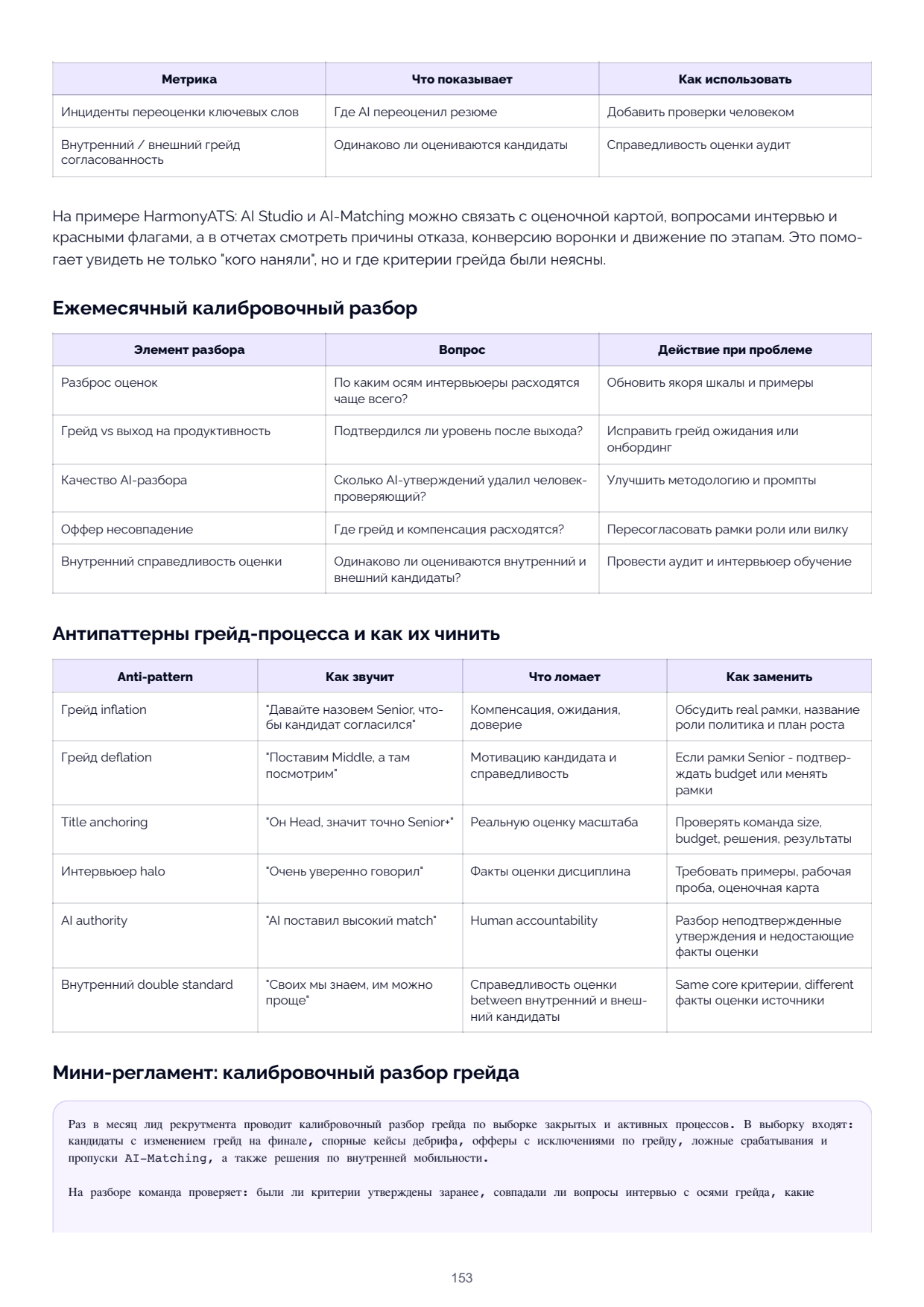
| Metric | What it shows | How to use it |
|---|---|---|
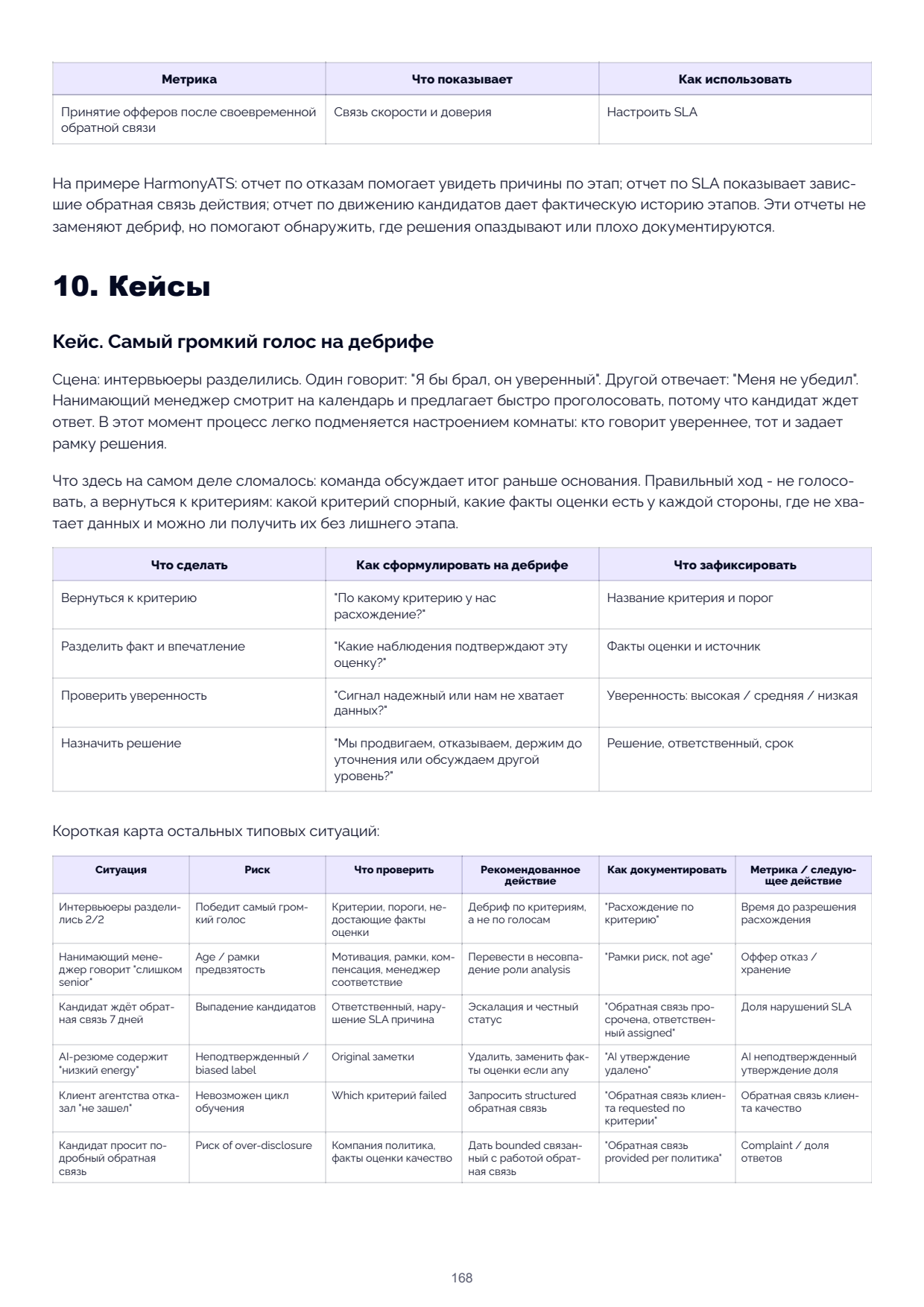
| Keyword over-scoring incidents | Where AI over-scored a CV | Add human checks |
| Internal / external level consistency | Whether candidates are assessed equally | Fair assessment audit |
12. Maturity model
Level How it looks
Chaos Level is determined by job title, years of experience and gut feeling
Managed There is a universal matrix with role-specific anchor points on the scale
process
Calibrated Interviewers regularly cross-check examples and assessment maps
Data-informed Ramp-up, rejection reasons and offer outcomes update the matrix
AI-assisted AI helps structure the match, but human verification is mandatory
operations
Key takeaways / where to go next
What you need Where to find it
Terms and short definitions Appendix B. Mini glossary
Ready-made procedures and SLAs Appendix D. Ready-made procedures and processes
Templates for daily use Appendix E. Template library
End-to-end BDM and Backend examples Appendix F. End-to-end BDM and Backend case studies
Full AI prompts for this chapter Appendix H. AI prompt library, section H4. Role, criteria and assessment
In short: this chapter covers candidate assessment, levels and AI matching. If you need a ready-made artefact, take
it from the appendices and keep the logic in the chapter.
How to use this chapter
Working scenario. The debrief starts at 5:40 pm. Everyone is tired. One interviewer says: "I liked them, strong candidate."
The second replies: "Not our vibe." The hiring manager suggests "just in case" another interview. The
recruiter spots a risk point: if the team does not return to the criteria now, the decision will be made not on
the basis of facts but on loudness, tiredness and personal preferences.
What has actually broken here: the team has already gathered plenty of impressions, but has not yet gathered a decision.
Decision-making does not start with a vote for / against. It starts with the question: which criteria were agreed,
what assessment facts exist, where the signal is reliable, where there is a gap, and who owns the next step.
This chapter builds on chapters 6–8: first the team defines criteria, skills, motivational signals, level and
signal reliability, then turns assessment facts into a decision. If the criteria were not defined upfront,
the debrief almost always turns into an argument of taste.
Remember in one phrase: a decision becomes honest when the argument is about facts, not favouritism.
| If your task is | Go to section | What you will get |
|---|---|---|
| Set up decision rules | 1–2 | Advance / reject / pause / offer options |
| Run a debrief | 4 | Agenda and facilitation rules |
| Give feedback | 6 | Templates grounded in assessment facts |
| Remove vague feedback | 7 | Translate “not our fit” into working criteria language |
| Reduce ageism / bias | 8 | Fair assessment checklist |
| Use AI | 11 | Prompts and human checks |
| Implement a procedure | 12 | SOP fragment and maturity model |
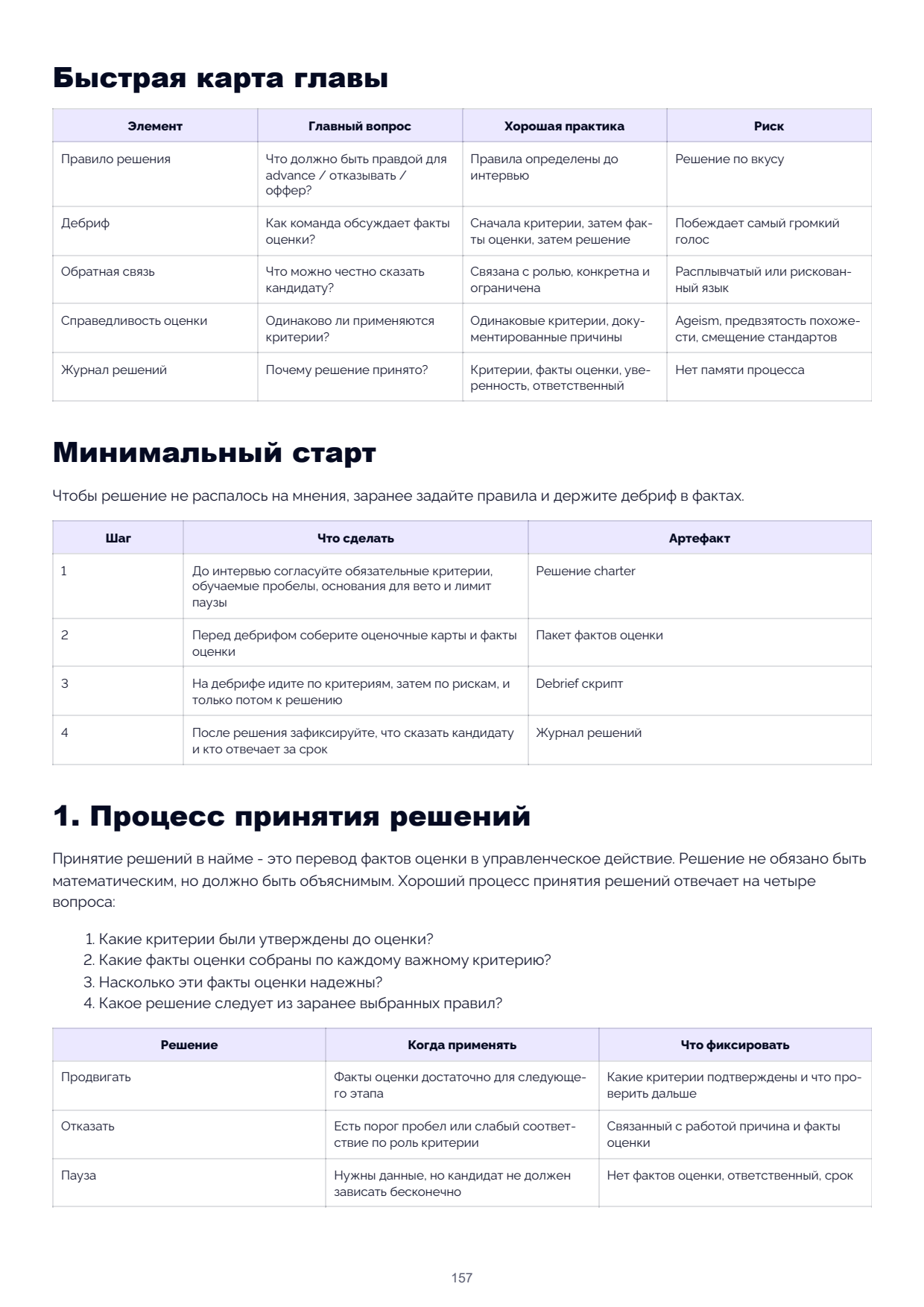
Quick chapter map
| Element | Key question | Good practice | Risk |
|---|---|---|---|
| Decision rule | What must be true before advance / reject / offer? | Clear thresholds, veto grounds and pause options are agreed in advance | The team improvises the decision |
| Debrief | How does the team discuss assessment facts? | Criteria first, then assessment facts, then decision | The loudest voice wins |
| Feedback | What can honestly be said to the candidate? | Linked to the role, specific and bounded language | Vague or risky feedback |
| Fair assessment | Are criteria applied equally? | Consistent criteria and documented reasons | Ageism, affinity bias, standard-shifting |
| Decision log | Why was the decision made? | Criteria, assessment facts, confidence, responsible person | No process memory |
Decision rule
What must be true before advance / reject / offer?
Debrief How does the team discuss Criteria first, then assessment The loudest voice wins
assessment facts? facts, then decision
Feedback What can honestly be said Linked to the role, specific and Vague or risky
to the candidate? bounded language
Fair assessment Are criteria applied Consistent criteria, documented Ageism, affinity bias,
equally? reasons standard-shifting
Decision log Why was the decision made? Criteria, assessment facts, confi‐ No process memory
dence, responsible person
Minimal start
For the decision not to collapse into opinions, set the rules in advance and keep the debrief grounded in facts.
| Step | What to do | Artefact |
|---|---|---|
| 1 | Before the interview agree must-have criteria, trainable gaps, veto grounds and pause limits | Decision charter |
| 2 | Before the debrief collect assessment maps and assessment facts | Assessment facts pack |
| 3 | At the debrief work through criteria, then risks, and only then move to the decision | Debrief script |
| 4 | After the decision record what to tell the candidate and who owns the deadline | Decision log |
Decision-making in hiring translates assessment facts into management action. The decision does not have to be
mathematical, but it must be explainable. A good decision-making process answers four
questions:
1. Which criteria were agreed before the assessment?
2. What assessment facts have been gathered against each important criterion?
3. How reliable are those assessment facts?
4. What decision follows from the pre-selected rules?
Decision When to apply What to record
Advance Assessment facts are sufficient for the next Which criteria are confirmed and what to
stage verify next
Reject Threshold gap or weak match against Work-related reason and assessment
role criteria facts
Pause Data is needed but the candidate should No assessment facts, responsible person,
not hang indefinitely deadline
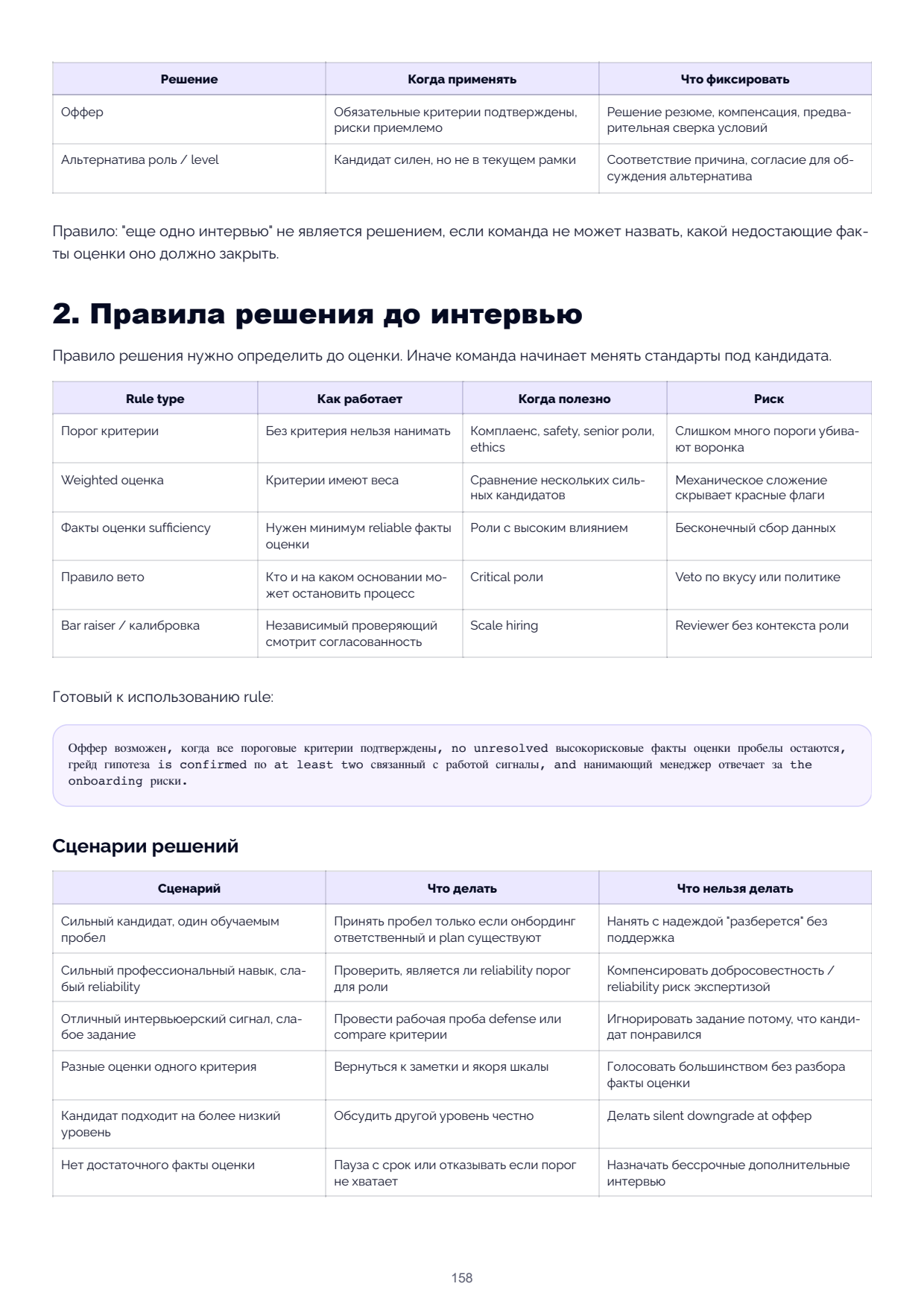
| Decision | When to apply | What to record |
|---|---|---|
| Offer | Must-have criteria confirmed, risks acceptably | Decision summary, compensation, preliminary terms |
| Alternative role / level | Candidate is strong but not within current scope | Fit reason, consent to discuss alternative |
Stop / go / pause rule
Rule Condition Action
Stop Threshold criterion not met with reliable assessment Reject with a work-related reason
facts
Go Must-have assessment facts sufficient, risks accepted Advance or offer
by responsible person
Pause Material assessment facts missing and can be Assign responsible person and deadline
obtained quickly
Recalibrate Criteria changed or interviewers used Pause the process and update role
different standards criteria
Alternative path Candidate is strong but there is a mismatch Request consent to discuss a different
with current role role or level
Decision agreement: a short compact agreed before the interview starts
The decision charter is a one-page document that protects the process from subjectivity. It is convenient to attach it
to a vacancy intake / hiring plan, but the chapter itself does not teach intake in detail: what matters here is the decision layer.
Block Ready-to-use question Example answer
Must-have criteria What must we not hire without? Enterprise stakeholder management;
ethical sales behaviour
Trainable gaps What can be learned after joining? Product specifics; internal reporting
process
Assessment facts sources Where do we verify each criterion? Screening, case study, HM interview, referral
with permission
Decision owner Who makes the final decision? Hiring manager, after the debrief
Veto basis On what grounds can we stop the Integrity risk, threshold gap, compensation
process? mismatch
Pause limit How long can we keep the candidate Max 3 working days without a new status
waiting?
Feedback policy What level of feedback do we give? Bounded, work-related feedback after
each interview stage
AI rule How do we use AI CV summaries? Draft only; human verification is
mandatory
Ready-to-use fragment:
Before the interview the team agreed a decision charter. The final decision is based on must-have criteria, trainable gaps,
assessment facts quality and accepted onboarding risks. New criteria are not added after the interview without recalibration. A pause status is only permitted with a responsible person, outstanding assessment facts and a deadline.
If the hiring manager is not ready to complete the decision charter, this is not a signal to "delay recruitment forever"
but rather to run a short calibration: 20–30 minutes is often enough to prevent hours of argument at the debrief.
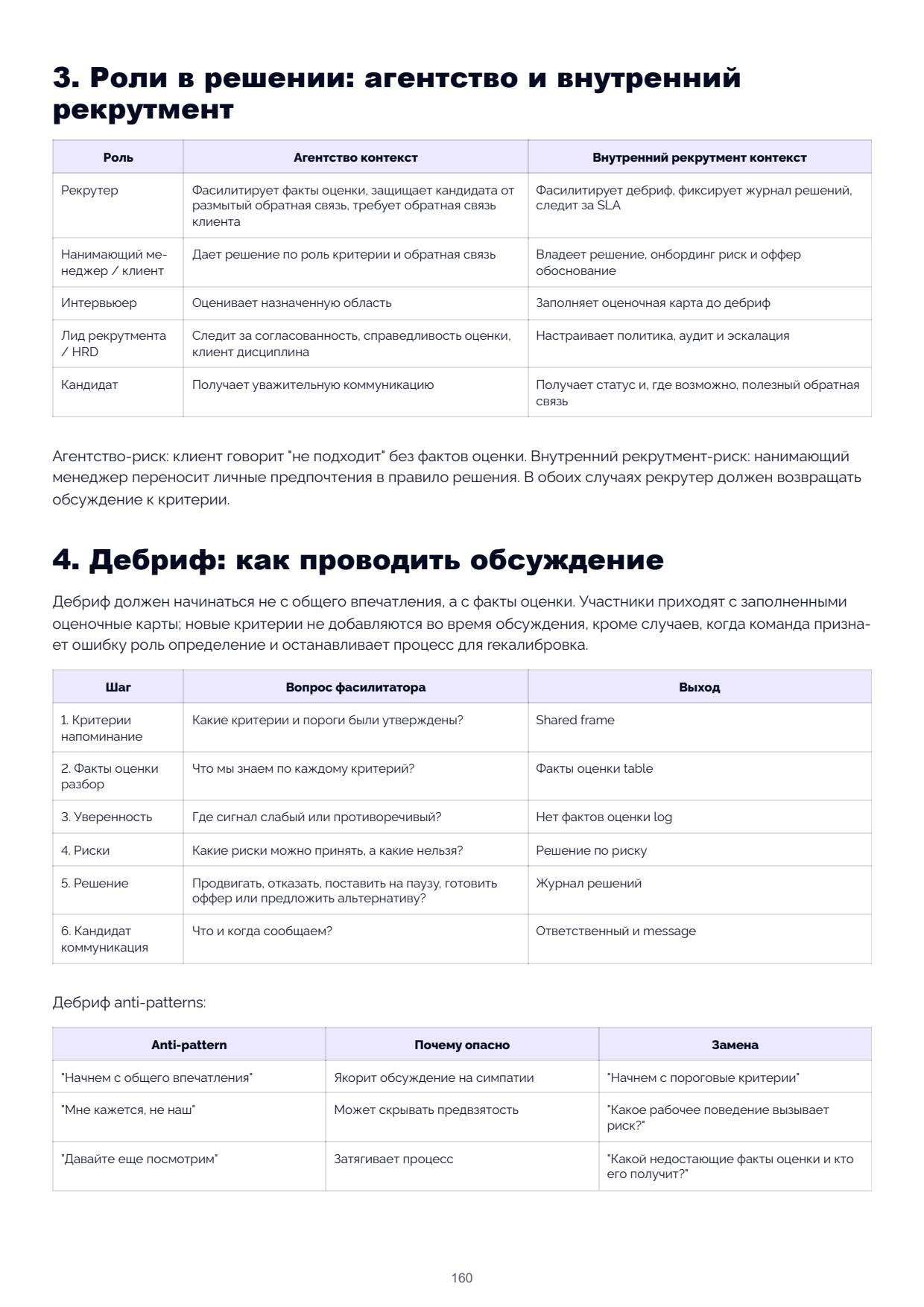
3. Roles in the decision: agency and in-house
recruitment
Role Agency context In-house recruitment context
Recruiter Facilitates assessment facts, protects the Facilitates the debrief, records the decision log,
candidate from vague feedback, requires monitors SLA compliance
client feedback
Hiring Provides the decision based on role criteria and Owns the decision, onboarding risk and offer
manager / client feedback rationale
Interviewer Assesses the assigned area Completes the assessment map before the debrief
Recruitment Monitors consistency, fair assessment, Sets policy, conducts audits and escalates
lead / HRD discipline
Candidate Receives respectful communication Receives a status update and, where possible,
helpful feedback
Agency risk: the client says "not a fit" without assessment facts. In-house risk: the hiring manager carries
personal preferences into the decision rule. In both cases the recruiter must steer the discussion back to the criteria.
4. Debrief: how to run the discussion
The debrief must start not with a general impression but with assessment facts. Participants arrive with completed
assessment maps; new criteria are not added during the discussion, unless the team acknowledges an
error in role definition and pauses the process for recalibration.
Step Facilitator question Output
1. Criteria Which criteria and thresholds were agreed? Shared frame
reminder
2. Assessment facts What do we know for each criterion? Assessment facts
breakdown table
3. Confidence Where is the signal weak or contradictory? Assessment facts log
4. Risks Which risks can we accept and which not? Risk decision
5. Decision Advance, reject, pause, prepare an offer Decision log
or suggest an alternative?
6. Candidate What and when do we communicate? Responsible person and message
communication
Debrief anti-patterns:
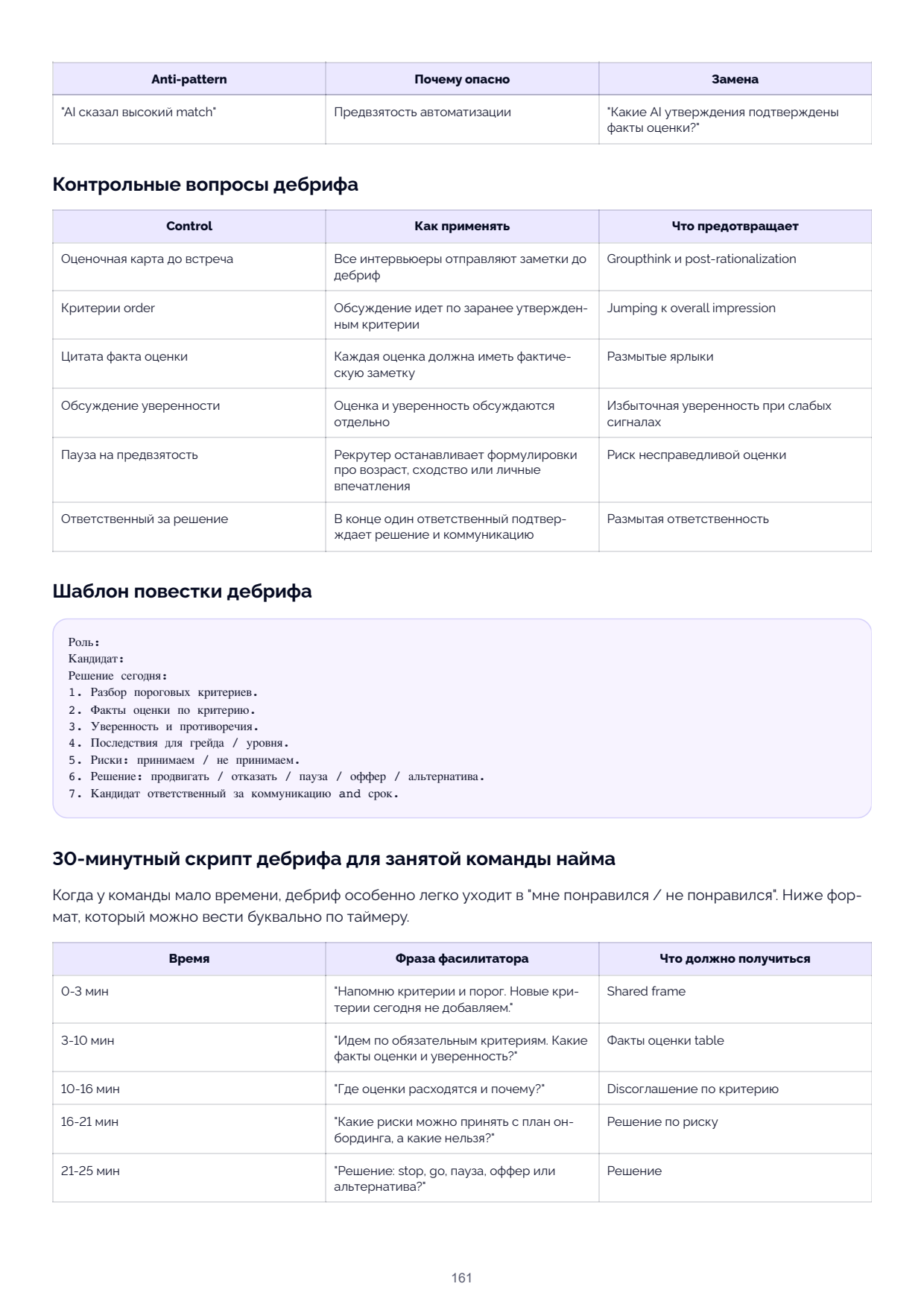
Anti-pattern Why it is dangerous Replacement
"Let us start with a general impression" Anchors the discussion on favouritism "Let us start with the threshold criteria"
"I just don't think they fit" May conceal bias "What work behaviour raises a
concern?"
"Let us wait and see a bit more" Drags out the process "What assessment facts are missing and who
will obtain them?"
| Anti-pattern | Why it is dangerous | Replacement |
|---|---|---|
| "AI said it's a strong match" | Automation bias | "Which AI claims are confirmed by assessment facts?" |
| Debrief control questions | ||
| Control | How to apply | What it prevents |
| Assessment map before the meeting | All interviewers submit notes before the debrief | Groupthink and post-rationalisation |
| Criteria order | Discussion follows the pre-agreed criteria | Jumping to overall impression |
| Assessment fact quote | Every rating must have a factual note | Vague labels |
| Confidence discussion | Rating and confidence are discussed separately | Overconfidence on weak signals |
| Bias pause | The recruiter halts phrasing about age, similarity or personal impressions | Risk of unfair assessment |
| Decision owner | At the end one responsible person confirms the decision and communication | Diffused accountability |
| Debrief agenda template |
1. Threshold criteria review.
2. Assessment facts against each criterion.
3. Confidence and contradictions.
4. Implications for level / grade.
5. Risks: accepted / not accepted.
6. Decision: advance / reject / pause / offer / alternative.
7. Candidate communication: responsible person and deadline.
30-minute debrief script for a busy hiring team
When time is tight, the debrief easily slides into "I liked them / I didn't". Below is a format you can follow
literally by timer.
Time Facilitator phrase Expected outcome
0–3 min "I'll remind you of the criteria and thresholds. Shared frame
No new criteria today."
3–10 min "Let us go through the must-have criteria. Assessment facts
What are the facts and how confident are you?" table
10–16 min "Where do the ratings diverge and why?" Disagreement on criterion
16–21 min "Which risks can be accepted with an onboarding Risk decision
plan and which cannot?"
21–25 min "Decision: stop, go, pause, offer or Decision
alternative?"
| Time | Facilitator phrase | Expected outcome |
|---|---|---|
| 25–30 min | "What do we tell the candidate, who is responsible, and what is the deadline?" | Candidate communication plan |
| Phrases that help keep the debrief grounded in assessment facts: | ||
| If it sounds like | Facilitator response | |
| "I'd like to see a bit more" | "Which assessment facts still need to be obtained and by what method?" | |
| "I don't feel a match" | "Which criterion is causing doubt?" | |
| "They're too senior" | "Is that a role realism, compensation, motivation or reporting risk?" | |
| "AI scored them low" | "Which specific AI claims have we verified?" | |
| "Let us just vote" | "Let us review the thresholds first. Hiring is not a popularity vote." |
5. Decision log. A decision log is a short record that allows you to explain the decision through assessment facts
linked to the role. It is needed for process memory, fair assessment audits, interviewer training and candidate communication.
| Field | Example | |
| Candidate | Name / ID | |
| Role | Vacancy | |
| Stage | Final interview | |
| Decision | Reject / Offer / Pause | |
| Criteria met | Discovery, communication | |
| Criteria not met | Enterprise stakeholder management | |
| Assessment facts | Case study showed a weak multi-stakeholder plan | |
| Confidence | Medium-high | |
| Risks accepted | Domain ramp-up can be trained | |
| Risks not accepted | Threshold gap in a regulated process | |
| Responsible person | Hiring manager | |
| Candidate message | Recruiter by Friday | |
| End-to-end example: decision log | ||
| Field | BDM in B2B SaaS payments | Backend Engineer |
| Decision | Advance to final / commercial case debrief | Pause for additional system design probe |
| Field | BDM in B2B SaaS payments | Backend Engineer |
|---|---|---|
| Strong assessment facts | High discipline in qualification; good lost-deal breakdown; can explain the stakeholder map | Operational responsibility, idempotency example, incident training |
| Weak assessment facts | Payment domain knowledge still at a conceptual level | Payment-specific consistency and edge-case tests not yet confirmed |
| Risk | Longer ramp-up on domain / product | May be a strong Middle+ but not Senior enough for payment-critical component ownership |
| Risk mitigation | In the final round provide a payment-specific scenario and check how the candidate handles unknowns | Give a scenario: recurring payment retry + webhook + reconciliation; check compromises and observability |
| Candidate communication | "The next stage will probe the depth of payment context and stakeholder management" | "An additional technical stage is needed on the reliability of payment-like flows" |
6. Feedback grounded in assessment facts
Candidate feedback must be honest, respectful, bounded and linked to the role. Not every company gives detailed
feedback, but even a short rejection should avoid vague labels.
| Poor phrasing | Why it is risky | Better |
| "You weren't our vibe" | Unclear, may conceal bias | "We have chosen a candidate with more relevant experience in [work-related area]" |
| "We need someone younger / more energetic" | Ageism risk | "The role requires experience in [specific task]; assessment facts were insufficient against this criterion" |
| "Not senior enough" | Does not explain the criterion | "The role requires autonomous work with [complexity]; this level was not demonstrated at interview" |
| "Weak communication" | Too broad | "In the case study there was insufficient structuring of risks, ownership and next steps" |
| "AI showed a low match" | Unacceptable as a reason | "We made the decision based on [criteria] after human verification" |
| Rejection template: |
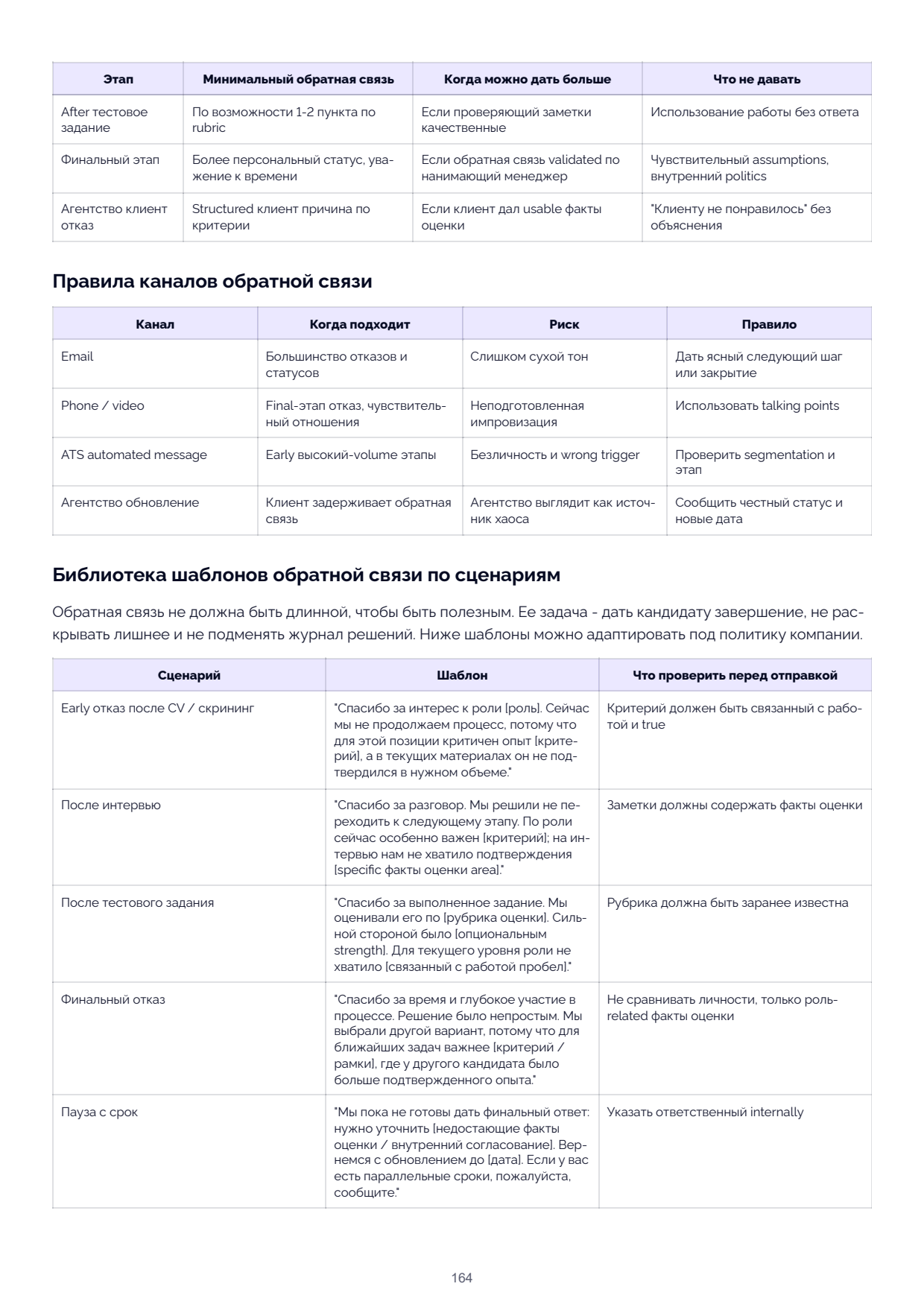
| Stage | Minimum feedback | When more can be given | What not to share |
|---|---|---|---|
| After a test task | 1–2 points against the rubric where possible | If the assessor's notes are of good quality | Using the work without acknowledgement |
| Final stage | A more personal status, respect for the candidate's time | If feedback has been validated by the hiring manager | Sensitive assumptions, internal politics |
| Agency client rejection | Structured client reason by criterion | If the client provided usable assessment facts | "The client didn't like them" without explanation |
| Feedback channel rules | |||
| Channel | When appropriate | Risk | Rule |
| Most rejections and status updates | Too dry a tone | Provide a clear next step or closure | |
| Phone / video | Final-stage rejection, sensitive situations | Unprepared improvisation | Use talking points |
| ATS automated message | Early high-volume stages | Impersonality and wrong trigger | Check segmentation and stage |
| Agency update | Client is delaying feedback | Agency looks like a source of chaos | Share an honest status and new date |
| Scenario | Template | Check before sending |
|---|---|---|
| Alternative level | "We can see a strong match in [area], but the current role scope [level] requires more proven experience in [criterion]. We are happy to discuss an alternative [different level / role] if you are interested." | Do not make a silent downgrade |
| Agency client delay | "The client has not yet provided final feedback. I do not want to leave you without a status update: I will give you the next update by [date], even if the decision is still in progress." | Do not promise a client decision |
7. Translating vague feedback
Vague feedback Clarifying question Work-related rewrite
"Not our fit" Which work behaviour did not align with "The required level of stakeholder
the role? communication was not demonstrated"
"Too old / too young" Which task requires different assessment Remove age; discuss only current
facts? skills and scope
"Not motivated" What motivation risk is visible? "Interest in high-volume operational work
was not confirmed"
"Too theoretical" What practical output was missing? "The case study lacked a concrete
implementation plan"
"Overqualified" What role-mismatch risk exists? "There is a risk that the role scope does
not meet the candidate's expectations;
a preliminary terms check is required"
"Too blunt" What behaviour was observed? "In the role-play scenario they interrupted
the stakeholder and did not check understanding"
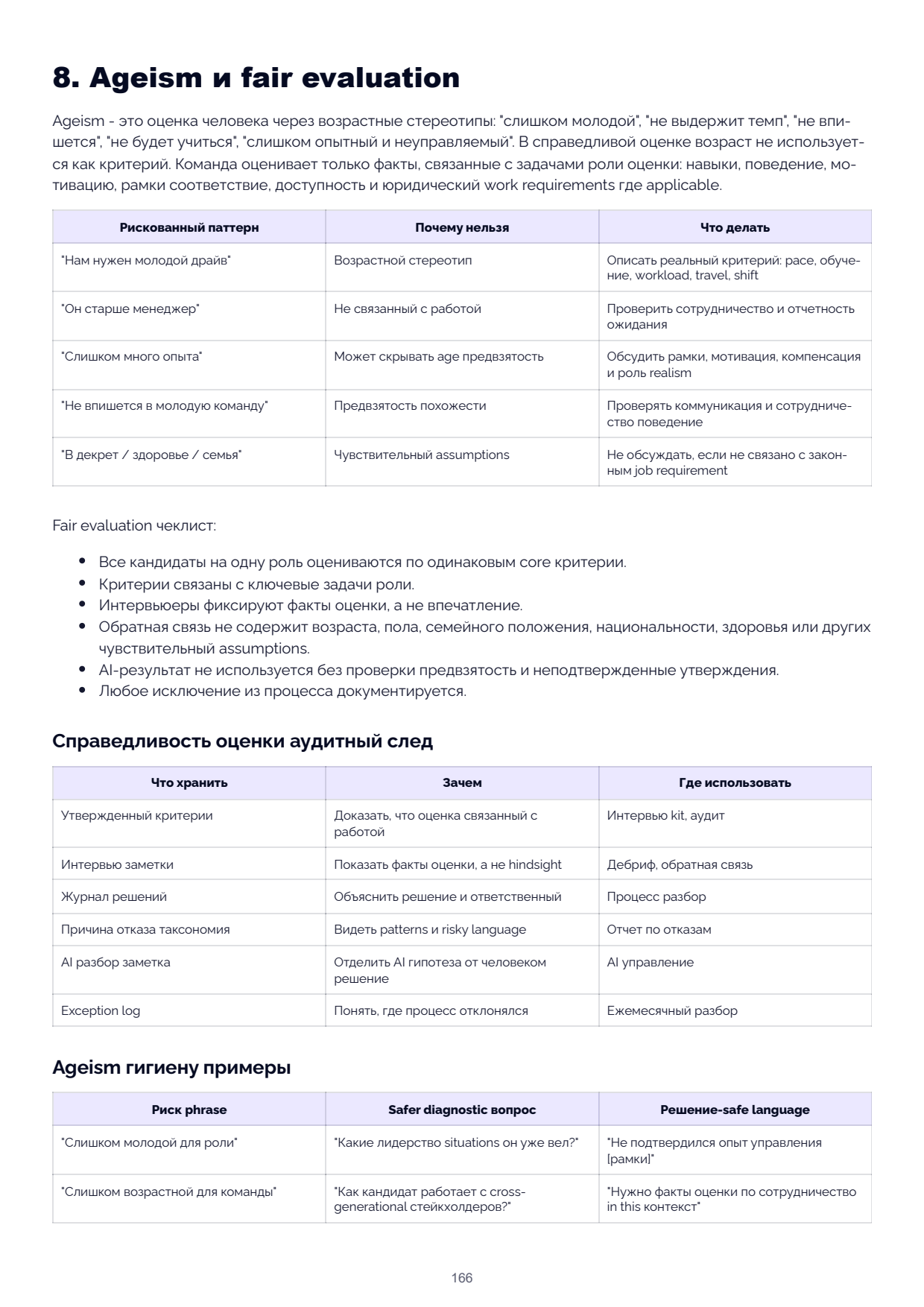
8. Ageism and fair assessment
Ageism is assessing a person through age-related stereotypes: "too young", "won't keep up the pace", "won't fit in",
"won't learn", "too experienced and unmanageable". In a fair assessment, age is not used
as a criterion. The team assesses only facts related to the role's tasks: skills, behaviour, motivation,
scope fit, availability and legal work requirements where applicable.
Risky pattern Why it is unacceptable What to do
"We need young drive" Age stereotype Describe the real criterion: pace, learning,
workload, travel, shift patterns
"They're older than the manager" Not work-related Check collaboration and reporting
expectations expectations
"Too much experience" May conceal age bias Discuss scope, motivation, compensation
and role realism
"Won't fit into a young team" Affinity bias Check communication and collaboration
behaviour
"Maternity leave / health / family" Sensitive assumptions Do not discuss unless linked to a lawful
job requirement
Fair assessment checklist:
All candidates for the same role are assessed against the same core criteria.
Criteria are linked to the key tasks of the role.
Interviewers record assessment facts, not impressions.
Feedback does not contain age, gender, marital status, nationality, health or other
sensitive assumptions.
AI results are not used without checking for bias and unverified claims.
Any departure from the process is documented.
Fair assessment audit trail
What to store Why Where to use it
Approved criteria To prove the assessment was work-related Interview kit, audit
Interview notes To show facts, not hindsight Debrief, feedback
Decision log To explain the decision and responsible person Process review
Rejection reason taxonomy To spot patterns and risky language Rejection report
AI review note To separate AI hypotheses from human AI governance
decisions
Exception log To understand where the process deviated Monthly review
Ageism hygiene examples
Risk phrase Safer diagnostic question Decision-safe language
"Too young for the role" "Which leadership situations have they "Experience managing [scope] was not
already led?" demonstrated"
"Too old for the team" "How does the candidate work with "Assessment facts on collaboration
cross-generational stakeholders?" in this context are needed"
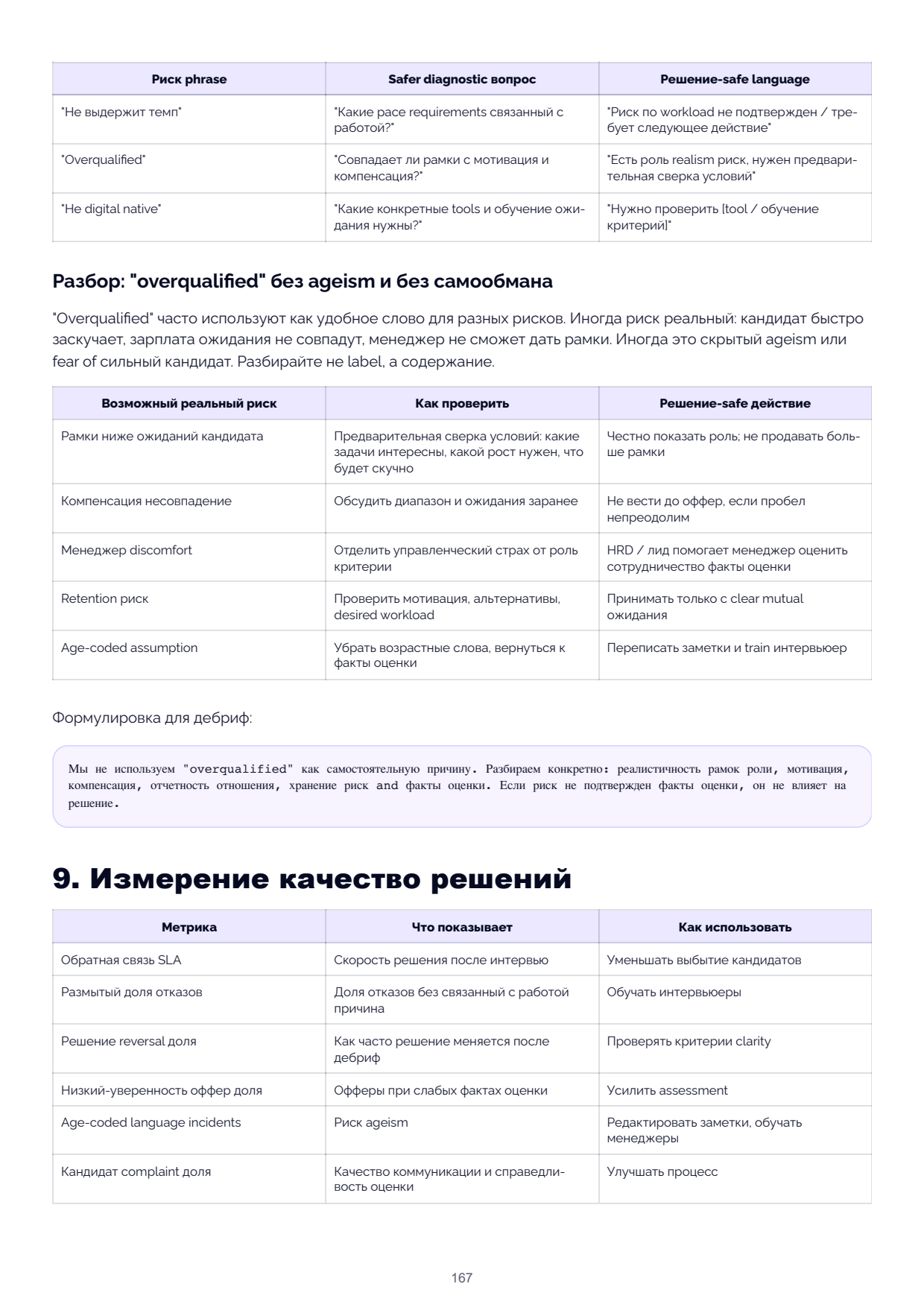
| Risk phrase | Safer diagnostic question | Decision-safe language |
|---|---|---|
| "Won't keep up the pace" | "What are the work-related pace requirements?" | "Workload risk not confirmed / requires next action" |
| "Overqualified" | "Does the scope match the motivation and compensation?" | "A role realism risk exists; a preliminary terms check is needed" |
| "Not a digital native" | "What specific tools and training expectations are there?" | "Need to verify [tool / training criterion]" |
9. Measuring decision quality
Metric What it shows How to use it
Feedback SLA Speed of decision after interview Reduce candidate drop-off
Vague rejection share Share of rejections without a Train interviewers
work-related reason
Decision reversal share How often the decision changes after Check criteria clarity
the debrief
Low-confidence offer share Offers made on weak assessment Strengthen assessment
facts
Age-coded language incidents Ageism risk Edit notes, train managers
Candidate complaint share Quality of communication and Improve the process
fair assessment
| Metric | What it shows | How to use it |
|---|---|---|
| Offer acceptance after timely feedback | Link between speed and trust | Set SLA |
| Complex decision case studies: mini breakdowns | ||||
|---|---|---|---|---|
| Case | Symptom | Diagnosis | Decision | Lesson for the process |
| "Brilliant interview, weak work sample" | Candidate is charismatic but the task does not confirm the skill | Check whether the task was poorly explained; conduct the defence only on missing assessment facts | If the rubric was clear and the gap is a threshold – reject / lower level | Do not let interview charisma override work assessment facts |
| "Strong candidate, but the team worries about age" | Phrases like "won't fit", "it'll be difficult with a younger manager" | Reframe as collaboration, reporting, motivation, scope | If assessment facts on collaboration are positive – disregard age-coded concern | Train the team in language hygiene |
| "Candidate needed urgently, assessment facts are weak" | Business is pushing for speed | Weigh the cost of an unfilled vacancy against a wrong-hire risk | Can hire only with accepted risk, an assigned responsible person and onboarding controls | Urgency does not override thresholds |
| "Agency client changes criteria after the shortlist" | All first candidates are rejected on a new criterion | Document the criteria drift | Pause shortlist, recalibrate the role, only continue the search after agreement | Client feedback quality feeds into agency operational rhythm |
| "The AI CV summary convinced the hiring manager" | Manager cites AI as fact | Check the source notes and unverified claims | Remove unverified claims, run the debrief with a human | AI may draft summaries but must not own the decision |
11. Procedure fragment: decisions and
feedback
All candidate decisions are made against approved criteria linked to the role's tasks. Interviewers complete their assessment maps before the debrief. The debrief is led by the recruiter or the hiring lead: first criteria and assessment facts,
then confidence and risks, then the decision.
Candidate feedback is formulated through work-related reasons and documented assessment facts. Phrasing
based on age, gender, marital status, health, origin, similarity to the team, vague "vibe" or
unverified AI results is prohibited. The decision and communication owner are recorded in the ATS.
12. Maturity model
Level How it looks
Chaos The most influential participant makes the decision; feedback is vague
Managed There is a decision rule, assessment map and feedback SLA
process
Evidence-based The debrief discusses criteria, assessment facts and confidence
assessment
Fair assessment Notes and feedback pass a bias / ageism hygiene check
AI-assisted AI helps prepare summaries and review notes, but a human owns the decision
operations
Key takeaways / where to go next
What you need Where to find it
Terms and short definitions Appendix B. Mini glossary
Ready-made procedures and SLAs Appendix D. Ready-made procedures and processes
Templates for daily use Appendix E. Template library
End-to-end BDM and Backend examples Appendix F. End-to-end BDM and Backend case studies
Full AI prompts for this chapter Appendix H. AI prompt library, section H6. Debrief,
decisions and feedback
In short: this chapter covers decisions, feedback and rejections. If you need a ready-made artefact, take it from the
appendices and keep the logic in the chapter.
Chapter 10. Candidate Experience
How to use this chapter
Working scenario. The candidate performed well in the interview but receives no updates for five days afterwards.
Then an automated email arrives without the manager's name and without an explanation of the next step. They
reply with a brief note, are simultaneously going through another process and are no longer as engaged on the
final call. The team is surprised: "But we were interested." For the candidate, no interest was visible.
What has actually broken here: candidate experience was mistaken for a polite tone, when it is a managed pathway from
first contact to the final status. Candidates need clarity, speed, respect, honest role information, personal data safety,
predictable stages, reasonable tasks and correct automation.
This chapter is practical for agencies and in-house recruitment teams. In an agency, candidate experience affects
candidate trust and client reputation. In-house, it affects the employer brand, referrals, offer acceptance
and the future talent pipeline. In both cases, automation should help people receive status updates rather than
turn the process into an impersonal conveyor belt.
Remember in one phrase: candidate experience is the promises of the process that the team actually keeps.
| If your task is | Go to section | What you will get |
|---|---|---|
| Map the candidate journey | 1–2 | Stage and expectation map |
| Set up communication | 3–5 | Templates, SLA, channel rules |
| Use automation respectfully | 6 | Rules for respectful automation |
| Handle personal data | 7 | Consent, storage, access checklist |
| Measure experience | 8 | Candidate experience metrics |
| Work through case studies | 10 | Mini-guides |
| Use AI | 11 | Prompts with human checks |
Quick chapter map
| Element | Key question | Good practice | Risk |
|---|---|---|---|
| Communication | Does the candidate know what is happening? | Status, deadlines, responsible person, next step | Silence and uncertainty |
| Respectful automation | Is the automation helpful to the person? | Personalised, relevant, respects communication preferences | Mass robotic messages |
| Personal data consent | Can we store and use the data? | Consent status, storage, access rules | Outdated database without legal grounds |
| Test task / interview | Is the assessment proportional to the role? | Time limits, rubric, preparation information | Exploitative tasks |
| Metrics | Can we see experience losses? | SLA, candidate drop-off, complaints, offer acceptance | Managing only speed |
Minimal start
Candidate experience improves fastest through predictability.
Candidate experience improves fastest through predictability.
| Step | What to do | Artefact |
|---|---|---|
| 1 | For each stage note what the candidate should know in advance | Candidate preparation checklist |
| 2 | State the deadline for the next status and the responsible person | Communication SLA |
| 3 | If there is no status yet, send an “update with no news” before the promised deadline | No-news update |
| 4 | Check that automated messages are not sent to finalists and sensitive cases without human oversight | Automation guardrail |
1. Process: what is candidate experience
Candidate experience is the sum of touchpoints where the candidate understands whether the process respects their time,
data and effort. This includes sourcing messages, screening, meeting scheduling, interviews, test tasks,
feedback, offers, rejections, consent management and future contact.
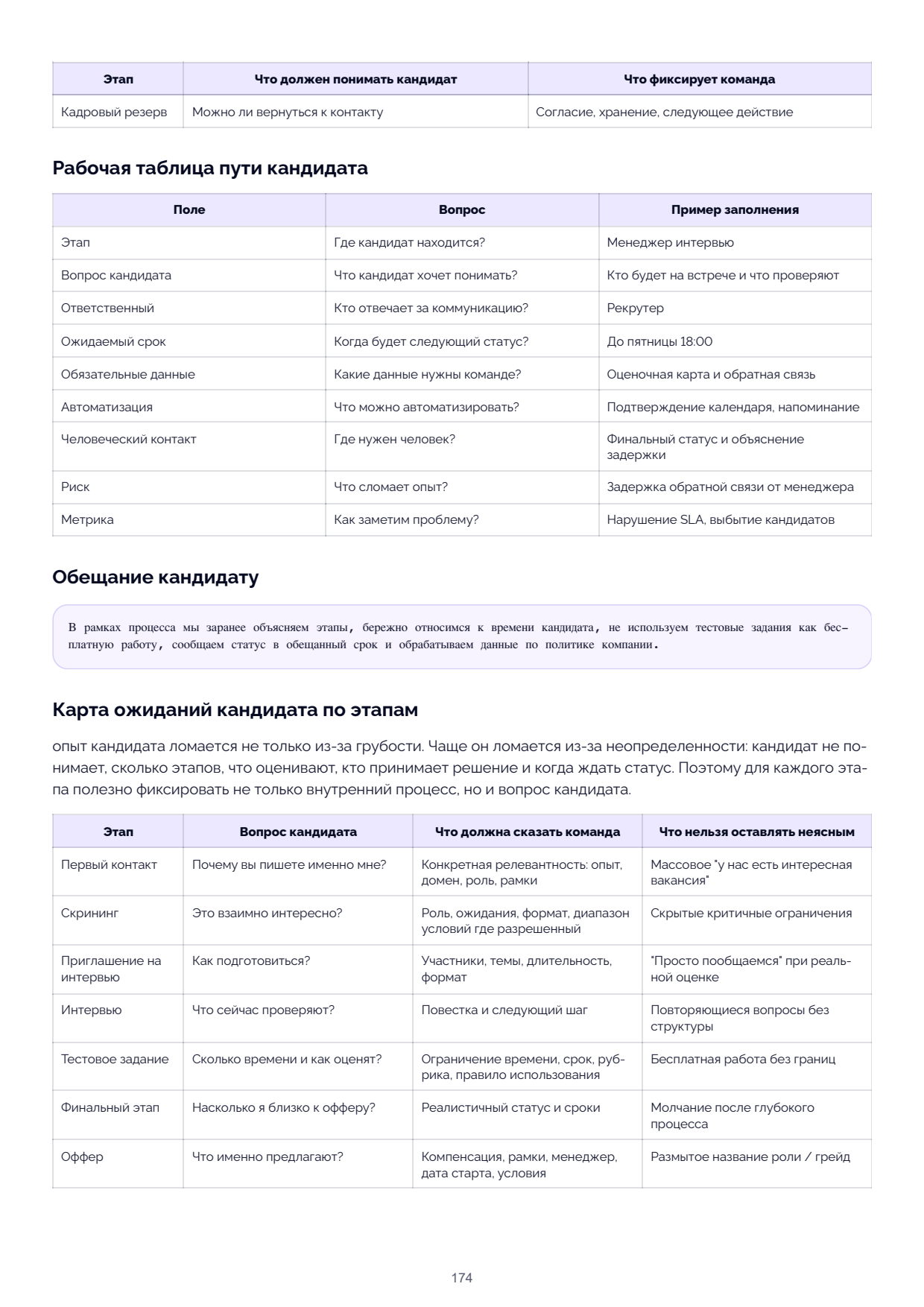
Stage What the candidate should understand What the team records
First contact Why they are being approached and which role Source, message, basis for contact, where
applicable
Screening What is being checked and what happens next Motivation, constraints, next step
Scheduling When the meeting is, who will attend, how to prepare Calendar, responsible person, SLA
Interview What topics, format, criteria Interview notes, assessment map
Test task Purpose, time limit, rubric, usage rule Task sent, received, assessed
Decision When the answer will come Decision owner, deadline
Offer / rejection What has been decided and why, within approved Decision log, message
scope
| Stage | What the candidate should understand | What the team records |
|---|---|---|
| Talent pipeline | Can they be contacted again? | Consent, storage, next action |
| Candidate journey worksheet | ||
| Field | Question | Example answer |
| Stage | Where is the candidate in the process? | Interview manager |
| Candidate question | What does the candidate want to understand? | Who will be in the meeting and what will they assess |
| Responsible person | Who is responsible for communication? | Recruiter |
| Expected deadline | When will the next status come? | By Friday 6 pm |
| Mandatory data | What data does the team need? | Assessment map and feedback |
| Automation | What can be automated? | Calendar confirmation, reminder |
| Human touchpoint | Where is a person needed? | Final status and explanation of delay |
| Risk | What will break the experience? | Delayed feedback from the manager |
| Metric | How will we spot the problem? | SLA breach, candidate drop-off |
| Candidate promise |
| Stage | Candidate question | What the team should say | What must not be left unclear |
|---|---|---|---|
| Rejection | Is this the end or is future contact possible? | Closure and consent to join the talent pipeline, if applicable | "We'll keep your CV" without consent logic |
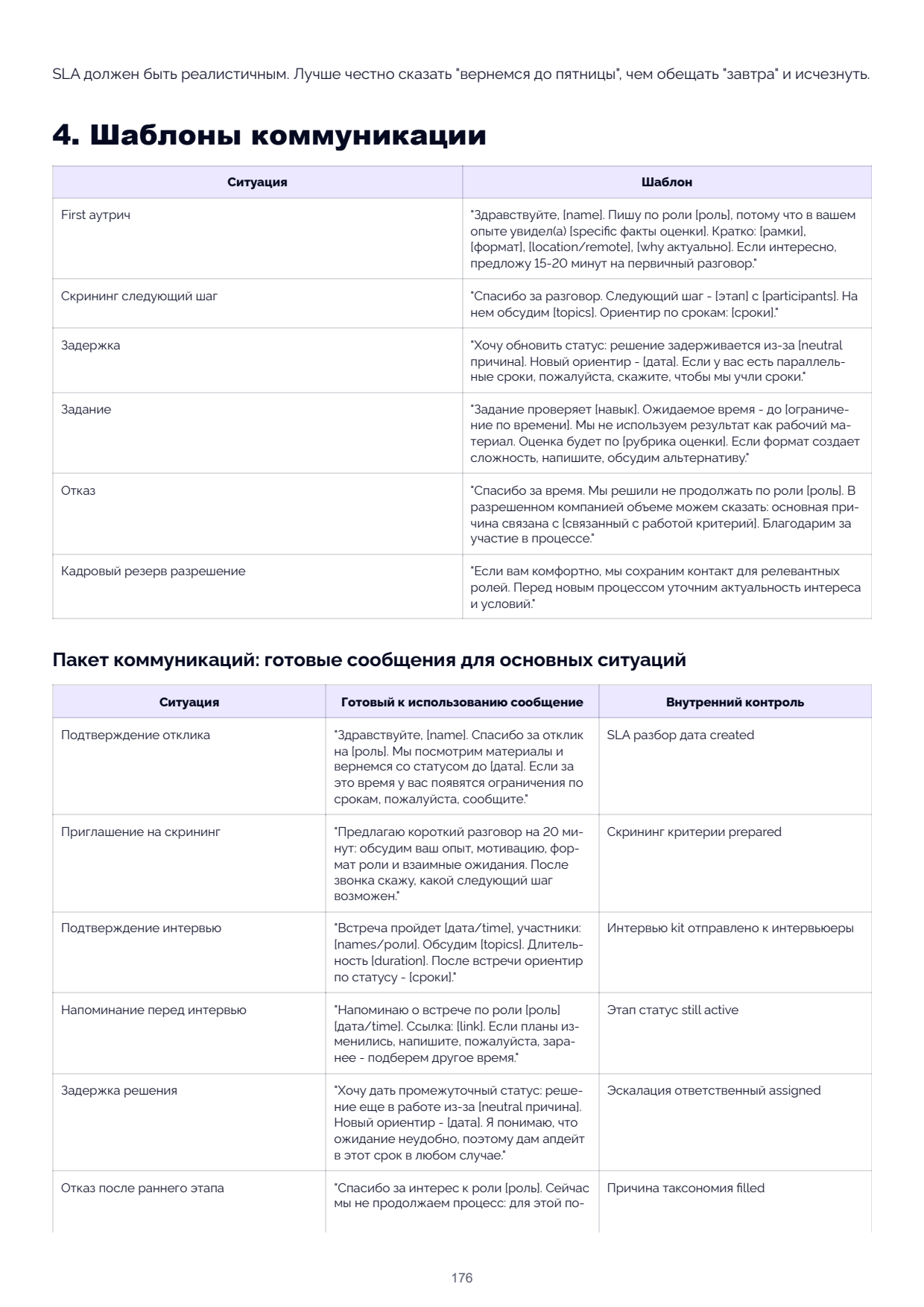
4. Communication templates
Situation Template
First outreach "Hello [name]. I'm writing about the [role] because I noticed
[specific assessment facts] in your experience. Briefly: [scope],
[format], [location/remote], [why it's relevant]. If you are
interested, I can suggest 15–20 minutes for an initial conversation."
Screening next step "Thank you for the call. The next step is [stage] with [participants].
We will discuss [topics]. Timeline: [deadlines]."
Delay "I want to update the status: the decision is delayed due to
[neutral reason]. New timeline: [date]. If you have parallel
deadlines, please let us know so we can factor them in."
Test task "The task tests [skill]. Expected time: up to [time limit].
We do not use the result as work material. Assessment will
be against [assessment rubric]. If the format creates a difficulty,
please write to us and we will discuss an alternative."
Rejection "Thank you for your time. We have decided not to proceed with
the [role]. Within the scope the company allows us to share:
the main reason relates to [work-related criterion]. We
appreciate your participation in the process."
Talent pipeline consent "If you are comfortable, we will keep your details for relevant
roles. Before a new process we will confirm whether the
interest and terms still apply."
Communication pack: ready-made messages for common situations
Situation Ready-to-use message Internal control
Application acknowledgement "Hello [name]. Thank you for applying SLA review date recorded
for [role]. We will review your details and
get back to you with a status by [date].
If you have any deadline constraints in
the meantime, please let us know."
Screening invitation "I suggest a short 20-minute conversation: Screening criteria prepared
we'll discuss your experience, motivation,
role format and mutual expectations.
After the call I will tell you which next
step is possible."
Interview confirmation "The meeting will be on [date/time], Interview kit sent to interviewers
participants: [names/roles]. We will
discuss [topics]. Duration: [duration].
After the meeting the status timeline is
[deadlines]."
Pre-interview reminder "A reminder about the meeting for [role] Stage status still active
on [date/time]. Link: [link]. If your plans
have changed, please let us know in
advance — we will find another time."
Decision delay "I want to give an interim status: the Escalation responsible assigned
decision is still in progress due to
[neutral reason]. New timeline: [date].
I understand that waiting is inconvenient,
so I will send you an update by that
deadline regardless."
Early-stage rejection "Thank you for your interest in [role]. We Rejection taxonomy filled
are not proceeding at this stage: this
| Situation | Ready-to-use message | Internal control |
|---|---|---|
| position requires more proven experience in [criterion]. Thank you for your time." | ||
| Post-final rejection | "Thank you for the serious engagement in the process. We have decided to move forward with a different candidate because [criterion/scope] is more critical for the near-term tasks. External feedback is given only within the scope the company allows and based on verified notes. We very much value your time and, if you are comfortable, would be happy to get in touch when a more suitable role arises." | Human check; no generic automation |
| Talent pipeline return | "A [role] role has come up that may be closer to your experience [specific reason]. Could you let me know whether now would be a good time to discuss new opportunities?" | Consent and last contact verified |
5. Candidate-friendly interviews
Element Good practice Why it matters
Agenda Candidate knows the meeting format Reduces uncertainty
Criteria Questions are linked to the role Process looks professional
Time discipline Interview starts and finishes on time Respect for the candidate's time
Repetitive questions Interviewers do not repeat the same thing Reduces fatigue
Preparation Candidate understands what to prepare Improves the quality of assessment facts