Chapter 12. Preboarding and Closing the Loop

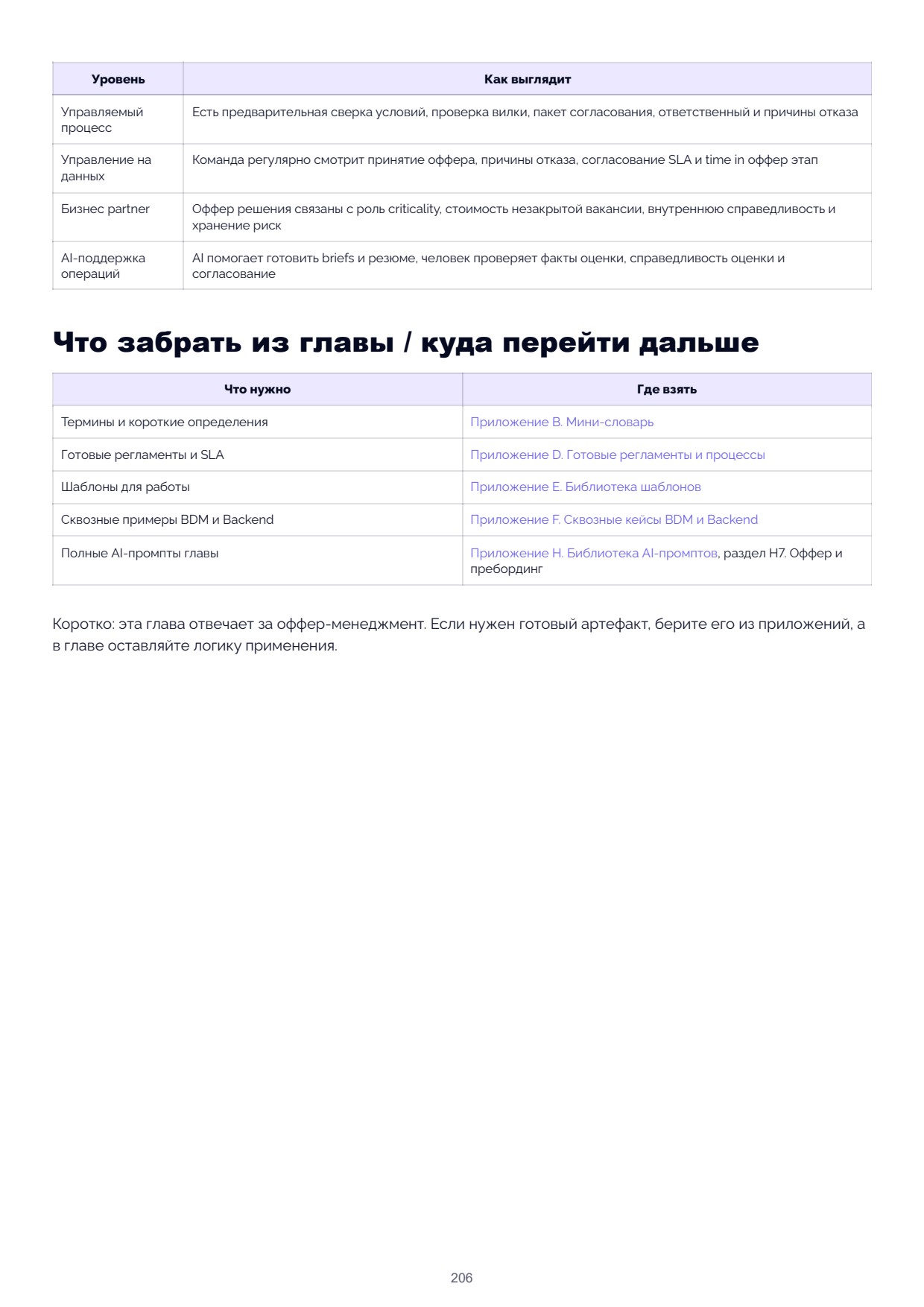
| Level | What it looks like |
|---|---|
| Managed process | There is a preliminary terms check, salary band review, approval package, a responsible person, and reasons for rejection |
| Data-driven management | The team regularly reviews offer acceptance, reasons for rejection, SLA compliance, and time in offer stage |
| Business partner | Offer decisions are linked to role criticality, cost of the unfilled vacancy, internal fairness, and retention risk |
| AI-assisted operations | AI helps prepare briefs and summaries; a person verifies assessment facts, assessment fairness, and approval |
| What to take from this chapter / where to go next | |
| What you need | Where to find it |
| Terms and short definitions | Appendix B. Mini-glossary |
| Ready-made regulations and SLAs | Appendix D. Ready-made regulations and processes |
| Templates for use | Appendix E. Template library |
| Cross-cutting BDM and Backend examples | Appendix F. Cross-cutting BDM and Backend case studies |
| Full AI prompts for this chapter | Appendix H. AI prompt library, section H7. Offer and preboarding |
How to use this chapter
Working scenario. The candidate has accepted the offer, the team has congratulated each other, and the vacancy is nearly closed. One week before
their start date, the candidate writes to say their current employer has offered them a promotion. IT has not yet ordered access, the manageer has not prepared the first week, finalists have not been sent a status update, and rejection reasons remain blank.
Formally the offer is accepted. Systematically, hiring is not yet complete.
What actually went wrong here: the team marked the finish where the final control loop was needed.
A role is only closed when the person has started, the team is ready for launch, the remaining candidates have received a correct status, finalists have not been lost, and lessons from the vacancy have been captured.
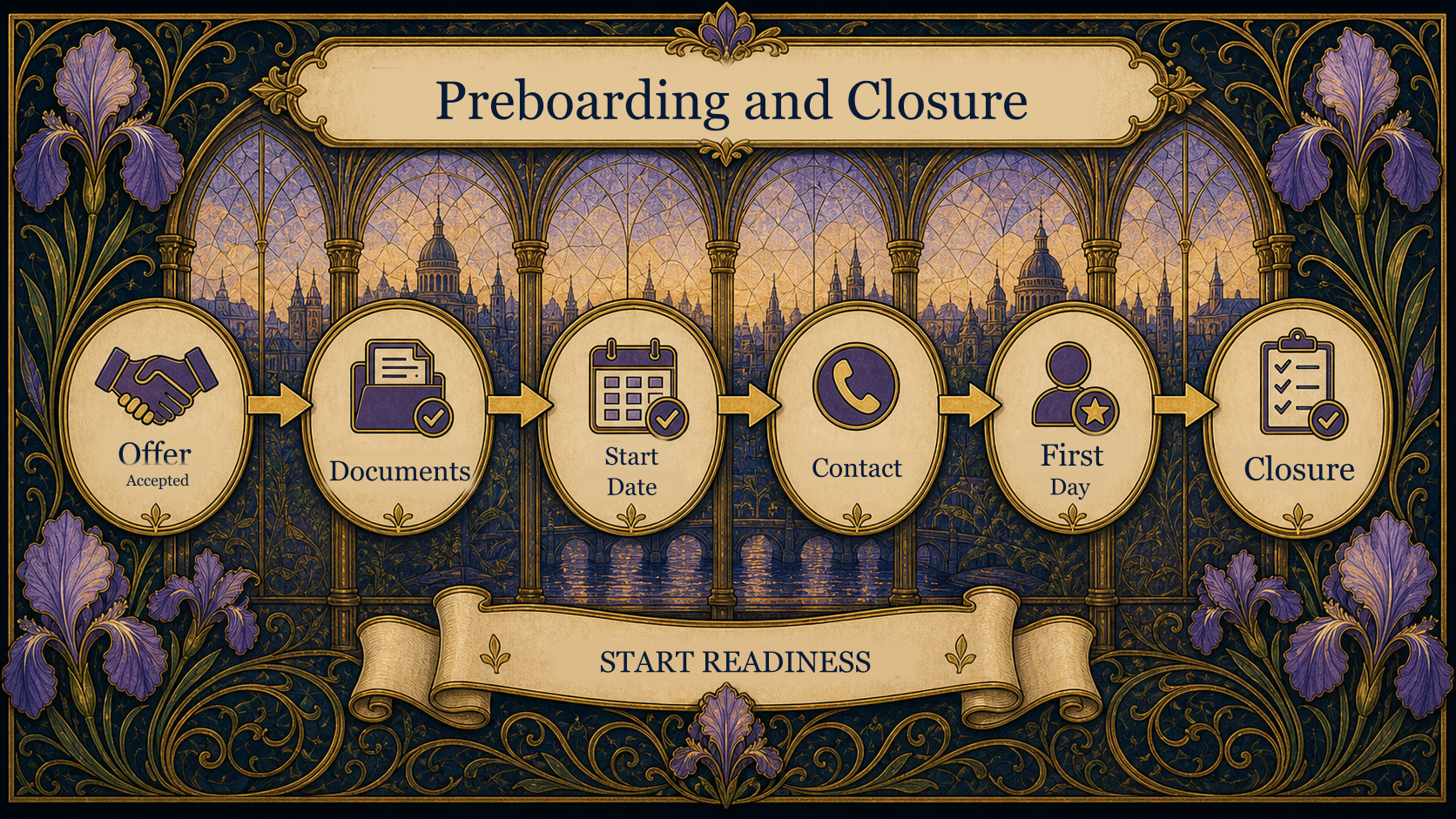
Preboarding is the period between an accepted offer and the first working day. Closing the loop is broader: hand over
context to HR, the manager, and IT; prepare for launch; maintain contact with the candidate; close statuses in ATS;
reject the remaining candidates properly; retain strong finalists; run a retrospective; and update the rules.
If this loop is not closed, the company loses the value of the work already done.
Read this chapter as an operational checklist for the last 10–30 days of hiring. If candidates accept the offer
but do not start, begin with risks and the communication cadence. If the new hire walks into chaos, look at
context handover and launch readiness. If recruitment does not learn from closed roles, use the retrospective and data sections. If an agency closes a placement but does not manage warranty-period risk,
see the agency sections.
Remember in one phrase: hiring does not end with an accepted offer but with a reliable start and closed
commitments.
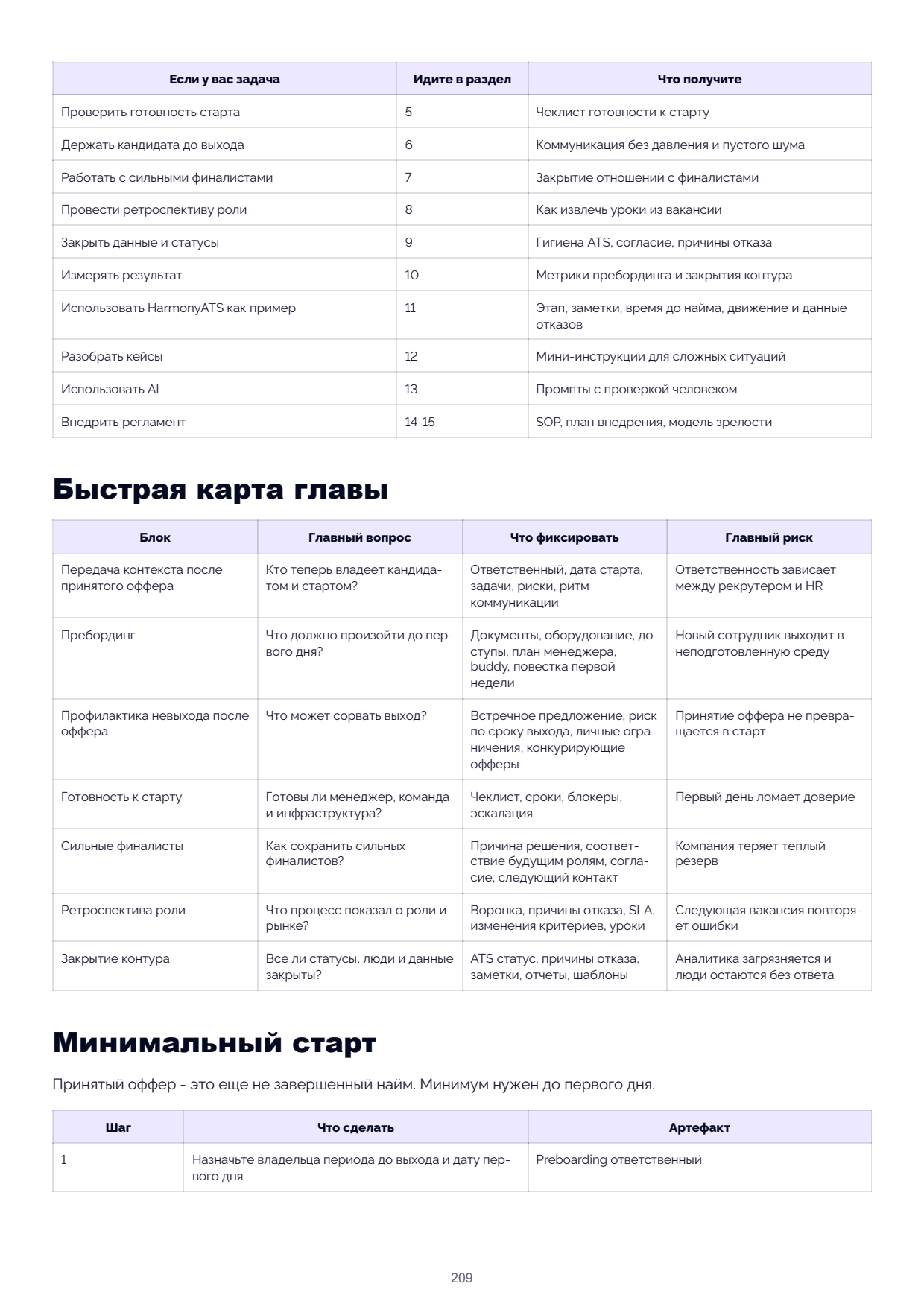
If you have this task Go to section What you will get
Understand preboarding boundaries 1 Process from accepted offer to start
Reduce post-offer non-start risk 2 Risk map and communication cadence
Divide agency / internal recruitment 3 Who is responsible for what after the offer is accepted
Set up context handover 4 Handover to manager, HR, IT, and buddy
| If you have this task | Go to section | What you will get | |
|---|---|---|---|
| Check launch readiness | 5 | Launch readiness checklist | |
| Keep the candidate until start date | 6 | Communication without pressure or empty noise | |
| Work with strong finalists | 7 | Closing relationships with finalists | |
| Run a role retrospective | 8 | How to extract lessons from a vacancy | |
| Close data and statuses | 9 | ATS hygiene, consent, rejection reasons | |
| Measure the result | 10 | Preboarding and loop-closing metrics | |
| Use HarmonyATS as an example | 11 | Stage, notes, time-to-hire, candidate movement, and rejection data | |
| Work through case studies | 12 | Mini-guides for complex situations | |
| Use AI | 13 | Prompts with human verification | |
| Roll out a regulation | 14–15 | SOP, implementation plan, maturity model | |
| Quick chapter map | |||
| Block | Key question | What to capture | Key risk |
| Context handover after accepted offer | Who now owns the candidate and the start? | Responsible person, start date, tasks, risks, communication cadence | Responsibility hangs between recruiter and HR |
| Preboarding | What must happen before day one? | Documents, equipment, access, manager's plan, buddy, first-week agenda | The new hire starts in an unprepared environment |
| Post-offer non-start prevention | What could derail the start? | Counter-offer, start-date risk, personal constraints, competing offers | An accepted offer does not become a start |
| Launch readiness | Are the manager, team, and infrastructure ready? | Checklist, deadlines, blockers, escalation | Day one breaks trust |
| Strong finalists | How do we retain strong finalists? | Reason for the decision, fit for future roles, consent, next contact | The company loses a warm talent pipeline |
| Role retrospective | What did the process reveal about the role and the market? | Funnel, rejection reasons, SLA, criteria changes, lessons | The next vacancy repeats the same mistakes |
| Closing the loop | Are all statuses, people, and data closed? | ATS status, rejection reasons, notes, reports, templates | Analytics become corrupted and people are left without a response |
Minimum starting point
An accepted offer is not yet a completed hire. At a minimum, the following is needed before day one.
Step What to do Deliverable
1 Appoint an owner of the pre-start period and set the day-one date Preboarding owner
| Step | What to do | Deliverable |
|---|---|---|
| 2 | Verify documents, access, equipment, schedule, and the manager's contact details | Launch readiness tracker |
| 3 | Hand over only the necessary context to the team, without excess personal data | Context handover note |
| 4 | Close statuses, rejection reasons, strong finalists, and the role retrospective | Closing checklist |
1. Why an accepted offer is not the end of hiring
An accepted offer shows the candidate's intention to join. But before the first working day there is a risk period: the candidate is finishing their current role, receiving a counter-offer, discussing the move with their family, comparing alternatives, waiting for documents, and observing the speed and quality of the new company's communication. If silence follows the accepted offer, trust falls. For the company this period is also risky. The manager may think recruitment has finished, HR may expect the manager to prepare the start themselves, IT may assume the request will arrive later, and the recruiter may believe everything is now with the onboarding team. As a result, the first day becomes an improvisation and the new hire receives a signal: the process inside is worse than it appeared at interview. What counts as closing a role
| State | Why it is insufficient | What to add |
| Offer accepted | The candidate has not yet started | Preboarding plan and post-offer non-start risk monitoring |
| Contract signed | Documents exist but the start may not be ready | Equipment, access, manager's agenda, buddy |
| First day completed | The person has started but the hiring process has not been reviewed | Role retrospective and data clean-up |
| Vacancy status closed | ATS shows closure but relationships may not be closed | Candidate communication, strong finalists, rejection reasons |
2. Preboarding: process, risks, and cadence
Preboarding is the managed preparation of a new hire's start before the first day. It should not replace
onboarding. Its purpose is to maintain trust after the offer, prepare documents and infrastructure, remove uncertainty, confirm the start date, and give the person their first orientations.
Preboarding risk map
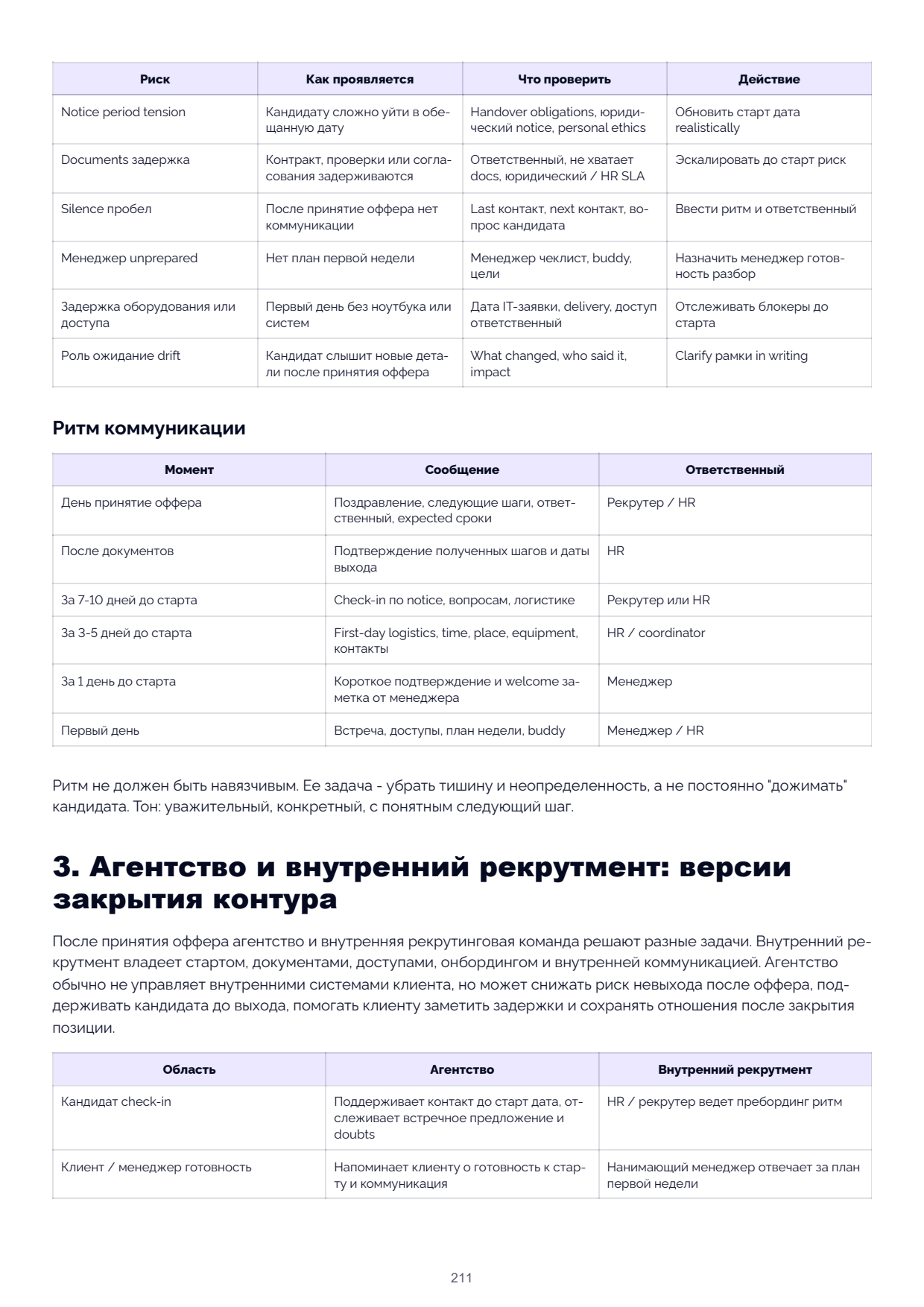
Risk How it manifests What to check Action
Counter-offer Current employer offers Counter-offer or new offer, reasons to Calm check-in, do
a promotion or new offer, new decision to leave, updated not pressure
scope confidence
| Risk | How it manifests | What to check | Action |
|---|---|---|---|
| Notice period tension | The candidate cannot leave by the promised date | Handover obligations, legal notice period, personal ethics | Update the start date realistically |
| Document delays | Contract, checks, or approvals are delayed | Responsible person, missing documents, legal / HR SLA | Escalate to start-date risk |
| Silence gap | No communication after the offer is accepted | Last contact, next contact, candidate's question | Establish a cadence and assign a responsible person |
| Manager unprepared | No first-week plan | Manager checklist, buddy, objectives | Schedule a manager readiness review |
| Equipment or access delay | First day without a laptop or systems | IT request date, delivery, access owner | Track blockers until start date |
| Role expectations drift | The candidate hears new details after accepting the offer | What changed, who said it, impact | Clarify scope in writing |
| Communication cadence | |||
| Timing | Message | Responsible person | |
| Day offer is accepted | Congratulations, next steps, responsible person, expected timeframes | Recruiter / HR | |
| After documents | Confirmation of received items and the start date | HR | |
| 7–10 days before start | Check-in on notice period, questions, logistics | Recruiter or HR | |
| 3–5 days before start | First-day logistics, time, place, equipment, contacts | HR / coordinator | |
| 1 day before start | Short confirmation and welcome note from the manager | Manager | |
| First day | Welcome, access, weekly plan, buddy | Manager / HR |
3. Agency and internal recruitment: versions
of closing the loop
After the offer is accepted, the agency and the internal recruitment team face different tasks. Internal recruitment owns the start, documents, access, onboarding, and internal communication. The agency
typically does not manage the client's internal systems but can reduce post-offer non-start risk, support the candidate until the start date, help the client notice delays, and maintain the relationship after the placement
is closed.
Area Agency Internal recruitment
Candidate check-in Maintains contact until the start date, HR / recruiter runs the preboarding cadence
monitors counter-offers and
doubts
Client / manager readiness Reminds the client of launch readiness and Hiring manager responsible for the first-week plan
communication
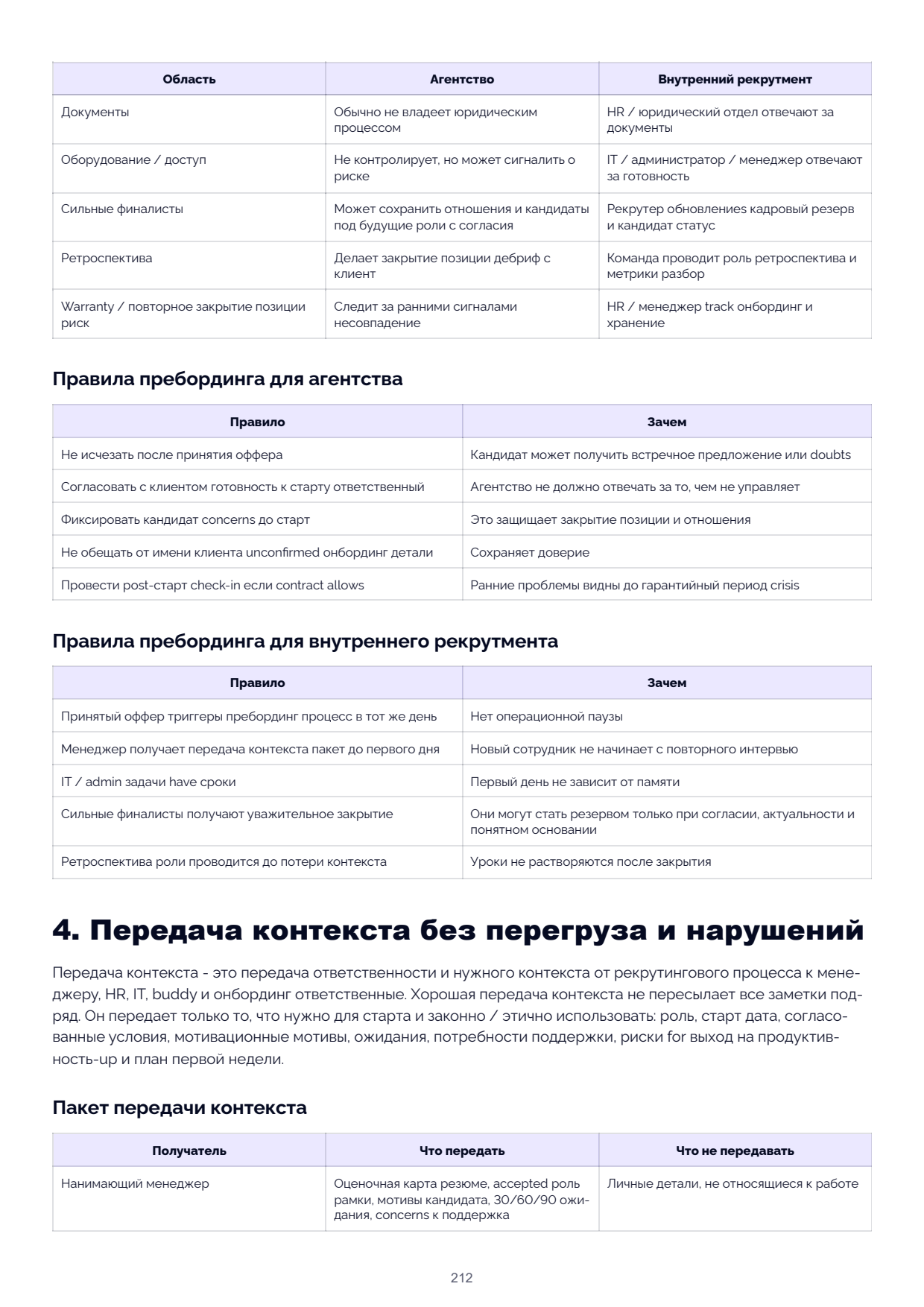
| Area | Agency | Internal recruitment |
|---|---|---|
| Documents | Does not typically own the legal process | HR / legal department responsible for documents |
| Equipment / access | Does not control but can flag risk | IT / admin / manager responsible for readiness |
| Strong finalists | Can maintain relationships and candidates for future roles with consent | Recruiter updates the talent pipeline and candidate status |
| Retrospective | Runs a placement-closing debrief with the client | The team conducts a role retrospective and metrics review |
| Warranty / re-placement risk | Monitors early signs of mismatch | HR / manager tracks onboarding and retention |
| Preboarding rules for the agency | ||
| Rule | Why | |
| Do not disappear after the offer is accepted | The candidate may receive a counter-offer or doubts | |
| Agree with the client on the launch-readiness owner | The agency must not be accountable for what it does not control | |
| Capture candidate concerns before the start date | This protects the placement and the relationship | |
| Do not promise unconfirmed onboarding details on the client's behalf | Preserves trust | |
| Run a post-start check-in if the contract allows | Early issues become visible before a warranty-period crisis | |
| Preboarding rules for internal recruitment | ||
| Rule | Why | |
| An accepted offer triggers the preboarding process on the same day | There is no operational pause | |
| The manager receives the context handover pack before day one | The new hire does not start with a re-interview | |
| IT / admin tasks have deadlines | Day one does not depend on memory | |
| Strong finalists receive a respectful closing | They may become a reserve only with consent, relevance, and a clear rationale | |
| The role retrospective is conducted before context is lost | Lessons do not evaporate after closure |
4. Context handover without overload or breaches
Context handover is the transfer of responsibility and necessary context from the recruitment process to the manager, HR, IT, buddy, and onboarding owners. Good context handover does not forward all notes at
random. It transfers only what is needed for the start and is lawful / ethical to use: role, start date, agreed
terms, motivational drivers, expectations, support needs, risks for productivity ramp-up, and the first-week plan. Context handover pack
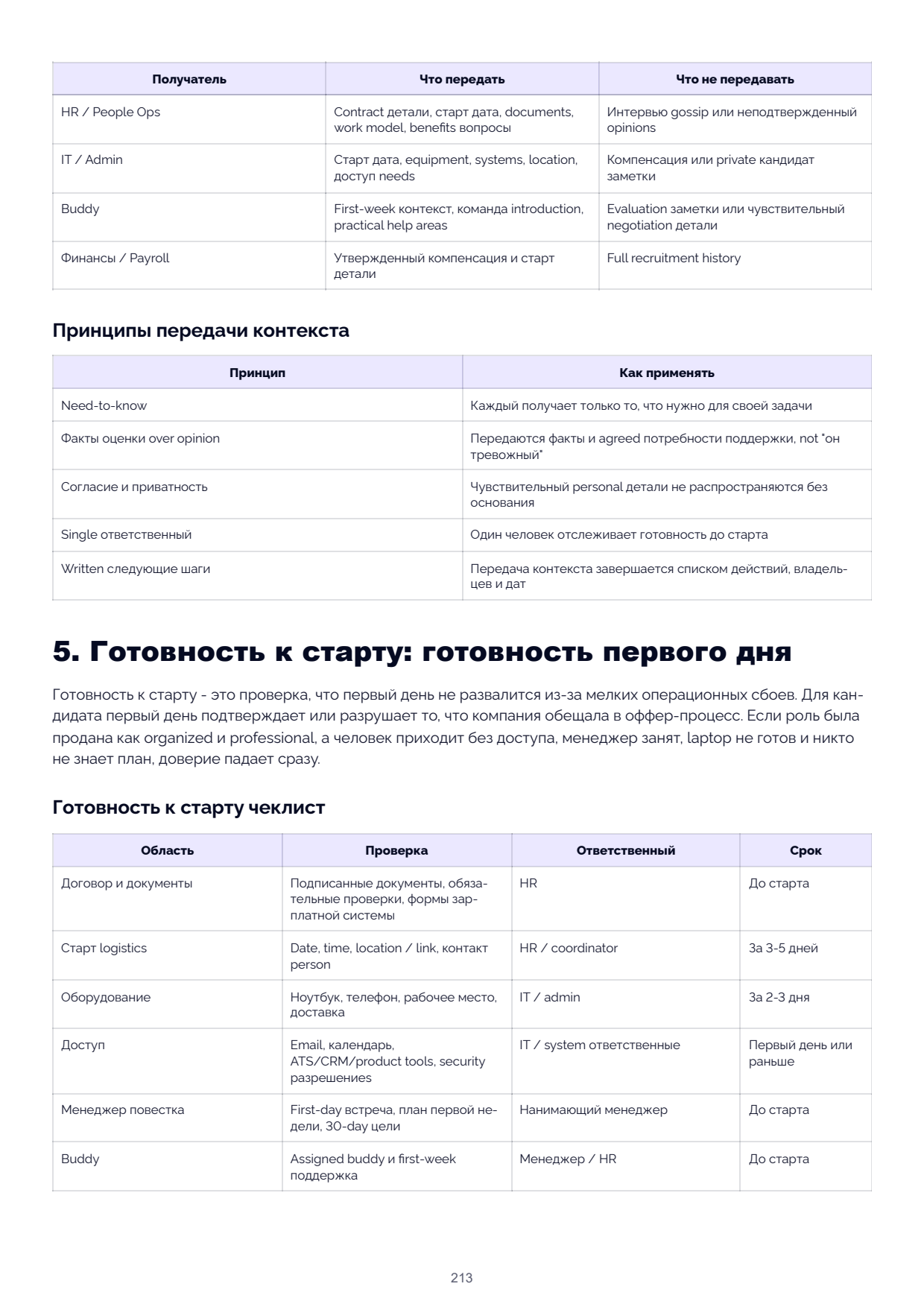
| Recipient | What to hand over | What not to hand over |
| Hiring manager | Assessment scorecard, accepted role scope, candidate motivations, 30/60/90 expectations, support concerns | Personal details unrelated to work |
| Recipient | What to hand over | What not to hand over |
|---|---|---|
| HR / People Ops | Contract details, start date, documents, work model, benefits questions | Interview gossip or unconfirmed opinions |
| IT / Admin | Start date, equipment, systems, location, access needs | Compensation or private candidate notes |
| Buddy | First-week context, team introduction, practical help areas | Evaluation notes or sensitive negotiation details |
| Finance / Payroll | Approved compensation and start details | Full recruitment history |
| Context handover principles | ||
| Principle | How to apply | |
| Need-to-know | Each person receives only what they need for their task | |
| Facts over opinion | Transfer facts and agreed support needs, not "they seem anxious" | |
| Consent and privacy | Sensitive personal details are not shared without justification | |
| Single point of responsibility | One person tracks readiness until the start date | |
| Written next steps | Context handover ends with a list of actions, owners, and dates |
5. Launch readiness: first-day preparedness
Launch readiness is the verification that day one will not fall apart due to minor operational failures. For the candidate, day one confirms or destroys what the company promised during the offer process. If the role was sold as
organised and professional, yet the person arrives without access, the manager is unavailable, the laptop is not ready, and nobody knows the plan, trust collapses immediately. Launch readiness checklist
| Area | Check | Responsible person | Deadline |
| Contract and documents | Signed documents, mandatory checks, payroll-system forms | HR | Before start |
| Start logistics | Date, time, location / link, contact person | HR / coordinator | 3–5 days before |
| Equipment | Laptop, phone, workstation, delivery | IT / admin | 2–3 days before |
| Access | Email, calendar, ATS / CRM / product tools, security permissions | IT / system owners | First day or earlier |
| Manager's agenda | Day-one meeting, first-week plan, 30-day objectives | Hiring manager | Before start |
| Buddy | Assigned buddy and first-week support | Manager / HR | Before start |
| Area | Check | Responsible person | Deadline |
|---|---|---|---|
| Team communication | Announcement, role context, expectations | Manager | Before or on day one |
| Training materials | Product documentation, policies, role work instructions | Manager / HR | First week |
| Risk check | Counter-offer, notice period, personal constraints | Recruiter / HR | 7 and 3 days before |
| First-week plan | |||
| Day / period | Focus | Outcome | |
| Day 1 | Welcome, logistics, manager context, systems | The person understands where they have joined and what to do next | |
| Days 2–3 | Product / process overview, key stakeholders | There is a map of people, systems, and tasks | |
| Days 4–5 | First small tasks, shadowing, questions | The new hire begins to act safely | |
| End of week | Manager check-in | First questions and blockers are resolved | |
| Cross-cutting example: accepted offer → first day | |||
| Area | BDM at a B2B SaaS payments company | Backend Engineer | |
| Preboarding materials | Product documents, ICP, sales playbook, payments-domain glossary, CRM/ATS rules, first call observations | Architecture overview, API documentation, security and data-handling policy, release process, observability dashboards | |
| First-day readiness | CRM/ATS access, segment list, onboarding owner, calendar with sales / product / finance touchpoints | Repo access, dev environment, onboarding buddy, first safe task, code owner for walkthrough | |
| First-week outcome | Understands the product, ICP, qualification criteria, and does not over-promise to clients | Understands the architecture map, release process, monitoring, and can pick up a small safe PR | |
| Risk check | Counter-offer, OTE misunderstanding, territory ambiguity, domain anxiety | Compensation / level mismatch, remote / hybrid expectations, security-access delays | |
| Cautions when handing over context | Do not share personal compensation negotiation details with the team; transfer only agreed support needs | Do not share unconfirmed interview opinions; transfer evidence-based onboarding risks |
6. Post-offer non-start prevention and maintaining trust until start date
Post-offer non-start is a situation where the candidate has accepted the offer but does not start. Reasons vary: counter-offer, another offer, fear of the move, document problems, personal circumstances, poor communication, company unreadiness, and changed conditions. Some reasons cannot be controlled, but the likelihood can be reduced through honest preboarding.
7. Strong finalists and respectful closure of relationships
Closing a role does not mean that all unsuccessful finalists should disappear from view. Strong finalists
are strong candidates who were not hired for a non-critical reason. Working with them links Chapter 12 to the talent pipeline: a respectful rejection, preserving context, consent / permission for future contact, and fit-for-future-
roles tags turn a completed process into a future opportunity.
Closing process for a strong finalist
| Step | What to do | Mistake |
| Confirm the reason for non-selection | Compare the final decision and the assessment scorecard | Giving a generic "we liked you" rejection with no substance |
| Determine fit for future roles | Is there a role / level / direction where the candidate is relevant | Keeping all finalists without justification |
| Give a respectful rejection | Gratitude, brief reason, next-contact permission | Promising a future role |
| Update ATS / talent pipeline | Segment, strengths, risks, consent, last contact, responsible person | Leaving the candidate at the final stage |
| Schedule the next action | Only if there is justification and permission | Mass-mailing after a year with no context |
Thank you for the strong process and the time spent on final meetings. This time we selected a candidate whose experience more closely matched the current priority of the role: [brief reason]. At the same time, we valued your experience in [area], and we see potential alignment with [direction / type of role]. If you are comfortable, we will keep in touch and return only when a relevant opportunity arises; before any new conversation we will update your expectations and the relevance of your interest.
8. Role retrospective: what the closed vacancy taught us
A role retrospective is a short review of a closed vacancy after an accepted offer or a start. The aim is not to find blame but to update the system: criteria, sourcing assumptions, interview cycle, salary band, SLA, offer process, preboarding, and candidate experience. Retrospective agenda
| Block | Question | Deliverable |
| Role clarity | Did the criteria change after launch? | Criteria change log |
| Funnel | Where were the biggest drop-offs? | Funnel snapshot |
| SLA | Where did candidates wait longer than normal? | SLA review |
| Assessment | Which criteria predicted the final decision? | Assessment scorecard review |
| Offer | Were there delays, negotiation, counter-offers, compensation mismatches? | Offer notes |
| Preboarding | Were there start risks or blockers? | Readiness checklist |
| Candidate experience | Did everyone receive a status update and respectful communication? | Communication audit |
| Learning | What should change in the next similar role? | 3–5 action items |
| When to run it | ||
| Situation | Timeframe | |
| Standard role | Within 1 week of the start date | |
| Critical role | After the accepted offer and after the first week | |
| Agency placement | After the offer is accepted and after start / warranty-period checkpoint | |
| Role with high rejection rate | Immediately after the final rejection or closure |
| Situation | Timeframe |
|---|---|
| Role with changed scope | Before launching the next similar vacancy |
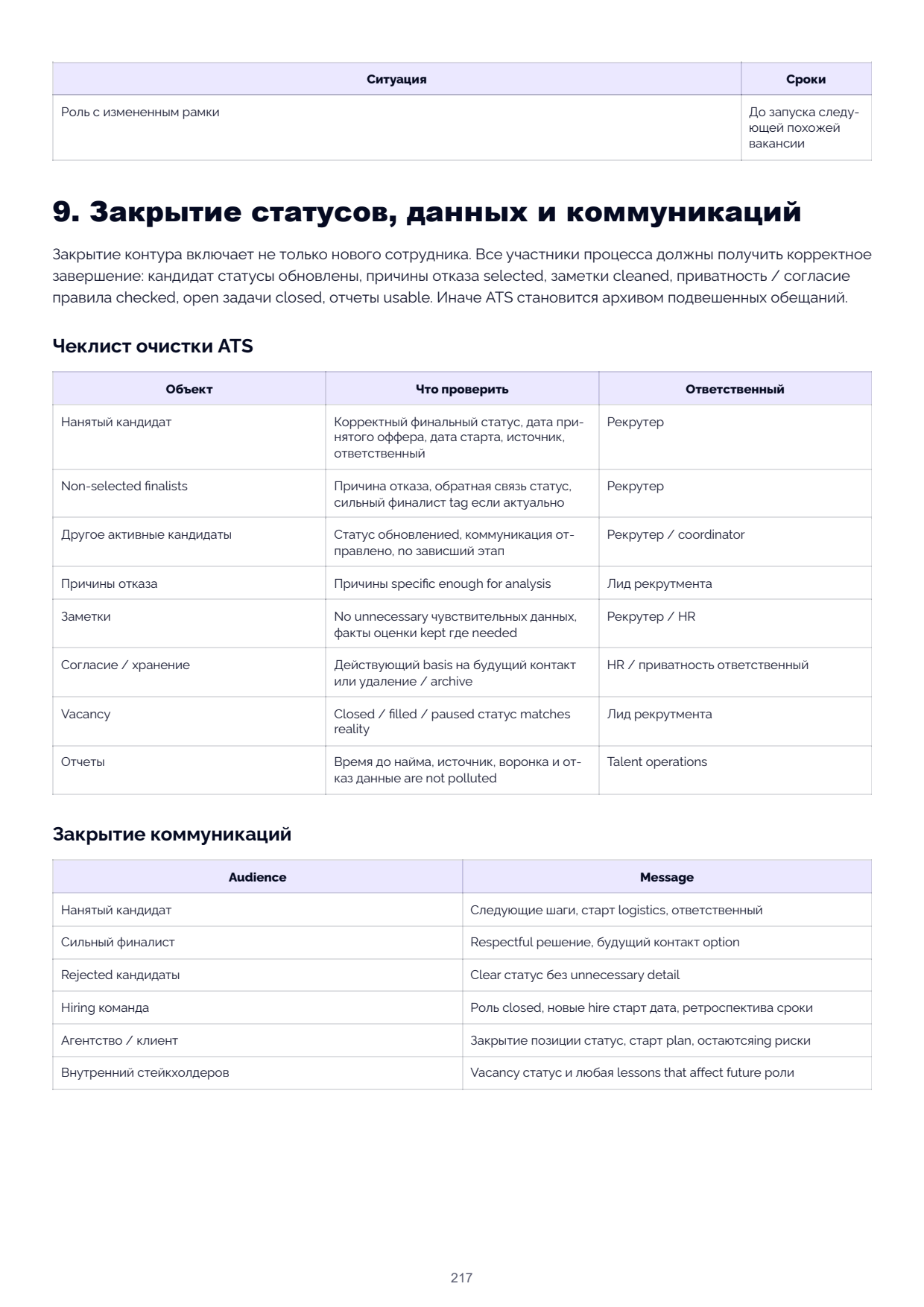
9. Closing statuses, data, and communications
Closing the loop goes beyond the new hire. All participants in the process must receive proper closure: candidate statuses updated, rejection reasons selected, notes cleaned, privacy / consent rules checked, open tasks closed, reports made usable. Otherwise ATS becomes an archive of hanging promises. ATS clean-up checklist
| Item | What to check | Responsible person |
| Hired candidate | Correct final status, accepted-offer date, start date, source, responsible person | Recruiter |
| Non-selected finalists | Rejection reason, feedback status, strong-finalist tag if applicable | Recruiter |
| Other active candidates | Status updated, communication sent, no lingering stage | Recruiter / coordinator |
| Rejection reasons | Reasons specific enough for analysis | Recruitment lead |
| Notes | No unnecessary sensitive data; assessment facts kept where needed | Recruiter / HR |
| Consent / retention | Valid basis for future contact or deletion / archive | HR / privacy owner |
| Vacancy | Closed / filled / paused status matches reality | Recruitment lead |
| Reports | Time-to-hire, source, funnel, and rejection data are not corrupted | Talent operations |
| Closing communications | ||
| Audience | Message | |
| Hired candidate | Next steps, start logistics, responsible person | |
| Strong finalist | Respectful decision, future-contact option | |
| Rejected candidates | Clear status without unnecessary detail | |
| Hiring team | Role closed, new hire start date, retrospective timeframe | |
| Agency / client | Placement status, start plan, remaining risks | |
| Internal stakeholders | Vacancy status and any lessons that affect future roles |
10. How to measure preboarding and closing the loop
The metrics in Chapter 12 must answer the question: does the accepted offer turn into a successful start, and does the
hiring system learn after the role is closed? Counting hires is not enough. You need to look at
conversion from accepted offer to start, launch readiness, post-offer non-start rate, time to start, candidate
communication, and retrospective completion.
Metrics and formulas
Metric Formula What it shows How to use it
Start rate Started hires / accepted What proportion of accepted Check preboarding and non-
offers offers turned into starts start risks
Post-offer non-start rate Non-starts after offer / Analyse counter-offers, silence,
accepted offers Losses between acceptance and start documents
Time-to-start Start date minus accepted- Length of the preboarding period Plan the risk-management
offer date cadence
Launch readiness Completed readiness First-day readiness Manage HR / IT / manager
completion items / mandatory items tasks
First-week blocker rate Hires with critical blockers / Quality of preparation Fix access, equipment,
started hires manager plan
Strong finalist retention rate Future-fit finalists Future-fit finalists Is the warm pipeline being Improve the talent pipeline
documented / eligible finalists retained?
Loop-closing rate Closed tasks / mandatory Process completion cleanliness Monitor ATS and
closing tasks communications
Retrospective completion rate Completed retrospectives Is the system learning? Embed continuous
/ closed priority roles improvement
Misinterpretations
Poor interpretation Better interpretation
"Post-offer non-start means the candidate is unreliable" Check preliminary terms check, counter-offers, silence,
documents, and changed conditions
"Day one is HR's problem; recruitment is already done" The recruiter is responsible for context-handover quality until
responsibility is explicitly transferred
"No need for a retro; the role is closed" A closed role provides data for the next role
"Strong finalists are a nice-to-have" Finalists can reduce the cost of unfilled vacancies for
future roles
11. Using HarmonyATS as an example
Using HarmonyATS as an example, Chapter 12 treats the ATS as a facts layer: stage, candidate status, notes, source,
rejection reason, time-to-hire, candidate movement, and vacancy state. It is important not to turn the system into bureaucracy. Only fields that help retain the person, avoid corrupting analytics, and preserve
lessons are needed.
HarmonyATS element How to use it Caution
Candidate status Accepted, hired, declined, post-offer Status must reflect reality
non-start, rejected, future-fit
| HarmonyATS element | How to use it | Caution |
|---|---|---|
| roles | ||
| Stage / movement | See the transition from accepted offer → preboarding → start, if configured | Do not create extra stages without accountability |
| Time-to-hire report | Understand the journey from candidate entry to accepted offer | Time to start requires a separate operational flag |
| Candidate movement report | Verify actual changes per candidate | Use alongside notes |
| Rejection report | Analyse final rejection reasons | The reason must be specific |
| Vacancy report | See closed or active roles | Vacancy status must be updated after hire |
| Consent report | Verify future-contact consent for strong finalists | Do not retain a future pipeline without justification |
| Field | Instruction |
|---|---|
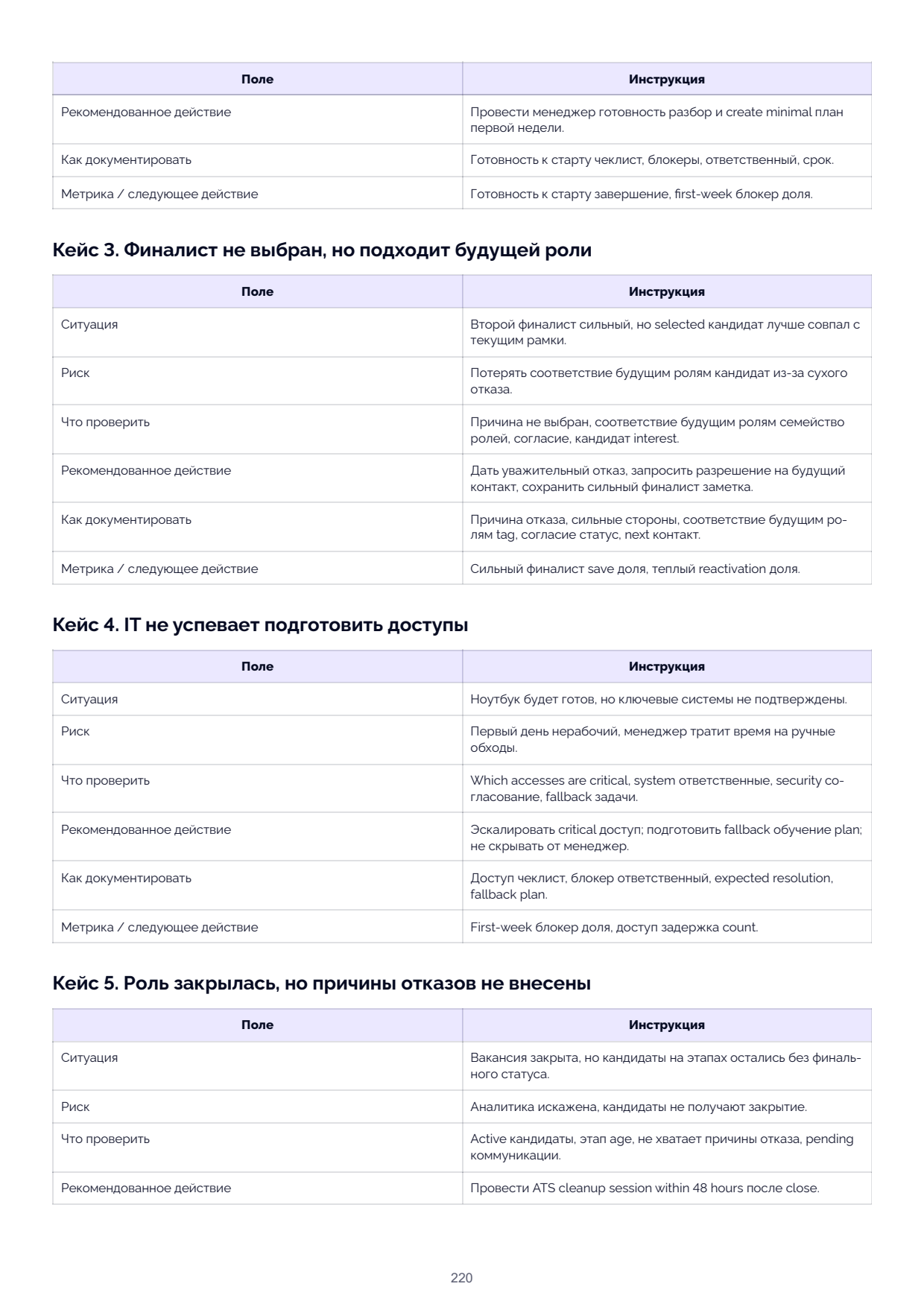
| Recommended action | Run a manager readiness review and create a minimal first-week plan. |
| How to document | Launch readiness checklist, blockers, responsible person, deadline. |
| Metric / next action | Launch readiness completion, first-week blocker rate. |
| Case 3. Finalist not selected but suitable for a future role | |
| Field | Instruction |
| Situation | The second finalist is strong, but the selected candidate was a better fit for the current scope. |
| Risk | Losing a future-fit candidate due to a blunt rejection. |
| What to check | Reason for non-selection, future-fit role family, consent, candidate interest. |
| Recommended action | Give a respectful rejection, request permission for future contact, save a strong-finalist note. |
| How to document | Rejection reason, strengths, future-fit role tag, consent status, next contact. |
| Metric / next action | Strong finalist retention rate, warm reactivation rate. |
| Case 4. IT cannot prepare access in time | |
| Field | Instruction |
| Situation | The laptop will be ready, but key systems are not confirmed. |
| Risk | Day one is non-productive, the manager spends time on manual workarounds. |
| What to check | Which accesses are critical, system owners, security approval, fallback tasks. |
| Recommended action | Escalate critical access; prepare a fallback training plan; do not hide it from the manager. |
| How to document | Access checklist, blocker owner, expected resolution, fallback plan. |
| Metric / next action | First-week blocker rate, access-delay count. |
| Case 5. Role closed but rejection reasons not entered | |
| Field | Instruction |
| Situation | The vacancy is closed, but candidates at various stages have no final status. |
| Risk | Analytics are corrupted, candidates do not receive closure. |
| What to check | Active candidates, stage age, missing rejection reasons, pending communications. |
| Recommended action | Run an ATS clean-up session within 48 hours of closure. |
| Field | Instruction |
|---|---|
| How to document | Updated statuses, reasons, sent messages, vacancy-closure note. |
| Metric / next action | Loop-closing rate, candidates without a next action. |
| Case 6. Agency placement at risk during the warranty period | |
| Field | Instruction |
| Situation | The candidate started through the agency but reports a mismatch in expectations within a week. |
| Risk | Early departure, warranty-period re-placement, client conflict. |
| What to check | What was promised, what changed, manager support, role scope, onboarding blockers. |
| Recommended action | Run a three-way fact-based check if appropriate; separate onboarding issues from true mismatch. |
| How to document | Candidate concern, client response, agreed action, warranty-period risk note. |
| Metric / next action | Early attrition, warranty-period cases, role-realism issues. |