Chapter 4. Screening and Qualification

How to use this chapter
A working scenario. The recruiter spoke with a candidate for fifteen minutes and wrote to the manager: "Generally good, worth progressing." At the interview it turned out the candidate was not ready for a hybrid schedule, expected a different salary range, had not worked with the right type of clients, and was in fact treating the role as a temporary option. The manager is frustrated: "Why did we waste an hour?" The candidate is also frustrated: important conditions surfaced too late.
What actually broke here: screening happened as a pleasant chat, but not as first-
qualification. The team did not check basic role fit, motivation, pay expectations, availability, constraints, process risks and initial assessment evidence.
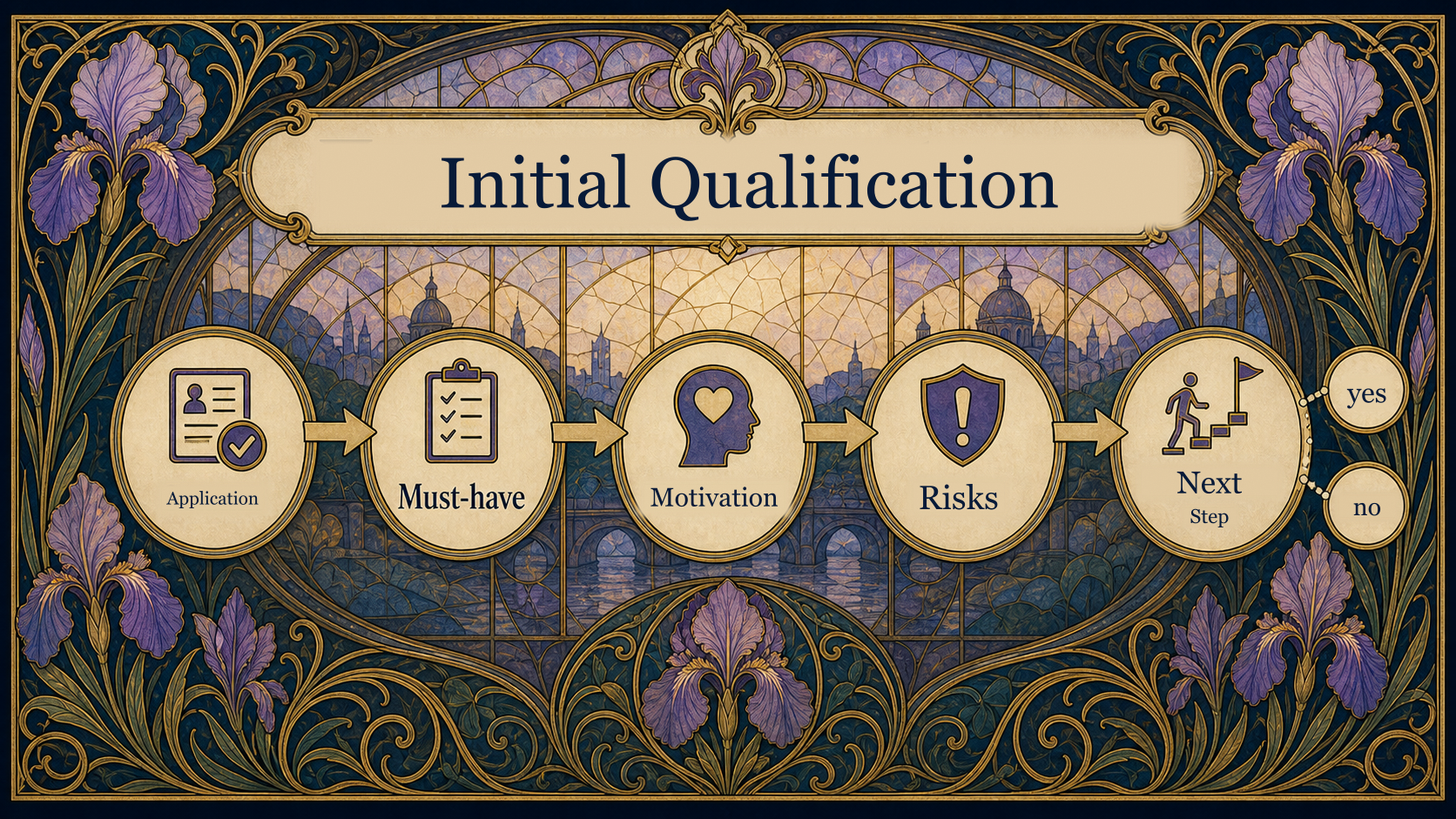
A good screening is not a mini-interview and not a secret exam. It is a short check that helps choose a clear next step: advance the candidate, honestly stop the process, clarify data, pass to an interview with specific risks, or return to the role criteria.
Read this chapter as a working module for the recruiter, hiring manager, agency consultant and recruitment lead. If you need to implement the process quickly, start with the script, notes rules and SOP. If managers receive CVs without context, use the CV template from the reference guide. If screening is too rigid or too soft, look at the sections on assessment facts, metrics and cases. If you use AI, take the prompts only together with a human-check checklist.
Remember in one sentence: screening does not decide the candidate's fate — it protects the next step from
randomness.
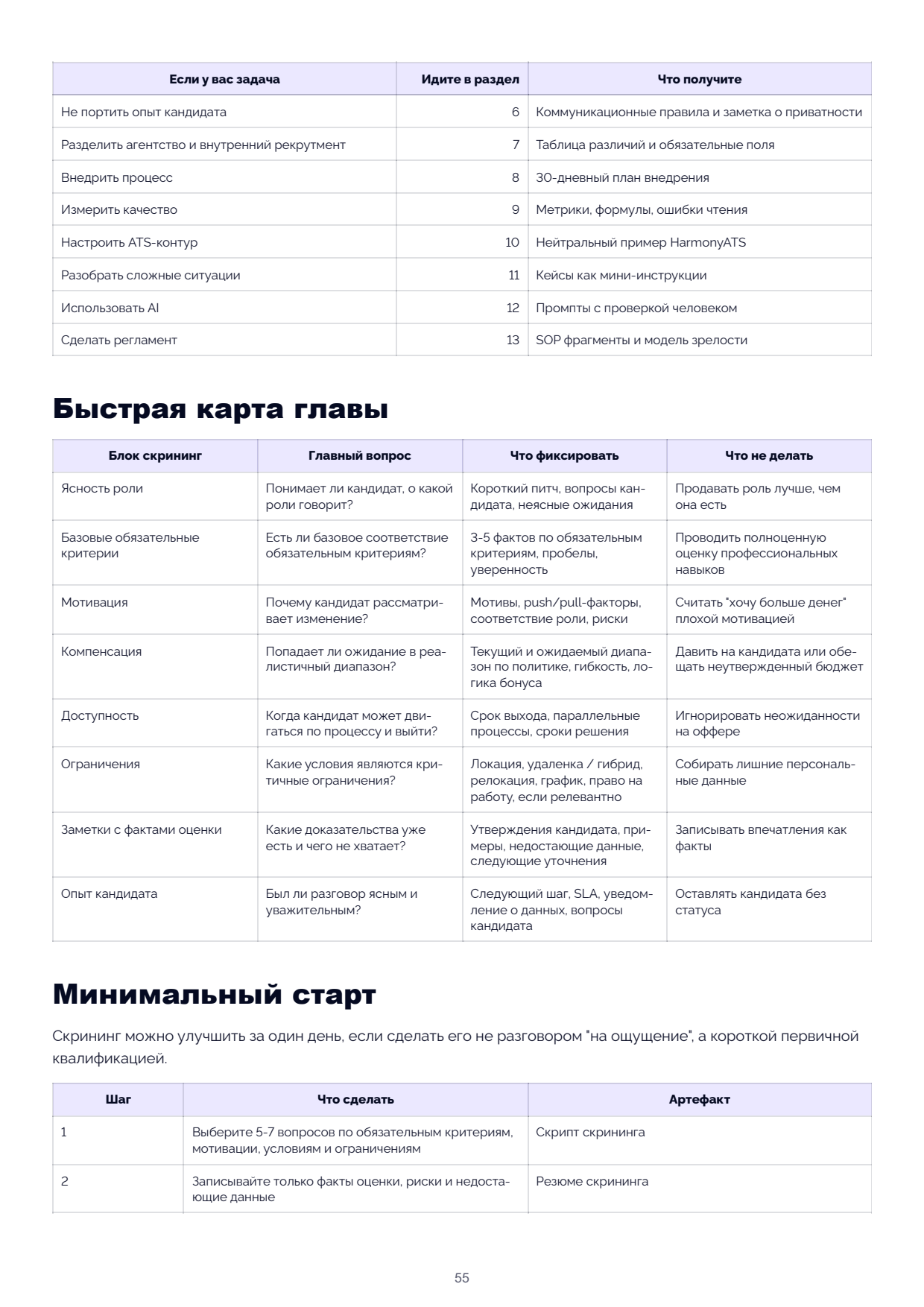
| If your task is | Go to section | What you will get |
|---|---|---|
| Explain what screening is | 1 | Stage boundaries and difference from interviews |
| Create a call structure | 2–3 | Script, timing, mandatory blocks |
| Check motivation and conditions | 4 | Questions on motivation, compensation, availability and constraints |
| Write notes without assumptions | 5 | Evidence-based CV rules |
| Protect candidate experience | 6 | Communication rules and privacy note |
| Separate agency and in-house screening | 7 | Differences table and mandatory fields |
| Implement the process | 8 | 30-day implementation plan |
| Measure quality | 9 | Metrics, formulas, reading errors |
| Set up the ATS layer | 10 | Neutral HarmonyATS example |
| Handle complex situations | 11 | Mini-instruction case studies |
| Use AI | 12 | Prompts with human checks |
| Create a procedure | 13 | SOP fragments and maturity model |
Minimum start
Screening can be improved in a single day if you turn it from a "gut feel" conversation into a short first-qualification call.
Step What to do Artifact
1 Choose 5–7 questions on must-have criteria, Screening script
motivation, conditions and constraints
2 Record only assessment facts, risks and missing Screening summary
data
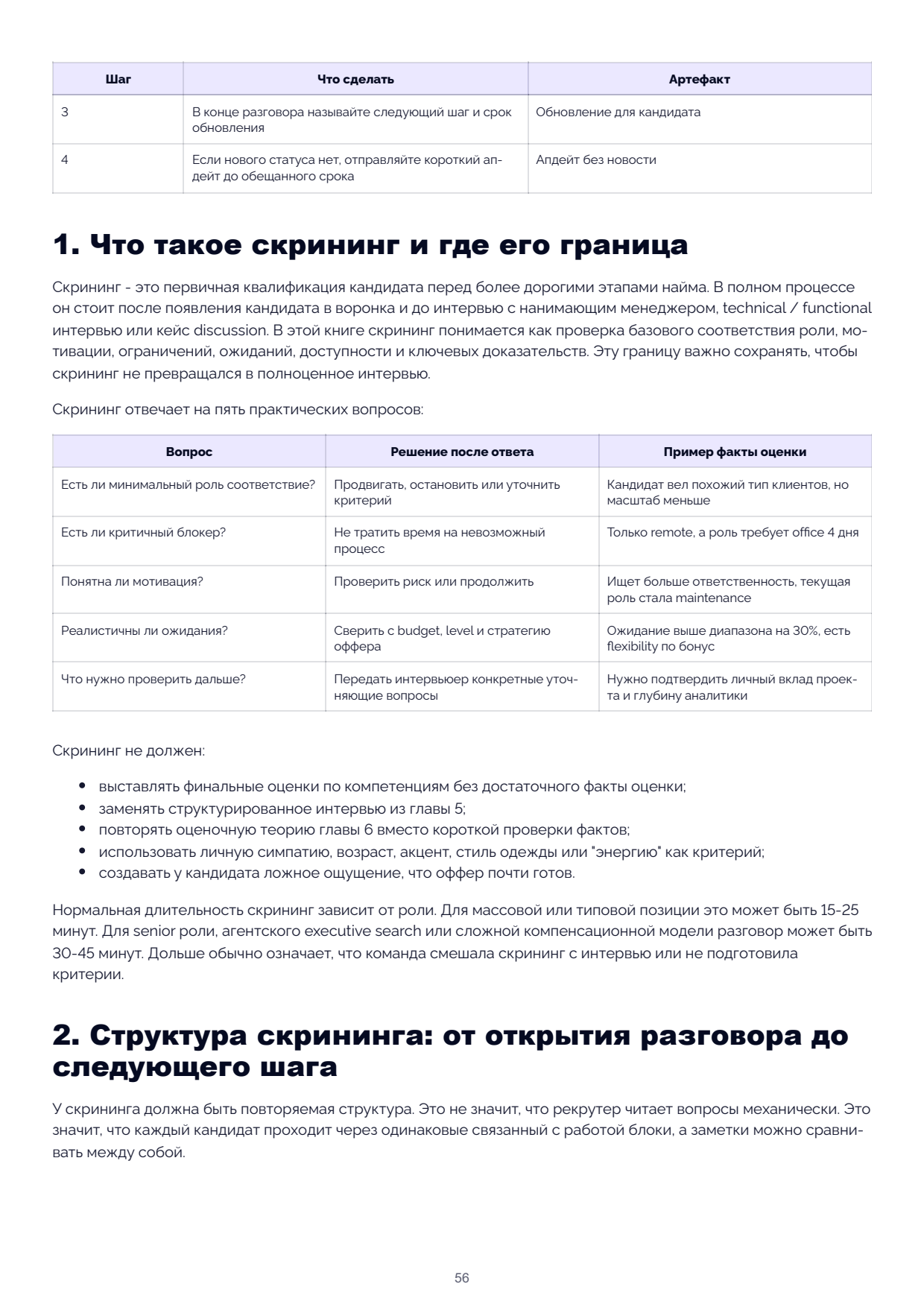
| Step | Action | Artifact |
|---|---|---|
| 3 | At the end of the call, state the next step and the update deadline | Candidate update |
| 4 | If there is no new status, send a brief update before the promised deadline | Update with no news |
1. What screening is and where its boundary lies
Screening is the first qualification of a candidate before more expensive hiring stages. In a full process, it sits after the candidate appears in the funnel and before the hiring manager interview, technical / functional interview or case discussion. In this book, screening is understood as a check of basic role fit, motivation, constraints, expectations, availability and key evidence. It is important to preserve this boundary so that screening does not turn into a full interview. Screening answers five practical questions:
| Question | Decision after answering | Example assessment fact |
| Is there a minimum role fit? | Advance, stop or refine the criterion | Candidate managed a similar client type but at a smaller scale |
| Is there a critical blocker? | Do not waste time on an impossible process | Remote only, but the role requires 4 days in the office |
| Is the motivation clear? | Check the risk or continue | Looking for more responsibility, current role has become maintenance-heavy |
| Are expectations realistic? | Cross-check against budget, level and offer strategy | Expectation is 30% above the range; some flexibility on bonus |
| What needs to be verified next? | Pass the interviewer specific clarifying questions | Need to confirm personal project contribution and depth of analytics |
2. Screening structure: from opening the call to the
next step
Screening should have a repeatable structure. This does not mean the recruiter reads questions mechanically. It means every candidate passes through the same work-related blocks, and notes can be compared against each other.
| Call stage | Purpose | Example wording | Artifact |
|---|---|---|---|
| Opening and permission | Explain the format and get consent for the call | "I suggest 25 minutes: I will briefly share the role context, clarify your experience and expectations, then we will agree on the next step." | Call objective |
| Role context | Give an honest framing of the role | "The role involves mid-market clients, 2 days in the office, the first 90 days focus on onboarding stabilisation." | Candidate understanding |
| Must-have criteria baseline | Check 3–5 must-have criteria | "Tell me about a recent project where you were responsible for..." | Criterion assessment facts |
| Motivation | Understand drivers and risks | "What must be in the next role for the move to make sense for you?" | Motivation snapshot |
| Compensation | Cross-check expectations | "What range are you considering and how is it structured: base, bonus, internal equity, benefits?" | Compensation snapshot |
| Availability and process | Understand timelines | "Which processes are you already running and by when do you need to make a decision?" | Decision timelines |
| Constraints | Identify critical constraints | "Are there conditions under which you would not consider an offer?" | Constraints |
| Candidate questions | Check clarity and show respect | "What questions about the role or the process are important to discuss now?" | Questions / risks |
| Closing and next step | Align expectations | "I will log the summary and come back to you by [date] with an update / the next stage." | Next action, SLA |

3. Basic must-have criteria: what to check
at first qualification
Must-have criteria at screening are not the full assessment scorecard. At this stage it is enough to check criteria without which the next stage is almost always a waste of time. If a criterion requires deep professional assessment, screening only notes the direction and passes a targeted probe to the interview.
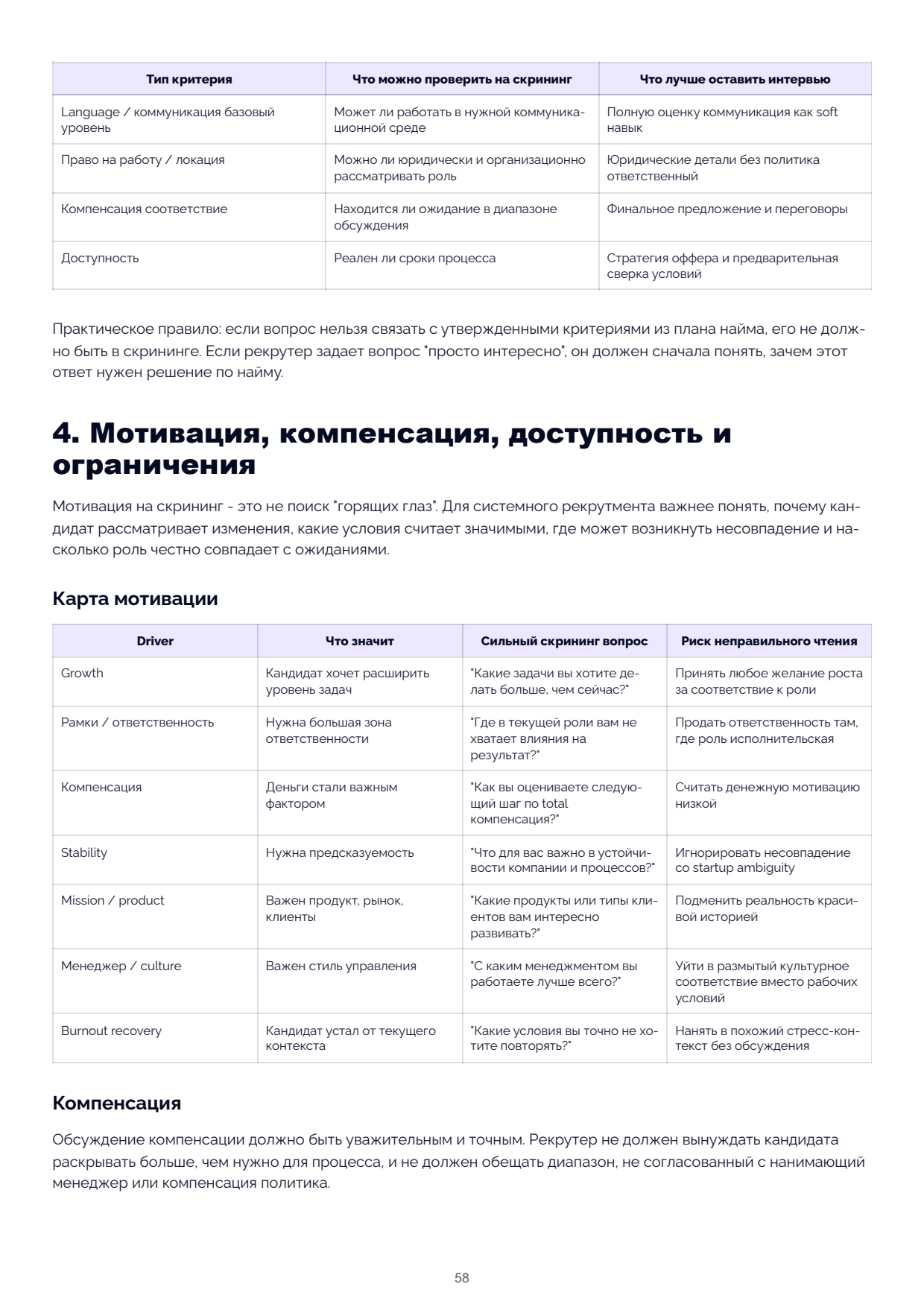
Criterion type What can be checked at screening What is better left to the interview
Domain experience Has the candidate worked with a similar market, Decision depth and maturity quality
product, regulation, client type
Scale / complexity What scale of tasks has the candidate faced Level of autonomy and trade-offs
Tool familiarity Has the candidate used a critical tool, if it is truly a Ability to design processes around the
must-have criterion tool
| Criterion type | What can be checked at screening | What is better left to the interview |
|---|---|---|
| Language / communication baseline | Can the person work in the required communication environment | Full assessment of communication as a soft skill |
| Right to work / location | Can the role be legally and organisationally considered | Legal details without a policy owner |
| Compensation alignment | Is the expectation within the discussion range | Final offer and negotiation |
| Availability | Is the process timeline realistic | Offer strategy and pre-offer alignment |
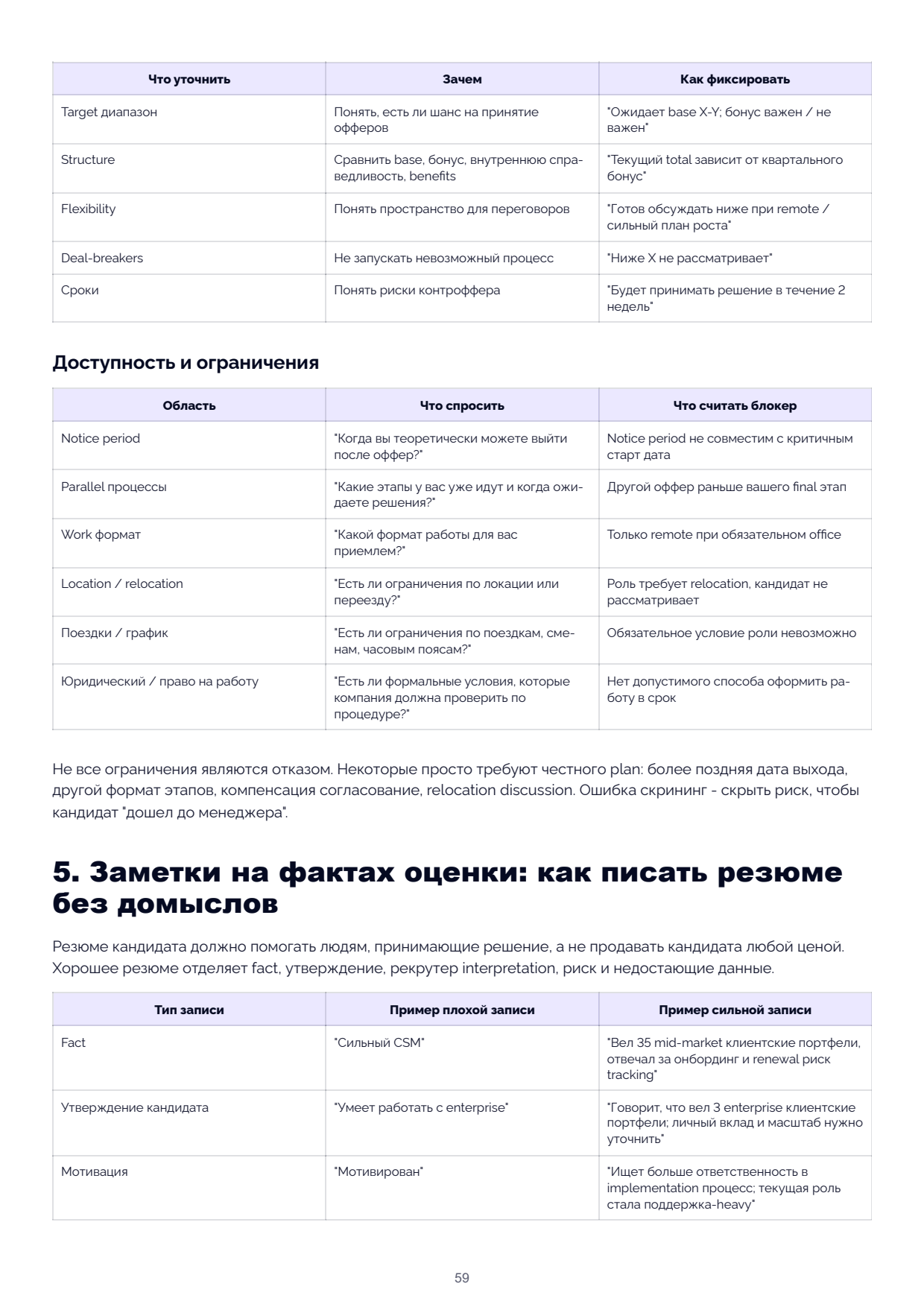
| What to clarify | Why | How to record |
|---|---|---|
| Target range | Understand if there is a chance of offer acceptance | "Expects base X-Y; bonus important / not important" |
| Structure | Compare base, bonus, internal equity, benefits | "Current total depends on quarterly bonus" |
| Flexibility | Understand the room for negotiation | "Willing to discuss lower if remote / strong growth plan" |
| Deal-breakers | Do not launch an impossible process | "Will not consider below X" |
| Timelines | Understand counter-offer risks | "Will make a decision within 2 weeks" |
| Availability and constraints | ||
| Area | What to ask | What counts as a blocker |
| Notice period | "When could you theoretically start after an offer?" | Notice period incompatible with critical start date |
| Parallel processes | "Which stages are you already in and when do you expect decisions?" | Another offer arriving before your final stage |
| Work format | "What working format is acceptable to you?" | Remote only when office is mandatory |
| Location / relocation | "Are there any location or relocation constraints?" | Role requires relocation; candidate not considering it |
| Travel / schedule | "Are there any constraints on travel, shifts, time zones?" | Mandatory role requirement is impossible |
| Legal / right to work | "Are there formal conditions the company must check by procedure?" | No permissible way to arrange employment on time |
5. Assessment-fact notes: how to write a summary
without assumptions
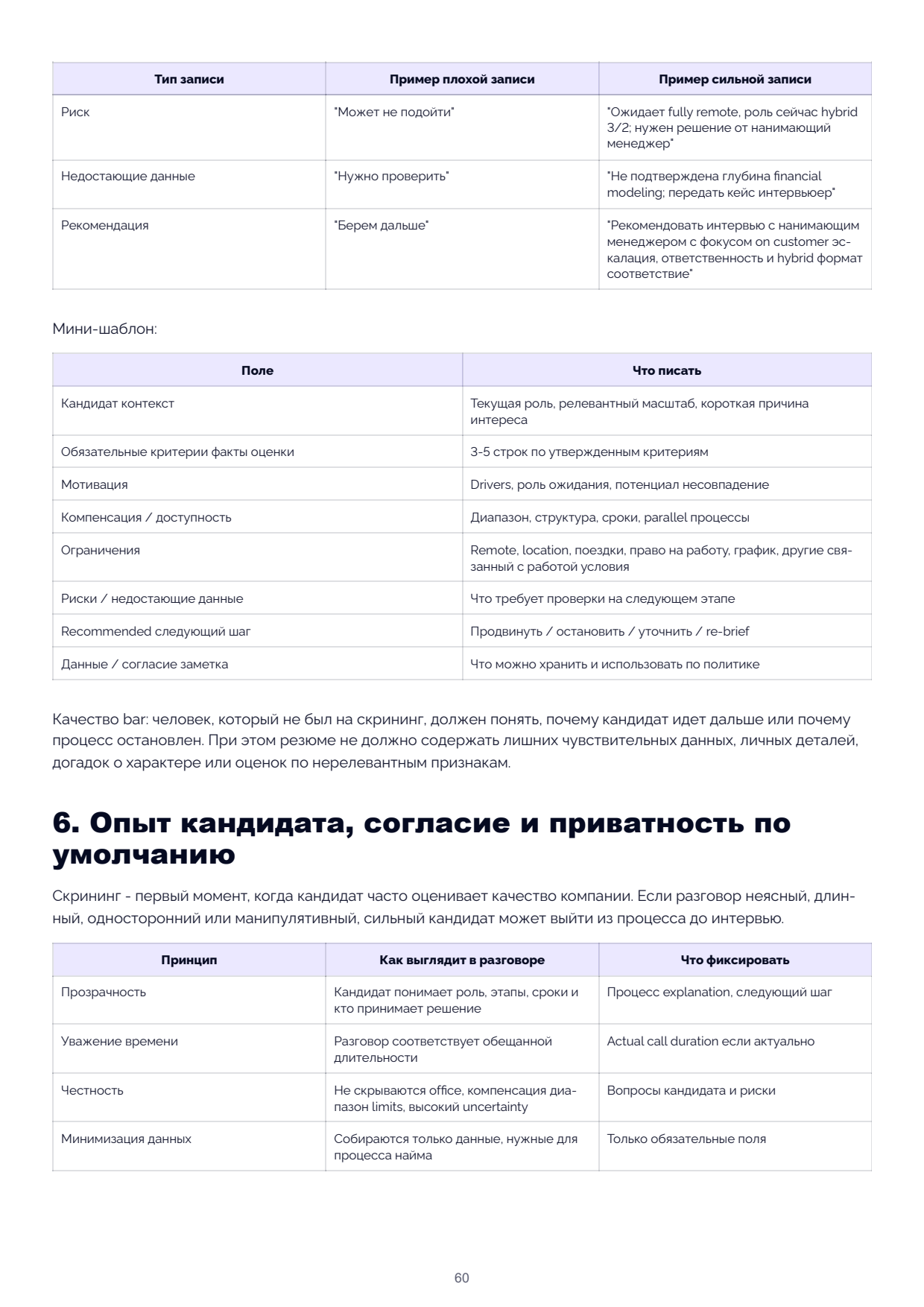
The candidate's summary must help decision-makers, not sell the candidate at any cost. A good summary separates fact, candidate statement, recruiter interpretation, risk and missing data.
Note type Bad example Strong example
Fact "Strong CSM" "Managed 35 mid-market client portfolios,
responsible for onboarding and renewal risk
tracking"
Candidate statement "Can handle enterprise clients" "Says they managed 3 enterprise client
portfolios; personal contribution and scale
need clarification"
Motivation "Motivated" "Looking for more responsibility in the
implementation process; current role has
become support-heavy"
| Note type | Bad example | Strong example |
|---|---|---|
| Risk | "May not be a fit" | "Expects fully remote; role is currently hybrid 3/2; decision needed from hiring manager" |
| Missing data | "Needs checking" | "Financial modelling depth not confirmed; pass to case-study interviewer" |
| Recommendation | "Progressing" | "Recommend hiring-manager interview focused on client escalation, accountability and hybrid format fit" |
| Mini-template: | ||
| Field | What to write | |
| Candidate context | Current role, relevant scale, brief reason for interest | |
| Must-have criteria assessment facts | 3–5 lines on the agreed criteria | |
| Motivation | Drivers, role expectations, potential misfit | |
| Compensation / availability | Range, structure, timelines, parallel processes | |
| Constraints | Remote, location, travel, right to work, schedule, other work-related conditions | |
| Risks / missing data | What requires checking at the next stage | |
| Recommended next step | Advance / stop / clarify / re-brief | |
| Data / consent note | What may be stored and used per policy |
6. Candidate experience, consent and privacy
by default
Screening is the first moment when the candidate often assesses the company's quality. If the conversation is unclear, long, one-sided or manipulative, a strong candidate may exit the process before the interview.
Principle How it looks in conversation What to record
Transparency Candidate understands the role, stages, Process explanation, next step
timeline and who makes decisions
Respect for time Call matches the promised duration Actual call duration if relevant
Honesty Office, compensation range limits and Candidate questions and risks
high uncertainty are not hidden
Data minimisation Only data needed for the hiring process Mandatory fields only
is collected
Principle How it looks in conversation What to record
Consent / lawful basis Agency obtains consent for Consent status or policy note
presentation; in-house recruitment follows its
own privacy policy
Feedback expectation Candidate understands when SLA and accountable person
there will be an update
For the agency, presentation consent is especially important: the candidate should understand which client they are being presented to, which materials are being shared and who will contact them next. For in-house recruitment, it is more important to explain the privacy notice, data storage, retention rules and the candidate's rights under company policy and local legislation.
This chapter is not legal advice. The practical rule from Chapter 1: collect only necessary data, restrict access, record the consent status and align storage with a legal or compliance officer. If jurisdiction, vendor terms or company policy do not permit using AI or storing certain data, the process must be adapted before screening begins.
7. Agency and in-house recruitment: different
risks of the same stage
Screening in an agency and in-house recruitment is similar in structure but differs in accountability and documentation.
Area Agency version In-house recruitment version
Primary goal Prepare a quality shortlist and Prepare hiring-manager-ready CVs
client-ready CVs and next steps
Additional consent Presentation consent, consent to share Consent / lawful-basis notification and
data with the client candidate data processing per company policy
Key risk Sending a candidate to the client without Passing a CV to the manager without
motivation, expectations or consent context, causing screening to be repeated
What to record Motivation, expectations, consent, Assessment facts, risks, compensation,
shortlist match, client-specific availability, stage recommendation
constraints
Communication Candidate must understand who the Candidate must understand the company,
client is and how the agency represents stages and the process owner
their interests
Quality metrics Shortlist-to-interview conversion, Screening-to-interview conversion, first
client feedback quality, candidate drop-off interview rejection reasons, manager
satisfaction
The agency must not turn screening into a sales pitch at any cost. In-house recruitment must not turn screening into an internal bureaucratic filter. In both cases, the recruiter is responsible for data accuracy, respectful communication and passing to decision-makers only supported assessment facts.
8. How to implement screening in 30 days
Week Actions Owner Output
1 Choose 2–3 active roles for the pilot; Recruitment lead + hiring Screening criteria one-pager
list baseline must-have criteria; manager
remove irrelevant questions
| Week | Actions | Owner | Output |
|---|---|---|---|
| 1 | Agree the minimum script and candidate summary template | Recruiter owner | Script v1 |
| 2 | Run 5–10 screenings with the new structure; collect sample notes | Recruiters | Sample summaries |
| 2 | Check which questions give useful signals and which create noise | Recruiter + HM | Updated script |
| 3 | Configure ATS fields / notes format / rejection reasons | Recruitment ops | Data capture rules |
| 3 | Train hiring managers to read CVs and not repeat screening | Recruitment lead | HM briefing |
| 4 | Compare pass-through, first-interview rejections, missing data | Recruitment lead | Pilot report |
| 4 | Approve SOP, SLA and debrief rhythm | HRD / lead | Screening SOP |
9. How to measure that screening works
Metric Formula What it shows Risk of misuse
Screening-to-interview Candidates who progressed to interview / all Chasing high conversion and
conversion candidates after screening screening out weak candidates
Rejection after first Rejected after first interview / candidates How much screening skips Blaming the recruiter without
interview after screening criteria and interviewer behaviour analysing criteria
Missing data share CVs with empty mandatory fields / all Notes quality Making a field mandatory even
CVs though it is not needed for the decision
Candidate decline after Candidates who declined after screening / Considering all declines a
screening candidates after screening role clarity, competitive match, recruiter failure
candidate experience
Compensation mismatch Rejections due to compensation / Budget and salary realism Pressuring candidates instead of
share candidates after screening communication reviewing the range
SLA to next step Update date – screening date Process speed Updating status without a real
decision
CV usefulness rating HM-rated useful CVs / CVs checked Does the CV help avoid Turning the assessment into a
repeating screening subjective recruiter judgement
without criteria
The best screening audit is not just numbers. Every 2–4 weeks the recruitment lead should take a sample of summaries and verify:
whether assessment facts are linked to criteria;
whether facts are separated from interpretation;
whether there are forbidden or irrelevant traits;
whether there is a next step and an owner;
whether screening risks match rejection reasons at later stages.
10. HarmonyATS example
Using HarmonyATS, screening summaries can be stored in notes and structured candidate-card fields: motivation, compensation snapshot, availability, constraints, assessment facts on must-have criteria, missing data and the recommended next step. This is an example of a working layer, not a mandatory implementation method.
Using HarmonyATS, the rejection report helps you see which rejection reasons appear after screening and after the first interview. If "skills gap" on one must-have criterion keeps repeating after the first interview, the screening script needs refinement.
Using HarmonyATS, the Funnel with details and candidate movement report can be used to check stage conversion and movement. If candidates remain after screening for a long time without a next action, the problem is not in sourcing but in SLA or owner discipline.
Using HarmonyATS, the data consent report and personal data consent module are useful as a control layer: which candidates have valid consent, where data retention has expired, who must not receive mass requests. This is especially important for warm-pool candidates and agency presentations.
End-to-end example: screening summary
Field BDM in B2B SaaS payments Backend Engineer
CV match 4 years B2B SaaS sales/BD, managed mid-market 5 years backend, last 2 years in a product
client portfolios, can describe qualification team with API and async jobs. Has work
logic. Knows the payments domain accountability, participated in incident
at a surface level but provided a strong reviews. No direct payments experience but
example of rapid learning in a new domain. has experience integrating with billing.
Assessment facts Described qualification: ICP match –> pain / Described the idempotency problem in
urgency –> buying process –> technical or webhook processing, adding monitoring and
compliance blocker –> next step. Gave a post-release checklist. Explained the
breakdown of a lost deal and message trade-off between a quick fix and schema
changes. migration.
Risks No direct payments orchestration experience; Need to check system design for a payments
need to verify trainability in the payments scenario and code-quality depth on the
domain and stakeholder communication with example.
finance/product.
| Field | BDM in B2B SaaS payments | Backend Engineer |
|---|---|---|
| Motivation | Interested in complex product and segment strategy; expects a transparent productivity ramp plan and realistic OTE. | Interested in reliable backend systems, payments APIs and responsible data handling. |
| Recommendation | Advance to hiring-manager interview, but provide targeted clarifying questions on the payments domain and funnel discipline. | Advance to technical screen and system design interview. |
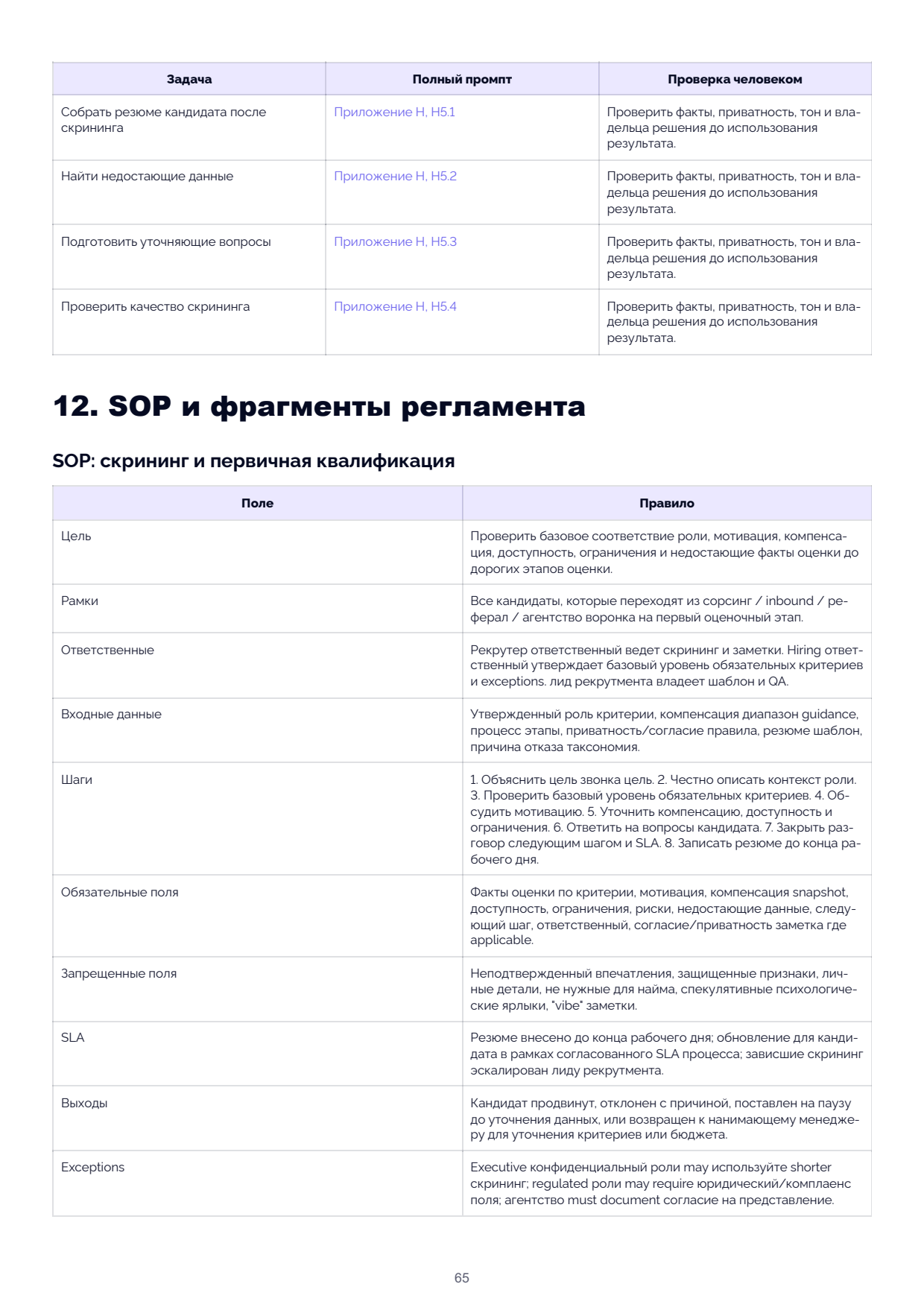
| Task | Full prompt | Human check |
|---|---|---|
| Compile candidate summary after screening | Appendix H, H5.1 | Check facts, privacy, tone and decision owner before using the output. |
| Find missing data | Appendix H, H5.2 | Check facts, privacy, tone and decision owner before using the output. |
| Prepare clarifying questions | Appendix H, H5.3 | Check facts, privacy, tone and decision owner before using the output. |
| Audit screening quality | Appendix H, H5.4 | Check facts, privacy, tone and decision owner before using the output. |
| 12. SOP and procedure fragments. SOP: screening and first qualification | ||
| Field | Rule | |
| Objective | Check basic role fit, motivation, compensation, availability, constraints and missing assessment facts before expensive assessment stages. | |
| Scope | All candidates moving from sourcing / inbound / referral / agency funnel to the first assessment stage. | |
| Owners | Recruiter owner conducts screening and notes. Hiring owner confirms baseline must-have criteria and exceptions. Recruitment lead owns the template and QA. | |
| Inputs | Approved role criteria, compensation range guidance, process stages, privacy / consent rules, CV template, rejection reason taxonomy. | |
| Steps | 1. Explain the call objective. 2. Honestly describe the role context. 3. Check baseline must-have criteria. 4. Discuss motivation. 5. Clarify compensation, availability and constraints. 6. Answer candidate questions. 7. Close the call with the next step and SLA. 8. Log the summary by end of business day. | |
| Mandatory fields | Criterion assessment facts, motivation, compensation snapshot, availability, constraints, risks, missing data, next action, owner, consent / privacy note where applicable. | |
| Prohibited fields | Unconfirmed impressions, protected traits, personal details unnecessary for hiring, speculative psychological labels, "vibe" notes. | |
| SLA | Summary logged by end of business day; candidate update within the agreed process SLA; stalled screenings escalated to the recruitment lead. | |
| Outputs | Candidate advanced, rejected with reason, placed on pause pending data clarification, or returned to the hiring manager for criteria or budget clarification. | |
| Exceptions | Executive confidential roles may use shorter screening; regulated roles may require legal / compliance fields; agency must document presentation consent. |
3. Check baseline must-have criteria. 4. Discuss
motivation. 5. Clarify compensation, availability and
constraints. 6. Answer candidate questions. 7. Close the call
with the next step and SLA. 8. Log the summary by end of
business day.
Mandatory fields Criterion assessment facts, motivation, compensation snapshot,
availability, constraints, risks, missing data, next action,
owner, consent / privacy note where applicable.
Prohibited fields Unconfirmed impressions, protected traits, personal details
unnecessary for hiring, speculative psychological labels,
"vibe" notes.
SLA Summary logged by end of business day; candidate update
within the agreed process SLA; stalled screenings escalated to
the recruitment lead.
Outputs Candidate advanced, rejected with reason, placed on pause
pending data clarification, or returned to the hiring manager
for criteria or budget clarification.
Exceptions Executive confidential roles may use shorter
screening; regulated roles may require legal / compliance
fields; agency must document presentation consent.
| Field | Rule |
|---|---|
| Metrics | Screening-to-interview conversion, first-interview rejection reasons, missing data share, post-screening declines, SLA to next step. |
| Procedure fragment for the corporate knowledge base |
What to take from this chapter / where to go next
What you need Where to find it
Terms and short definitions Appendix B. Mini-glossary
Ready-made procedures and SLA Appendix D. Ready-made procedures and processes
Working templates Appendix E. Template library
BDM and Backend end-to-end examples Appendix F. BDM and Backend end-to-end cases
Full AI prompts for this chapter Appendix H. AI prompt library, section H5. Screening and
candidate summaries
In short: this chapter covers screening and first qualification. If you need a ready-made artefact, take it from the appendices and leave the application logic in the chapter.