Chapter 5. Interview Process
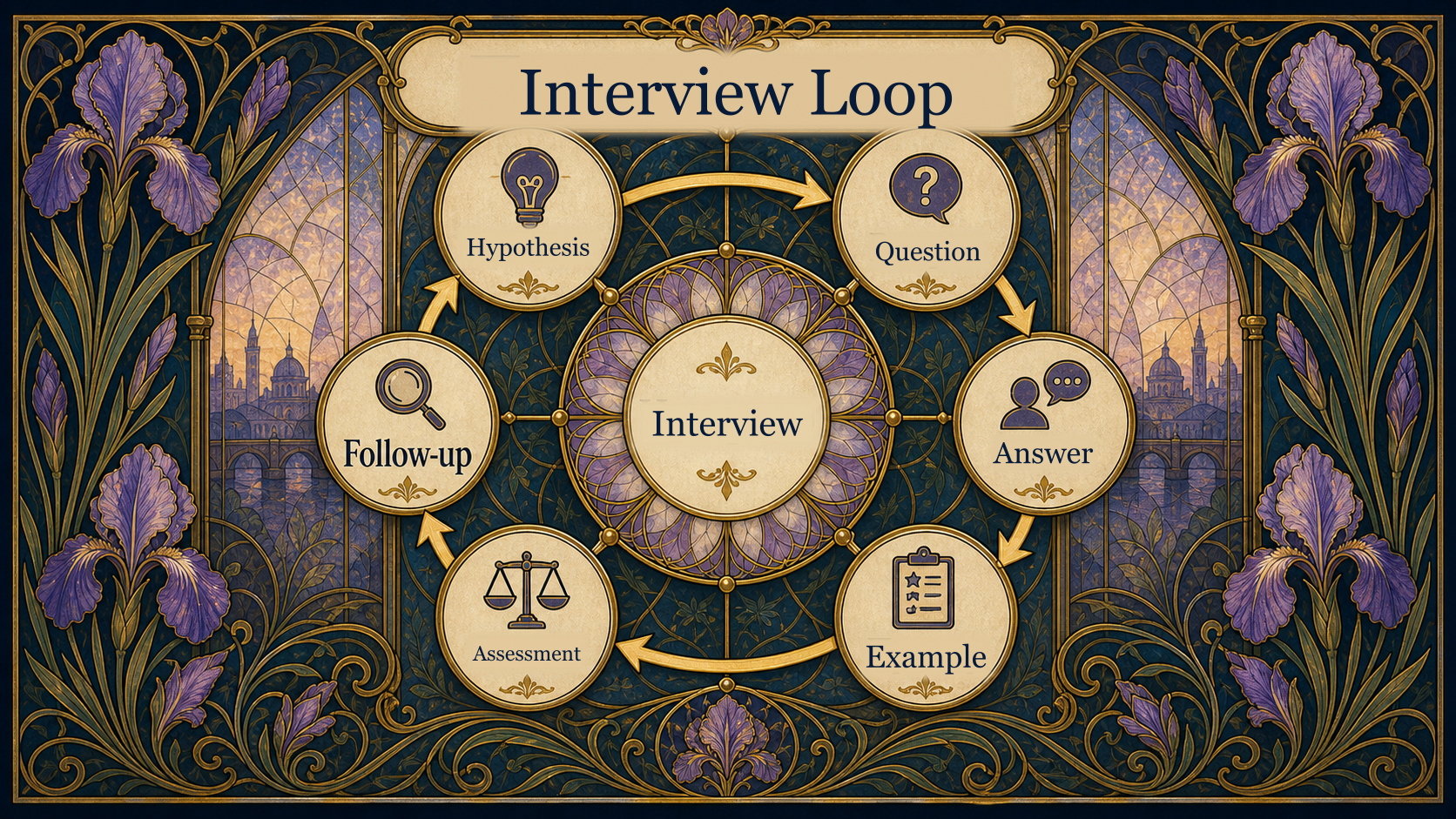

How to use this chapter
Working scenario. A candidate has completed four interviews. At the debrief, the first interviewer says the candidate
is "strong on communication", the second says "there wasn't enough depth", the third asked almost the same questions as the first,
and the fourth wasn't even assessing the right criterion. The team has plenty of opinions but few facts. The candidate is tired,
the hiring manager is uncertain, and the recruiter has nothing to put towards the decision beyond impressions.
What actually went wrong here: the interviews were meetings, but not a system for gathering assessment facts. To
make interviews support decision-making, each stage must check its own criterion, each interviewer must
understand their area, and the debrief must discuss facts rather than likeability.
This chapter does not repeat all the theory on candidate assessment from Chapter 6. That chapter covers professional
skills, behavioural skills, motivation, signal reliability, scorecards and scale anchors in detail. The focus here is different:
how to design an interview cycle, assign areas between interviewers, prepare behavioural and
situational questions, run a panel interview without voting on impressions, conduct a debrief and
honestly pass assessment facts to the decision-maker.
Use this chapter as a self-contained working module: it contains a process map, role tables, templates,
prompts, SOP snippets, case studies and a maturity model. If you need a quick implementation, use sections 2, 4, 8, 13 and
the desk reference. If you need to train interviewers, use sections 3, 5, 6, 7 and the case studies.
Remember in one phrase: a good interview does not start with a question to the candidate, but with the criterion that
question is designed to assess.
| If your task is | Go to section | What you will get |
|---|---|---|
| Explain the interview process | 1 | Boundaries and purpose of the interview cycle |
| Design the stages | 2 | Interview cycle map and stage objectives |
| Prepare a structured interview | 3 | Criterion-question-assessment fact model |
| Use behavioural questions | 4 | STAR without mechanical interrogation |
| Use situational questions | 5 | Role-realistic scenarios and scales |
| Run a panel interview | 6 | Rules for no impression-based voting |
| Assign interviewer roles | 7 | Interviewer roles and context handover |
| Implement the process | 8 | Implementation plan |
| Measure quality | 9 | Interview quality metrics |
| Configure the ATS workflow | 10 | Neutral HarmonyATS example |
| Work through complex cases | 11 | Case study tables as mini-guides |
| Use AI | 12 | Prompts with human oversight |
| Create an SOP | 13 | Procedure snippets |
| Assess maturity | 14 | Maturity model |
Minimum starting point
If interviews are already running but quality is inconsistent, start not by training everyone, but by introducing one standardised
cycle.
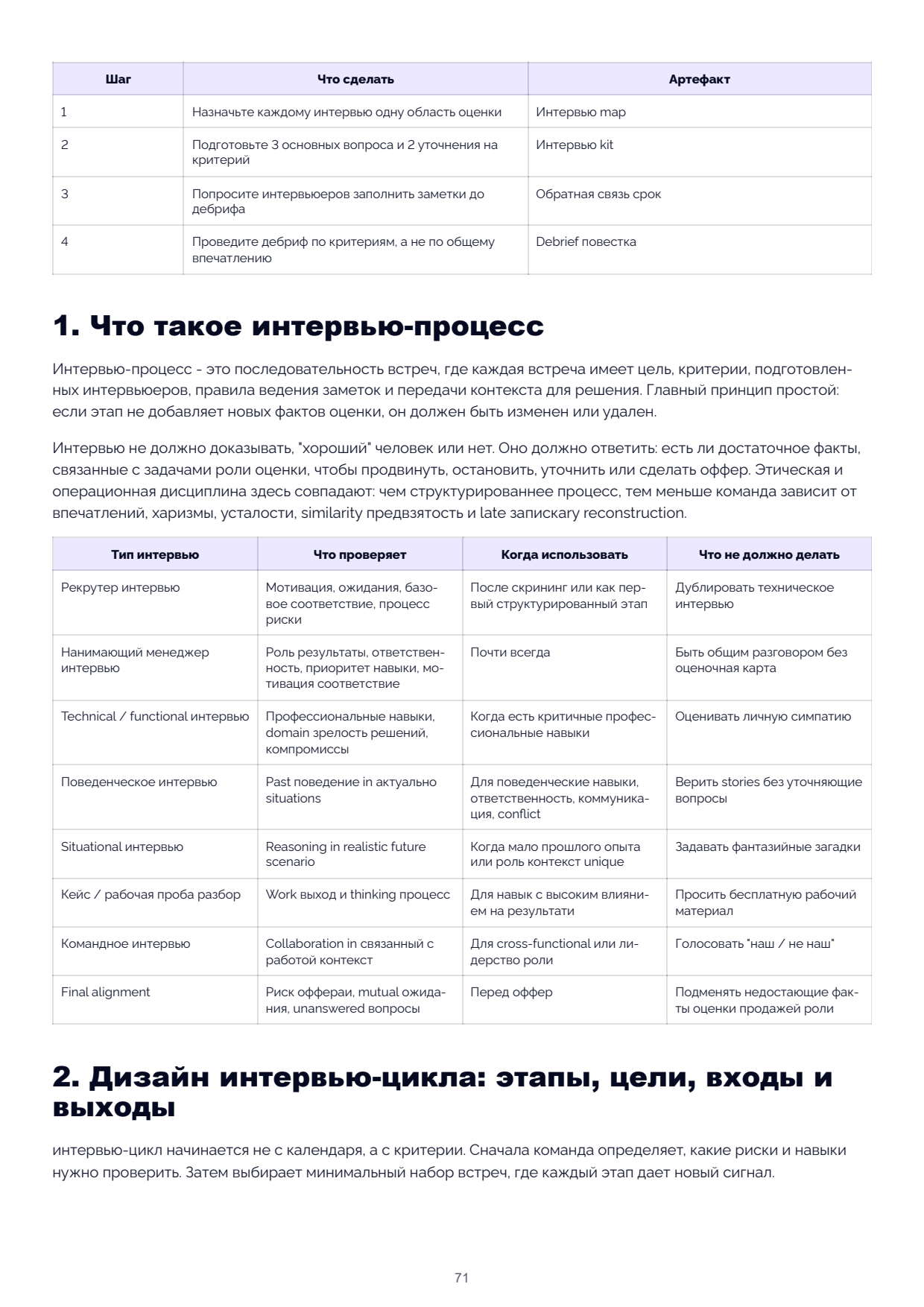
| Step | What to do | Artifact |
|---|---|---|
| 1 | Assign each interview one assessment area | Interview map |
| 2 | Prepare 3 core questions and 2 follow-ups per criterion | Interview kit |
| 3 | Ask interviewers to complete notes before the debrief | Feedback deadline |
| 4 | Run the debrief by criteria, not by overall impression | Debrief agenda |
1. What is the interview process
The interview process is a sequence of meetings where each meeting has a purpose, defined criteria, prepared interviewers, rules for note-taking and context handover for decision-making. The core principle is simple: if a stage does not add new assessment facts, it should be changed or removed. An interview should not prove whether someone is a "good person". It should answer: are there sufficient facts related to the role's tasks to progress, pause, clarify, or make an offer? Ethical and operational discipline align here: the more structured the process, the less the team depends on impressions, charisma, fatigue, similarity bias and late-recorded recollections.
| Interview type | What it checks | When to use it | What it must not do |
| Recruiter interview | Motivation, expectations, basic fit, process risks | After screening or as the first structured stage | Duplicate the technical interview |
| Hiring manager interview | Role outcomes, responsibilities, priority skills, motivation fit | Almost always | Become a general chat without a scorecard |
| Technical / functional interview | Professional skills, domain maturity, decision-making, trade-offs | When critical professional skills are required | Assess personal likeability |
| Behavioural interview | Past behaviour in relevant situations | For behavioural skills, responsibility, communication, conflict | Accept stories without follow-up questions |
| Situational interview | Reasoning in a realistic future scenario | When past experience is limited or the role context is unique | Ask fantastical riddles |
| Case / work sample review | Work output and thinking process | For skills with a high impact on outcomes | Request free work from the candidate |
| Panel interview | Collaboration in a work-related context | For cross-functional or leadership roles | Vote "one of us / not one of us" |
| Final alignment | Offer risks, mutual expectations, unanswered questions | Before the offer | Replace missing assessment facts with selling the role |
2. Designing the interview cycle: stages, objectives, inputs and outputs
The interview cycle does not start with the calendar, but with the criteria. First the team identifies which risks and skills need to be checked. Then it selects the minimum set of meetings where each stage provides a new signal.
Recruiter interview Motivation, expectations, basic After screening or as the first Duplicate the technical
fit, process risks structured stage interview
Hiring manager Role outcomes, responsibilities, Almost always Become a general chat without
interview priority skills, motivation fit a scorecard
Technical / functional interview Professional skills, When critical professional skills Assess personal likeability
domain maturity, trade-offs
Behavioural interview Past behaviour in relevant For behavioural skills, Accept stories without follow-up
situations responsibility, communication, questions
conflict
Situational interview Reasoning in realistic future When past experience is limited Ask fantastical riddles
scenario or role context is unique
Case / work sample review Work output and thinking process For skills with a high impact on Request free work from the
outcomes candidate
Panel interview Collaboration in a work-related For cross-functional or Vote "one of us / not one of
context leadership roles us"
Final alignment Offer risks, mutual expectations, Before the offer Replace missing assessment facts
unanswered questions with selling the role
2. Designing the interview cycle: stages, objectives, inputs and
outputs
The interview cycle does not start with the calendar, but with the criteria. First the team identifies which risks and skills
need to be checked. Then it selects the minimum set of meetings where each stage provides a new signal.
| Design step | Question | Output | |
|---|---|---|---|
| 1. Criteria review | Which must-have criteria have already been approved? | 5–7 criteria from the hiring plan / scorecard | |
| 2. Risk mapping | Where is the cost of error highest? | Must-check risks | |
| 3. Assessment fact mapping | Which method will yield the best signal? | Interview / case / portfolio / reference check | |
| 4. Stage design | Which stages are needed to avoid duplicating signals? | Interview cycle | |
| 5. Role assignment | Who checks which criterion? | Interviewer brief | |
| 6. Question design | Which behavioural/situational questions and follow-ups? | Question bank | |
| 7. Scorecard setup | How do you record rating, assessment facts, confidence? | Scorecard template | |
| 8. Debrief rules | How is a decision reached? | Decision process and owner | |
| Example cycle for Head of Customer Implementation: | |||
| Stage | Objective | Interviewer | Assessment facts |
| Recruiter structured screen | Motivation, compensation, availability, role realism | Recruiter | Motivation snapshot and process risks |
| Hiring manager interview | Responsibility, implementation leadership, stakeholder management | VP Customer | Behavioural assessment facts and role fit |
| Functional case discussion | Project planning, risk diagnostics, customer escalation | Implementation lead | Scenario reasoning, trade-offs |
| Panel interview | Cross-functional collaboration and conflict maturity | CS, Product, Support representatives | Observed behaviour against criteria |
| Debrief | Assessment fact synthesis and decision | Hiring owner + recruiter | Decision log |
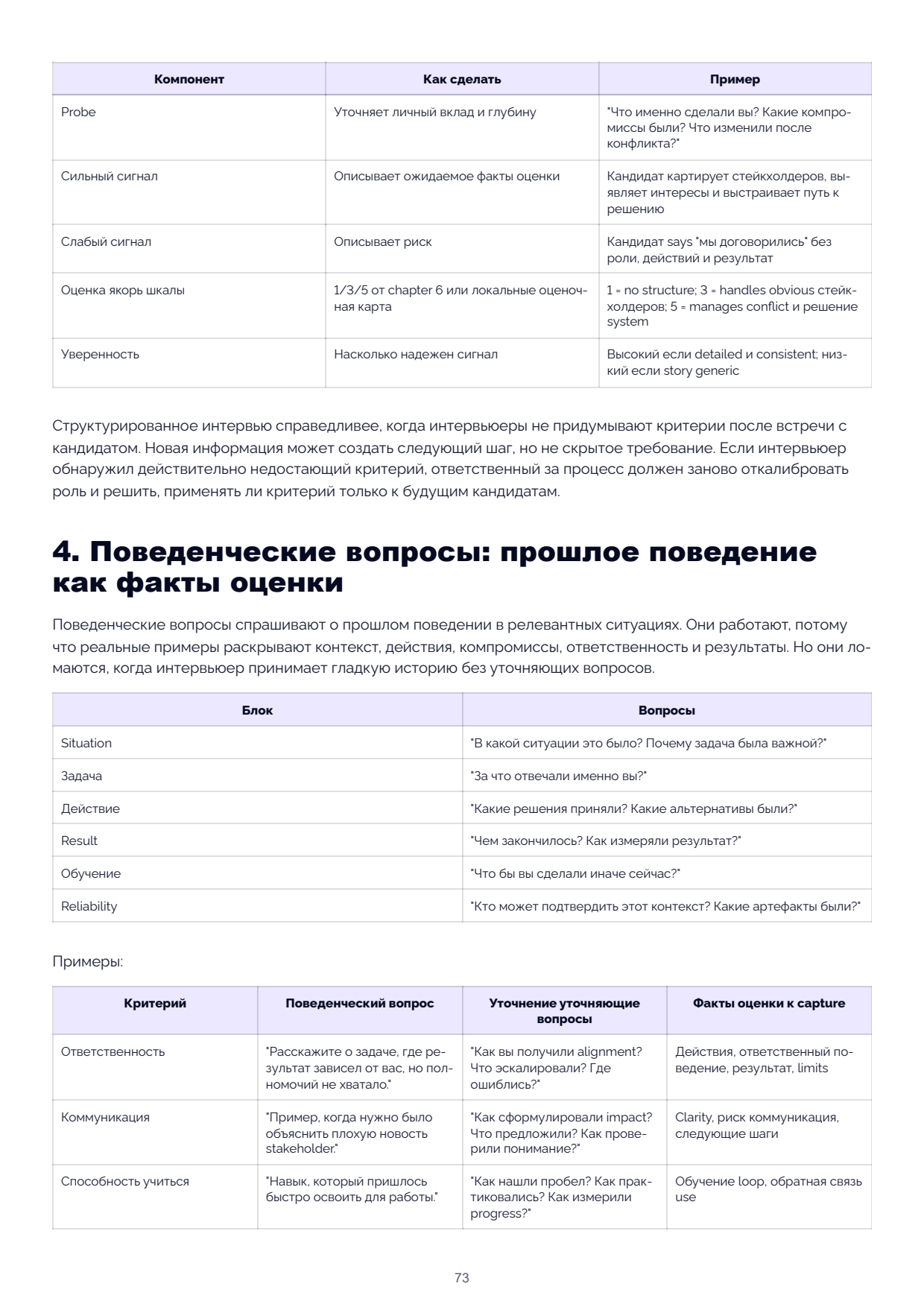
| Component | How it works | Example |
|---|---|---|
| Probe | Clarifies personal contribution and depth | "What exactly did you do? What trade-offs did you make? What did you change after the conflict?" |
| Strong signal | Describes expected assessment facts | Candidate maps stakeholders, identifies interests and builds a path to a solution |
| Weak signal | Describes risk | Candidate says "we agreed" without explaining their role, actions or outcome |
| Scale anchor | 1/3/5 from Chapter 6 or local scorecard | 1 = no structure; 3 = handles obvious stakeholders; 5 = manages conflict and decision systems |
| Confidence | How reliable is the signal | High if detailed and consistent; low if the story is generic |
Structured interviews are fairer when interviewers do not invent criteria after meeting the candidate. New information may create a next step, but not a hidden requirement. If an interviewer discovers a genuinely missing criterion, the process owner must recalibrate the role and decide whether to apply the criterion only to future candidates.
4. Behavioural questions: past behaviour as assessment facts
Behavioural questions ask about past behaviour in relevant situations. They work because real examples reveal context, actions, trade-offs, responsibility and outcomes. But they fail when the interviewer accepts a polished story without asking follow-up questions.
| Block | Questions | ||
| Situation | "In what situation did this happen? Why was the task important?" | ||
| Task | "What were you specifically responsible for?" | ||
| Action | "What decisions did you make? What alternatives were available?" | ||
| Result | "How did it end? How did you measure the outcome?" | ||
| Learning | "What would you do differently now?" | ||
| Reliability | "Who can confirm this context? What artifacts were produced?" | ||
| Examples: | |||
| Criterion | Behavioural question | Follow-up questions | Assessment facts to capture |
| Accountability | "Describe a task where the outcome depended on you but you lacked full authority." | "How did you gain alignment? What did you escalate? Where did you go wrong?" | Actions, responsible behaviour, outcome, limits |
| Communication | "Give an example of when you had to explain bad news to a stakeholder." | "How did you frame the impact? What did you propose? How did you verify understanding?" | Clarity, risk communication, next steps |
| Ability to learn | "A skill you had to pick up quickly for a role." | "How did you identify the gap? How did you practise? How did you measure progress?" | Learning loop, feedback use |
Behavioural questions ask about past behaviour in relevant situations. They work because
real examples reveal context, actions, trade-offs, responsibility and outcomes. But they fail
when the interviewer accepts a polished story without asking follow-up questions.
Block Questions
Situation "In what situation did this happen? Why was the task important?"
Task "What were you specifically responsible for?"
Action "What decisions did you make? What alternatives were available?"
Result "How did it end? How did you measure the outcome?"
Learning "What would you do differently now?"
Reliability "Who can confirm this context? What artifacts were produced?"
Examples:
Criterion Behavioural question Follow-up Assessment facts to
questions capture
Accountability "Describe a task where the "How did you gain alignment? Actions, responsible
outcome depended on you but What did you escalate? Where behaviour, outcome,
you lacked full authority." did you go wrong?" limits
Communication "Give an example of when you "How did you frame the Clarity, risk communication,
had to explain bad news to a impact? What did you propose? next steps
stakeholder." How did you verify understanding?"
Ability to learn "A skill you had to pick up "How did you identify the gap? Learning loop, feedback
quickly for a role." How did you practise? How use
did you measure progress?"
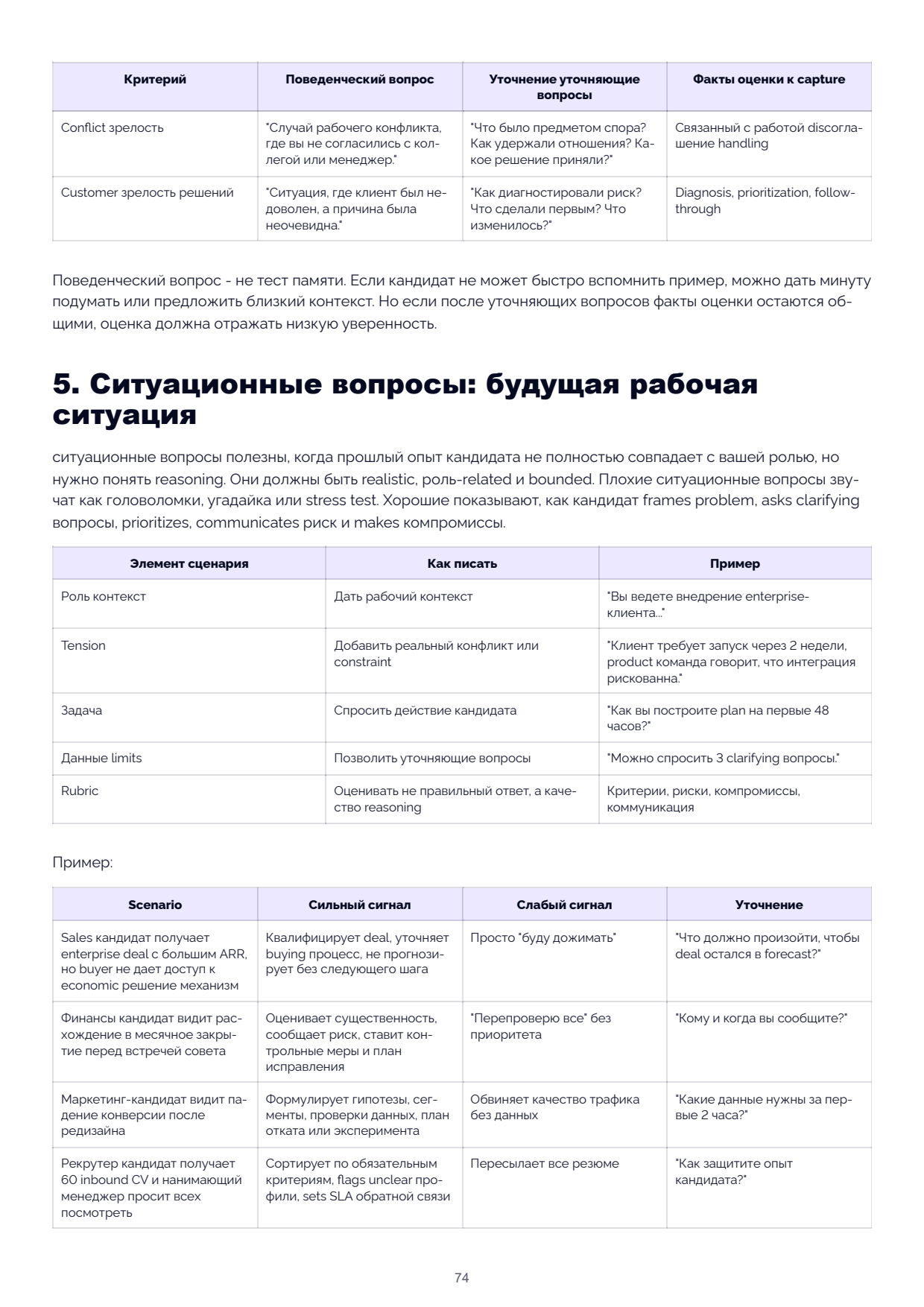
| Criterion | Behavioural question | Follow-up questions | Assessment facts to capture |
|---|---|---|---|
| Conflict maturity | "An occasion where you disagreed with a colleague or manager at work." | "What was the disagreement about? How did you preserve the relationship? What decision was made?" | Work-related disagreement handling |
| Customer decision maturity | "A situation where a client was unhappy, but the cause was not obvious." | "How did you diagnose the risk? What did you do first? What changed?" | Diagnosis, prioritisation, follow-through |
Example:
Scenario Strong signal Weak signal Follow-up
Sales candidate receives an Qualifies the deal, refines the "I'll push it over the "What needs to happen for the
enterprise deal with high ARR, but buying process, doesn't the deal to stay in forecast?"
the buyer won't provide access to forecast without a next step
the economic decision-maker
Finance candidate spots a variance Assesses materiality, reports "I'll double-check everything" "Who do you inform and when?"
in monthly close before the board risk, sets controls and a without prioritisation
meeting correction plan
Marketing candidate sees a drop in Formulates hypotheses, Tests quality of traffic without "What data do you need in the
conversion after a redesign segments, tests data, a plan for data first 2 hours?"
rollback or experiment
Recruiter candidate receives 60 Sorts by must-have criteria, "I'll forward all CVs" "How do you protect the
inbound CVs and the hiring flags unclear profiles, sets candidate's experience?"
manager asks them to review all feedback SLA
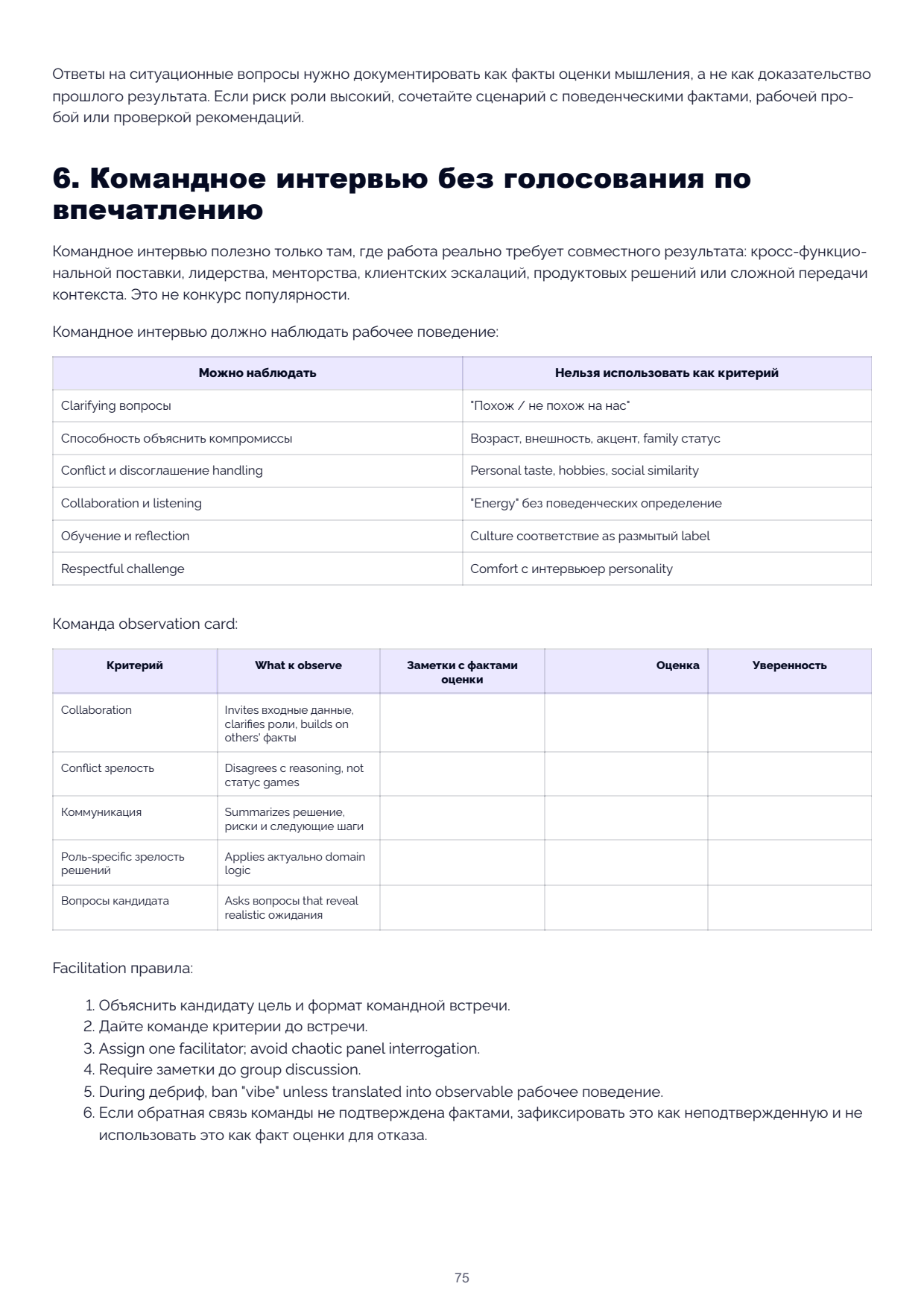
Answers to situational questions should be documented as assessment facts about thinking, not as proof of
a past result. If the role risk is high, combine the scenario with behavioural facts, a work
sample or reference checks.
6. Panel interviews without impression-based
voting
Panel interviews are only useful where the work genuinely requires a joint outcome: cross-functional
delivery, leadership, mentoring, client escalations, product decisions or complex context transfer.
This is not a popularity contest.
A panel interview should observe work behaviour:
Can be observed Must not be used as a criterion
Clarifying questions "Similar / not similar to us"
Ability to explain trade-offs Age, appearance, accent, family status
Conflict and disagreement handling Personal taste, hobbies, social similarity
Collaboration and listening "Energy" without behavioural definition
Learning and reflection Culture fit as a vague label
Respectful challenge Comfort with interviewer personality
Team observation card:
Criterion What to observe Notes with Assessment Confidence
assessment facts rating
Collaboration Invites input,
clarifies roles, builds on
others' facts
Conflict maturity Disagrees with reasoning, not
status games
Communication Summarises decision,
risks and next steps
Role-specific maturity Applies relevant domain
decision logic
Candidate questions Asks questions that reveal
realistic expectations
Facilitation rules:
1. Explain the purpose and format of the panel meeting to the candidate.
2. Give the team the criteria before the meeting.
3. Assign one facilitator; avoid chaotic panel interrogation.
4. Require notes before group discussion.
5. During the debrief, ban "vibe" unless translated into observable work behaviour.
6. If team feedback is not supported by facts, record this as unconfirmed and do not
use it as an assessment fact for rejection.
7. Interviewer roles and context handover
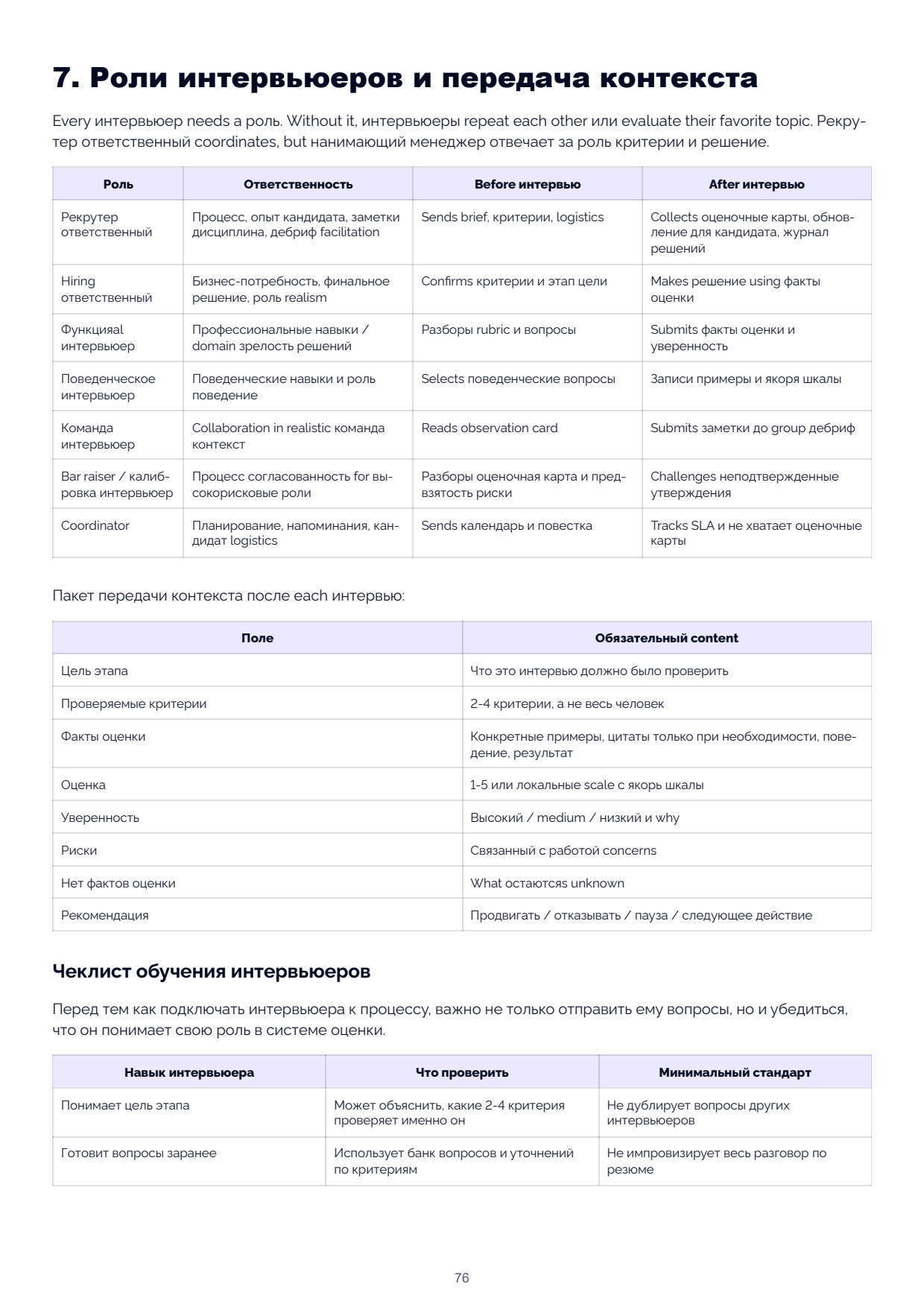
Every interviewer needs a role. Without one, interviewers duplicate each other or assess their favourite topic. The recruiter
owner coordinates, but the hiring manager is responsible for role criteria and the decision.
Role Responsibility Before interview After interview
Recruiter Process, candidate experience, note Sends brief, criteria, logistics Collects scorecards, updates for
owner discipline, debrief facilitation the candidate, decision log
Hiring Business need, final decision, Confirms criteria and stage Makes the decision using
owner role realism objectives assessment facts
Functional Professional skills / domain Reviews rubric and questions Submits assessment facts and
interviewer maturity confidence
Behavioural Behavioural skills and role Selects behavioural questions Records examples and scale
interviewer behaviour anchors
Team Collaboration in a realistic team Reads observation card Submits notes before group
interviewer context debrief
Bar raiser / calibration Process consistency for high- Reviews scorecard and Checks unsubstantiated
interviewer stakes roles bias risks assertions
Coordinator Planning, reminders, candidate Sends calendar and agenda Tracks SLA and missing
logistics scorecards
Context handover pack after each interview:
Field Mandatory content
Stage objective What this interview should have checked
Criteria assessed 2–4 criteria, not the whole person
Assessment facts Concrete examples, quotes only where necessary, behaviour,
outcome
Rating 1–5 or local scale with scale anchors
Confidence High / medium / low and why
Risks Work-related concerns
No assessment facts What remains unknown
Recommendation Progress / reject / pause / next action
Interviewer training checklist
Before bringing an interviewer into the process, it is important not just to send them the questions, but to ensure
they understand their role within the assessment system.
Interviewer skill What to check Minimum standard
Understands the stage objective Can explain which 2–4 criteria Does not duplicate other
they are specifically assessing interviewers' questions
Prepares questions in advance Uses the question bank and Follow-up questions, not
against criteria follow-ups improvisation based on CV
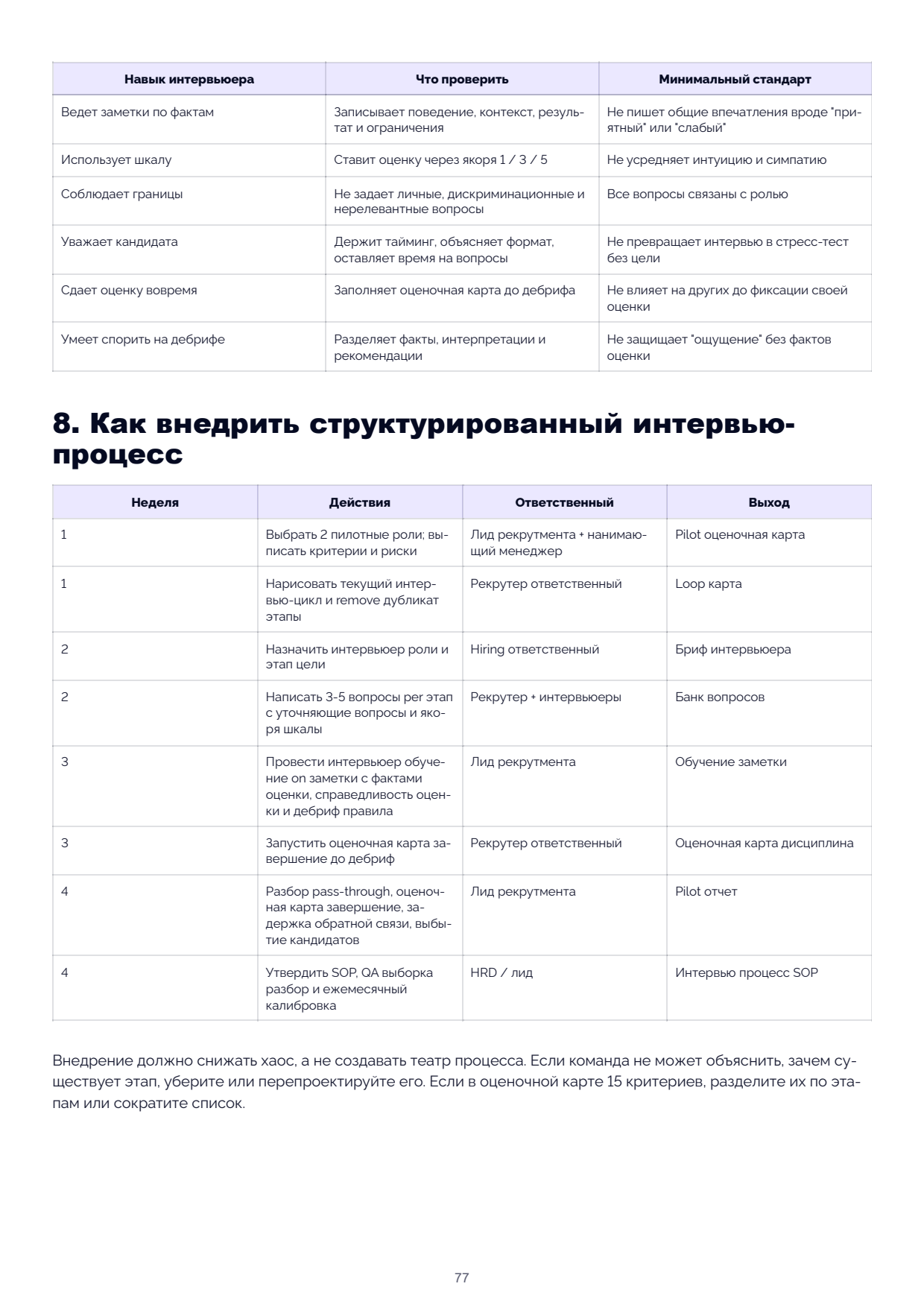
| Interviewer skill | What to check | Minimum standard | |
|---|---|---|---|
| Takes notes based on facts | Records behaviour, context, outcome and constraints | Does not write generic impressions like "pleasant" or "weak" | |
| Uses the scale | Assigns a rating using 1/3/5 anchors | Does not average intuition and likeability | |
| Stays within boundaries | Does not ask personal, discriminatory or irrelevant questions | All questions relate to the role | |
| Respects the candidate | Maintains timing, explains the format, leaves time for questions | Does not turn the interview into a purposeless stress test | |
| Submits assessment on time | Completes the scorecard before the debrief | Does not influence others before their own rating is recorded | |
| Can argue in the debrief | Separates facts, interpretations and recommendations | Does not defend a "feeling" without assessment facts | |
| 8. How to implement a structured interview process | |||
| Week | Actions | Owner | Output |
| 1 | Select 2 pilot roles; list criteria and risks | Recruitment lead + hiring manager | Pilot scorecard |
| 1 | Map the current interview cycle and remove duplicate stages | Recruiter owner | Cycle map |
| 2 | Assign interviewer roles and stage objectives | Hiring owner | Interviewer brief |
| 2 | Write 3–5 questions per stage with follow-ups and scale anchors | Recruiter + interviewers | Question bank |
| 3 | Run interviewer training on assessment fact notes, assessment fairness and debrief rules | Recruitment lead | Training notes |
| 3 | Launch scorecard completion before the debrief | Recruiter owner | Scorecard discipline |
| 4 | Review pass-through, scorecard completion, feedback delays, candidate drop-offs | Recruitment lead | Pilot report |
| 4 | Approve SOP, QA sample review and monthly calibration | HRD / lead | Interview process SOP |
9. How to measure interview quality and
assessment fairness
Metric Formula What it shows Risk of misuse
Interview pass-through Candidates passing on / candidates Low pass-through does not always
passing the stage per stage Stage strictness and fit mean poor quality; the stage may be
intentionally selective
Scorecard completion Completed scorecards / completed Assessment fact discipline Filling in the scorecard formally
interviews after the decision
Assessment fact completeness Scorecards with assessment facts Quality of notes Counting long notes as good
for each rated criterion / all for relevance
scorecards
Feedback latency Date feedback submitted Candidate experience and Update status without useful
• interview date feedback
Duplicate questions share Repeated same criterion across Cycle design quality Remove repetition that is
stages / all criteria intentionally confirming high-risk
criteria
Unconfirmed feedback share Vague comments without Assessment fairness and Punishing interviewers instead
assessment facts / selective decision quality of training
comments
Candidate drop-off after Candidate departures after Process length, communication, Blaming the candidate instead of
interviews interview / candidates after role realism fixing the process
interview
Rating variance by Average rating variance by Need for calibration Compare across different roles
interviewer interviewer and role without context
Time to decision Decision date – final interview Debrief discipline Speed without quality
Qualitative QA matters. Review a sample of scorecards and ask:
Did the interviewer assess the assigned criteria?
Are the assessment facts concrete and work-related?
Have unsubstantiated phrases been removed or rewritten?
Did the debrief happen after individual notes?
Were candidate updates sent within SLA?
Are adverse patterns visible by source, stage or interviewer?
10. In HarmonyATS
In HarmonyATS: interview stages, scorecards, notes and decision logs can sit on the candidate
card. This helps the debrief use assessment facts instead of recollections and keeps stage progression
linked to rationale.
In HarmonyATS: the Funnel with detail, Rejections and SLA reports show where interviews create
bottlenecks: long feedback delays, high drop-off after a weak previous stage or
candidates stuck waiting for interviewer notes.
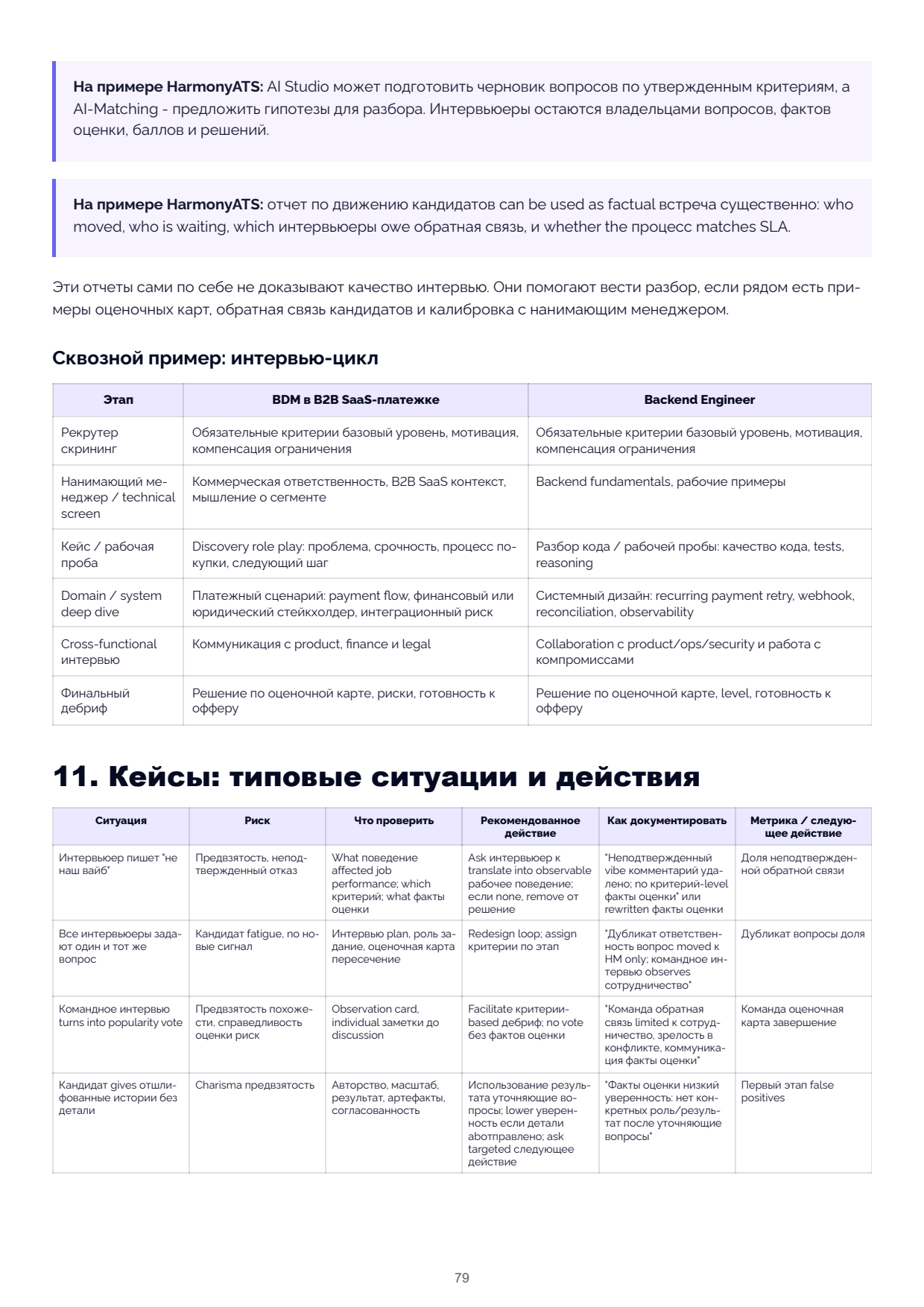
In HarmonyATS: AI Studio can draft questions from approved criteria, and
AI-Matching can suggest hypotheses for review. Interviewers remain the owners of questions, assessment
facts, ratings and decisions.
In HarmonyATS: the candidate movement report can serve as a factual meeting summary: who
moved, who is waiting, which interviewers owe feedback, and whether the process meets SLA.
These reports alone do not prove interview quality. They help run the debrief, provided there are
sample scorecards, candidate feedback and calibration with the hiring manager alongside them.
End-to-end example: interview cycle
Stage BDM in B2B SaaS payments Backend Engineer
Recruiter Must-have criteria: baseline level, motivation, Must-have criteria: baseline level, motivation,
screening compensation constraints compensation constraints
Hiring manager / Commercial responsibility, B2B SaaS context, Backend fundamentals, work examples,
technical screen segment thinking
Case / work sample Discovery role play: problem, urgency, purchase Code / work sample review: code quality, tests,
process, next step reasoning
Domain / system Payment scenario: payment flow, financial or System design: recurring payment retry, webhook,
deep dive legal stakeholder, integration risk reconciliation, observability
Cross-functional Communication with product, finance and legal Collaboration with product/ops/security and working
interview with trade-offs
Final debrief Scorecard decision, risks, offer readiness Scorecard decision, level, offer readiness
11. Case studies: typical situations and actions
Situation Risk What to check Recommended How to document Metric / next
action action
Interviewer writes "not our vibe" Bias, unconfirmed Ask the interviewer to "Unconfirmed comment Share of unconfirmed
rejection; which affected job translate into observable removed; no criterion-level assessment fact in feedback
performance; which criterion; what assessment facts in decision
assessment facts if none, remove or rewritten
All interviewers ask the Candidate fatigue, Interview plan, role Redesign cycle; assign "Duplicate responsibility Share of duplicate
same question no new signals assignment, scorecard criteria to stage; ownership moved to
panel interview observes
HM only; overlapping
collaboration"
Panel interview turns into Similarity bias, Observation card, Facilitate criterion-based "Team feedback limited to Team scorecard
popularity vote assessment fairness individual notes before discussion; no voting collaboration, conflict
discussion without assessment facts maturity, communication
assessment facts"
Candidate gives polished Charisma bias Authorship, scale, Use follow-up "Assessment facts low First-stage false
stories without detail outcome, artefacts, questions; lower confidence: no concrete positives
consistency role/outcome after follow-up role/outcome; ask
questions targeted next action
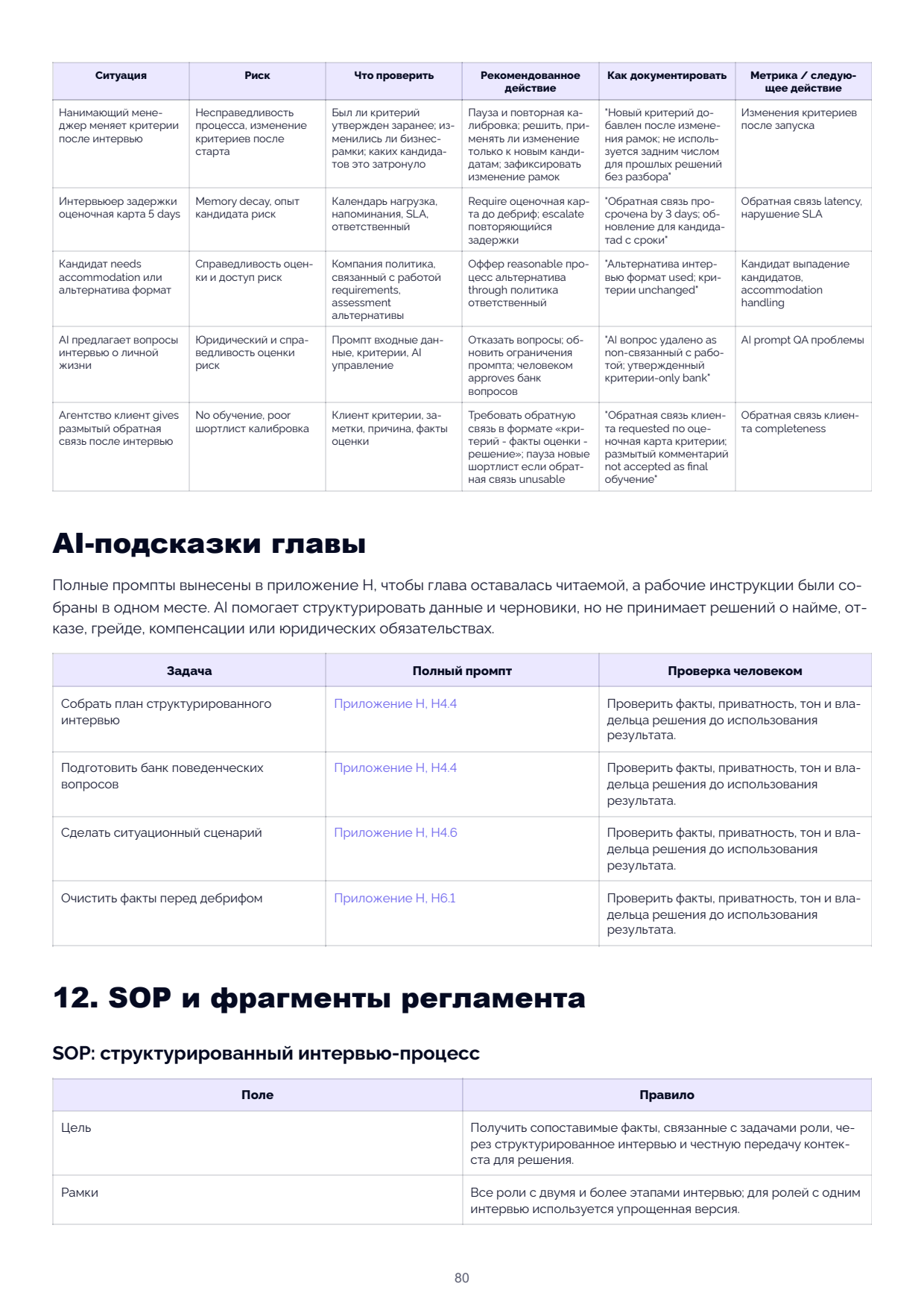
| Situation | Risk | What to check | Recommended action | How to document | Metric / next action |
|---|---|---|---|---|---|
| Hiring manager changes criteria after interview | Process unfairness, changing criteria after the start | Was the criterion approved in advance; have business parameters changed; which candidates were affected | Pause and recalibrate; decide whether to apply the change only to new candidates; record the parameter change | "New criterion added after parameter change; not applied retrospectively to past decisions without review" | Criteria changes after launch |
| Interviewer delays scorecard 5 days | Memory decay, candidate experience risk | Calendar load, reminders, SLA, owner | Require scorecard before debrief; escalate repeated delays | "Feedback overdue by 3 days; candidate update sent after deadline" | Feedback latency, SLA breach |
| Candidate needs accommodation or alternative format | Assessment fairness and accessibility risk | Company policy, work-related requirements, assessment alternatives | Offer reasonable process alternative through policy owner | "Alternative interview format used; criteria unchanged" | Candidate drop-off, accommodation handling |
| AI suggests interview questions about personal life | Legal and assessment fairness risk | Prompt inputs, criteria, AI governance | Reject questions; update prompt restrictions; human approves question bank | "AI question removed as non-work-related; approved criteria-only bank" | AI prompt QA issues |
| Agency client gives vague feedback after interview | No learning, poor shortlist calibration | Client criteria, notes, rationale, assessment facts | Require feedback in "criterion – assessment fact – decision" format; pause new shortlists if feedback is unusable | "Client feedback requested against scorecard criteria; vague comment not accepted as final input" | Client feedback completeness |
12. SOP and procedure snippets
SOP: structured interview process
Field Rule
Purpose Gather comparable facts related to role tasks through
structured interviews and honest context handover for
decision-making.
Scope All roles with two or more interview stages; for roles with one
interview a simplified version is used.
| Field | Rule |
|---|---|
| Owners | The hiring manager owns the criteria and decision. The recruiter owns the process, candidate experience and debrief discipline. Interviewers own notes and assessment facts for their assigned criteria. |
| Inputs | Approved criteria, scorecard, interview cycle, interviewer brief, candidate materials as permitted by policy, privacy/AI rules. |
| Steps | 1. Link criteria to stages. 2. Assign interviewer roles. 3. Prepare questions and follow-ups. 4. Brief the candidate and interviewers. 5. Conduct interviews. 6. Complete the scorecard before the debrief. 7. Run the debrief on assessment facts. 8. Record the decision and update the candidate. |
| Mandatory fields | Stage objective, criteria assessed, assessment facts, rating, confidence, risks, missing data, recommendation, next action. |
| Prohibited fields | Vague feedback about "vibe", protected characteristics, stereotypes, unsubstantiated personality labels, new hidden criteria discovered after the interview. |
| SLA | Scorecard completed by end of the next working day or before the debrief, whichever is earlier. Candidate update follows the process SLA. |
| Outputs | Progress, reject, pause for clarification, prepare the offer, or recalibrate the role/process. |
| Exceptions | Executive search, regulated roles or accessibility adaptations may require a different format, but criteria and documentation must remain work-related. |
| Metrics | Scorecard completion, feedback delay, unconfirmed feedback share, duplicate question share, stage pass-through, candidate drop-off. |
| Procedure snippet for the corporate knowledge base |
13. Interview process maturity levels
Level What it looks like Data Key risk Next
step
Chaos Every interviewer asks what they Bias, repeated questions, slow Create a scorecard
likes; decision by memory from decisions
chat calendar events and
impressions
Managed There is a cycle, roles, scorecards Stage notes, ratings, decisions Scorecards filled formally Train notes with
and debrief assessment facts and debrief facilitation
| Level | What it looks like | Data | Key risk | Next step |
|---|---|---|---|---|
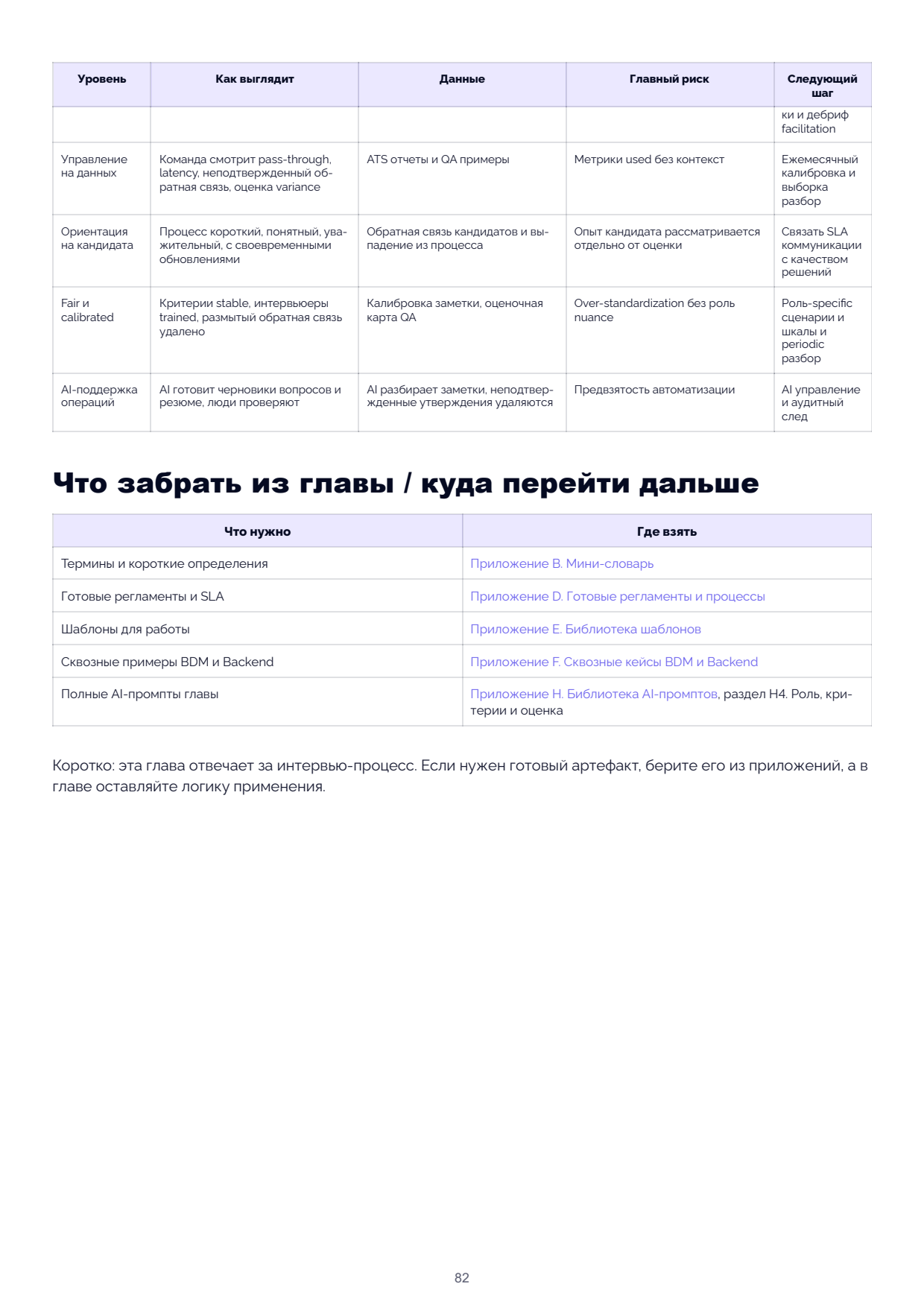
| Data-driven | Team reviews pass-through, latency, unconfirmed feedback, rating variance | ATS reports and QA samples | Metrics used without context | Monthly calibration and sample review |
| Candidate-oriented | Process is short, clear, respectful, with timely updates | Candidate feedback and drop-out | Candidate experience treated separately from assessment | Link communication SLA to decision quality |
| Fair and calibrated | Criteria are stable, interviewers are trained, vague feedback removed | Calibration notes, scorecard QA | Over-standardisation without role nuance | Role-specific scenarios and scales and periodic review |
| AI-assisted operations | AI drafts questions and summaries, humans verify | AI reviews notes, unsubstantiated assertions removed | Automation bias | AI governance and audit trail |
| What to take from this chapter / where to go next | ||||
| What you need | Where to find it | |||
| Terms and short definitions | Appendix B. Mini-glossary | |||
| Ready-made procedures and SLAs | Appendix D. Ready-made procedures and processes | |||
| Working templates | Appendix E. Template library | |||
| End-to-end BDM and Backend examples | Appendix F. End-to-end case studies for BDM and Backend | |||
| Full AI prompts for the chapter | Appendix H. AI prompt library, section H4. Role, criteria and assessment |
What to take from this chapter / where to go next
What you need Where to find it
Terms and short definitions Appendix B. Mini-glossary
Ready-made procedures and SLAs Appendix D. Ready-made procedures and processes
Working templates Appendix E. Template library
End-to-end BDM and Backend examples Appendix F. End-to-end case studies for BDM and Backend
Full AI prompts for the chapter Appendix H. AI prompt library, section H4. Role, cri-
teria and assessment
In short: this chapter covers the interview process. If you need a ready-made artifact, take it from the appendices, and
keep the application logic in the chapter.
Chapter 6. What exactly do we assess
in a candidate
How to use this chapter
Working scenario. At the BDM debrief everyone quickly agrees: the candidate is confident, energetic, "definitely knows
how to sell". Ten minutes later it emerges that nobody checked the key thing: can they actually run discovery in B2B
SaaS payments, distinguish the budget holder from an ordinary user, and avoid starting a presentation before understanding
the client's pain. In the neighbouring vacancy, a Backend Engineer speaks quietly and doesn't sell themselves, but calmly
explains where the system needs retries, idempotency and monitoring. If the assessment rests on impressions, the team
may choose charisma over signal and miss strong engineering maturity.
What actually went wrong here: the team discusses people using words that sound confident, but do not lead
to a decision. "Strong", "not senior", "lacks energy", "not our vibe" do not explain what the person actually did, what
outcome they created and how much that can be trusted.
This chapter helps turn assessment from an argument about impressions into a clear chain: criterion → verification
method → assessment fact → confidence → decision. After reading it, it should be easier to train interviewers, defend
decisions, reduce bias, use AI carefully and see where the process produces strong signals versus where the team
is simply believing a polished story.
Remember in one phrase: an assessment fact is only stronger than an impression when it is linked to the work.
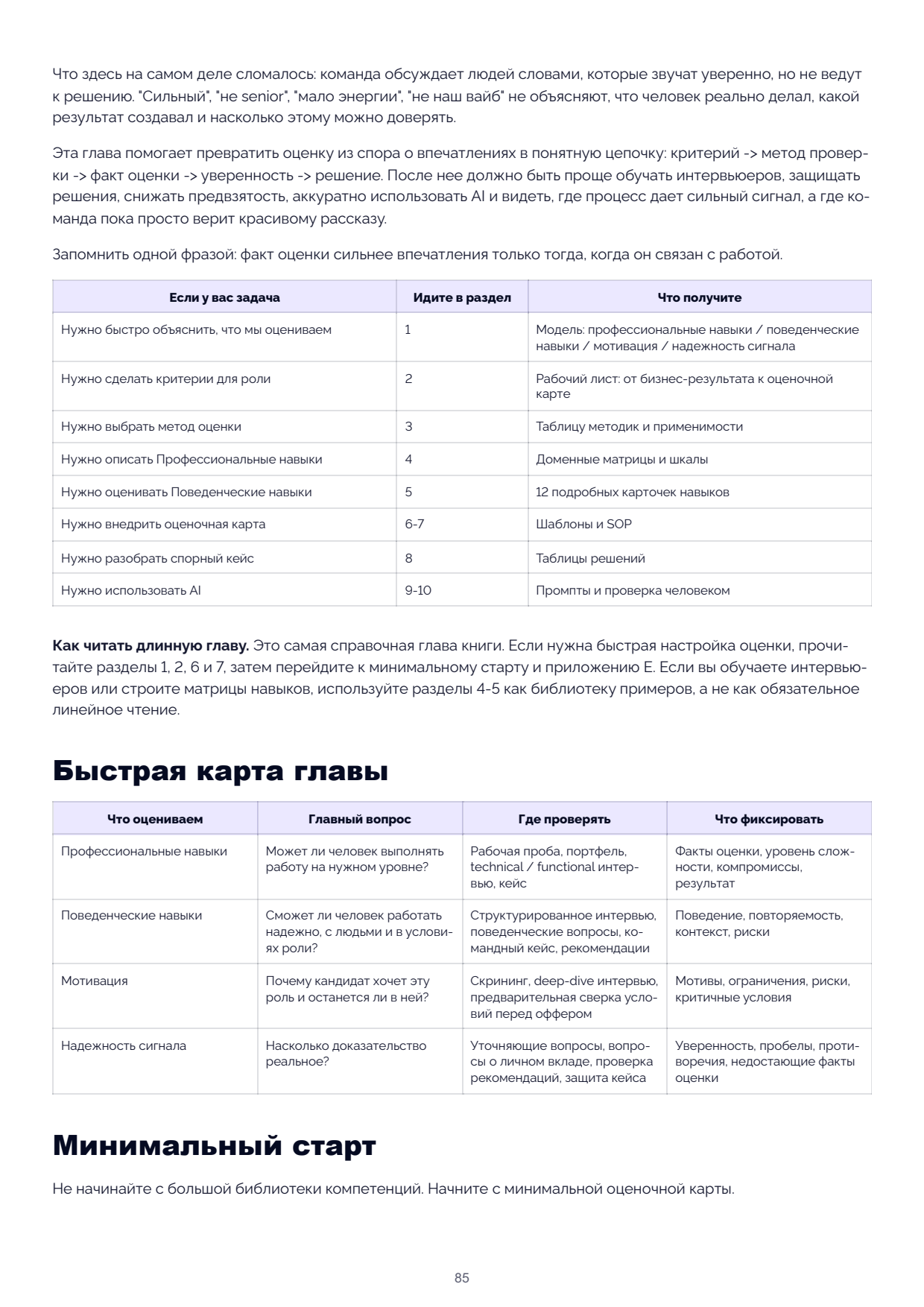
| If your task is | Go to section | What you will get |
|---|---|---|
| Quickly explain what we assess | 1 | Model: professional skills / behavioural skills / motivation / signal reliability |
| Create criteria for a role | 2 | Worksheet: from business outcome to scorecard |
| Choose an assessment method | 3 | Methods table and applicability |
| Describe professional skills | 4 | Domain matrices and scales |
| Assess behavioural skills | 5 | Twelve detailed skill cards |
| Implement a scorecard | 6–7 | Templates and SOP |
| Work through a contentious case | 8 | Decision tables |
| Use AI | 9–10 | Prompts and human oversight |
How to read a long chapter. This is the most reference-heavy chapter in the book. For a quick assessment setup, read sections 1, 2, 6 and 7, then move on to the minimum starting point and Appendix E. If you are training interviewers or building skill matrices, use sections 4–5 as an example library rather than as mandatory linear reading.
Quick chapter map
What we assess Key question Where to check What to record
Professional skills Can the person do the work Work sample, portfolio, Technical/functional Assessment facts, difficulty
at the required level? interview, case level, trade-offs,
outcome
Behavioural skills Will the person work reliably, Structured interview, Behaviour, repeatability,
with people and within the with others and within the role's behavioural questions, context, risks
conditions? panel case, references
Motivation Why does the candidate want Screening, deep-dive interview, Motivations, constraints, risks,
this role and will they stay? pre-offer condition check critical conditions
Signal reliability How real is the evidence? Follow-up questions, personal Contribution checks, Confidence, gaps, contradictions,
contribution questions, reference checks, missing assessment facts
case defence
Minimum starting point
Do not start with a large competency library. Start with a minimal scorecard.
| Step | What to do | Artifact |
|---|---|---|
| 1 | Choose 4–6 criteria without which the role decision is impossible | Minimum scorecard |
| 2 | For each criterion, define 3 levels: unconfirmed, sufficient, strong | Scale anchors |
| 3 | Separate rating from confidence: a high score without reliable facts does not equal an offer | Rating + confidence |
| 4 | At the debrief, bring assessment facts, not a final "for / against" verdict | Assessment facts table |
1. Assessment model: professional skills, behavioural skills, motivation and signal reliability
Candidate assessment fails not when the interviewer asks the "wrong" question. More often it fails earlier: the team has not agreed on what actually constitutes a strong candidate. One hiring manager says "we need a strong senior", another hears "an autonomous expert", the recruiter translates this as "five years of experience", and the interviewer in the meeting assesses confidence in speech. The result looks like competency assessment but actually collects impressions, habits and personal preferences. The simplest working model looks like this:
1. Criterion. What matters for the role and why is it linked to the work?
2. Verification method. Where can we see this criterion: screening, interview, case, work sample, portfolio, references?
3. Assessment fact. What did the candidate actually do, say, decide or demonstrate?
4. Confidence. How much can this fact be trusted?
5. Decision. What does the team do next: progress, pause, clarify, change level, or prepare the offer?
If even one link drops out, the team reverts to impressions. A polished story without a fact does not become evidence. A score without confidence does not become a decision. A criterion with no link to the work should not enter the assessment. The working assessment model must separate four layers:
1. Professional skills — abilities without which the person cannot perform the role's key tasks.
This is not a list of tools from the vacancy, but the ability to produce the required work outcome: running discovery, designing architecture, closing enterprise deals, building a financial model, writing working code, managing implementation, analysing the funnel. A good criterion describes the action, difficulty level, quality of outcome and the conditions in which the skill must be demonstrated.
2. Behavioural skills — observable work behaviour that affects a person's reliability in a specific environment. This is not "pleasant", "adequate" or "team-oriented", but behavioural patterns: how the candidate reports risks, argues a point, keeps commitments, clarifies expectations, handles conflict, accepts feedback, aligns stakeholders. A behavioural skill cannot be assessed by likeability. It must be translated into situations, actions and consequences.
3. Motivation — the reasons a person chooses this role and the risks that may cause them to quickly lose interest or fail to cope with the context. Motivation does not mean being "passionate". For hiring, what matters more is: do the candidate's expectations match the actual work, pace, level of uncertainty, task type, management style, compensation model and growth horizon? A strong candidate with misaligned motivation can become an expensive mistake.
reliable facts do not equal an offer
4 At the debrief, bring assessment facts, not a final Assessment facts table
"for / against" verdict
1. Assessment model: professional skills,
behavioural skills, motivation and signal
reliability
Candidate assessment fails not when the interviewer asks the "wrong" question. More often it fails earlier: the team
has not agreed on what actually constitutes a strong candidate. One hiring manager says "we need
a strong senior", another hears "an autonomous expert", the recruiter translates this as "five years of experience", and
the interviewer in the meeting assesses confidence in speech. The result looks like competency assessment but
actually collects impressions, habits and personal preferences.
The simplest working model looks like this:
1. Criterion. What matters for the role and why is it linked to the work?
2. Verification method. Where can we see this criterion: screening, interview, case, work sample, portfolio,
references?
3. Assessment fact. What did the candidate actually do, say, decide or demonstrate?
4. Confidence. How much can this fact be trusted?
5. Decision. What does the team do next: progress, pause, clarify, change level, or prepare
the offer?
If even one link drops out, the team reverts to impressions. A polished story without a fact
does not become evidence. A score without confidence does not become a decision. A criterion with no link to the work
should not enter the assessment.
The working assessment model must separate four layers:
1. Professional skills — abilities without which the person cannot perform the role's key tasks.
This is not a list of tools from the vacancy, but the ability to produce the required work outcome: running
discovery, designing architecture, closing enterprise deals, building a financial model, writing
working code, managing implementation, analysing the funnel. A good criterion describes the action,
difficulty level, quality of outcome and the conditions in which the skill must be demonstrated.
2. Behavioural skills — observable work behaviour that affects a person's reliability in
a specific environment. This is not "pleasant", "adequate" or "team-oriented", but behavioural patterns: how the candidate
reports risks, argues a point, keeps commitments, clarifies expectations, handles conflict,
accepts feedback, aligns stakeholders. A behavioural skill cannot be assessed
by likeability. It must be translated into situations, actions and consequences.
3. Motivation — the reasons a person chooses this role and the risks that may cause them to quickly
lose interest or fail to cope with the context. Motivation does not mean "passionate". For hiring, what
matters more is: do the candidate's expectations match the actual work, pace, level of uncertainty,
task type, management style, compensation model and growth horizon? A strong candidate with misaligned
motivation can become an expensive mistake.
4. Signal reliability — how much trust the received signal deserves. The same answer can be
strong evidence, weak evidence or simply unsuitable for a decision.
Consider the context: did the candidate do the work themselves or were they part of a strong team; was the outcome
measurable or described in vague terms; was the task similar to your role or merely sounds similar; did the interviewer
check the details or accept a polished story at face value.
Assessment facts are not the interviewer's opinion and not a restatement of the CV. They are verifiable observations
about the candidate's work.
A good assessment fact answers: what happened, what the task was, what role the candidate played, which
decisions they made, what they did personally, what constraints existed in the context, how the work ended and what
can be verified through a follow-up question, case, portfolio or reference. The higher the cost of error in
hiring, the less the team should rely on single impressions and the more they should rely on several independent
signals.
Vague labels are dangerous because they sound like assessment but do not lead to an actionable decision. "Strong", "senior",
"proactive", "not our vibe" do not explain what the person must actually do in the role and which behaviour the
team considers sufficient. Such words give interviewers too much freedom: each assesses their own thing,
there is nothing to debate, nothing to calibrate, it is impossible to give the candidate honest feedback, and bias is
easily disguised as "professional intuition".
Practical rule: any label must be translated into observable behaviour before the interview starts.
Vague formulation Why it is dangerous How to translate into a What assessment facts are
criterion needed
"Strong candidate" Unclear where the strength lies Professional skill / Specific example, outcome,
behavioural skill / difficulty, candidate's role
motivation / level
"Not senior" Could mean anything Complexity, What decisions they made, how
autonomy, influence, they affected the outcome, what
quality of decisions they did without oversight
"Proactive" Often substitutes for responsibility, or a Situation where the candidate
initiative, early risk reporting, action themselves identified a problem and drove
without reminders it to completion
"Not our vibe" May hide bias Communication style, Observed behaviour and link
collaboration, conflict to role tasks
maturity, pace fit
Translation examples:
Instead of "strong", ask: "In which tasks does the role demand a strong outcome: speed, quality of decisions,
depth of expertise, influence on others, resilience to uncertainty?" Then define the criterion:
"independently runs discovery with enterprise clients, identifies decision criteria, captures
implementation risks and translates them into an action plan".
Instead of "senior", break down the level along an axis: task complexity, autonomy, influence, quality of decisions,
ability to improve the system around them. Seniority for a given role is not age or years of experience, but the
ability to consistently make decisions at the right level without constant oversight.
Instead of "proactive", clarify what the business actually needs: early risk detection, independently
proposing options, driving outcomes without reminders, knowing when to escalate in time. If
this is not linked to role tasks, the criterion is better removed.
Instead of "not our vibe", record the work risk: communication pace, conflict, decision-making
style, maturity in feedback, ability to work with uncertainty. If the risk cannot be
linked to role tasks, it cannot be used as a hiring criterion.
Mini-template for calibration:
Label Observable behaviour Where we check What counts as a strong
assessment fact
Senior Makes decisions in complex Situational interview, Specific decision, alternatives,
conditions and explains trade-offs case, portfolio review consequences, candidate's role
Accountability Owns the outcome, risks and Behavioural interview, An example where the candidate
communication reference check spotted a problem, chose an
action and drove it to completion
Communication Helps others understand status, Structured interview, Clear answer structure, audience
risks and decisions role-play scenario, references adaptation, no hidden surprises
Pace fit Works at the required pace without Case, manager interview, Examples of deadlines, prioritisation,
damaging quality reference check trade-offs and recovery after
setbacks
2. From business task to measurable criteria
Assessment criteria must not start with a competency list. They must be derived from the business task of the role. Otherwise the team quickly falls into generic wishes: "analytical", "communicative", "autonomous", "learns quickly". Such words may be true, but they do not help choose between two candidates.
The correct sequence goes from outcome to verification method:
1. Business outcome. First, define what capacity or result the role must create. Not "hire a CSM" but "accelerate enterprise onboarding without losing quality", "reduce manual billing errors", "create a predictable outbound funnel", "reduce dependency on founder-led sales".
2. Key tasks. Then list the tasks that create this outcome. The important thing here is not to describe the job in its entirety, but to select 5–8 tasks where a hiring mistake would be expensive.
3. Professional skills. For each key task, define what the person must be able to do in practice. The skill must be verifiable: not "knows CRM" but "builds a funnel hygiene process and identifies the causes of conversion drops".
4. Behavioural skills. Define the work behaviour without which professional skills will not produce results in your environment. For example, with many stakeholders, what matters more than "sociability" is structured communication, expectation management and conflict maturity.
5. Motivation risks. Record why even a competent candidate may fail to stay or quickly lose effectiveness: too much uncertainty, too few established processes, a high proportion of client escalations, a slow enterprise cycle, no familiar team, a different balance of strategic versus operational work.
6. Signal reliability. For each important criterion, decide in advance what might be overstated and how to verify it: authorship of the outcome, depth of decisions, scale of the task, autonomy, data quality, genuine contribution to a team project.
7. Assessment methods. Choose methods to match the criteria, not the other way around. A professional skill can be checked with a work sample, case or technical interview; behaviour with a behavioural or structured interview; motivation with a deep-dive and pre-offer condition check; a questionable signal with a follow-up action, portfolio defence or reference check.
8. Scorecard. Assemble the criteria into a scorecard: 5–7 criteria, weights, 1/3/5 scale anchors, notes with assessment facts and confidence. The scorecard should help reach a decision, not be a formal appendix to the interview.
| Ready-to-use worksheet: | ||
|---|---|---|
| Field | Question | Example completion |
| Business outcome | What capacity or result must the role create? | Accelerate enterprise onboarding without losing quality |
| Key tasks | Which tasks create this outcome? | Client diagnostics, implementation plan, stakeholder coordination |
| Professional skills | What must the person be able to do? | Discovery, project planning, process mapping |
| Behavioural skills | Which behaviour is critical in this environment? | Communication, reliability, conflict maturity |
| Motivation risks | Why might the candidate fail to stay? | Not prepared for client escalations or high uncertainty |
| Signal reliability | What might be overstated? | Genuine contribution to projects, responsibility, depth of decision-making |
| Methods | How do we verify? | Structured interview, case, reference check |
| Scorecard | How do we rate? | 6 criteria, weights, 1/3/5 scale anchors, confidence |
| Example completion for the role of Head of Customer Implementation: | ||
| Step | Team decision | |
| Business outcome | Reduce chaos in enterprise client implementations and make onboarding predictable | |
| Key tasks | Diagnose the client, gather requirements, build an implementation plan, manage risks, align sales / product / support | |
| Professional skills | Discovery, project planning, stakeholder mapping, process design, basic analytics | |
| Behavioural skills | Structured communication, reliability, conflict maturity, expectation management | |
| Motivation risks | Candidate wants an advisory role without operational responsibility; not prepared for difficult client conversations | |
| Signal reliability | In the previous role may not have been the owner but a member of a strong implementation team | |
| Methods | Structured interview, case interview, portfolio review, reference check | |
| Scorecard | 6 criteria: implementation design, client diagnosis, stakeholder management, risk responsibility, communication, motivation fit |
| Criterion | Weak anchor 1 | Working anchor 3 | Strong anchor 5 |
|---|---|---|---|
| turns diagnostics into an implementation plan | |||
| Communication | Gives status irregularly or too broadly | Structures status, risks, decisions and next steps | Adapts communication to the audience, reduces uncertainty and prevents conflict before escalation |
3. Assessment methods: what to choose and when
An assessment method must answer the question "what signal do we need?" One method rarely covers the whole role. An interview shows thinking structure and past behaviour well, but is weak at checking actual work execution. A work sample produces a strong work-related signal, but can be costly for the candidate and team. Reference checks help verify behavioural repeatability, but depend on the quality of questions and the source. AI-assisted review speeds up material analysis, but does not remove responsibility from people.
| Method | What it checks | When to use it | Weaknesses | Cost / time | Candidate experience | Bias / fairness risks | How to implement |
| Structured interview | Comparable answers against pre-set criteria, hard/soft signals, reasoning depth | Almost any role, especially when multiple interviewers need a single standard | Poor at checking actual work execution without additional methods | Medium: requires question preparation, scale anchors and interviewer training | Usually perceived as fairer when questions are role-relevant and the interviewer explains the process | Risk shifts to criterion and scale design; poor scale anchors standardise poor assessment | Run job analysis, choose 4–6 criteria, write identical questions, follow-ups, 1/3/5 scale anchors and note-taking rules |
| Behavioural interview | Past behaviour in similar situations: responsibility, conflict maturity, decision quality, resilience | When the candidate has relevant experience and you need to understand repeatable patterns | Candidate may tell polished stories; past context may not match yours | Low–medium: quick to implement, but requires discipline on follow-up questions | Good experience if questions do not turn into interrogation and relate to the work | Interviewer may assess confidence instead of facts; cultural storytelling styles influence impressions | Use STAR/CARE logic: context, task, action, result, candidate's role, what they would repeat differently |
| Situational interview | How the candidate reasons in a realistic future scenario or dilemma | For new contexts, industry transitions, roles with high uncertainty | Tests intentions and reasoning, but does not prove past ability to execute | Medium: requires realistic scenarios and response criteria to be written | Can be good if the scenario is short, clear and does not require hidden knowledge | Advantage to candidates familiar with "correct" interview language | Describe a work-related scenario, give identical briefs, assess trade-offs, questions, risks and decision quality |
| Case interview | Analytics, problem structuring, business maturity, communication of decisions | For consulting, product, strategy, revenue, operations, implementation and leadership roles | Often turns into a puzzle if not linked to real work | Medium–high: case preparation, interviewer, review | Fair experience if the case is bounded and does not require free work for the company | May favour those who practised the format; risk of assessing presentation style over decision quality | Make the case resemble a real task, provide criteria, timebox, identical data and a rating rubric |
| Work sample | Ability to produce a slice of real work: a work product, solution, quality of execution | When you can honestly simulate a role task without access to internal secrets | Does not cover long-term behaviour, teamwork or motivation | Medium–high: task design, review, sometimes paid | Good experience if the task is short, transparent and does not resemble unpaid labour | Risk of unfair burden on busy candidates; risk of covert use of the result | Limit scope, remove commercially useful output, provide a rubric, deadline, context and the ability to explain decisions |
| Test assignment | Checking specific skills via a take-home or synchronous task | When an artefact is needed: code, text, analysis, plan, design, financial model | Take-home tasks poorly control conditions and may overburden the candidate | Medium: cheaper than an assessment centre, more expensive than an interview | Often worsens if the task is long or unpaid | Unequal conditions on time, caregiving, access to tools; risk of AI-generated output without understanding | Keep it short, work-related, with a clear time limit; assess not just the answer but the reasoning |
| Method | What it checks | When to use it | Weaknesses | Cost / time | Candidate experience | Bias / fairness risks | How to implement |
|---|---|---|---|---|---|---|---|
| behind the answer | |||||||
| Portfolio review | Quality of past work, task complexity, decision-making style, growth in level | For design, content, product, engineering, marketing, sales support and leadership roles with artefacts | Portfolio may be a team effort; outcome may depend on brand, budget or market | Low–medium: requires a prepared interviewer and rubric | Usually a good experience: candidate shows real work | Risk of assessing visual polish or company status instead of contribution | Request 2–3 artefacts, review context, candidate's role, constraints, decisions, outcome and process lessons |
| Technical interview | Depth of professional knowledge, reasoning, debugging, design decisions | For engineering, data, security, finance, legal, operations and other expert roles | May check trivia instead of work; live stress and whiteboard formats distort the signal | Medium: requires an expert and calibrated rubric | Can be stressful; better when tasks resemble real work | Bias towards thinking-out-loud style, language, format familiarity | Anchor questions to key tasks, define expected signals in advance, allow follow-up questions, record assessment facts |
| Reference check | Behavioural repeatability, reliability, boundaries, work style, risk management | After strong interviews, before an offer, or to verify contentious signals | Sources may be loyal, cautious or unable to remember details | Low–medium: 20–40 minutes per source plus preparation | Fine for the candidate if the process is transparent and consent is requested | Risk of informal checks without consent and unequal network access | Obtain consent, ask work-related questions, verify specific criteria, separate facts from opinions |
| Role play / assessment centre | Behaviour in an interactive situation: negotiation, escalation, coaching, stakeholder management | For sales, customer success, support, leadership, recruiting, people management | Expensive; candidate may "play a role" rather than demonstrate a consistent pattern | High: scenarios, observers, assessment, logistics | Can be a strong experience if scenarios are realistic and respectful | Risk of assessing acting confidence, accent, extroversion | Use short realistic scenarios, train observers, assess specific behaviours and outcomes |
| AI-assisted matching / AI-assisted review | Fast matching, CV summaries, comparing assessment facts against criteria, next-action prompts | To support sourcing, initial material review, preparing interviewer notes | AI does not know the full context, may err, amplify bias or invent confident conclusions | Low per candidate, but requires governance setup | May be invisible to the candidate; transparency is important where required by policy or law | Risk of discrimination, proxy variables, opaque vendor assessments, automation bias | Use AI output only as a hypothesis, keep human decision-making, check work-related criteria, monitor adverse impact |
| Scorecard / debrief / calibration | Unified decision on assessment facts: criteria, weights, confidence, interviewer disagreements | For all roles with more than one assessor or where the cost of error is high | Does not improve hiring quality if criteria are poor or the debrief turns into a status vote | Medium: requires a template, facilitation and note-taking discipline | Candidate does not see it directly, but benefits from a fairer process | Groupthink, HiPPO effect, post-hoc rationalisation, skew towards the loudest interviewer | Complete the scorecard before the debrief, discuss assessment facts by criteria, separate rating from confidence, record decision rationale |
4. Professional skills: how to describe,
verify and assess
Professional skills are work abilities, not a keyword list from the vacancy. "Knows Python", "worked with
HubSpot", "5 years in B2B SaaS" or "has enterprise experience" do not in themselves answer the key question: can the
person do the required work at the required level of difficulty and quality.
A good professional skill criterion describes four things:
1. Work output. What work result must the person produce: a debug plan, an architectural solution,
positioning, a financial model, qualification notes, an interview rubric.
2. Complexity. Under what conditions the skill must operate: ambiguous requirements, stakeholder
conflict, incomplete data, limited budget, high cost of error, tight deadlines.
3. Assessment facts. How we verify the skill: a past artefact, case review, work sample, technical
interview, portfolio defence, reference check.
4. Acceptable performance level. What counts as "good enough" for this role: not a perfect answer, but
a minimum level of autonomy, reasoning quality, accuracy and applicability of the solution.
Years of experience are a weak proxy for assessment facts. They may suggest where to look for examples, but they do not prove level.
One candidate in two years may have run complex tasks autonomously; another in seven years may have repeated a narrow
slice of the process without responsibility. Therefore, the scorecard should record not "5+ years of experience" but
"independently diagnoses problems, chooses a verification method, explains trade-offs and demonstrates
outcomes on data".
IT / Product / Engineering
Skill Simple Assessment facts Strong signal Weak signal Question / case 1/3/5 scale Rating error
definition anchors
Debugging Finds the cause of a Incident review, Builds hypotheses, Tries random "The service started 1: guesses Chaotic evaluation, assessing
technical or product code review, isolates permutations, variables, blames started giving errors randomly. 3: confidence or specific stack
problem and drives technical interview, tests logs and data, external factors, proposes a reason instead of quality of diagnosis
to a verified root cause postmortem cannot explain cannot explain the order of reasonable plan, diagnosis
corrective action preventive action causes, captures priority checks but misses plan, but the root but misses the systematic
the root cause within the first 30 diagnosis. 5: diagnosis itself
fix and prevention minutes?" systematically isolates the
problem, assesses
impact, proposes a
fix and prevention
System design Designs a system to Architecture review, Clearly describes Requirements, Draws trendy "Design a 1: a set of technologies Confusing maturity level with
handle load, constraints, design case, past limits, data flows, components with no notification for a without an architecture. quantity of named
reliability and scale schemes, next action for rejection scenarios link to the task, B2B product using 3: working schema for technologies
trade-offs failure modes, does not discuss failure resilience and SLA" basic scenarios. 5:
operational risks and escalation path, mitigation options justified design with
compromises observability trade-offs, risks,
observability and
migration path
Product discovery Uncovers real user Discovery notes, Separates problem Problem, solution, "Customers want a 1: collects wishes as Easuring hype and "product
problems and translates user interviews, from solution, tests backlog. 3: a new dashboard. language" instead of quality
them into product opportunity tree, assumptions, uncovers guiding How do we know it's assessment facts
solutions PRD, product case, segments what's actually needed? really needed? What
validates willingness to builds?" 5: validates
users, links insights to change, the problem, assesses
decisions formulates next experiment impact, selects
| Skill | Simple definition | Assessment facts | Strong signal | Weak signal | Question / case | 1/3/5 scale anchors | Rating error |
|---|---|---|---|---|---|---|---|
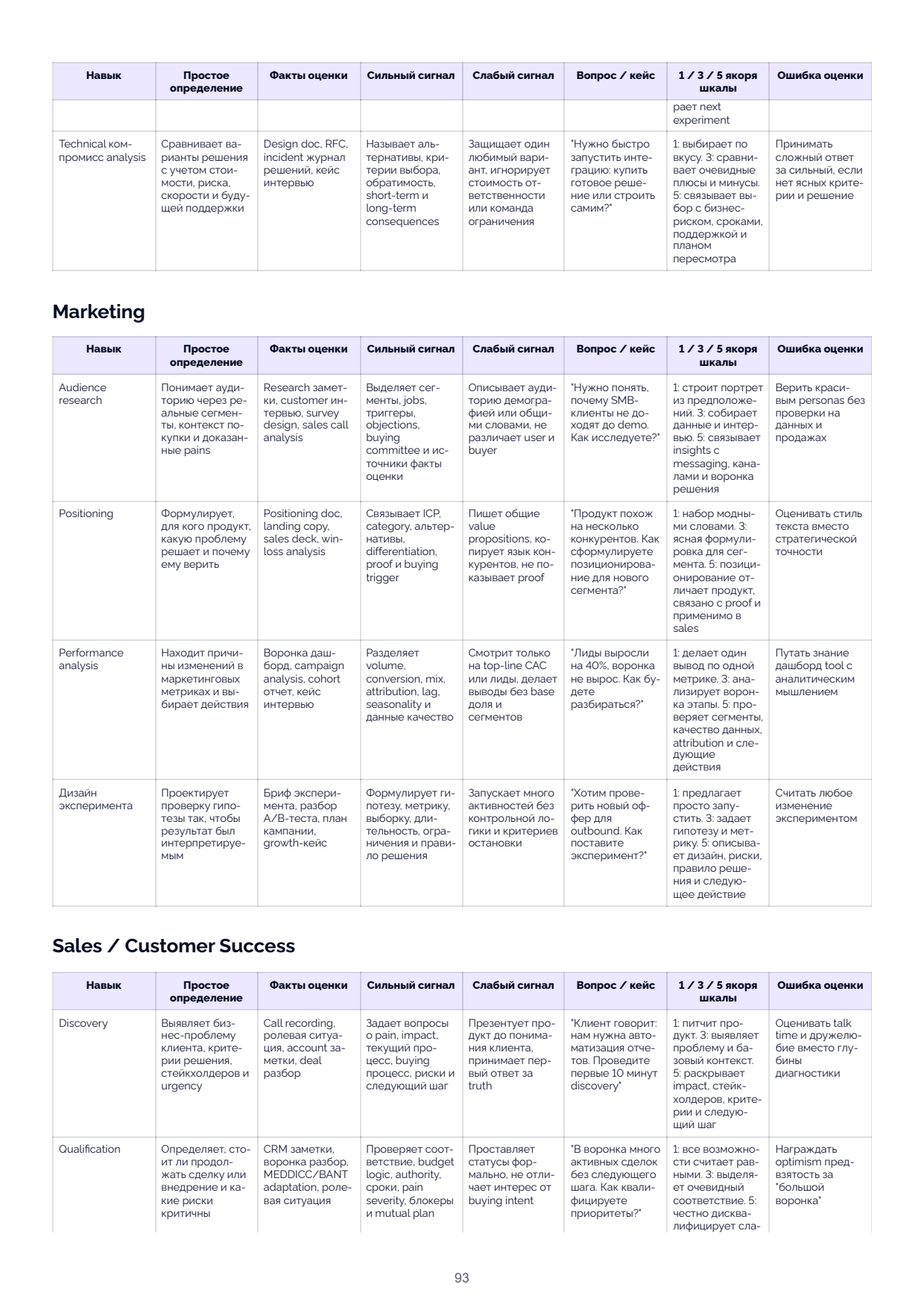
| Technical trade-off analysis | Compares solution options against cost, risk, speed and future support | Design doc, RFC, incident decision log, case interview | Names alternatives, selection criteria, reversibility, short-term and long-term consequences | Defends one favourite option, ignores ownership cost or team constraints | "We need to ship an integration quickly: buy an off-the-shelf solution or build in-house?" | 1: chooses by preference. 3: compares obvious pros and cons. 5: links choice to business risk, deadlines, support and review plan | Taking a complex answer for a strong one if there are no clear criteria and decision logic |
| Marketing | |||||||
| Skill | Simple definition | Assessment facts | Strong signal | Weak signal | Question / case | 1/3/5 scale anchors | Rating error |
| Audience research | Understands the audience through real segments, purchase context and proven pains | Research notes, customer interviews, survey design, sales call analysis | Identifies segments, jobs, triggers, objections, buying committee and fact sources | Describes the audience by demographics or vague terms, does not distinguish user and buyer | "We need to understand why SMB clients drop off before demo. How would you research this?" | 1: builds a persona from assumptions. 3: collects data and interviews. 5: links insights to messaging, channels and funnel decisions | Believing attractive personas without checking data and sales |
| Positioning | Defines who the product is for, what problem it solves and why it should be trusted | Positioning doc, landing copy, sales deck, win-loss analysis | Links ICP, category, alternatives, differentiation, proof and buying trigger | Writes generic value propositions, copies competitor language, does not show proof | "The product looks like several competitors. How would you formulate positioning for a new segment?" | 1: a set of trendy words. 3: a clear formulation for a segment. 5: positioning differentiates the product, links to proof and applies in sales | Assessing writing style instead of strategic accuracy |
| Performance analysis | Finds causes of changes in marketing metrics and selects actions | Funnel dashboard, campaign analysis, cohort report, case interview | Separates volume, conversion, mix, attribution, lag, seasonality and data quality | Looks only at top-line CAC or leads, draws conclusions without base rate and segments | "Leads grew by 40%, the funnel did not grow. How would you investigate?" | 1: draws one conclusion from one metric. 3: analyses funnel stages. 5: checks segments, data quality, attribution and next actions | Confusing knowledge of a dashboard tool with analytical thinking |
| Experiment design | Designs hypothesis testing so the result is interpretable | Experiment brief, A/B test review, campaign plan, growth case | Formulates hypothesis, metric, sample size, duration, constraints and decision rule | Launches many activities without control logic and stop criteria | "We want to test a new outbound offer. How would you design the experiment?" | 1: suggests just launching. 3: sets a hypothesis and metric. 5: describes design, risks, decision rule and next action | Counting any change as an experiment |
| Sales / Customer Success | |||||||
| Skill | Simple definition | Assessment facts | Strong signal | Weak signal | Question / case | 1/3/5 scale anchors | Rating error |
| Discovery | Uncovers the client's business problem, decision criteria, stakeholders and urgency | Call recording, role-play scenario, account notes, deal review | Asks about pain, impact, current process, buying process, risks and next step | Presents the product before understanding the client, accepts the first answer as truth | "The client says: we need report automation. Run the first 10 minutes of discovery." | 1: pitches the product. 3: uncovers the problem and basic context. 5: reveals impact, stakeholders, criteria and next step | Assessing talk time and friendliness instead of diagnostic depth |
| Qualification | Determines whether to continue a deal or implementation and which risks are critical | CRM notes, funnel review, MEDDICC/BANT adaptation, role-play scenario | Checks fit, budget logic, authority, timeline, pain severity, blockers and mutual plan | Updates statuses formally, does not distinguish interest from buying intent | "The funnel has many active deals with no next step. How would you qualify priorities?" | 1: treats all opportunities as equal. 3: identifies obvious fit. 5: honestly disqualifies weak deals and explains risk-adjusted forecast | Rewarding optimism bias for a "big funnel" |
| Skill | Simple definition | Assessment facts | Strong signal | Weak signal | Question / case | 1/3/5 scale anchors | Rating error |
|---|---|---|---|---|---|---|---|
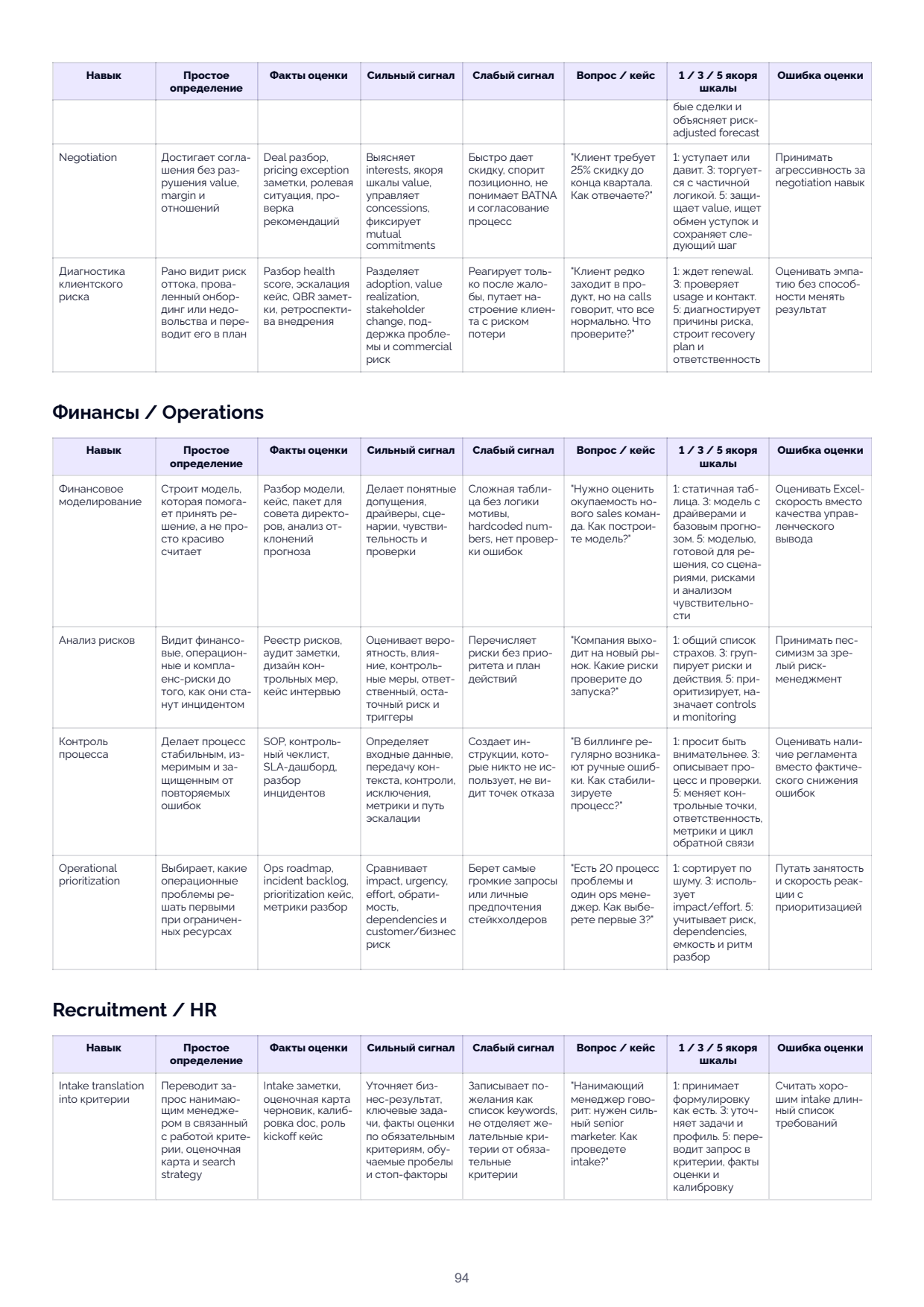
| Negotiation | Reaches agreement without destroying value, margin and relationships | Deal review, pricing exception notes, role-play scenario, reference check | Discovers interests, anchors value, manages concessions, captures mutual commitments | Quickly gives a discount, argues positionally, does not understand BATNA and alignment process | "The client demands a 25% discount before the quarter ends. How do you respond?" | 1: concedes or pressures. 3: trades with partial logic. 5: defends value, seeks trade-offs and preserves the next step | Taking aggression for negotiation skill |
| Client risk diagnostics | Early warning of churn risk, failed onboarding or dissatisfaction; translates it into a plan | Health score review, escalation case, QBR notes, implementation retrospective | Separates adoption, value realisation, stakeholder change, support issues and commercial risk | Reacts only after a complaint, confuses client mood with churn risk | "The client rarely logs into the product, but on calls says everything is fine. What would you check?" | 1: waits for renewal. 3: checks usage and contact. 5: diagnoses risk causes, builds a recovery plan and ownership | Assessing empathy without the ability to change outcomes |
| Finance / Operations | |||||||
| Skill | Simple definition | Assessment facts | Strong signal | Weak signal | Question / case | 1/3/5 scale anchors | Rating error |
| Financial modelling | Builds a model that supports a decision, not just one that calculates prettily | Model review, case, board pack, forecast variance analysis | Makes clear assumptions, drivers, scenarios, sensitivity and checks | Complex spreadsheet with no logic, hardcoded numbers, no error checks | "We need to assess the payback period for a new sales team. How would you build the model?" | 1: a static spreadsheet. 3: model with drivers and a baseline forecast. 5: a model ready for a decision, with scenarios, risks and sensitivity analysis | Assessing Excel speed instead of quality of management insight |
| Risk analysis | Sees financial, operational and compliance risks before they become incidents | Risk register, audit notes, control design, case interview | Assesses likelihood, impact, controls, owner, residual risk and triggers | Lists risks without prioritisation or action plan | "The company is entering a new market. Which risks would you check before launch?" | 1: a general list of worries. 3: groups risks and actions. 5: prioritises, assigns controls and monitoring | Taking pessimism for mature risk management |
| Process control | Makes the process stable, measurable and protected against repeated errors | SOP, control checklist, SLA dashboard, incident review | Defines inputs, context handover, controls, exceptions, metrics and escalation path | Creates instructions nobody uses, does not see failure points | "Billing regularly has manual errors. How would you stabilise the process?" | 1: asks people to be more careful. 3: describes the process and checks. 5: changes control points, ownership, metrics and the feedback loop | Assessing the existence of a procedure instead of actual error reduction |
| Operational prioritisation | Selects which operational problems to solve first under limited resources | Ops roadmap, incident backlog, prioritisation case, metrics review | Compares impact, urgency, effort, reversibility, dependencies and customer/business risk | Takes the loudest requests or personal stakeholder preferences | "There are 20 process problems and one ops manager. How would you pick the first 3?" | 1: sorts by noise. 3: uses impact/effort. 5: considers risk, dependencies, capacity and review cadence | Confusing busyness and reaction speed with prioritisation |
| Recruitment / HR | |||||||
| Skill | Simple definition | Assessment facts | Strong signal | Weak signal | Question / case | 1/3/5 scale anchors | Rating error |
| Intake translation into criteria | Translates a hiring manager's request into work-related criteria, a scorecard and search strategy | Intake notes, scorecard draft, calibration doc, role kickoff case | Clarifies business outcome, key tasks, assessment facts for must-have criteria, trainable gaps and stop factors | Records wishes as a keyword list, does not separate nice-to-have criteria from must-have criteria | "The hiring manager says: we need a strong senior marketer. How would you run the intake?" | 1: accepts the brief as-is. 3: clarifies tasks and profile. 5: translates the request into criteria, assessment facts and calibration | Counting a long list of requirements as a good intake |
| Skill | Simple definition | Assessment facts | Strong signal | Weak signal | Question / case | 1/3/5 scale anchors | Rating error |
|---|---|---|---|---|---|---|---|
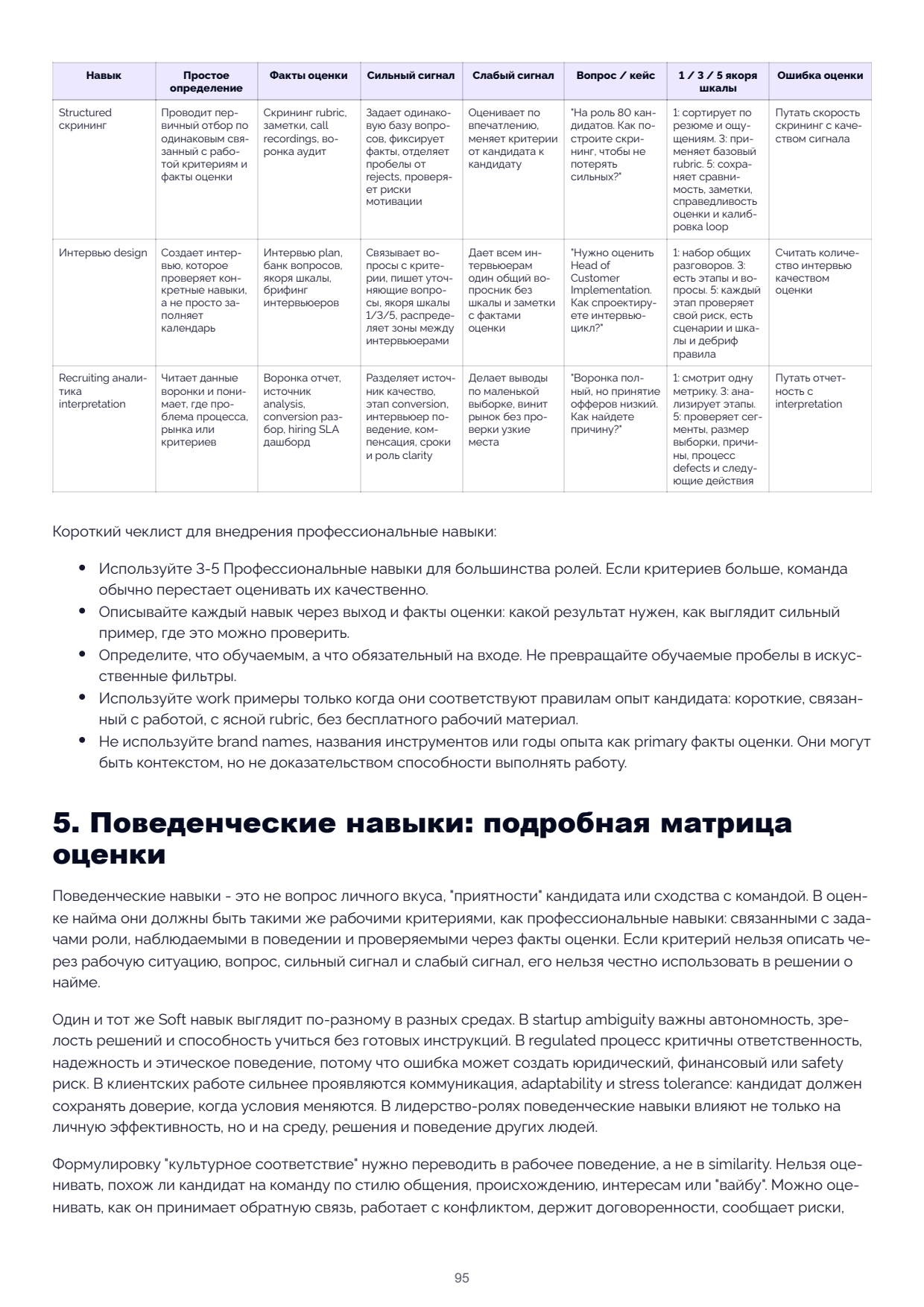
| Structured screening | Runs a first-pass selection against identical work-related criteria and assessment facts | Screening rubric, notes, call recordings, funnel audit | Asks a consistent baseline of questions, records facts, separates gaps from rejections, checks motivation risks | Assesses by impression, changes criteria from candidate to candidate | "For the role there are 80 candidates. How would you structure screening to avoid losing strong ones?" | 1: sorts by CV and feelings. 3: applies a basic rubric. 5: preserves comparability, notes, assessment fairness and calibration loop | Confusing screening speed with signal quality |
| Interview design | Creates interviews that check specific skills, not just fill the calendar | Interview plan, question bank, scale anchors, interviewer briefing | Links questions to criteria, writes follow-up questions, 1/3/5 scale anchors, distributes areas between interviewers | Gives all interviewers one generic questionnaire without scales or assessment fact notes | "We need to assess a Head of Customer Implementation. How would you design the interview cycle?" | 1: a set of generic chats. 3: has stages and questions. 5: each stage checks its own risk, has scenarios and scales and debrief rules | Counting the number of interviews as assessment quality |
| Recruiting analytics interpretation | Reads funnel data and understands where the problem is: process, market or criteria | Funnel report, source analysis, conversion review, hiring SLA dashboard | Separates source quality, stage conversion, interviewer behaviour, compensation, timeline and role clarity | Draws conclusions from a small sample, blames the market without checking bottlenecks | "The funnel is full but offer acceptance is low. How would you find the cause?" | 1: looks at one metric. 3: analyses stages. 5: checks segments, sample size, causes, process defects and next actions | Confusing reporting with interpretation |
5. Behavioural skills: a detailed assessment
matrix
Behavioural skills are not a matter of personal taste, candidate "likeability" or similarity to the team. In hiring
assessment they must be work-related criteria just like professional skills: linked to the role's tasks, observable
in behaviour and verifiable through assessment facts. If a criterion cannot be described through a work
situation, question, strong signal and weak signal, it cannot be honestly used in a hiring decision.
The same soft skill looks different across environments. In a start-up, what matters is autonomy, decision
maturity and the ability to learn without ready-made instructions. In a regulated process, what matters is
accountability, reliability and ethical behaviour, because an error can create legal, financial or safety
risk. In client-facing work, communication, adaptability and stress tolerance are more prominent: the candidate must
maintain trust when conditions change. In leadership roles, behavioural skills affect not just personal
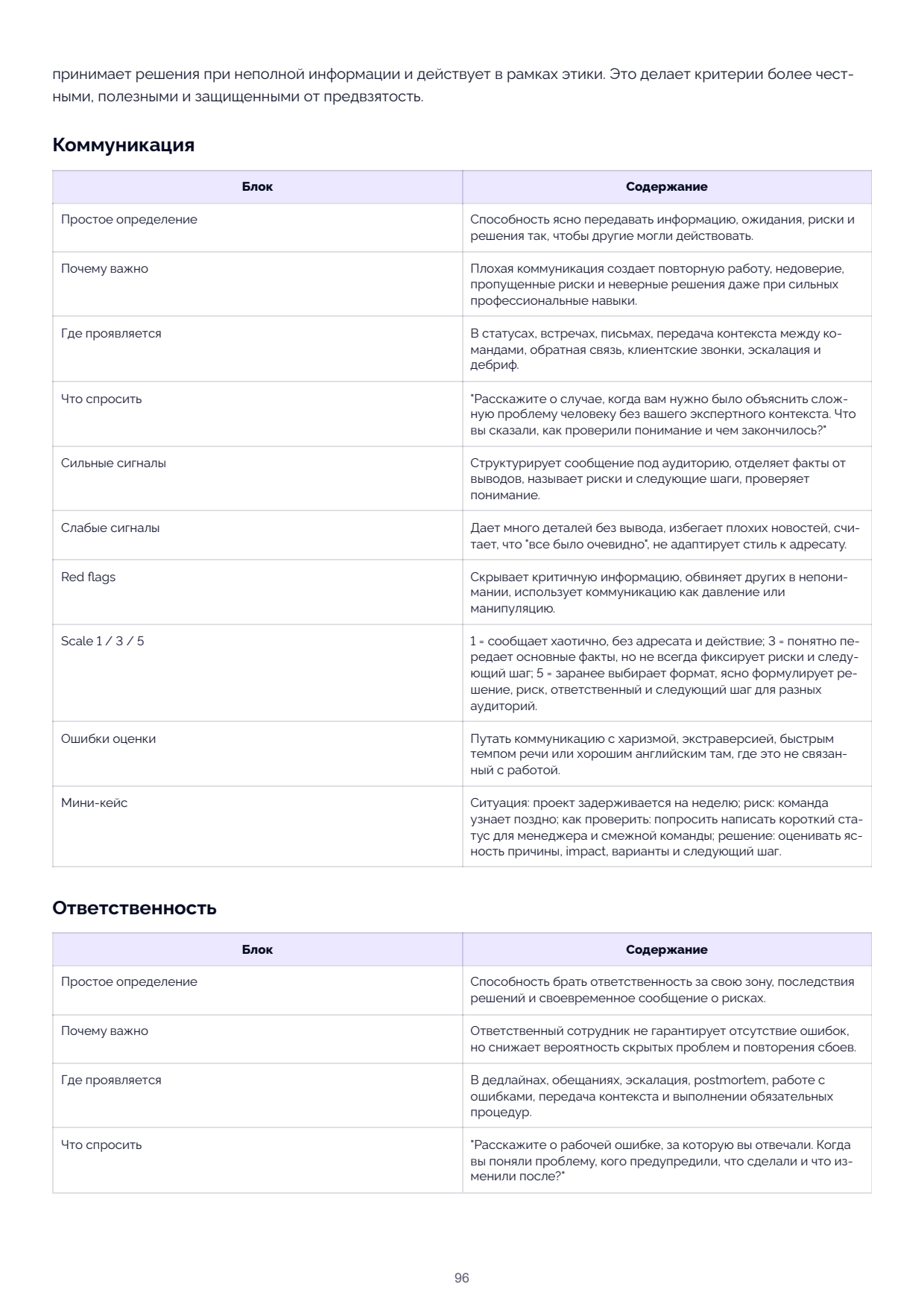
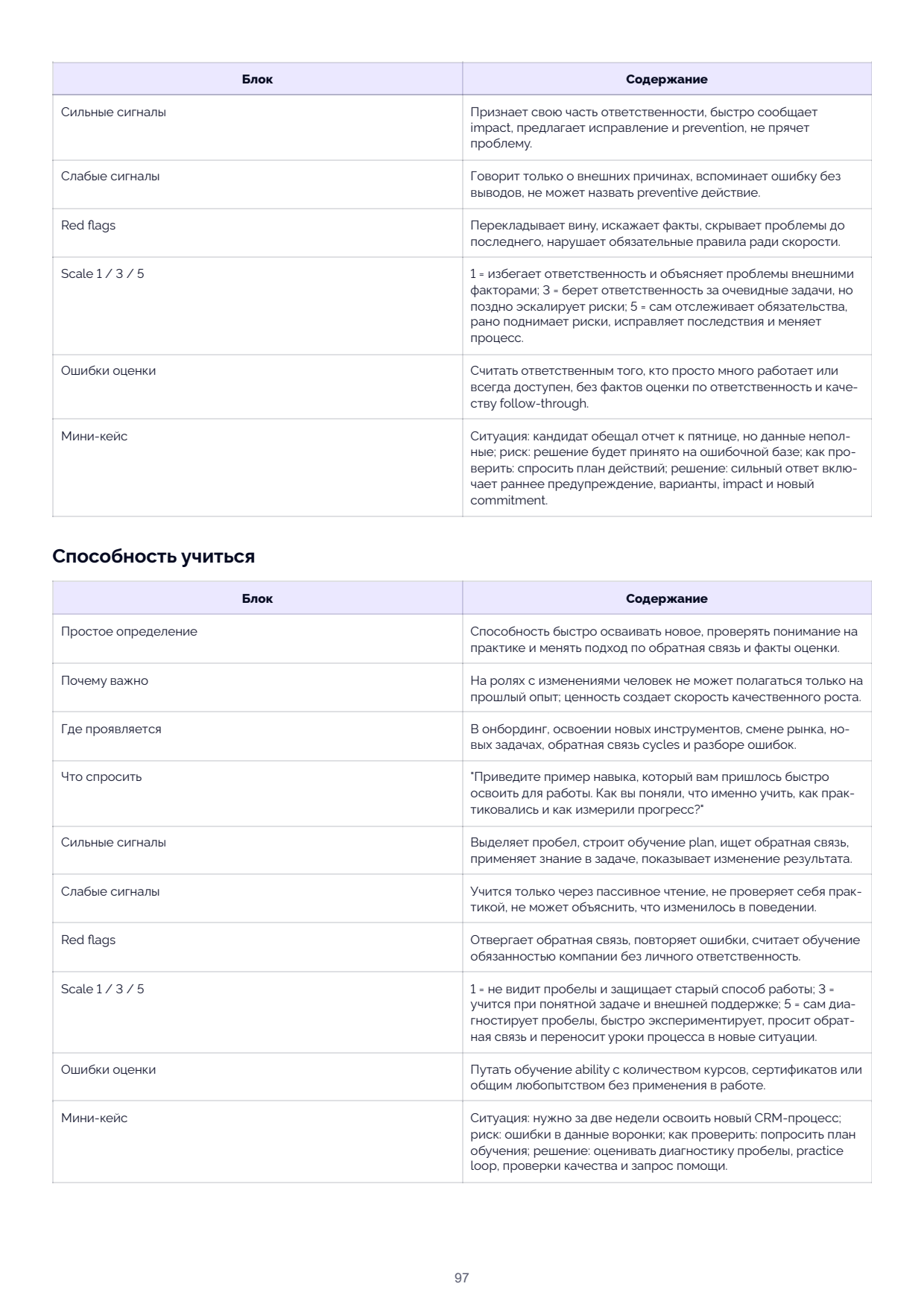
effectiveness, but the environment, decisions and behaviour of others.
The term "cultural fit" must be translated into work behaviour, not similarity. You must not assess
whether a candidate resembles the team in communication style, background, interests or "vibe". You can assess
how they accept feedback, handle conflict, keep commitments, report risks,
make decisions with incomplete information and act within ethical boundaries. This makes criteria fairer,
more useful and protected from bias.
Communication
Block Content
Simple definition The ability to convey information, expectations, risks and
decisions clearly so that others can act.
Why it matters Poor communication creates rework, mistrust,
missed risks and wrong decisions even with strong
professional skills.
Where it shows up In statuses, meetings, emails, context handover between teams,
feedback, client calls, escalation and debrief.
What to ask "Tell me about a time when you had to explain a complex
problem to someone without your expert context. What
did you say, how did you verify understanding and how did it end?"
Strong signals Structures the message for the audience, separates facts from
conclusions, names risks and next steps, checks understanding.
Weak signals Gives lots of detail without a conclusion, avoids bad news, assumes
"it was obvious", does not adapt style to the recipient.
Red flags Withholds critical information, blames others for not
understanding, uses communication as pressure or manipulation.
Scale 1/3/5 1 = communicates chaotically, without a recipient and action; 3 = clearly
conveys key facts, but does not always capture risks and the
next step; 5 = proactively chooses the format, clearly states the
decision, risk, owner and next step for different audiences.
Rating errors Confusing communication with charisma, extroversion, fast
speech or good English where it is not work-related.
Mini-case Situation: a project is delayed by a week; risk: the team
finds out late; how to verify: ask the candidate to write a short
status for the manager and a neighbouring team; decision:
assess clarity of cause, impact, options and next step.
Accountability
Block Content
Simple definition The ability to take responsibility for one's area, the consequences
of decisions and the timely reporting of risks.
Why it matters An accountable person does not guarantee the absence of errors,
but reduces the likelihood of hidden problems and repeated failures.
Where it shows up In deadlines, promises, escalations, post-mortems, handling
errors, context handover and completing mandatory procedures.
What to ask "Tell me about a work error you were responsible for. When did
you realise the problem, who did you warn, what did you do and what did you
change afterwards?"
| Block | Content |
|---|---|
| Strong signals | Acknowledges their part of the responsibility, quickly reports impact, proposes a fix and prevention, does not hide the problem. |
| Weak signals | Only talks about external causes, recalls the error without lessons learned, cannot name a preventive action. |
| Red flags | Shifts blame, distorts facts, hides problems until the last moment, breaks mandatory rules for speed. |
| Scale 1/3/5 | 1 = avoids responsibility and explains problems by external factors; 3 = takes responsibility for obvious tasks but escalates risks late; 5 = tracks their own commitments, raises risks early, fixes consequences and changes the process. |
| Rating errors | Counting someone as accountable merely because they work a lot or are always available, without assessment facts on accountability and quality of follow-through. |
| Mini-case | Situation: the candidate promised a report by Friday, but the data is incomplete; risk: the decision will be based on faulty data; how to verify: ask for an action plan; decision: a strong answer includes an early warning, options, impact and a new commitment. |
| Ability to learn | |
| Block | Content |
| Simple definition | The ability to quickly pick up new skills, verify understanding in practice and adjust approach based on feedback and assessment facts. |
| Why it matters | In roles with change, the person cannot rely solely on past experience; the value they create comes from the speed of quality growth. |
| Where it shows up | In onboarding, mastering new tools, changing markets, new tasks, feedback cycles and error reviews. |
| What to ask | "Give an example of a skill you had to learn quickly for a role. How did you identify what to study, how did you practise and how did you measure progress?" |
| Strong signals | Identifies a gap, builds a learning plan, seeks feedback, applies knowledge to tasks, demonstrates a change in outcome. |
| Weak signals | Learns only through passive reading, does not test themselves in practice, cannot explain what changed in their behaviour. |
| Red flags | Rejects feedback, repeats errors, treats learning as the company's duty without personal accountability. |
| Scale 1/3/5 | 1 = does not see gaps and defends the old way of working; 3 = learns when the task is clear and with external support; 5 = independently diagnoses gaps, experiments quickly, asks for feedback and transfers lessons to new situations. |
| Rating errors | Confusing the ability to learn with the number of courses, certificates or general curiosity without application to the work. |
| Mini-case | Situation: you need to master a new CRM process within two weeks; risk: errors in funnel data; how to verify: ask for a learning plan; decision: assess gap diagnosis, practice loop, quality checks and willingness to ask for help. |