Chapter 7. Motivation and Signal Reliability


| Block | Analysis |
|---|---|
| Metric / next action | Track how often candidates with strong professional skills and weak behavioural skills progress further, which soft gaps emerge during the probationary period, and whether they align with interview assessment facts. |
| Case 2. Average professional skills, strong behavioural skills, and high potential | |
| Block | Analysis |
| Situation | The candidate does not meet all professional skill requirements at the current level, but demonstrates strong learnability, structured communication, responsibility, mature motivation, and a clear growth trajectory. |
| Risk | The team may either over-score due to fondness and "potential", or lose a strong future hire because of a rigid requirement for full alignment with the vacancy. |
| What to check | Which professional skills are essential from day one, which can be taught; how long the productivity ramp-up costs; whether the manager has capacity for development; and whether high potential is confirmed by assessment facts rather than a gut feeling of confidence. |
| Questions / assessment facts | "What skill did you pick up fastest in the past 12 months? How did you identify the gap, how did you practise, who gave feedback, and what changed?" "Here is a task from this role. What can you already do, where will the gap be, and how will you close it in the first 30 days?" |
| Recommended action | Use hire / do not hire not as a binary argument of "strong or weak", but as a levelled decision: whether to hire at the current level, a lower level, an intern trajectory, or not at all. High potential requires a clear development plan, not wishful thinking. |
| How to document | "Professional skill gap: has not run enterprise onboarding end-to-end. Assessment facts — potential: within three months mastered a new system, reduced manual errors, requested feedback, and updated the SOP. Hiring condition: Level M, 60-day productivity ramp-up plan, designated mentor." |
| Metric / next action | Compare the predicted productivity ramp-up with the actual time to independent work. Each quarter, check whether "potential" is becoming an informal criterion without assessment facts. |
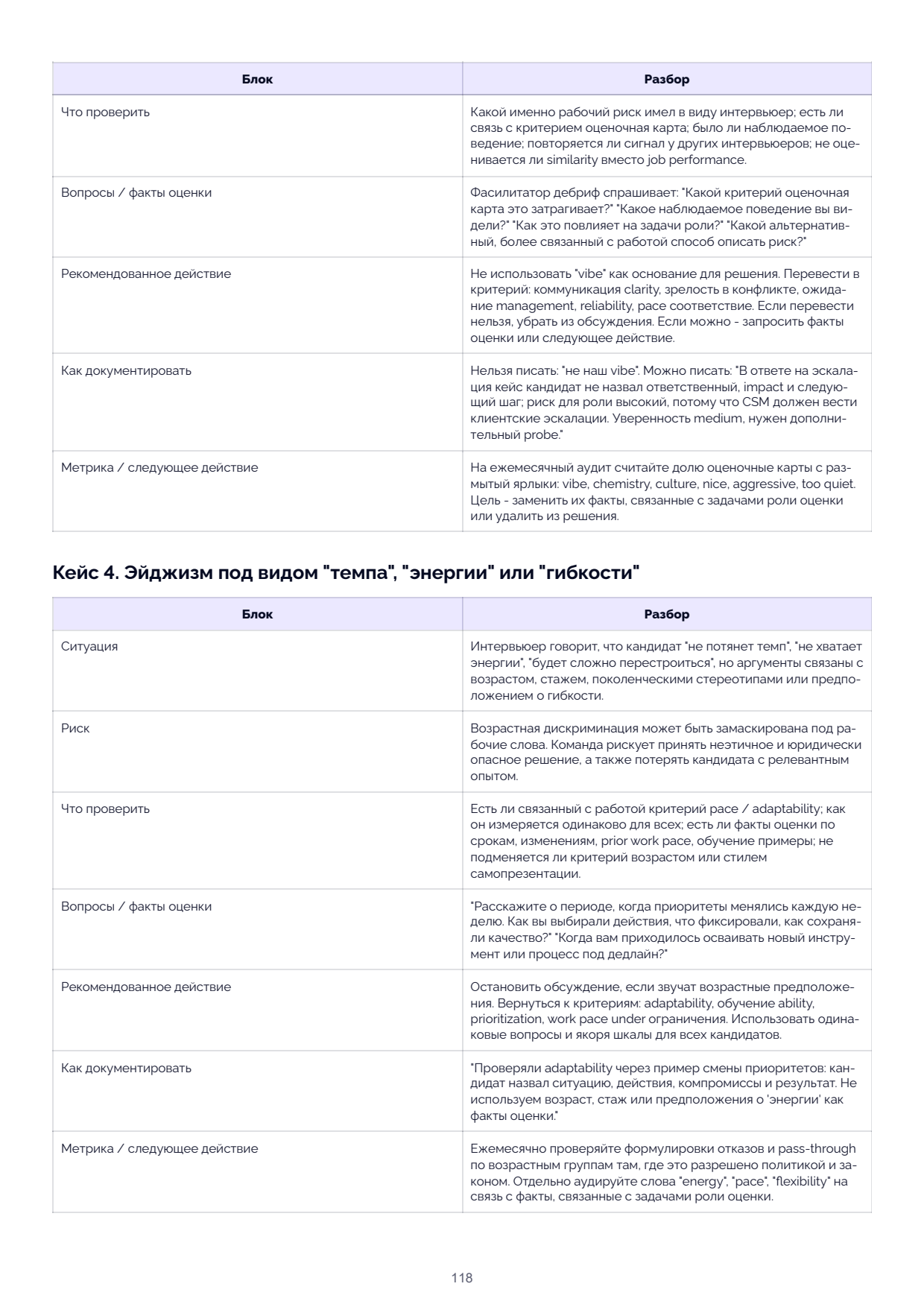
| Case 3. "Not our vibe" as a behavioural assessment error | |
| Block | Analysis |
| Situation | After the interview the feedback sounds like: "Candidate is not our vibe", "won't fit", "something feels off", "no chemistry". Yet the scorecard shows no specific work-related behaviour. |
| Risk | Such wording may mask bias, similarity preference, a reaction to speech style, age, accent, introversion, cultural background, or the interviewer's personal preferences. The decision becomes unprotected and uncalibrated. |
| Block | Analysis |
|---|---|
| What to check | What specific work risk the interviewer had in mind; whether it links to a scorecard criterion; whether the behaviour was observed; whether other interviewers saw the same signal; whether similarity is being assessed instead of job performance. |
| Questions / assessment facts | The debrief facilitator asks: "Which scorecard criterion does this affect?" "What observed behaviour did you see?" "How would this affect the role's tasks?" "What alternative, more work-related way of describing the risk is there?" |
| Recommended action | Do not use "vibe" as a basis for a decision. Translate it into a criterion: communication clarity, conflict maturity, expectation management, reliability, pace fit. If it cannot be translated, remove it from the discussion. If it can, request assessment facts or the next action. |
| How to document | Do not write: "not our vibe". Write: "In the escalation case response the candidate did not name the accountable person, impact, or next step; risk for the role is high because a CSM must handle client escalations. Confidence: medium; an additional probe is needed." |
| Metric / next action | For the monthly audit, count the proportion of scorecards with vague labels: vibe, chemistry, culture, nice, aggressive, too quiet. The goal is to replace them with task-related assessment facts or remove them from the decision. |
| Case 4. Ageism disguised as "pace", "energy", or "flexibility" | |
| Block | Analysis |
| Situation | The interviewer says the candidate "can't keep up the pace", "lacks energy", "will struggle to adapt", but the arguments relate to age, tenure, generational stereotypes, or assumptions about flexibility. |
| Risk | Age discrimination may be disguised behind professional-sounding language. The team risks making an unethical and legally dangerous decision, and also losing a candidate with relevant experience. |
| What to check | Is there a work-related criterion for pace / adaptability; how it is measured consistently for all; whether there are assessment facts regarding deadlines, changes, prior work pace, and learning examples; and whether the criterion is being substituted by age or self-presentation style. |
| Questions / assessment facts | "Tell me about a period when priorities changed every week. How did you choose actions, what did you track, and how did you maintain quality?" "When did you have to pick up a new tool or process under a deadline?" |
| Recommended action | Stop the discussion if age-based assumptions arise. Return to the criteria: adaptability, learning ability, prioritisation, work pace under constraints. Use identical questions and scale anchors for all candidates. |
| How to document | "We assessed adaptability through a priority-change example: the candidate named the situation, actions, compromises, and result. We do not use age, tenure, or assumptions about 'energy' as assessment facts." |
| Metric / next action | Monthly, review rejection and pass-through wording by age group where permitted by policy and the law. Separately audit the words "energy", "pace", "flexibility" for links to task-related assessment facts. |
| Block | Analysis |
|---|---|
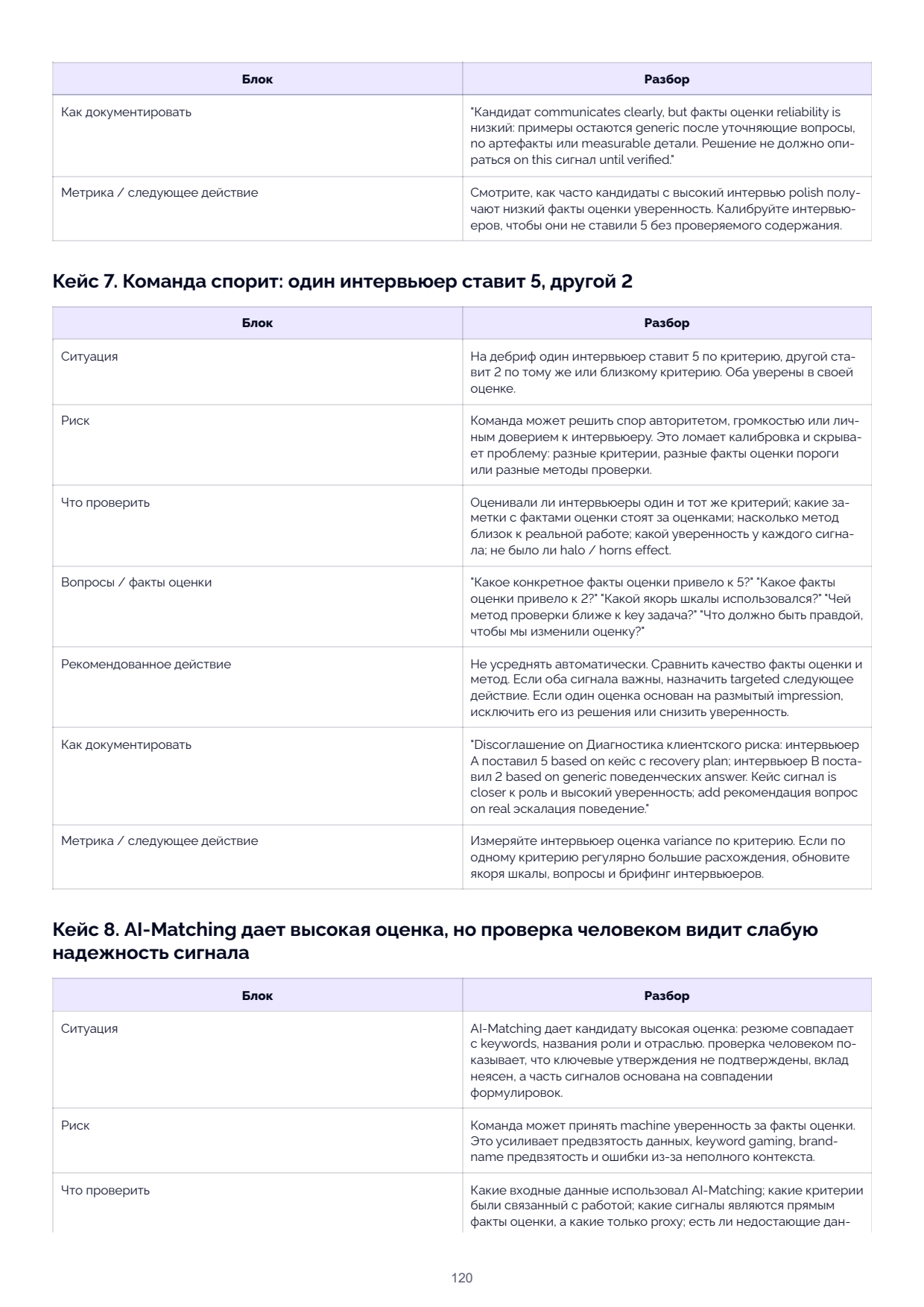
| How to document | "Candidate communicates clearly, but assessment facts on reliability are weak: examples remain generic after probing, no artefacts or measurable details. The decision should not rely on this signal until verified." |
| Metric / next action | Monitor how often candidates with high interview polish receive low assessment-fact confidence. Calibrate interviewers so that they do not award 5 without verifiable substance. |
| Case 7. The team disagrees: one interviewer scores 5, another scores 2 | |
| Block | Analysis |
| Situation | At the debrief, one interviewer scores 5 on a criterion and another scores 2 on the same or a similar criterion. Both are confident in their assessment. |
| Risk | The team may settle the dispute by authority, volume, or personal trust in the interviewer. This breaks calibration and hides the real problem: different criteria, different assessment-fact thresholds, or different verification methods. |
| What to check | Whether the interviewers assessed the same criterion; what assessment-fact notes support each score; how close the method is to real work; what confidence each signal carries; and whether a halo / horns effect was at play. |
| Questions / assessment facts | "Which specific assessment fact led to the 5?" "Which fact led to the 2?" "Which scale anchor was used?" "Whose method is closer to the key task?" "What would have to be true for us to change the score?" |
| Recommended action | Do not average automatically. Compare the quality of assessment facts and method. If both signals are important, assign a targeted next action. If one score rests on a vague impression, exclude it from the decision or lower its weight. |
| How to document | "Disagreement on Diagnosing client risk: Interviewer A scored 5 based on a case with a recovery plan; Interviewer B scored 2 based on a generic behavioural answer. The case signal is closer to the role and carries higher confidence; add a follow-up question on real escalation behaviour." |
| Metric / next action | Measure interviewer-score variance by criterion. If one criterion regularly produces large discrepancies, update the scale anchors, questions, and interviewer briefing. |
| Block | Analysis |
|---|---|
| whether the high score can be explained by clear factors. | |
| Questions / assessment facts | "Which three facts support the high score?" "What did the candidate do personally?" "Which must-have criteria are unconfirmed?" "Which words in the CV may have created a false positive?" "What next action is needed before a decision?" |
| Recommended action | Use AI-Matching as a hypothesis for debrief, not a decision. Bring only human-validated assessment facts into the debrief. If the signal is weak, do not advance the candidate solely because of the AI score; assign a screening or a targeted probe. |
| How to document | "AI-Matching high due to job title and industry keywords. Human review: assessment facts on must-have criteria for implementation responsibility not confirmed; signal reliability is low. Next step: recruiter screen focused on personal contribution, project scale, and client escalation." |
| Metric / next action | Compare AI-Matching scores with human assessment-fact confidence, stage progression, and reasons for rejection. Audit false positives and false negatives, especially for critical roles. |
9. Using HarmonyATS as an example
In HarmonyATS, the scorecard, interview notes, and AI-Matching CV can be stored alongside
the candidate card so that the debrief is grounded in assessment facts rather than interviewer memory. This is an
example of a working loop, not a mandatory implementation approach.
In HarmonyATS, AI-Matching works well as a hypothesis list: why the candidate may
be relevant, which claims need verifying, and where signal reliability is still low. The decision
remains with the human and the approved scorecard.
In HarmonyATS, the decision log and debrief notes help record which criteria were
discussed, which assessment facts were accepted, which were rejected as unconfirmed, and who owns the
next step. This reduces reliance on verbal agreements after the interview.
In HarmonyATS, analytics on completed scorecards, score variance, missing
assessment facts, stage conversion, and time-to-decision can be used as quality signals for assessment. They
do not prove hiring quality on their own, but show where the process requires calibration.
10. Implementation plan: 1 day, 1 week, 1 month
What to do in 1 day
Action Result Owner Artifact
Choose one active role to run Recruiting lead + The role name, stage, list
as a pilot The pilot is contained and does not hiring manager of interviewers
disrupt the entire hiring process
Formulate the business case The team understands why the Hiring manager 1–2 sentences on the role's
for the role exists result
List 5–8 key tasks Criteria derive from the actual Hiring manager + Task list with impact
work, not the CV recruiter
Select 6–8 assessment The scorecard is not overloaded Recruiter Professional skills,
criteria behavioural skills, motivation
risks, signal reliability
Remove vague labels "Culture fit" and "vibe" replaced Recruiter List of banned labels and
with observable behaviours replacements
Define decision options The debrief does not become a Recruiting lead Advance, reject, place on
free-form argument hold, clarify, prepare offer
What to do in 1 week
Action Result Owner Artifact
Create a scorecard with Interviewers assess the same Recruiter + hiring Scorecard template
1 / 3 / 5 scale anchors criteria manager
Divide interview zones Each stage tests its own risk Recruiting lead Interview-cycle map
Prepare structured and Interviewers tie questions to Interview owners Question bank
probing questions criteria and assessment facts
Brief the interviewers Everyone understands the scale Recruiting lead Briefing notes
anchors, notes, and do-not-score
rules
Launch the debrief SOP The decision is discussed based Recruiter Debrief agenda and log
on assessment facts, not opinions
Check the AI process if It does not make decisions and Process owner AI-human review
in use does not add new criteria checklist
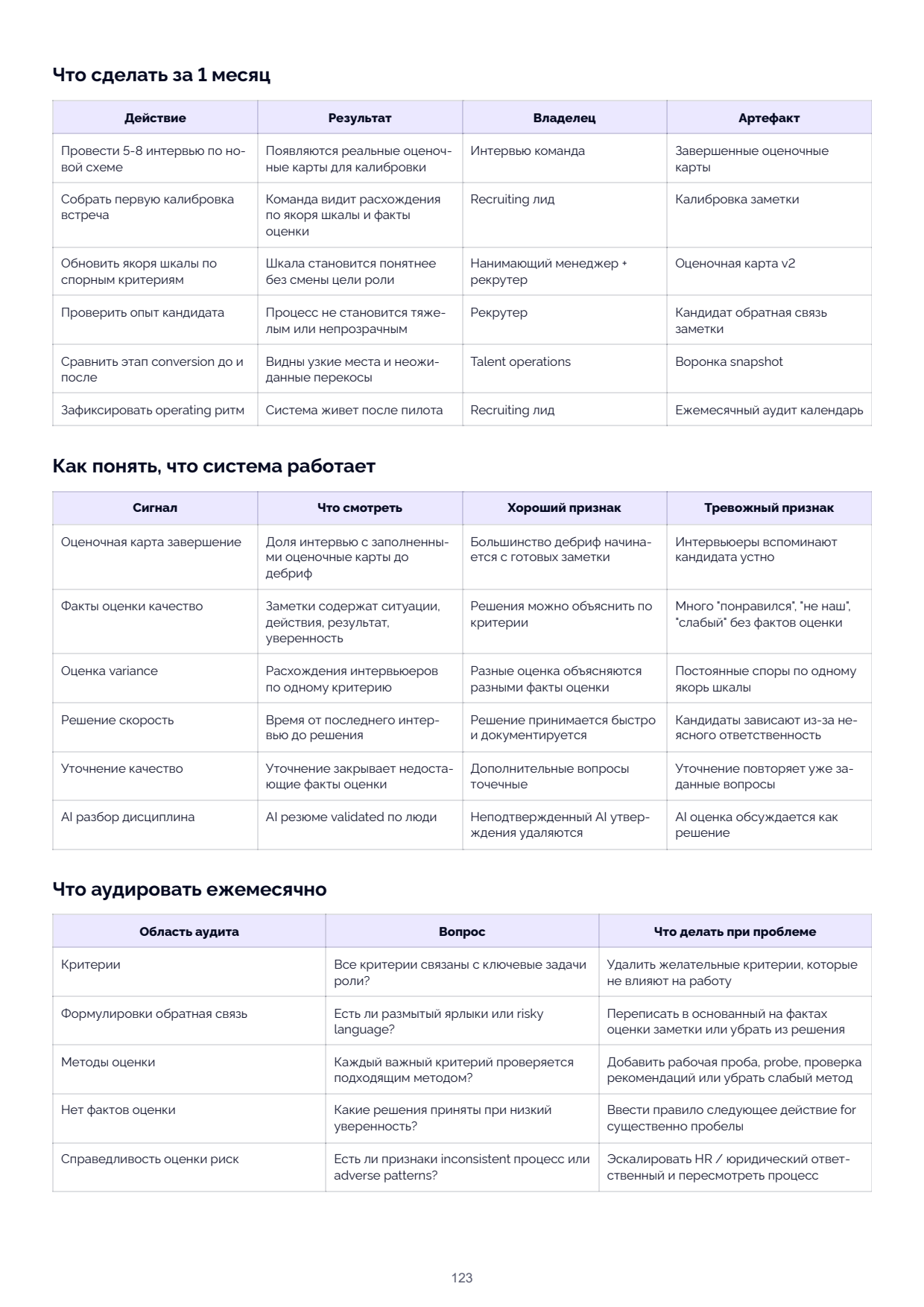
| What to do in 1 month | |||
|---|---|---|---|
| Action | Result | Owner | Artifact |
| Run 5–8 interviews under the new scheme | Real scorecards appear for calibration | Interview team | Completed scorecards |
| Hold the first calibration meeting | The team sees discrepancies in scale anchors and assessment facts | Recruiting lead | Calibration notes |
| Update scale anchors for contested criteria | The scale becomes clearer without changing the role's purpose | Hiring manager + recruiter | Scorecard v2 |
| Check candidate experience | The process does not become burdensome or opaque | Recruiter | Candidate feedback notes |
| Compare stage conversion before and after | Bottlenecks and unexpected skew become visible | Talent operations | Funnel snapshot |
| Establish the operating rhythm | The system lives on after the pilot | Recruiting lead | Monthly audit calendar |
| How to tell whether the system is working | |||
| Signal | What to look at | Good sign | Warning sign |
| Scorecard completion | Share of interviews with completed scorecards before debrief | Most debriefs start with ready notes | Interviewers recall the candidate from memory |
| Assessment-fact quality | Notes contain situations, actions, results, and confidence | Decisions can be explained by criterion | Many "liked them", "not our sort", "weak" without assessment facts |
| Score variance | Interviewer discrepancies on a single criterion | Different scores explained by different assessment facts | Recurring arguments about a single scale anchor |
| Decision speed | Time from last interview to decision | Decision is taken quickly and documented | Candidates stall due to unclear accountability |
| Clarification quality | Probing closes the missing assessment-fact gaps | Follow-up questions are targeted | Probing repeats already-asked questions |
| AI review discipline | AI CVs validated by humans | Unconfirmed AI claims are removed | AI score is discussed as a final decision |
| What to audit monthly | |||
| Audit area | Question | Action when a problem is found | |
| Criteria | Are all criteria linked to key tasks of the role? | Remove nice-to-have criteria that do not affect performance | |
| Feedback wording | Are there vague labels or risky language? | Rewrite as assessment-fact notes or remove from the decision | |
| Assessment methods | Is each important criterion checked by an appropriate method? | Add a work sample, probe, or reference check; or drop the weak method | |
| Missing assessment facts | Which decisions were taken at low confidence? | Introduce a next-action rule for material gaps | |
| Fairness / assessment risk | Are there signs of inconsistent process or adverse patterns? | Escalate to HR / legal and review the process |
| Audit area | Question | Action when a problem is found |
|---|---|---|
| AI usage | Have all AI outputs passed human review? | Block the use of unconfirmed CVs in the debrief |
| Calibration | Which scale anchors cause recurring arguments? | Update anchors, examples, and the interviewer briefing |
| Outcomes | Which interview predictions did not match work performance / productivity ramp-up? | Return to the skills model and signal-reliability check |
| Key takeaways from this chapter / where to go next | ||
| What you need | Where to find it | |
| Terms and short definitions | Appendix B. Mini glossary | |
| Ready-made processes and SLAs | Appendix D. Ready-made processes and procedures | |
| Working templates | Appendix E. Template library | |
| End-to-end BDM and Backend examples | Appendix F. End-to-end case studies: BDM and Backend | |
| Full AI prompts for this chapter | Appendix H. AI prompt library, section H4. Role, criteria, and assessment |
information, and signal reliability
How to use this chapter
Working scenario. A Backend Engineer candidate confidently describes a complex migration, but under
probing cannot explain which decisions they made themselves. A BDM says they want to "grow into strategic
sales", yet all their questions are about the fixed salary and quick bonuses. Both formally fit. In both cases the
team needs to understand not "is this a good person", but how reliable the signal is and whether the role
aligns with the candidate's genuine motivation.
What actually broke here: the team sees polished claims but does not yet know where personal contribution
lies, where context matters, where motivation sits, where risk lurks, and where data is simply missing. Chapter 6
covered what to assess: professional skills, behavioural skills, motivation, and signal reliability. Here we go
deeper into the last two layers.
Read this chapter as a practical anti-chaos tool. It does not teach you to "catch candidates out" and it does not
encourage suspicion of everyone. Its purpose is to make checks honest, work-related, and respectful: to
understand whether the role matches the person's expectations, which data may be incomplete, which signals
are strong, which are weak, and where a next step is needed rather than a hasty rejection.
Remember in a single phrase: signal reliability is tested through calm, work-related
clarifications, not through suspicion.
If your task is Go to section You will get
Understand candidate motivation 1–2 Motivator map, risks, and questions
Check hidden information 3 List of areas where data is often incomplete
Investigate exaggeration 4 Rules for verifying authorship, scale, and context
Set up a test assignment 5 The "one evening, paid or streamlined" rule
Roll out to agency / in-house recruitment 6–7 Process differences and accountability roles
Measure signal quality 8 Metrics on rejections, dropout, confidence, and offers
| If your task is | Go to section | You will get | |
|---|---|---|---|
| Use AI | 11 | Prompts with human review | |
| Quick chapter map | |||
| Object | Key question | Strong signal | Weak signal |
| Motivation | Why is the candidate choosing this role right now? | Specific motives, realistic expectations, clear compromises | Generic wording, contradictions, avoidance of specifics |
| Hidden information | What might the candidate, team, or market not fully disclose? | Open discussion of constraints and conditions | Material gaps in accessibility, compensation, authorship, or reasons for leaving |
| Deception risk | Where is the risk of deliberate distortion? | Verifiable facts, consistent story, willingness to discuss detail | Inability to explain one's own decisions, identically smooth answers without depth |
| Signal reliability | How much weight can the assessment facts carry? | Multiple independent signals, high confidence, work-related method | A single polished narrative, an AI score, an unconfirmed CV |
| Test assignment | Does the task reflect real work without exploitation? | Short, paid or streamlined, with a rubric and feedback rule | Long unpaid work that looks like a real project task |
Minimum starting point — The goal of this chapter is not to catch candidates out, but to understand how reliable the signal is.
| Step | Action | Artifact |
| 1 | Note which motivational drivers matter for the role | Motivator map |
| 2 | Separate facts, assumptions, and missing data | Signal note |
| 3 | Verify authorship and depth through probing questions, not pressure | Clarification questions |
| 4 | Cap the test assignment in time and provide assessment criteria upfront | Assignment rule |
1. Process: what motivation checks and signal reliability actually mean
Motivation checking is not the question "why do you want to work here?" and it is not an enthusiasm assessment. It is part of risk management in hiring: the team establishes how well the candidate's expectations match the reality of the role, management style, compensation, pace, uncertainty, career horizon, and task type. Signal reliability answers the question: can the gathered assessment facts be used to make a decision? The same fact can carry different weight. "Led an enterprise project" is a strong signal if the candidate can explain their role, decisions, constraints, outcome, and trade-offs. It is a weak signal if they were part of a large team and cannot separate their contribution from the team's.
Test assignment Does the task reflect real Short, paid or streamlined, Long unpaid work that looks
work without exploitation? with a rubric and feedback like a real project task
rule
Minimum starting point
The goal of this chapter is not to catch candidates out, but to understand how reliable the signal is.
Step Action Artifact
1 Note which motivational drivers matter for the role Motivator map
2 Separate facts, assumptions, and missing data Signal note
3 Verify authorship and depth through probing Clarification questions
questions, not pressure
4 Cap the test assignment in time and provide Assignment rule
assessment criteria upfront
1. Process: what motivation checks and
signal reliability actually mean
Motivation checking is not the question "why do you want to work here?" and it is not an enthusiasm assessment. It is part of risk
management in hiring: the team establishes how well the candidate's expectations match the reality of the role, management
style, compensation, pace, uncertainty, career horizon, and task type.
Signal reliability answers the question: can the gathered assessment facts be used to make a decision.
The same fact can carry different weight. "Led an enterprise project" is a strong signal if the candidate can
explain their role, decisions, constraints, outcome, and trade-offs. It is a weak signal if they were part of a
large team and cannot separate their contribution from the team's.
| Verification layer | What we establish | Where to check | What to document |
|---|---|---|---|
| Motivation drivers | What attracts the candidate to the role | Screening, deep-dive, offer pre-check | Drivers, critical constraints, expectations |
| Role realism | Does the candidate understand the actual work | Realistic job preview, hiring manager interview | Where expectations align / diverge |
| Constraints | Which constraints affect the decision | Screening, offer stage | Compensation, location, notice, schedule, legal constraints |
| Authorship | What the candidate did personally | Portfolio defence, next step, reference check | Personal contribution, decisions, accountability |
| Consistency | Does the story match across different signals | Interview, notes, references | Contradictions, missing assessment facts, confidence |
| Integrity | Is there a risk of deliberate distortion | Work sample, factual probing questions, references | Verifiable facts and unresolved concerns |
| Motivation questions by stage | ||||
|---|---|---|---|---|
| Stage | Question objective | Question | What counts as a strong assessment fact | What not to ask |
| Screening | Identify the main driver | "What must be in the next role for the move to make sense?" | Specific expectations about tasks, environment, level, and constraints | Questions about personal life, health, or family plans |
| Screening | Check constraints | "Which conditions would immediately make the process irrelevant?" | Salary range, notice period, work format, commute / remote | Pressure to disclose current salary if not required by policy |
| Hiring manager interview | Check role realism | "Which part of the described role sounds most challenging or contentious to you?" | Candidate names real compromises and asks clarifying questions | "Are you sure you can handle it?" without criteria |
| Deep-dive | Check motivation repeatability | "When were you last most engaged at work? What was set up right there?" | Link between tasks, environment, and outcome | Personality assessment through "energy" |
| Pre-offer terms check | Check decision criteria | "If you had several offers, which criteria would you choose on?" | Priority order, compromises, non-negotiables | Manipulative urgency or pressure |
| Final | Check for misalignment | "What could make you turn down the offer after receiving it?" | Honest risk conditions | Persuasion instead of diagnosis |
| Motivation risk note |
3. Hidden information: where data is usually
incomplete
Hidden information arises on both sides. A candidate may not disclose compensation expectations,
reasons for leaving, time constraints, actual contribution, or parallel processes. The company may not
disclose team dysfunction, weak management, overwork, budget uncertainty, or political conflicts. An
honest process reduces hidden information on both sides.
Area What may be hidden How to check respectfully Documentation
Reason for leaving Conflict, stagnation, "What would need to be different in Motivator notes without
performance problem, the next role?" diagnoses
restructuring
Compensation Actual floor, bonus expectations, "What range would make sense for Range, structure,
counter-offer risk the decision?" constraints
Availability Notice period, relocation, family "What timelines are realistic if Start-date risks
constraints, parallel offers both sides agree?"
Authorship of results Team contribution claimed as "Which decisions were yours alone?" Authorship assessment facts
personal
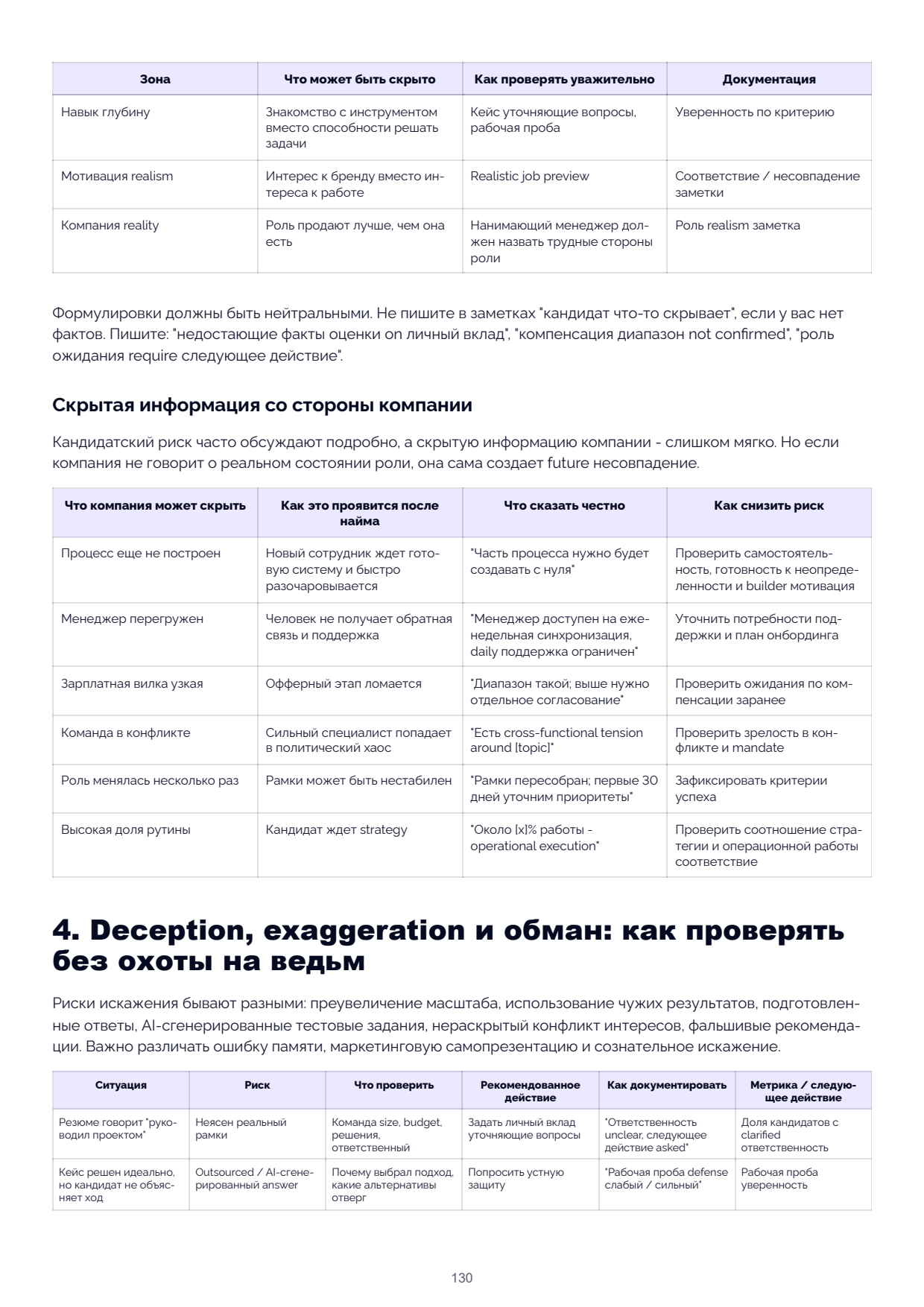
| Area | What may be hidden | How to check respectfully | Documentation |
|---|---|---|---|
| Skill depth | Familiarity with a tool instead of ability to solve problems | Case probing questions, work sample | Confidence per criterion |
| Motivation realism | Interest in the brand rather than interest in the work | Realistic job preview | Alignment / misalignment notes |
| Company reality | The role is sold as better than it is | Hiring manager must name the difficult aspects of the role | Role realism note |
4. Deception, exaggeration, and dishonesty: how to verify
without a witch-hunt
Risks of distortion vary: exaggerating scale, claiming credit for others' results, rehearsed answers,
AI-generated test assignments, undisclosed conflicts of interest, and fake references. It is important to
distinguish between a memory lapse, marketing self-presentation, and deliberate distortion.
Situation Risk What to check Recommended How to document Metric / next
action
CV says "led the project" Actual scope of responsibility, Team size, budget, Ask about personal "Accountability unclear, Share of candidates with
decision-making authority, follow-up questions clarified after next clarified responsibility
clarification action asked
Case solved perfectly, but Outsourced / AI-generated Why that approach was Share their defence verbally "Work sample defence Sample confidence
candidate cannot explain the answer chosen, which alternatives weak / strong"
reasoning were considered