Chapter 10. Candidate Experience

| Element | Good practice | Why it matters |
|---|---|---|
| Accessibility | There is the option to discuss reasonable adjustments | Reduces barriers |
| Close | The end includes deadlines and the next step | No hanging uncertainty |
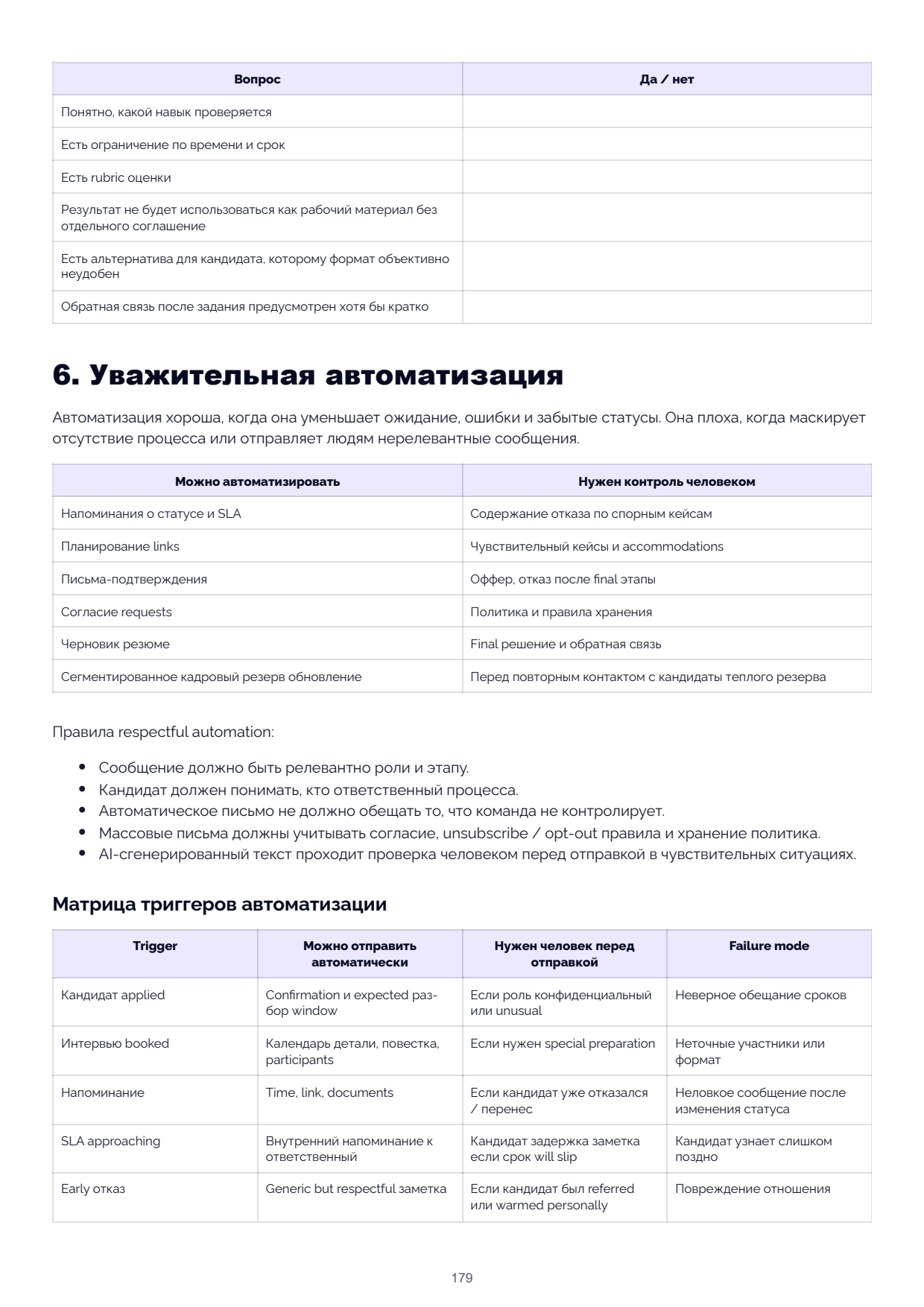
| Question | Yes / no |
|---|---|
| Is it clear which skill is being tested? | |
| Is there a time limit and deadline? | |
| Is there a marking rubric? | |
| Will the output not be used as working material without a separate agreement? | |
| Is there an alternative for candidates who objectively cannot use this format? | |
| Is feedback on the task provided, even briefly? |
6. Respectful automation Automation is good when it reduces waiting, errors and forgotten statuses.
It is bad when it masks the absence of a process or sends people irrelevant messages.
| Can be automated | Requires human oversight |
| Status and SLA reminders | Rejection content for disputed cases |
| Scheduling links | Sensitive cases and accommodations |
| Confirmation emails | Offer, rejection after final stages |
| Consent requests | Policy and retention rules |
| Draft CV | Final decision and feedback |
| Segmented talent pipeline update | Before re-contacting warm talent pipeline candidates |
| Trigger | Can send automatically | Requires human before sending | Failure mode |
|---|---|---|---|
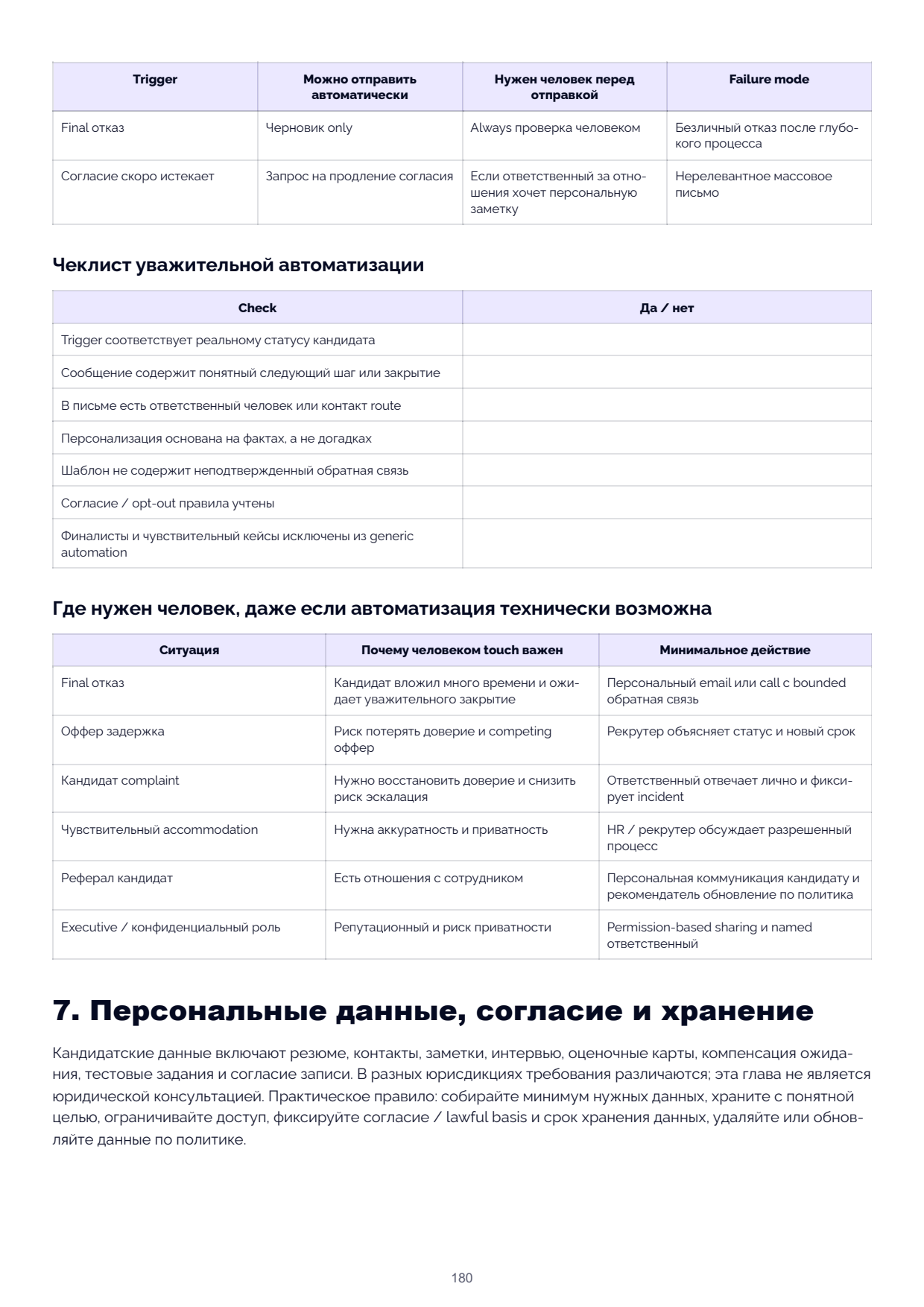
| Final rejection | Draft only | Always human review | Impersonal rejection after an in-depth process |
| Consent expiring soon | Consent renewal request | If the relationship owner wants a personal note | Irrelevant mass email |
| Respectful automation checklist | |||
| Check | Yes / no | ||
| Trigger matches the candidate's actual status | |||
| The message includes a clear next step or closure | |||
| The email contains a named responsible person or contact route | |||
| Personalisation is based on facts, not guesses | |||
| The template does not contain unconfirmed feedback | |||
| Consent / opt-out rules are observed | |||
| Finalists and sensitive cases are excluded from generic automation | |||
| A human is required even when automation is technically possible | |||
| Situation | Why a human touch matters | Minimum action | |
| Final rejection | The candidate invested significant time and expects a respectful close | Personal email or call with bounded feedback | |
| Offer delay | Risk of losing trust and a competing offer | Recruiter explains status and new deadline | |
| Candidate complaint | Trust must be restored and escalation risk reduced | The responsible person replies personally and logs the incident | |
| Sensitive accommodation | Care and privacy are required | HR / recruiter discusses the approved process | |
| Referral candidate | There is a relationship with the referring employee | Personal communication to the candidate and a policy-compliant update for the referrer | |
| Executive / confidential role | Reputational and privacy risk | Permission-based sharing and a named responsible person |
7. Personal data, consent and retention
Candidate data includes CVs, contact details, notes, interview records, assessment scorecards, compensation expectations, test tasks and consent records. Requirements vary across jurisdictions; this chapter does not constitute legal advice. As a practical rule: collect the minimum data necessary, store it with a clear purpose, restrict access, record consent / lawful basis and data retention periods, and delete or update data in line with policy.
Offer delay Risk of losing trust and a competing Recruiter explains status and new deadline
offer
Candidate complaint Trust must be restored and reduce The responsible person replies personally and logs the
escalation risk incident
Sensitive accommodation Care and privacy are required HR / recruiter discusses the approved
process
Referral candidate There is a relationship with the employee Personal communication to the candidate and
a policy-compliant update for the referrer
Executive / confidential role Reputational and privacy risk Permission-based sharing and a named
responsible person
7. Personal data, consent and retention
Candidate data includes CVs, contact details, notes, interview records, assessment scorecards, compensation
expectations, test tasks and consent records. Requirements vary across jurisdictions; this chapter does not
constitute legal advice. As a practical rule: collect the minimum data necessary, store it with a clear
purpose, restrict access, record consent / lawful basis and data retention periods, and delete or update
data in line with policy.
| Area | What to do | Risk |
|---|---|---|
| Consent | Record consent status and source where required | Cannot demonstrate the lawfulness of processing |
| Purpose | Store data for a specific recruitment purpose | Using stale data without a purpose |
| Retention | Set a retention period and review date | Indefinite databases |
| Access | Restrict roles that can view data | Excessive access for interviewers |
| Deletion / update | Have a request procedure in place | Ignoring candidates' rights |
| Sensitive data | Do not collect without necessity and policy | Unnecessary legal / ethical risks |
Data minimisation examples
Do not store if unnecessary What to store instead
Personal details unrelated to work Work-related restrictions and accessibility
Hearsay from third parties Validated referral CV with permission
Sensitive assumptions Policy-approved accommodation or work requirement
notes
Full documents beyond the purpose Link / status / mandatory verification result
Old CVs without a review date Current profile, consent status, retention date
Mini-SOP: candidate data request
This section does not replace local legal policy. It exists to help recruiters understand the operational
logic and not lose requests in email threads.
Step Action Responsible What to record
1. Recognise Understand what the candidate is Request data and channel
request requesting — access, rectification, deletion or
restriction
2. Route Hand over to the privacy / HR Responsible person and deadline
responsible person
3. Verify Verify identity per policy if required Verification status
4. Freeze risky Do not send new outreach or share Processing pause if needed
actions data until a decision is made
5. Execute Update, export, delete or restrict data Completion note
per policy
6. Confirm Notify the candidate of the outcome in Candidate response data
an admissible format
Example internal note:
Candidate data request received: [date/channel].
Request type: [access/rectification/deletion/restriction].
Assigned responsible: [name].
Recruitment status: [active/talent pipeline/rejected].
Interim action: [pause outreach / no action needed].
Completion due: [date per policy].
8. Candidate experience metrics
Metric Formula / observation What it shows How to use it
Candidate response time Time from candidate message to Response speed Set responsible person and
team reply reminders
Feedback SLA breach rate Overdue feedback actions / all Where candidates are waiting Escalate to managers
feedback actions
Candidate drop-off by stage Drop-offs / candidates entering Where the experience breaks Review interviews, tasks,
each stage deadlines
Task completion rate Completed tasks / sent tasks Fairness of the task Brief, shorten, pay, improve
instructions
Offer acceptance rate Accepted offers / sent offers Role realism and closing quality Improve pre-offer
condition checks
Candidate pulse survey Short survey after the process Quality of experience Identify recurring pain points
Consent hygiene Active consent / profiles where Consent discipline Clean the database
consent is required
Complaint / escalation count Candidate complaints Trust and assessment fairness risks Investigate root causes
Important: candidate experience cannot be measured by NPS alone. You need behavioural data: speed, candidate
drop-offs, task completion, offer acceptance, complaints and consent hygiene.
Candidate pulse survey: a short survey after the process
The survey should be short and optional. Its purpose is to spot recurring problems, not to gather a
flattering score.
Question Format How to use it
How clear was the process? 1-5 Look for communication and expectation
issues
How respectfully did the team handle 1-5 Check timing, rescheduling, task length
your time?
Was it clear what was being assessed 1-5 Improve prep emails and interview
at each stage? structure
Where was the process weakest? Short text Group themes for monthly debrief
What would you change in one area? Short text Add specific improvements to the
backlog
Do not ask candidates about issues you are not prepared to address. If the team does not change the process
based on survey results, the pulse survey becomes a decorative metric.
Interpreting metrics
Symptom Possible problem What not to do What to do
Low satisfaction but good speed Communication is fast but not Do not speed up further Review content and human
personal enough touch
High candidate drop-off before task Task looks too expensive Blame the market Review time limits and
the task rubric
Offer acceptance is falling Role realism or compensation Do not increase outreach volume Improve pre-offer
mismatch volume and expectations checks
Consent hygiene is weak Database lives outside the process Do not bulk-email everyone Conduct a cleanup and
retention review
Complaints after rejection Feedback tone or timing Do not remove all feedback Make templates safer and
bounded
Slow feedback after interview Hiring manager SLA is not working Do not pressure only the Assign hiring manager and
recruiter escalation
Candidate experience dashboard: minimum set for the team
A small dashboard is better than a large presentation if it helps manage the process weekly.
Widget Formula / source How to read it Action
Overdue statuses Candidates promised an update by Shows who is waiting without Assign a responsible person
today a status and send the update
Interview feedback SLA Overdue feedback actions / Shows the hiring team's Escalate blockers to the
completed interviews discipline hiring manager
| Widget | Formula / source | How to read it | Action |
|---|---|---|---|
| Candidate drop-off by stage | Drop-offs / candidates entering the stage | Finds stages with a poor experience | Review deadlines, tasks, communication |
| Task completion | Completed tasks / sent tasks | Shows whether a stage is too onerous | Shorten, pay, or change the format |
| Final-stage rejection time | Time from final stage to rejection message | Protects finalist trust | Named responsible person and maximum SLA |
| Consent validity | Active consent / profiles requiring consent | Shows privacy hygiene | Clean the database and update consents |
| Candidate complaints | Volume and topics | Shows reputational risk | Investigate root causes |
10. Cases
Situation Risk What to check Recommended How to document Metric / next
action step
Candidate waits a week Loss of trust in the Responsible person, Urgently provide status "Final-stage feedback SLA breach
after final for the offer blocker resolution and a new date overdue"
Bulk outreach on an old Privacy and reputational Consent, relevance, Stop, segment, update "Talent pipeline consent Consent validity
database risk last contact consent consent review"
Task takes weekends Exploitation feeling Time limit, role level, Simplify or pay "Task over-engineered" Completion rate
pay
Auto-rejection reached Trust blow Automation rule Apologise personally, fix "Automation incident" Incident count
a finalist the process
Candidate asks to delete Legal risk and trust risk Policy and identity Check "Deletion request SLA of the request
data verification processed"
Hiring manager asks Assessment fairness risk Interviewer training Stop, document, "Sensitive question Training completion
sensitive questions retrain incident"
| Situation | Risk | What to check | Recommended action | How to document | Metric / next step |
|---|---|---|---|---|---|
| Incident recovery: working guide | |||||
| Incident | First response | Root-cause debrief | Prevention | ||
| Candidate received an erroneous automated rejection | Apologise personally, correct the status and explain the next step | Trigger, stage matching, automation QA | Exclude final stages from general automation | ||
| Interviewer no-show after offer | Apologise, reassign with priority, notify the hiring manager | Calendar accountability and reminders | Backup interviewer and reminder rules | ||
| Feedback not delivered by promised date | Send a delay message before the candidate has to ask | Responsible person, SLA and blocker resolution | Internal SLA reminders and escalation | ||
| Task instructions are unclear | Clarify the brief and extend the deadline if needed | Template and reviewer briefing | Standard task brief pack | ||
| Data subject request processed incorrectly | Escalate to the privacy responsible person | Process gap and access rights | Request process and training | ||
| Common situations and management decisions | |||||
| Situation | What the candidate feels | What a strong team does | What we change in the process | ||
| Three interviewers ask the same questions | "They are not aligned" | Apologises for the repetition and explains the meeting focus | Competency-based interview plan | ||
| The role changed mid-process | "I was assessed against a moving target" | Communicates the change honestly and asks whether the role is still relevant | Recalibration rule and candidate notification | ||
| Candidate receives a counter-offer | "I need to understand your position quickly" | Conducts a pre-offer condition check, clarifies motivators, does not pressure | Motivation notes and offer timelines | ||
| Referral candidate rejected without explanation to the referrer | The employee loses trust in the referral programme | Gives the candidate a status update; the referrer receives a policy-compliant update | Referral communication policy | ||
| Candidate ghosted the process | The team gets frustrated and draws market conclusions | Checks deadlines, role realism, communication quality | Candidate drop-off reasons and reactivation template | ||
| Candidate asks for more time on a task | Fears looking weak | Asks the reason, extends if reasonable, preserves assessment fairness | Deadline extension rule |
| Task | Full prompt | Human check |
|---|---|---|
| Review the candidate journey | Appendix H, H6.5 | Verify facts, privacy, tone and decision ownership before using the output. |
| Review respectful automation | Appendix H, H10.1 | Verify facts, privacy, tone and decision ownership before using the output. |
| 11. Policy fragment: candidate experience and data |
Every candidate in an active process must have a named person responsible for communication. This person is accountable for timely statuses, accurate messages, recording the next step and feedback SLAs. Automation is used for reminders, scheduling meetings, consent management and status support, but it does not replace human review for offers, final rejections, sensitive cases or complaints. Candidate data is processed solely for recruitment purposes, with restricted access, retention rules and consent / lawful basis where required. Requests to update, delete or restrict processing are forwarded to the company's policy responsible person.
| 12. Maturity model | |
| Level | What it looks like |
| Chaos | Candidates wait without status; data is stored in chat messages |
| Managed process | There is a journey map, SLAs, a responsible person and templates |
| Respectful automation | Automation accelerates statuses without breaking trust |
| Data-conscious | Consent, retention and access are controlled |
| Experience-led ops | The team measures candidate drop-offs, satisfaction, complaints, offer acceptance and improves the process |
| Key takeaways and next steps | |
| What you need | Where to find it |
| Terminology and short definitions | Appendix B. Mini-glossary |
| Ready-made policies and SLAs | Appendix D. Ready-made policies and processes |
| Working templates | Appendix E. Template library |
| End-to-end examples: BDM and Backend | Appendix F. End-to-end cases: BDM and Backend |
| Full AI prompts for the chapter | Appendix H. AI prompt library, section H6. Debrief, decisions and feedback |
In short: this chapter covers candidate experience and communication. If you need a ready-made artefact, take it from the appendices; leave the application logic in the chapter itself.
automation
Data-conscious Consent, retention and access are controlled
Experience-led ops The team measures candidate drop-offs, satisfaction, complaints, offer acceptance and improves the process
Key takeaways and next steps
What you need Where to find it
Terminology and short definitions Appendix B. Mini-glossary
Ready-made policies and SLAs Appendix D. Ready-made policies and processes
Working templates Appendix E. Template library
End-to-end examples: BDM and Backend Appendix F. End-to-end cases: BDM and Backend
Full AI prompts for the chapter Appendix H. AI prompt library, section H6. Debrief,
decisions and feedback
In short: this chapter covers candidate experience and communication. If you need a ready-made artefact, take it
from the appendices; leave the application logic in the chapter itself.
How to use this chapter
Working scenario. The team has finally selected a strong candidate. Everyone exhales: "All that's left is to send the
offer." Two days later, it emerges that the pay range has not yet been agreed, the candidate understood the
bonus differently, the start date is disputed, the current employer is preparing a counter-offer, and the manager
promised something that is not in company policy.
The offer was close, but the process was not ready.
What actually broke here: the team assumed the offer begins with the letter containing a number. In reality,
before the letter, you must verify motivation, check conditions, align compensation, honestly describe the role,
assess the counter-offer risk, record the decision and hand the candidate to preboarding.
The key idea of this chapter: an offer is not an administrative formality and not a last-day negotiation. It is the
final management stage where role criteria, candidate assessment, hiring economics, compensation fairness
and candidate experience converge. A good offer process reduces late-stage losses, avoids impossible
promises and maintains a respectful tone even in the event of rejection.
Read this chapter as a working guide. If offer acceptance is falling, start with the process, pre-offer condition
checks and metrics. If the hiring manager asks to "just offer more", look at the sections on offer structure,
alignment and internal fairness. If a candidate receives a counter-offer, use the case section. If you work in an
agency, pay attention to the sections on roles and alignment: agencies often influence the offer without direct
control over salary and client approvals.
Remember in one phrase: the offer is won before the letter, when the team has honestly removed acceptance risks.
| If your task is | Go to section | What you will get |
|---|---|---|
| Understand what offer management involves | 1 | Process boundaries from pre-offer condition checks to an accepted offer |
| Conduct a pre-offer condition check without pressure | 2 | Questions on motivation, constraints and acceptance probability |
| Separate agency and internal recruitment roles | 3 | Responsibilities of the recruiter, client, hiring manager and HR |
| Build the offer structure | 4 | Compensation components, roles, conditions and expectations |
| Set up the approval process | 5 | Decision package, SLAs and escalation rules |
| Handle a counter-offer | 6 | Risk diagnostics and safe scenarios |
| Check assessment and condition fairness | 8 | Fair-range rules and exception handling |
| Measure the offer process | 9 | Metrics, formulas, risk signals |
| Use HarmonyATS as an example | 10 | How to link the offer stage, rejection reasons and time-to-hire |
| Resolve complex situations | 11 | Cases in mini-instruction format |
| Use AI | 12 | Prompts with human review |
| Implement the policy | 13–14 | SOP, checklist and maturity model |
Minimum starting point
The offer begins before the letter with a number: you first need to remove acceptance and alignment risks.
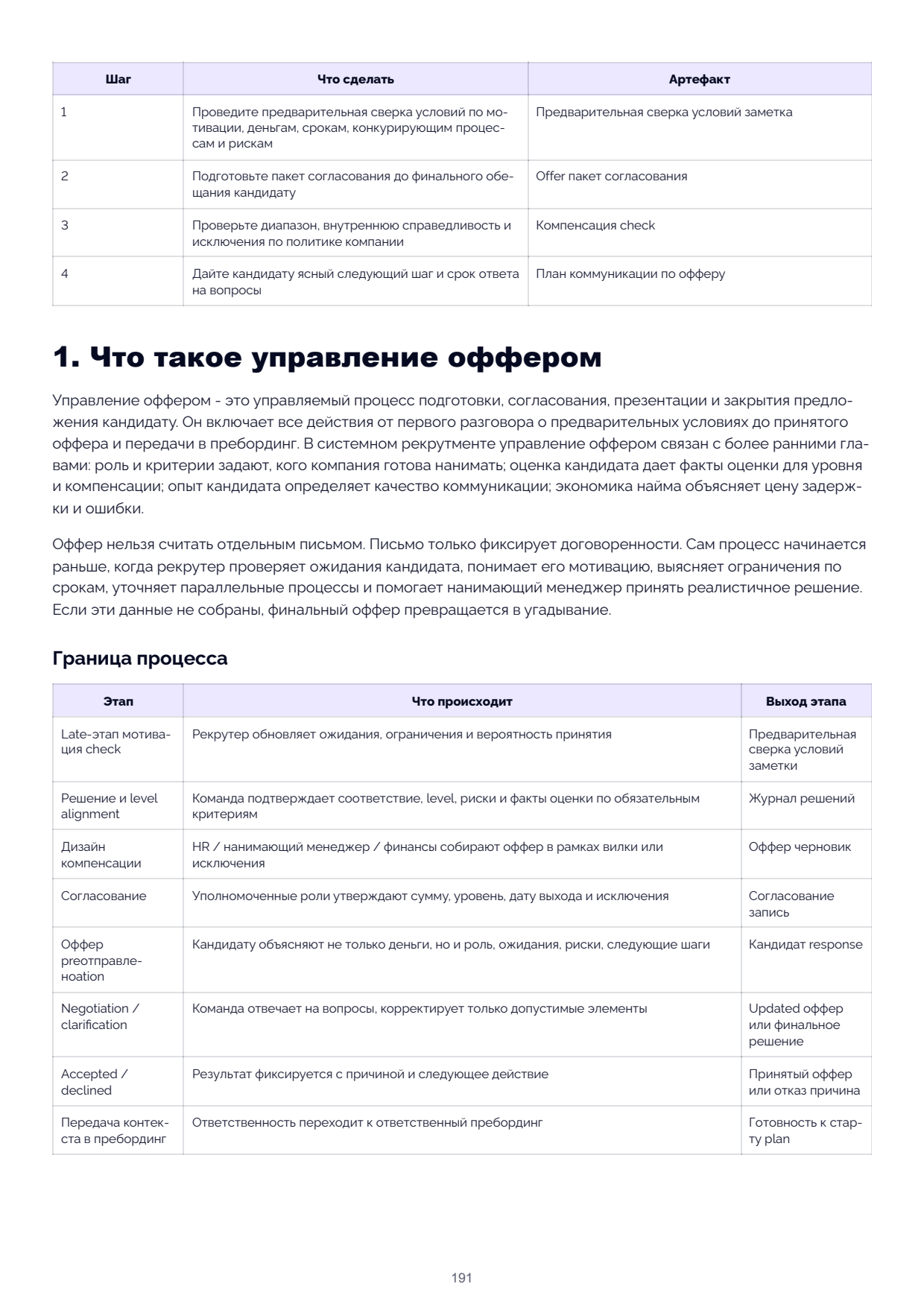
| Step | What to do | Artefact |
|---|---|---|
| 1 | Conduct a pre-offer condition check on motivation, money, timelines, competing processes and risks | Pre-offer condition check note |
| 2 | Prepare the approval package before making a final promise to the candidate | Offer approval package |
| 3 | Check the range, internal fairness and policy exceptions | Compensation check |
| 4 | Give the candidate a clear next step and a deadline for questions | Offer communication plan |
1. What is offer management
Offer management is the managed process of preparing, approving, presenting and closing an offer to a candidate. It covers every action from the first conversation about preliminary conditions through to a accepted offer and handover to preboarding. In systemic recruitment, offer management connects to earlier chapters: role and criteria define whom the company is prepared to hire; candidate assessment provides the facts for level and compensation; candidate experience determines the quality of communication; hiring economics explains the cost of delay and error. An offer cannot be treated as a standalone letter. The letter merely records the agreements. The real process begins earlier, when the recruiter checks the candidate's expectations, understands their motivation, clarifies time constraints, identifies parallel processes and helps the hiring manager reach a realistic decision. If this data is not gathered, the final offer becomes guesswork. Process boundary
| Stage | What happens | Stage output |
| Late-stage motivation check | The recruiter updates expectations, constraints and acceptance probability | Pre-offer condition check notes |
| Decision and level alignment | The team confirms fit, level, risks and assessment facts against must-have criteria | Decision log |
| Compensation design | HR / hiring manager / finance assemble the offer within the band or as an exception | Offer draft |
| Approval | Authorised roles approve the amount, level, start date and exceptions | Approval record |
| Offer pre-send | The candidate is briefed on not just the money but the role, expectations, risks and next steps | Candidate response |
| Negotiation / clarification | The team answers questions and adjusts only permissible elements | Updated offer or final decision |
| Accepted / declined | The outcome is recorded with the reason and next action | Accepted offer or rejection reason |
| Context handover to preboarding | Responsibility transfers to the preboarding responsible person | Start readiness plan |
2. Pre-offer condition check: verification before
the final proposal
A pre-offer condition check is a respectful verification of offer acceptance probability before the company
launches approval and sends a formal proposal. It is not manipulation and not an attempt to pressure the
candidate into agreeing in advance. A good pre-offer condition check helps both sides avoid wasting time on a
proposal that does not meet expectations and avoids creating false promises.
The pre-offer condition check should happen several times: during screening, before the final interview, after
the decision debrief and before offer approval. The depth varies at each stage. At the start, a range of
expectations and motivation is sufficient. At the end, specific conditions are needed: compensation, start date,
competing offers, notice period, work model, relocation, family constraints, risk appetite and critical
constraints.
Questions for the pre-offer condition check
Topic Question What counts as a What to record
useful answer
Motivation What would need to be true about the The candidate names work Primary motivators, secondary
new role for you to accept?
motivators, not just money
Compensation What total compensation range are you The range, structure, bonuses, Current comp, target comp,
considering and what is in your current benefits, internal fairness, flexibility
package? guarantees
Role What tasks would you like to do more / Connection to the actual Role realism risks
less? work of the role
Risk What might make you decline after the The candidate names real Deal-breakers
offer? blockers
Parallel processes What other processes might affect the The competitive landscape is Competing offers, timelines
decision and within what timelines? clear
Start What is the notice period and what is the Earliest start, constraints
earliest realistic start window? constraints
Counter-offer How would you react if your current The candidate understands their reasons Counter-offer risk
employer offered improved conditions? for wanting to leave
Pre-offer condition check errors
Error Why it is dangerous How to fix it
"If we offer X, will you join?" It pressures the candidate and reduces the Ask about the set of conditions and
choice to a number decision drivers
Checking expectations only at the start Expectations change after interviews and Ask about the set of conditions and
of the process other offers update after each significant stage
Not recording the current package The offer looks better on base but worse Compare total compensation and
on total risk
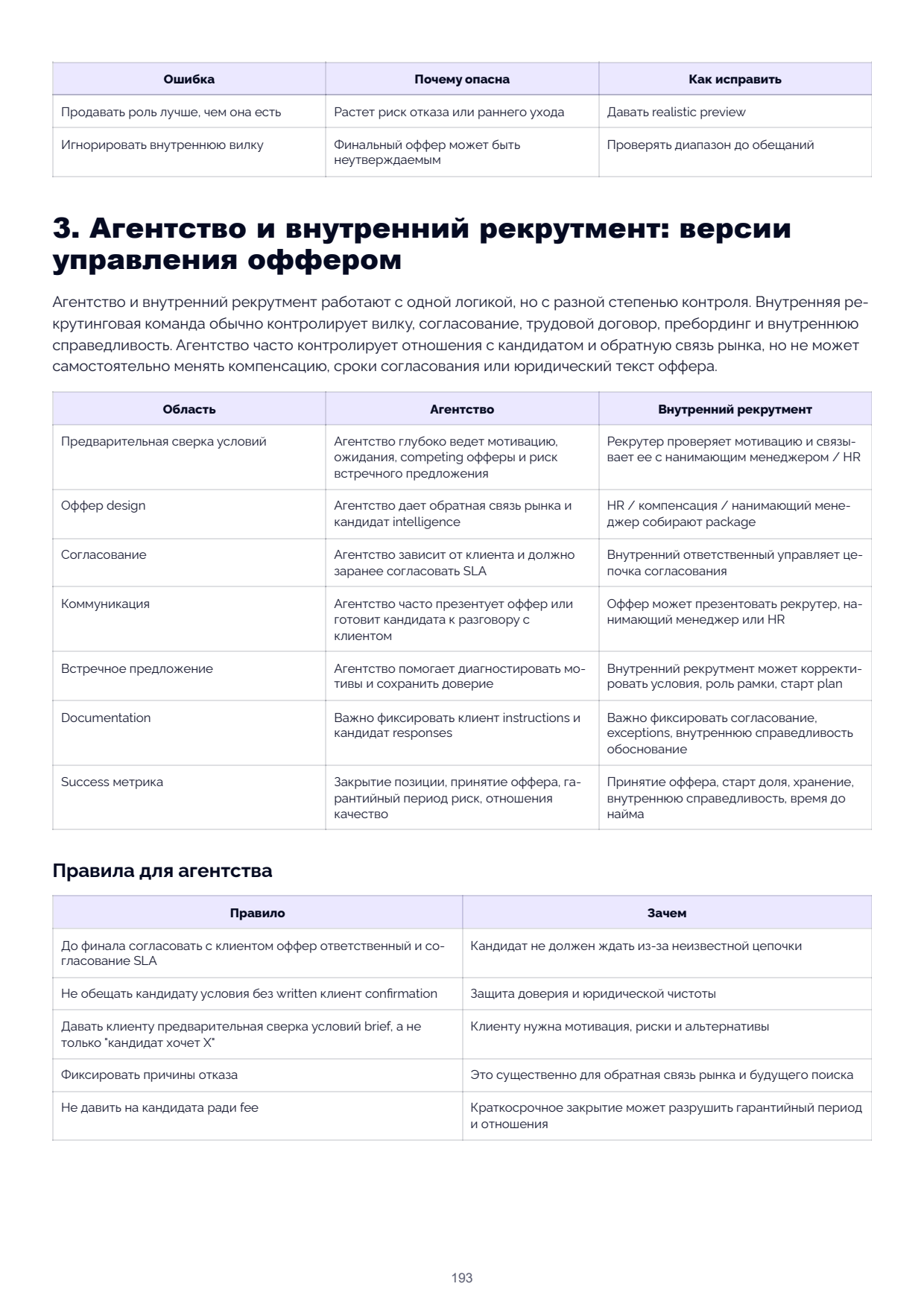
| Error | Why it is dangerous | How to fix it |
|---|---|---|
| Selling the role as better than it is | Increases the risk of rejection or early attrition | Provide a realistic preview |
| Ignoring the internal pay band | The final offer may be unapprovable | Check the range before making promises |
3. Agency and internal recruitment: versions of offer management
Agency and internal recruitment follow the same logic but with different levels of control. The internal recruitment team typically controls the pay band, approval, employment contract, preboarding and internal fairness. The agency often manages the candidate relationship and market feedback but cannot independently change compensation, approval timelines or the legal text of the offer.
| Area | Agency | Internal recruitment |
| Pre-offer condition check | The agency deeply manages motivation, expectations, competing offers and counter-offer risk | The recruiter checks motivation and links it to the hiring manager / HR |
| Offer design | The agency provides market feedback and candidate intelligence | HR / compensation / hiring manager assemble the package |
| Approval | The agency depends on the client and must pre-agree SLAs | The internal responsible person manages the approval chain |
| Communication | The agency often presents the offer or prepares the candidate for a conversation with the client | The offer may be presented by the recruiter, hiring manager or HR |
| Counter-offer | The agency helps diagnose motives and preserve trust | Internal recruitment can adjust conditions, role scope, start plan |
| Documentation | It is important to record client instructions and candidate responses | It is important to record approvals, exceptions and internal fairness rationale |
| Success metric | Position closure, offer acceptance, warranty-period risk, relationship quality | Offer acceptance, start rate, retention, internal fairness, time-to-hire |
| Agency rules | ||
| Rule | Why | |
| Before finalising, agree with the client on the offer responsible person and approval SLA | The candidate must not wait because of an unknown approval chain | |
| Do not promise the candidate conditions without written client confirmation | Protects trust and legal integrity | |
| Give the client a pre-offer condition check brief, not just "the candidate wants X" | The client needs motivation, risks and alternatives | |
| Record rejection reasons | This is essential for market feedback and future searches | |
| Do not pressure the candidate to secure the fee | A short-term close may destroy the warranty period and the relationship |
Rule Why
Before finalising, agree with the client on the offer responsible person and The candidate must not wait because of an unknown
approval SLA approval chain
Do not promise the candidate conditions without written client Protects trust and legal integrity
confirmation
Give the client a pre-offer condition check brief, not just "the The client needs motivation, risks and alternatives
candidate wants X"
Record rejection reasons This is essential for market feedback and future searches
Do not pressure the candidate to secure the fee A short-term close may destroy the warranty period
and the relationship
| Rules for internal recruitment | |
|---|---|
| Rule | Why |
| A compensation exception requires a responsible person and written justification | Protects internal fairness |
| The hiring manager must not promise salary outside the band | Reduces the risk of offer withdrawal |
| The offer pre-send must include a realistic role preview | Reduces early attrition |
| An accepted offer is immediately handed over to preboarding | Acceptance does not equal start |
| Rejection reasons are analysed alongside funnel and compensation data | Offer losses become material for improvement |
4. Offer structure: what exactly is being offered to the candidate
The offer must describe more than money. The candidate makes the decision to join based on the entire
construct: role, level, manager, tasks, compensation, risks, flexibility, start date, onboarding process and trust
in promises. The more senior the role and the higher the cost of error, the more important it is to make the
offer package transparent. Offer components
| Component | What to include | Common mistake |
| Role and job title | Position, reporting line, team, level | Title promises more authority than exists |
| Scope | Initial tasks, area of responsibility, success criteria | The candidate is sold strategy but given execution-only |
| Fixed salary | Fixed portion, currency, payment frequency | Comparing only gross / net without clarity |
| Variable pay | Bonus, commission, KPI, payment rules, payment caps | Promising "up to X" without explaining realism |
| Equity / long-term incentives | Vesting, cliff, liquidity assumptions, risk | Presenting internal fairness elements as guaranteed money |
| Benefits | Insurance, holiday, equipment, education, relocation | Listing benefits without conditions |
| Work model | Office, hybrid, remote, travel, relocation | Not discussing actual office attendance frequency |
| Start date | Earliest start, notice period, handover, constraints | Pressuring a quick start without considering current obligations |
| Probation / trial | Duration, expectations, review points | Not explaining the pass criteria |
| Preboarding | Documents, equipment, access, buddy, first week | Candidate accepts the offer and hears nothing |