Chapter 11. Offer Management


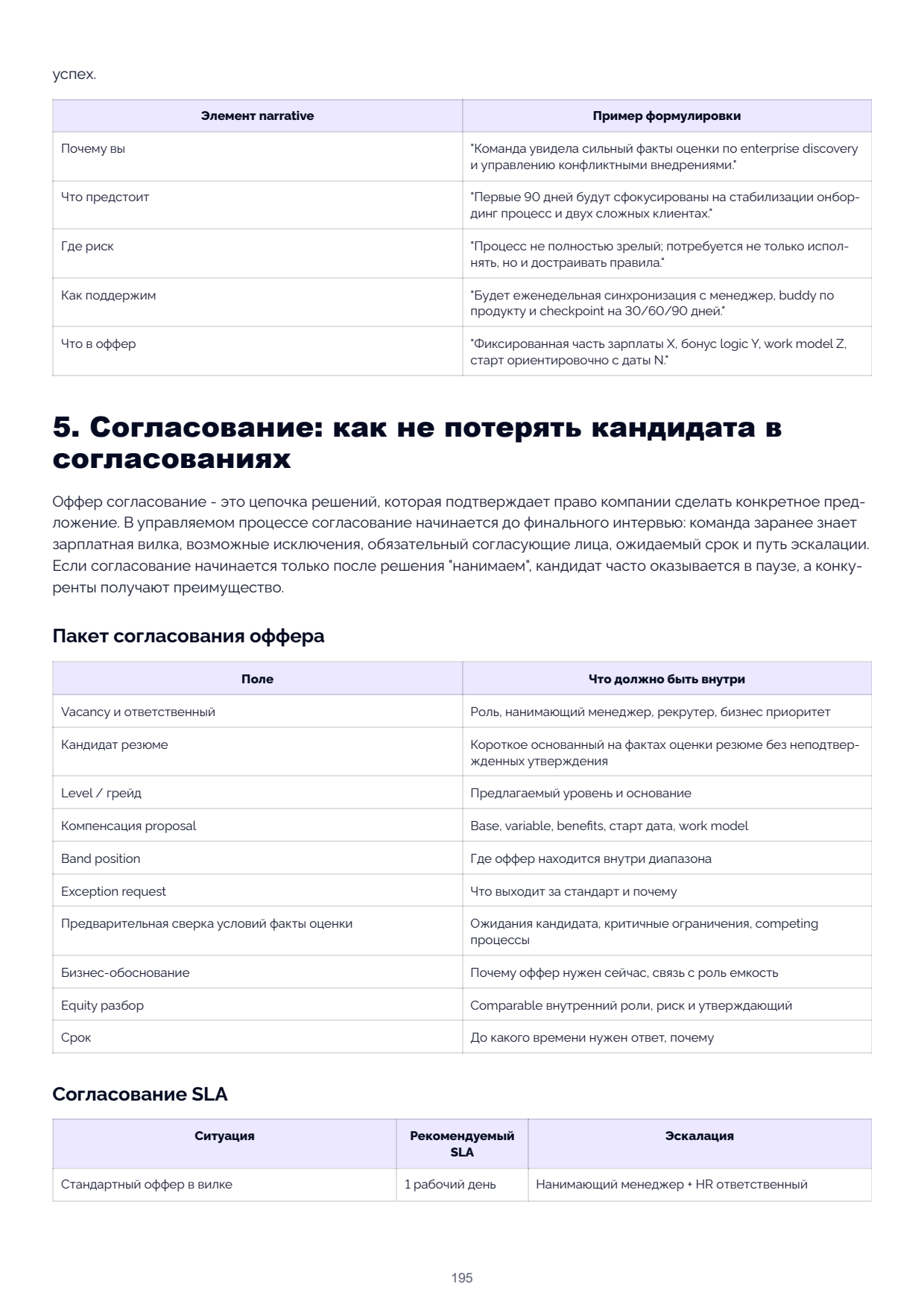
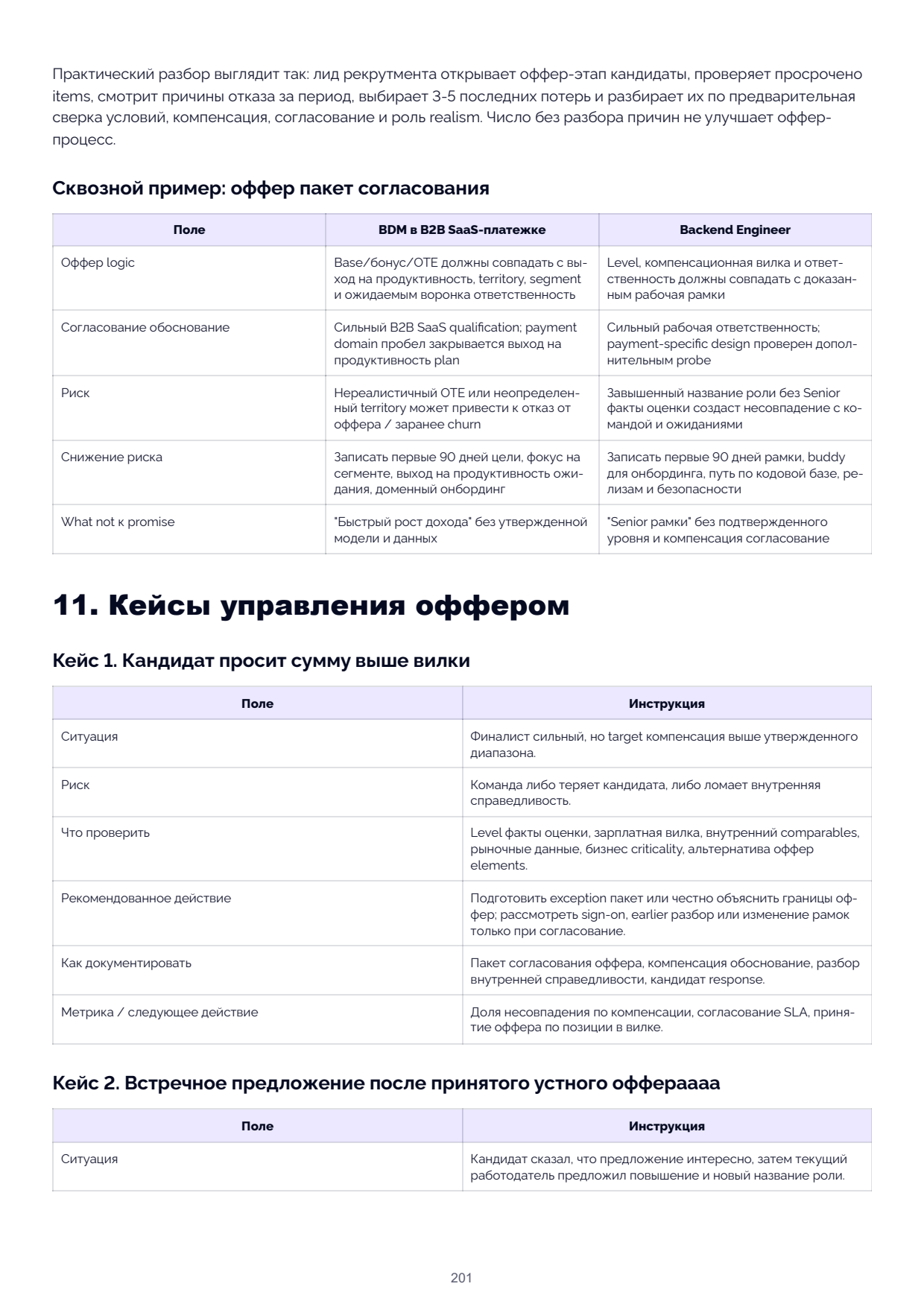
| success. | |
|---|---|
| Narrative element | Example wording |
| Why you | "The team observed strong assessment evidence around enterprise discovery and managing complex deployments." |
| What lies ahead | "The first 90 days will focus on stabilising the onboarding process and two complex clients." |
| Where the risk lies | "The process is not fully mature; you will need not only to execute but also to build the rules." |
| How we will support you | "There will be a weekly sync with your manager, a product buddy, and a 30/60/90-day checkpoint." |
| What is in the offer | "Fixed salary X, bonus logic Y, work model Z, start date approximately N." |
5. Approvals: how not to lose a candidate in sign-offs
An offer approval is a chain of decisions that confirms the company's right to make a specific proposal. In a managed process, approval begins before the final interview: the team already knows the salary band, possible exceptions, mandatory approvers, expected timeline, and escalation path. If approval only starts after the "we are hiring" decision, the candidate is often left waiting, and competitors gain the advantage. Offer approval pack
| Field | What should be included | |
| Vacancy and owner | Role, hiring manager, recruiter, business priority | |
| Candidate summary | Short evidence-based assessment summary without unverified claims | |
| Level / grade | Proposed level and rationale | |
| Compensation proposal | Base, variable, benefits, start date, work model | |
| Band position | Where the offer sits within the range | |
| Exception request | What deviates from the standard and why | |
| Pre-offer evidence check | Candidate expectations, critical constraints, competing processes | |
| Business case | Why the offer is needed now, link to role capacity | |
| Equity review | Comparable internal roles, risk, and approver | |
| Deadline | By when a response is needed and why | |
| Approval SLA | ||
| Situation | Recommended SLA | Escalation |
| Standard offer within band | 1 working day | Hiring manager + HR owner |
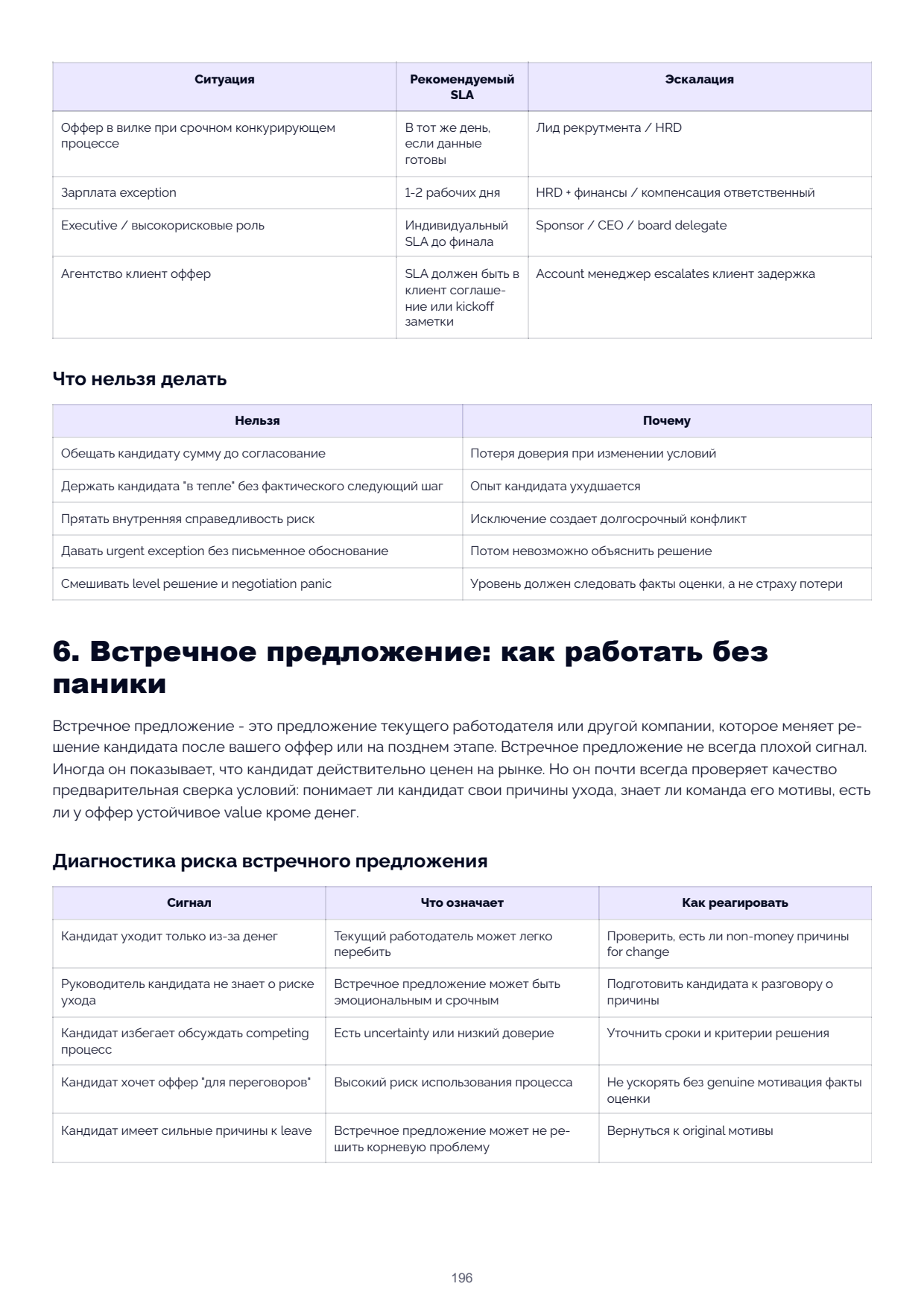
| Situation | Recommended SLA | Escalation |
|---|---|---|
| Offer within band for an urgent competing process | Same day, if data are ready | Recruitment Lead / HRD |
| Salary exception | 1–2 working days | HRD + finance / compensation owner |
| Executive / high-risk role | Individual SLA agreed at shortlist stage | Sponsor / CEO / board delegate |
| Agency client offer | SLA must be in the client agreement or kickoff notes | Account manager escalates client delays |
| What you must not do | ||
| Do not | Why | |
| Promise a candidate a figure before approval | Trust is lost when terms change | |
| Keep a candidate "warm" without a genuine next step | Candidate experience deteriorates | |
| Conceal internal equity risk | Exception creates long-term conflict | |
| Grant an urgent exception without written justification | Impossible to explain the decision afterwards | |
| Conflate level decisions with negotiation panic | Level must follow assessment evidence, not fear of loss |

6. Counter-offers: how to handle them without panic
A counter-offer is a proposal from the candidate's current employer or another company that changes the candidate's decision after your offer or at a late stage. A counter-offer is not always a bad signal. Sometimes it indicates that the candidate is genuinely valued on the market. But it almost always tests the quality of your pre-offer evidence check: does the candidate understand their reasons for leaving, does the team know their motivations, and does the offer have sustainable value beyond money. Counter-offer risk diagnosis
| Signal | What it means | How to respond |
| Candidate is leaving only for money | Current employer can easily outbid | Check whether there are non-monetary reasons for the change |
| Candidate's manager is unaware of the departure risk | Counter-offer may be emotional and urgent | Prepare the candidate for a conversation about their reasons |
| Candidate avoids discussing competing processes | There is uncertainty or low trust | Clarify timelines and decision criteria |
| Candidate wants an offer "for leverage" | High risk of process misuse | Do not expedite without genuine motivation evidence |
| Candidate has strong reasons to leave | Counter-offer may not resolve the root problem | Return to the original motivations |
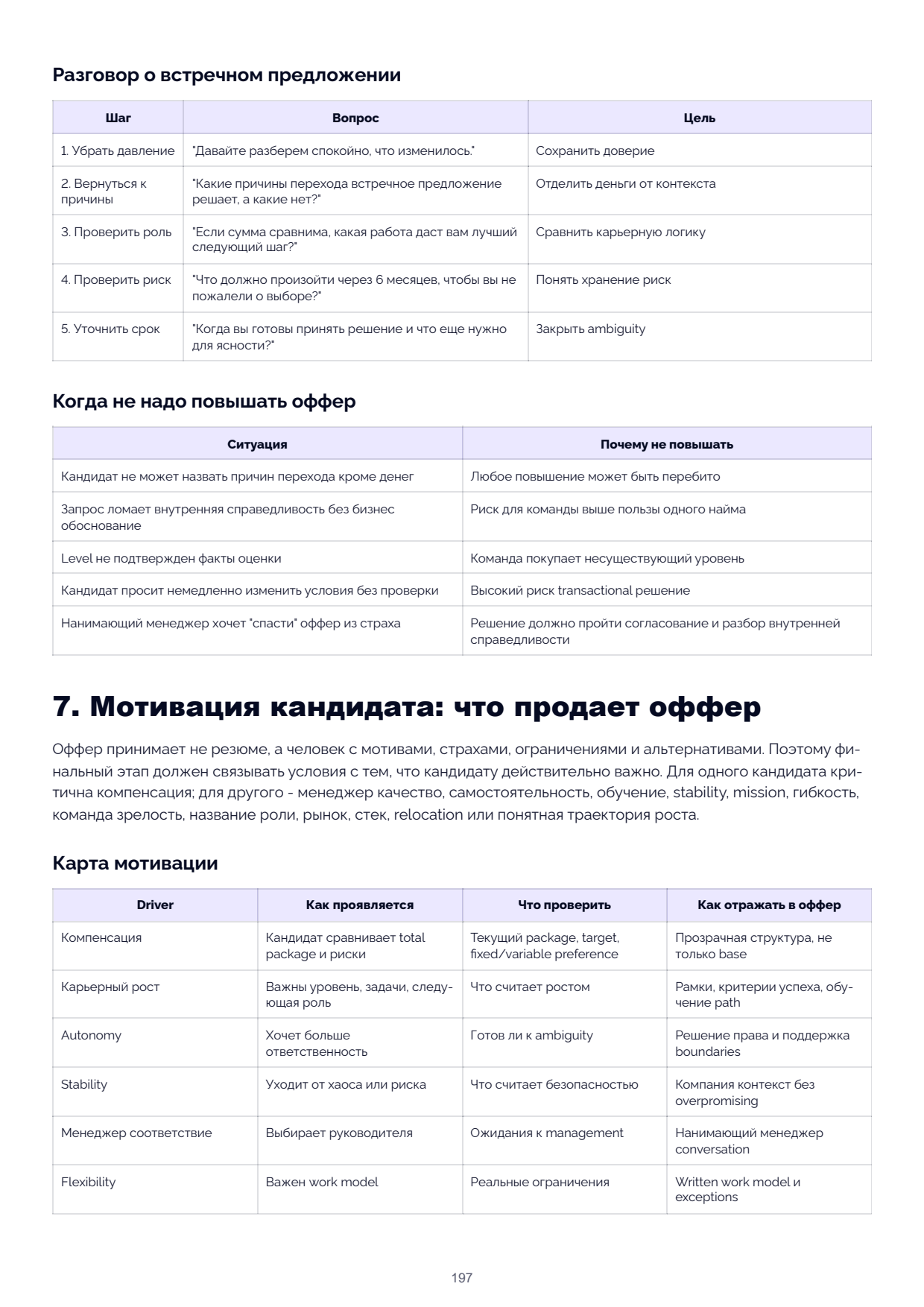
| Counter-offer conversation | ||
|---|---|---|
| Step | Question | Goal |
| 1. Remove pressure | "Let us calmly explore what has changed." | Preserve trust |
| 2. Return to reasons | "Which reasons for moving does the counter-offer address, and which does it not?" | Separate money from context |
| 3. Test the role | "If the salary is comparable, which job will give you the better next step?" | Compare career logic |
| 4. Test the risk | "What must happen in six months for you not to regret this choice?" | Understand retention risk |
| 5. Agree the deadline | "When are you ready to make a decision, and what else do you need for clarity?" | Close the ambiguity |
| When you should not raise the offer | ||
| Situation | Why not to raise | |
| Candidate cannot name a reason for moving beyond money | Any increase can be outbid | |
| Request breaks internal equity without business justification | Risk to the team outweighs benefit of one hire | |
| Level is not supported by assessment evidence | Team is paying for a level that does not exist | |
| Candidate demands immediate term changes without review | High risk of a transactional decision | |
| Hiring manager wants to "rescue" the offer out of fear | Decision must go through approval and internal equity review |
7. Candidate motivation: what sells the offer
An offer is accepted not by a CV but by a person with motivations, fears, constraints, and alternatives. Therefore, the final stage must link terms to what truly matters to the candidate. For one candidate, compensation is critical; for another, it is manager quality, autonomy, learning, stability, mission, flexibility, team maturity, job title, market, tech stack, relocation, or a clear growth trajectory. Motivation map
| Driver | How it manifests | What to check | How to reflect in the offer |
| Compensation | Candidate compares total package and risks | Current package, target, fixed/variable preference | Transparent structure, not just base |
| Career growth | Level, tasks, and next role matter | What they consider growth | Framework, success criteria, learning path |
| Autonomy | Wants more responsibility | Ready for ambiguity | Decision rights and support boundaries |
| Stability | Leaving chaos or risk | What they consider safe | Company context without overpromising |
| Manager fit | Choosing the manager | Expectations of management | Hiring manager conversation |
| Flexibility | Work model matters | Real constraints | Written work model and exceptions |
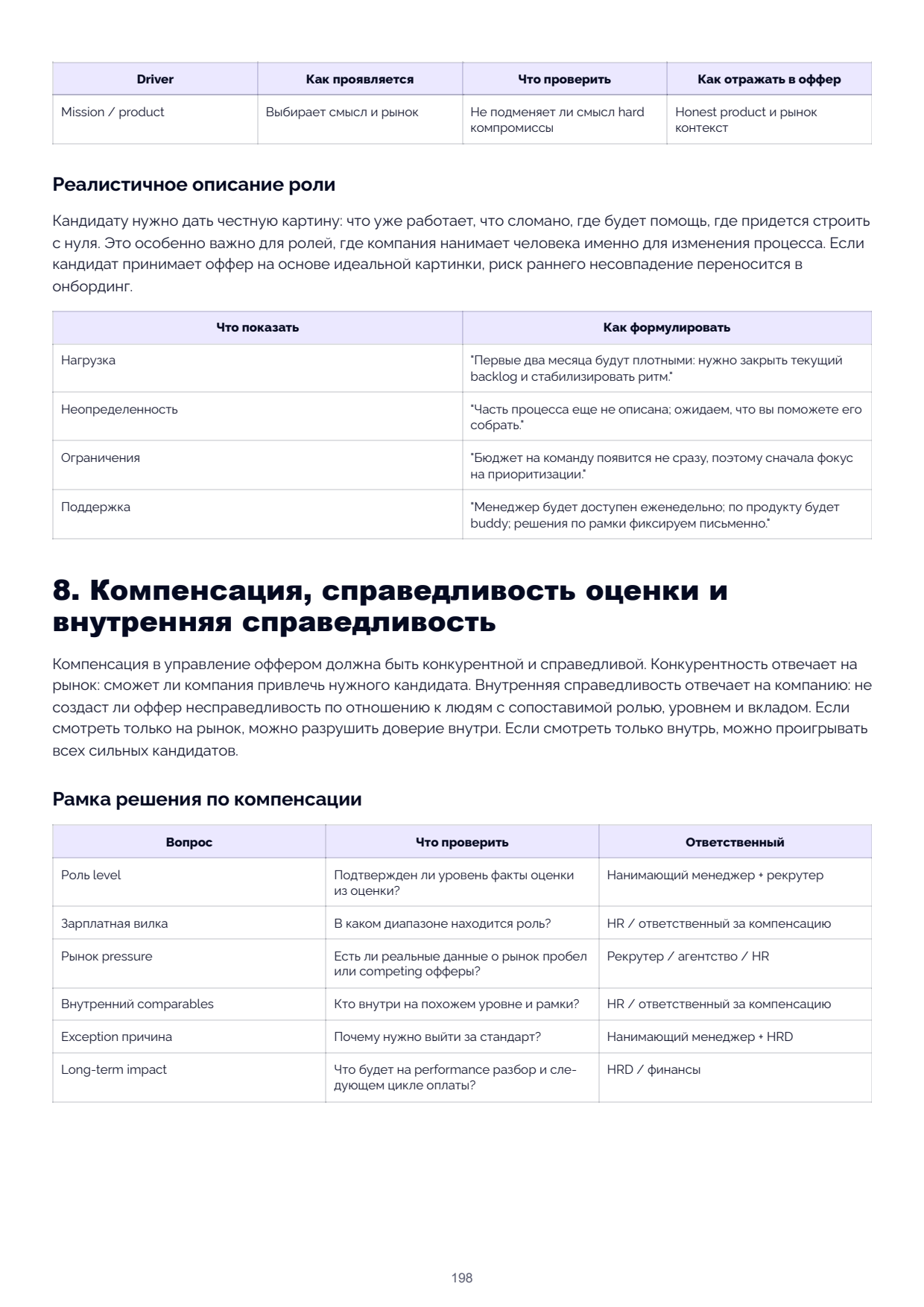
| Driver | How it manifests | What to check | How to reflect in the offer |
|---|---|---|---|
| Mission / product | Chooses purpose and market | Whether purpose masks hard trade-offs | Honest product and market context |
| Types of exceptions | ||
|---|---|---|
| Exception | When acceptable | What to document |
| Salary above the band | Role is critical, market confirmed, level matches | Business case, market data, internal equity review, approver |
| Sign-on bonus | Need to compensate for lost bonus, relocation, timing | Amount, reason, clawback if applicable, approval |
| Earlier review | Compensation below expectations but a planned review exists | Criteria, date, owner, no vague promises |
| Title adjustment | Framework genuinely matches a more senior job title | Level assessment evidence, responsibility, internal comparables |
| Work model exception | Candidate is valuable and role permits flexibility | Conditions, review date, team impact |
| Assessment equity risks | ||
| Risk | How it manifests | Control |
| Urgency premium | Urgent candidate receives more without level basis | Exception review and temporary alternatives |
| Negotiation bias | Those who negotiate harder get more | Structured band logic and internal equity review |
| Hidden internal inequity | Comparable employees have an unexplained gap | Compensation audit by role / level |
| Counter-offer escalation | Company raises the offer only out of fear of loss | Re-check motivation and business case |
| Agency pressure | Urgency for fee revenue affects client decision | Written client approval and evidence-based assessment pack |
9. How to measure offer management
Offer metrics should reveal where the process loses candidates and why. They should not become a "get the offer accepted at any cost" competition. Sometimes the right outcome is for the candidate to decline, rather than accept an offer built on false expectations. Key metrics
| Metric | Formula | What it shows | How to use it |
| Offer acceptance rate | Accepted offers / extended offers | Proportion of offers accepted | Review pre-offer evidence, compensation, role realism |
| Offer decline rate | Declined offers / extended offers | Losses at the final stage | Investigate reasons and segments |
| Approval SLA breach rate | Overdue approvals / all approval requests | Speed of internal decisions | Improve owner, pack, escalation |
| Time in offer stage | Offer stage exit date − offer stage entry date | Where the candidate waits | Reduce delays without applying pressure |
9. How to measure offer management
Offer metrics should reveal where the process loses candidates and why. They should not become a
"get the offer accepted at any cost" competition. Sometimes the right outcome is for the candidate to decline,
rather than accept an offer built on false expectations.
Key metrics
Metric Formula What it shows How to use it
Offer acceptance rate Accepted offers / extended Proportion of offers accepted Review pre-offer
offers evidence, compensation,
role realism
Offer decline rate Declined offers / extended Losses at the final stage Investigate reasons and
offers segments
Approval SLA breach Overdue approvals / Speed of internal decisions Improve owner,
rate all approval requests pack, escalation
Time in offer stage Offer stage exit date − Where the candidate waits Reduce delays without
offer stage entry date pressure
| Metric | Formula | What it shows | How to use it |
|---|---|---|---|
| Counter-offer impact | Counter-offer-related declines / offers with known counter-offer | Risk from current employer | Improve motivation diagnosis |
| Compensation mismatch rate | Declines due to compensation / declined offers | How far the offer misses expectations | Review bands and pre-offer evidence check |
| Start rate | Started hires / accepted offers | Whether offer acceptance converts to a start | Link to Chapter 12 preboarding |
| Early attrition after offer | Early leavers / started hires | Whether the offer was honest | Review realistic preview and onboarding |
| Analysis segments | |||
| Segment | Why look at it | ||
| Role family | Sales, engineering, finance, and marketing have different markets | ||
| Level | Senior roles often require more pre-offer evidence and approval discipline | ||
| Source | Agency, referral, inbound, and direct sourcing may have different expectations | ||
| Hiring manager | Different managers present the role and respond to SLA differently | ||
| Offer position within the compensation band | An offer at the lower bound may have a different acceptance pattern | ||
| Reason for decline | Decline reasons matter more than the overall percentage |
10. Using HarmonyATS as an example
Using HarmonyATS as an example, offer management can be tracked through stage, decline reason, notes, SLA, and time-to-hire. This does not require turning the ATS into a financial system. It is enough for the candidate record to capture the facts: when the candidate entered the offer stage, who is responsible, what the next action is, which terms have been approved, and which decline reason was selected if the offer is not accepted.
| HarmonyATS element | How to use it | Cautions |
| Stage | A dedicated offer stage shows actual time at the final stage | Do not move candidates for a flattering metric |
| Decline reason | Separate compensation, counter-offer, role mismatch, timing, location | Do not select "other" without a comment |
| Notes | Record pre-offer evidence, motivation, constraints, agreement facts | Do not store unnecessary sensitive detail |
| SLA | Track approval delays, feedback, and candidate response | SLA must not be used as a punishment tool |
| Time-to-hire report | See how much time the final stage adds to the process | Compare roles only with due regard to complexity |
| Candidate movement report | Check actual transitions between stages | Use alongside qualitative review |
11. Offer management case studies
Case 1. Candidate requests a figure above the band
Field Instruction
Situation The finalist is strong, but target compensation exceeds the approved
range.
Risk The team either loses the candidate or breaks internal
equity.
What to check Level assessment evidence, salary band, internal comparables,
market data, business criticality, alternative offer
elements.
Recommended action Prepare an exception pack or honestly explain offer
boundaries; consider sign-on, earlier review, or framework
changes only with approval.
How to document Offer approval pack, compensation justification, internal
equity review, candidate response.
Metric / next step Compensation mismatch rate, approval SLA, offer
acceptance by band position.
Case 2. Counter-offer after verbal acceptance
Field Instruction
Situation The candidate said the offer was interesting, then the current
employer offered a promotion and a new job title.
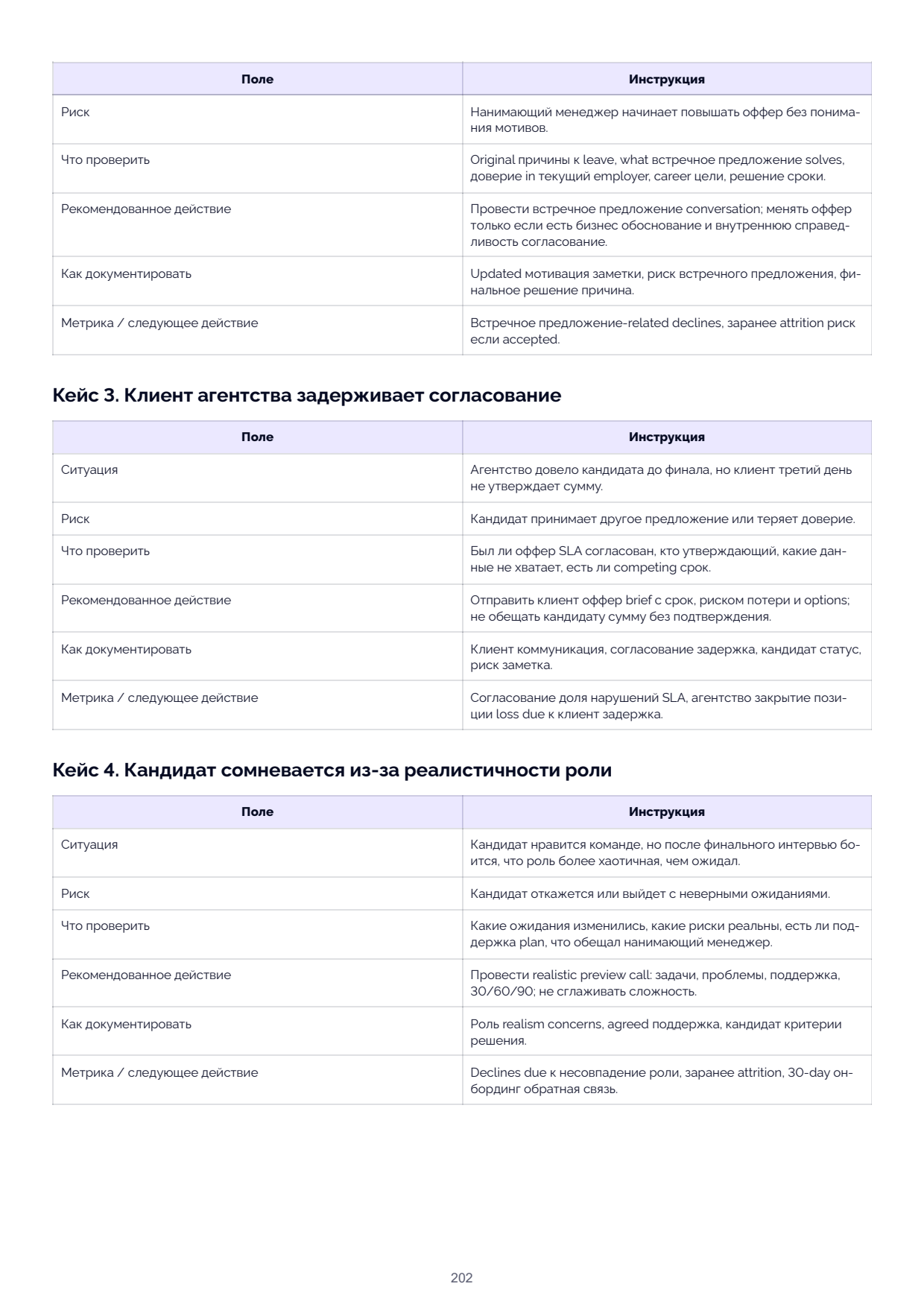
| Field | Instruction |
|---|---|
| Risk | Hiring manager starts raising the offer without understanding motivations. |
| What to check | Original reasons for leaving, what the counter-offer solves, trust in current employer, career goals, decision timelines. |
| Recommended action | Conduct a counter-offer conversation; change the offer only if there is a business case and internal equity approval. |
| How to document | Updated motivation notes, counter-offer risk, final decision reason. |
| Metric / next step | Counter-offer-related declines, early attrition risk if accepted. |
| Case 3. Agency client delays approval | |
| Field | Instruction |
| Situation | Agency brought the candidate to shortlist, but client has not approved the figure for three days. |
| Risk | Candidate accepts another offer or loses trust. |
| What to check | Was the offer SLA agreed, who is the approver, what data is missing, is there a competing deadline. |
| Recommended action | Send the client an offer brief with deadline, loss risk, and options; do not promise the candidate a figure without confirmation. |
| How to document | Client communication, approval delay, candidate status, risk note. |
| Metric / next step | Approval SLA breach rate, agency position loss due to client delay. |
| Case 4. Candidate has doubts about role realism | |
| Field | Instruction |
| Situation | Candidate appeals to the team, but after the final interview fears the role is more chaotic than expected. |
| Risk | Candidate declines or starts with wrong expectations. |
| What to check | Which expectations changed, which risks are real, is there a support plan, what did the hiring manager promise. |
| Recommended action | Run a realistic preview call: tasks, challenges, support, 30/60/90; do not smooth over the complexity. |
| How to document | Role realism concerns, agreed support, candidate decision criteria. |
| Metric / next step | Declines due to role mismatch, early attrition, 30-day onboarding feedback. |
| Case 5. Two strong finalists, one offer | |
|---|---|
| Field | Instruction |
| Situation | There are two finalists: one receives an offer, the other could become a strong finalist. |
| Risk | Second candidate receives a flat rejection and is lost for future roles. |
| What to check | Assessment scorecard differences, reason for selection, potential fit for future roles, consent to future contact. |
| Recommended action | Make the offer to the first; give the second a respectful rejection, record strengths and future role fit, request permission to stay in touch. |
| How to document | Decision log, strong finalist note, future contact status. |
| Metric / next step | Strong finalist conversion, candidate experience feedback. |
12. SOPs and policy excerpts
SOP: offer readiness review
Field Description
Objective Ensure the team is ready to make the offer without false
promises and unnecessary delay.
Scope All finalists before a formal offer or salary
exception.
Roles Recruiter owns pre-offer evidence check with
candidate; hiring manager owns role and level;
HR/compensation own band and internal equity;
finance approve significant exceptions; account-
| Field | Description |
|---|---|
| manager coordinates client approvals where relevant. | |
| Inputs | Assessment scorecard, decision log, pre-offer evidence notes, salary band, candidate expectations, vacancy priority, approval chain. |
| Steps | 1. Confirm decision and level. 2. Review motivation and constraints. 3. Check compensation against band. 4. Determine whether exceptions are needed. 5. Confirm approvers and deadline. 6. Prepare offer logic. 7. Assign owner for offer presentation. |
| SLA / timeline | Readiness review within 1 working day of final decision; urgent competing offers require same-day review if data are complete. |
| Mandatory fields | Candidate, role, level, proposed package, pre-offer evidence summary, risks, approvers, deadline, presentation owner. |
| Outputs | Approved offer draft or documented reason to pause. |
| Exceptions | No offer may be presented before approval if compensation, job title, work model, or start date are not confirmed. |
| Metrics | Approval SLA, time in offer stage, offer acceptance, decline reasons. |
| Example | Candidate for Head of Sales has high counter-offer risk; review confirms stronger narrative and same-day compensation exception decision. |
| SOP: offer presentation and next step | |
| Field | Description |
| Objective | Present the offer clearly, respectfully, and consistently. |
| Scope | Verbal and written offers for employees or agency fills. |
| Roles | Recruiter coordinates; hiring manager explains role and expectations; HR confirms employment terms; agency communicates only client-approved conditions. |
| Inputs | Approved offer, role narrative, start plan, candidate questions, decision timelines. |
| Steps | 1. Schedule offer call. 2. Explain why candidate was selected. 3. Present role, package, start date, and work model. 4. Pause for questions. 5. Agree response timeline. 6. Send written summary. 7. Log response and next step. |
| SLA / timeline | Written summary sent the same day after the offer call unless legal / HR process requires another route. |
| Mandatory fields | Offer details, candidate questions, response deadline, next step, owner. |
| Outputs | Accepted offer, negotiation items, declined offer, or pending response with clear next step. |
| Exceptions | Candidate pressure, exploding offers, and unapproved verbal promises are prohibited. |
| Field | Description |
|---|---|
| Metrics | Offer acceptance rate, time to response, candidate question pattern, decline reasons. |
| Example | Recruiter presents package; hiring manager joins to explain the first 90 days; HR sends formal document. |
| 13. Implementation plan and maturity model 1 day | |
| Action | Result |
| Appoint offer stage owner | Clear who leads the final stage |
| Introduce pre-offer evidence checklist | Offers are not made in the dark |
| Fix salary band before shortlist | Hiring manager does not promise the impossible |
| Add decline reasons for offer declines | Final-stage losses become analysable |
| Set approval SLA | Candidates do not wait without reason |
| 1 week | |
| Action | Result |
| Create offer approval pack template | Exceptions are approved faster and more honestly |
| Calibrate on recent decline reasons | Team sees real reasons for declines |
| Set up counter-offer conversation guide | Recruiters do not improvise under pressure |
| Review internal equity rule | Urgent offers do not break the pay system |
| Add offer metrics to weekly review | Final stage enters the operational rhythm |
| 1 month | |
| Action | Result |
| Review the last 5–10 offers | Patterns visible by role, source, manager, compensation |
| Compare pre-offer evidence quality with outcomes | Clear which questions predict risk |
| Update salary exception rules | Exceptions become manageable |
| Link accepted offers to start dates | Chapter 11 connects to preboarding from Chapter 12 |
| Prepare training for hiring managers | Managers understand their role in the offer process |
| Maturity model | |
| Level | How it looks |
| Chaos | Offers made in chats, terms promised verbally, approval unpredictable |
Chaos Offers made in chats, terms promised verbally, approval unpredictable