Chapter 8. Assessment, Levels and AI-Matching


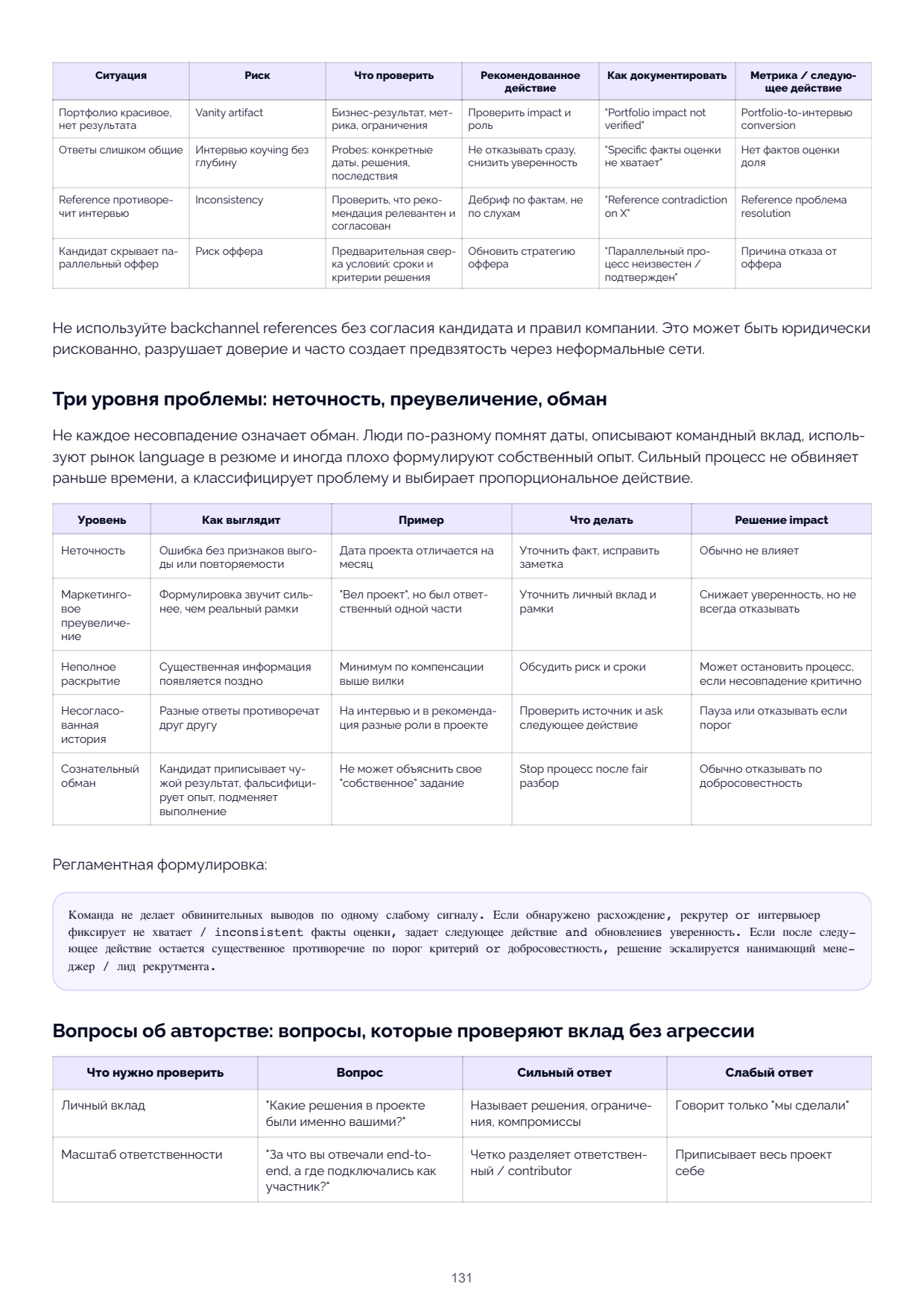
| Situation | Risk | What to check | Recommended action | How to document | Metric / next step |
|---|---|---|---|---|---|
| Portfolio looks impressive, but there are no results | Vanity artifact | Business result, metric, constraints | Verify impact and role | "Portfolio impact not verified" | Portfolio-to-interview conversion |
| Answers are too generic | Interview coaching without depth | Probes: specific dates, decisions, consequences | Do not reject immediately; lower confidence | "Specific assessment facts lacking" | Share of assessments without facts |
| Reference contradicts interview | Inconsistency | Check that the recommendation is relevant and consistent | Debrief on facts, not hearsay | "Reference contradiction on X" | Reference issue resolution |
| Candidate conceals a parallel offer | Offer risk | Pre-check terms: timeline and decision criteria | Update offer strategy | "Parallel process unknown / confirmed" | Offer decline reason |
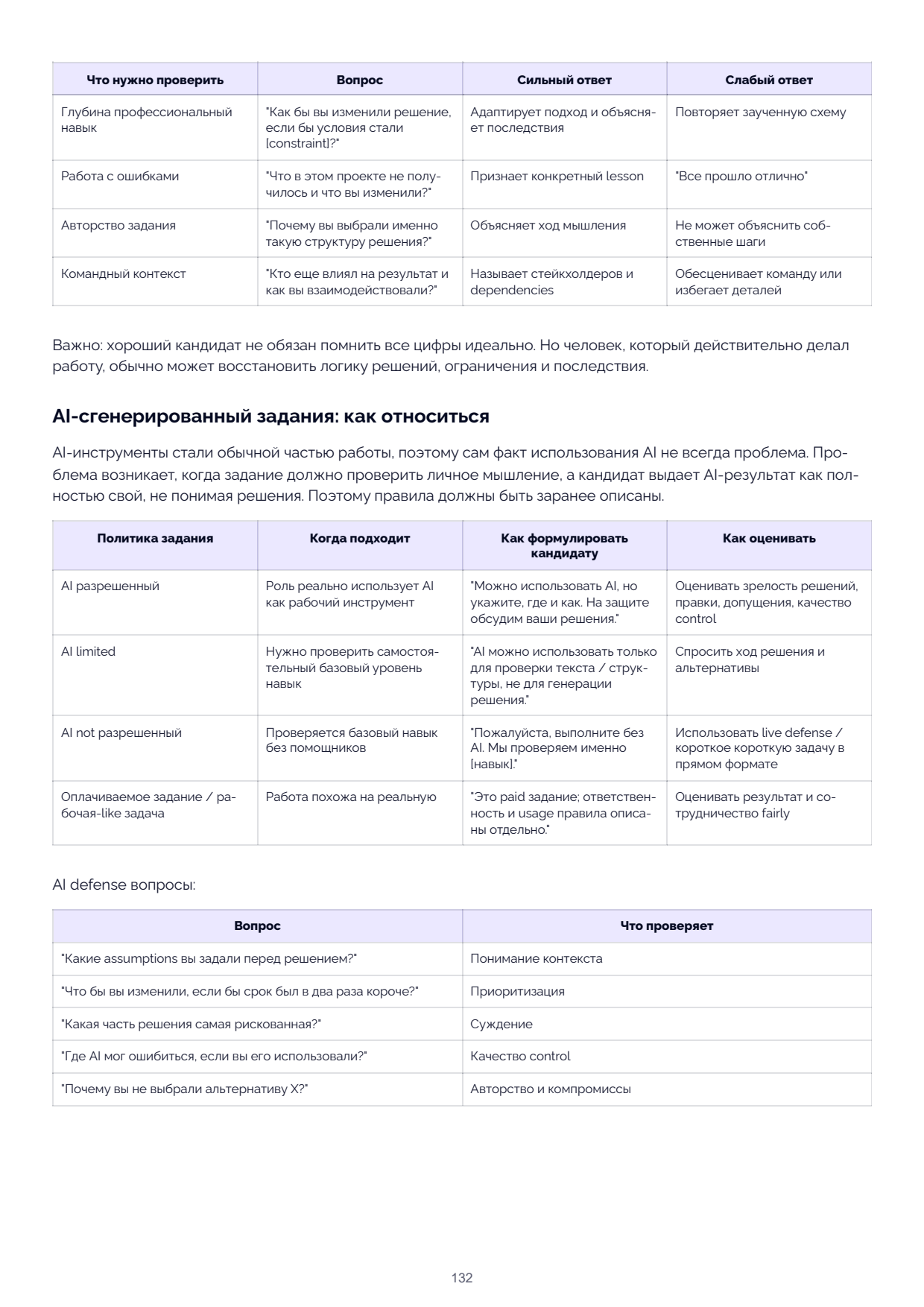
| What to check | Question | Strong answer | Weak answer |
|---|---|---|---|
| Depth of professional skill | "How would you change your approach if the constraints became [constraint]?" | Adapts the approach and explains the consequences | Repeats a memorised pattern |
| Handling errors | "What went wrong in this project and what did you change?" | Acknowledges a specific lesson | "Everything went perfectly" |
| Ownership of the task | "Why did you choose this particular structure for the solution?" | Explains the thought process | Cannot explain their own steps |
| Team context | "Who else influenced the outcome and how did you interact with them?" | Names stakeholders and dependencies | Dismisses the team or avoids detail |
5. Test assignment: the "one evening" rule — paid or simplified
A test assignment should provide a work-related signal, not extract free labour. A practical rule for most roles: if the assignment cannot be completed in one evening, it must be paid, simplified or replaced with another assessment method. "One evening" means a limited scope with a clear time constraint, not a hidden 12 hours of work.
Assignment type When to use Quality rule What is prohibited
Short work sample Need to verify a specific 60–180 minutes, rubric, not Using the result in the
professional skill work employer's business
Paid assignment Need deep verification of a high- Payment, boundaries, IP rules Calling the payment a "bonus"
impact skill and usage of result without terms
Simplified case Need to assess thinking structure, Synthetic case with limited Requiring a full strategic
not finished work data plan
Live case Reasoning process matters Brief, with equal conditions Applying work-unrelated stress
| Assignment type | When to use | Quality rule | What is prohibited | |
|---|---|---|---|---|
| Portfolio defence | Past work exists | Verify authorship and decisions | Asking for confidential data | |
| Mini-SOP for an assignment: | ||||
| Step | Rule | |||
| 1. Purpose | State which criterion is being assessed | |||
| 2. Time constraint | Write the expected time and an upper limit | |||
| 3. Input data | Give all candidates the same brief | |||
| 4. Rubric | Describe how the result will be assessed | |||
| 5. Usage of result | Confirm that the work will not be used as deliverable output without a separate agreement | |||
| 6. Feedback | Explain whether brief feedback will be provided | |||
| 7. Alternative | Offer an alternative for accessibility / time constraints, if policy allows | |||
| Rubric for a short assignment | ||||
| Criterion | 1 | 3 | 5 | Reviewer note |
| Work-related thinking | Answer not connected to the role's task | Solves an obvious part of the task | Sees the goal, constraints, trade-offs and risks | Do not assess presentation polish beyond the role |
| Practicality | General ideas with no next steps | Plan exists but lacks accountability / metrics | Action plan with accountable person, risks, fallback | Check applicability, not volume |
| Use of assessment facts | Ignores the brief | Partially uses the data | Separates facts, assumptions and unknowns | Do not reward invented data |
| Communication | Conclusion is hard to follow | Conclusion is clear but structure is mediocre | Clear, concise executive summary and rationale | Do not conflate style with substance |
| Ethics / data | Recommends questionable actions | Follows basic constraints | Proactively flags privacy / fairness of assessment / policy risks | Important threshold for HR / recruiting roles |
| When to skip the assignment | ||||
| Condition | Why it is better not to give an assignment | Alternative | ||
| Senior role with a strong portfolio | The assignment may be weaker than real assessment facts | Portfolio defence + reference checks | ||
| Candidate pool is overheated | A long process reduces conversion | Structured interview + short live case | ||
| Assignment mirrors actual work materials | Risk of exploitation and distrust | Synthetic case or paid assignment |
| Condition | Why it is better not to give an assignment | Alternative |
|---|---|---|
| Team is not ready to assess | Feedback will be chaotic | Set up rubric and reviewer briefing first |
| The skill under assessment is better observed in conversation | Written work will produce a false signal | Situational interview or role-play scenario |
6. Agency and in-house recruitment: process variants
In an agency context, motivation and signal reliability are especially important because the agency manages the trust of three parties: the candidate, the client and its own team. In an in-house recruitment context, the main risk is often that the hiring manager mistakes a polished signal for readiness for the role or oversells the candidate on a role that is better than it actually is.
| Context | Main risk | What the recruiter does | What the hiring manager / client does |
| Agency | Client receives a shortlist with unverified motivation | Checks motives, availability, compensation, personal contribution; records confidence | Provides honest role realism and feedback on criteria |
| In-house recruitment | Team overvalues interview impressions | Maintains a scorecard, logs missing assessment facts, conducts pre-checks on terms | Explains the difficult aspects of the role and takes part in the debrief |
| Executive search | Candidates are guarded due to confidential search | Works via permission-based disclosure | Does not demand extra data before mutual interest |
| High-volume hiring | Signals are reduced to keywords | Standardises screening and rejection reasons | Does not change criteria from one candidate to the next |
| 7. How to implement in 1 day, 1 week and 1 month | |||
| Timeframe | Action | Artifact | Owner |
| 1 day | Add 5 screening questions on motivation and constraints | Motivation snapshot | Recruiter |
| 1 day | Add a confidence field next to the rating | Scorecard update | Recruitment lead |
| 1 week | Rewrite test assignments using the time-limit / paid / simplified rule | Assignment rubric | Hiring manager + recruiter |
| 1 week | Set up the debrief question "which signal is unreliable?" | Debrief agenda | Recruiter |
| 1 month | Audit rejections and offer declines for motivation / signal issues | Rejection analysis | Recruitment lead |
| 1 month | Update interviewer training on personal-contribution probing questions | Training notes | HRD / lead |
| Implementation checklist: |
7. How to implement in 1 day, 1 week and 1 month
Timeframe Action Artifact Owner
1 day Add 5 screening questions on Motivation snapshot Recruiter
motivation and
constraints
1 day Add a confidence field next Scorecard update Recruitment lead
to the rating
1 week Rewrite test assignments Assignment rubric Hiring manager +
using the time-limit / recruiter
paid / simplified rule
1 week Set up the debrief question Debrief agenda Recruiter
"which signal is unreliable?"
1 month Audit rejections and offer Rejection analysis Recruitment lead
declines for motivation /
signal issues
1 month Update interviewer training Training notes HRD / lead
on personal-contribution
probing questions
Implementation checklist:
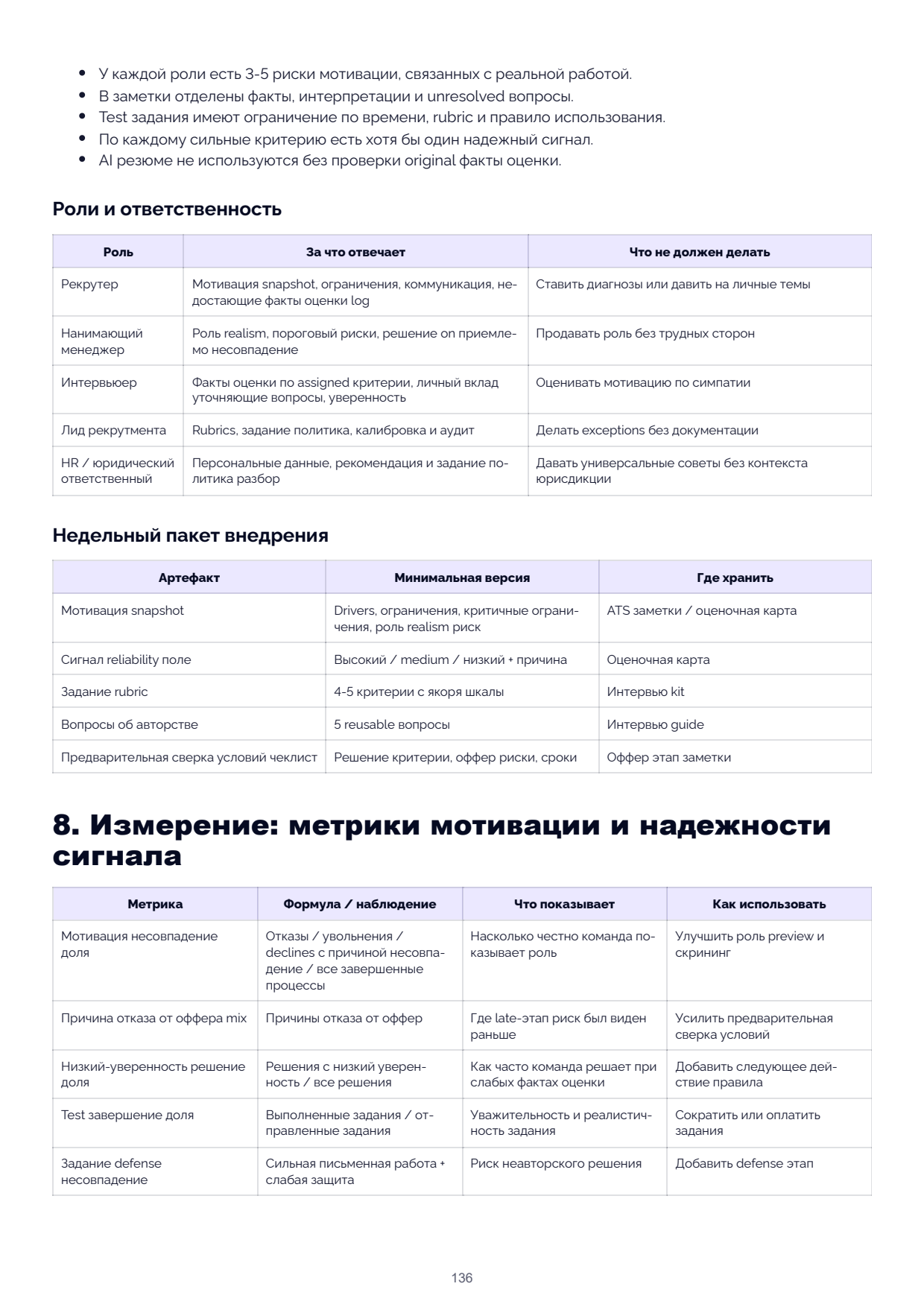
Every role has 3–5 motivation risks linked to the actual work.
Notes separate facts, interpretations and unresolved questions.
Test assignments have a time limit, rubric and usage rule.
For each must-have criterion there is at least one reliable signal.
AI summaries are not used without verifying the original assessment facts.
Roles and responsibilities
Role What they are responsible for What they must not do
Recruiter Motivation snapshot, constraints, communication, missing Set diagnoses or press on personal topics
assessment facts log
Hiring manager Role realism, threshold risks, decision on acceptable Do not oversell the role without its difficult
mismatches aspects
Interviewer Assessment facts against assigned criteria, personal- Assess motivation on sympathy alone
contribution probing questions, confidence
Recruitment lead Rubrics, assignment policy, calibration and audit Make exceptions without documentation
HR / legal Personal data, reference and assignment policy Provide generic advice without context
owner jurisdiction review
Weekly implementation pack
Artifact Minimum version Where to store
Motivation snapshot Drivers, constraints, critical constraints, role realism risk ATS notes / scorecard
Signal reliability field High / medium / low + reason Scorecard
Assignment rubric 4–5 criteria with scale anchors Interview kit
Authorship questions 5 reusable questions Interview guide
Pre-check terms checklist Decision criteria, offer risks, timeline Offer stage notes
8. Measuring: motivation metrics and signal
reliability
Metric Formula / observation What it shows How to use it
Motivation mismatch rate Rejections / leavers / How honestly the team Improve role preview and
declines with reason mismatch / all completed portrays the role screening
processes
Offer decline mix Reasons for offer Where late-stage risk was Strengthen pre-check
declines visible earlier on terms
Low-confidence decision Decisions with low How often the team decides Add a next-step rule
rate confidence / all decisions on weak assessment facts
Test completion rate Completed assignments / Respectfulness and realism Shorten or pay for
sent assignments of the assignment assignments
Assignment defence mismatch Strong written work + weak defence Risk of unattributed Add a defence stage
decisions
| Metric | Formula / observation | What it shows | How to use it |
|---|---|---|---|
| Rejection reason quality | Share of rejections with work-related reasons | Discipline of fact-based assessment notes | Train interviewers |
Using HarmonyATS as an example: the rejection report helps you see rejection reasons by stage; the funnel with details shows where candidates drop out after an assignment or a manager interview; the candidate movement report shows delays between a signal and a decision. These reports are only useful alongside qualitative notes — the numbers alone do not tell you whether the signal was genuinely reliable. Diagnostics from reports:
| Observation | Possible cause | What to check manually | Action | ||
| Many candidates drop out after the assignment | The assignment is too long or looks like free labour | Assignment instructions, time limit, candidate replies | Simplify, pay for or replace | ||
| Many team rejections at final stage for motivation reasons | Motivation risks are checked too late | Screening notes and pre-check terms | Move questions earlier | ||
| High screening conversion, low manager-interview conversion | Screening accepts weak signals | Assessment facts quality and criteria | Add work-related probing questions | ||
| Offer declines due to compensation | Pay range is discussed too late or incompletely | Compensation notes | Introduce an early range check | ||
| Frequent "other reasons" | Rejection reasons are not structured | Rejection taxonomy | Update the reason list and training | ||
| 9. Good and difficult cases | |||||
| Situation | Risk | What to check | Recommended action | How to document | Metric / next step |
| Strong candidate who wants "strategy" but the role is 80% execution | Early departure | Task expectations, tolerance for operational work | Realistic job preview before offer | "Motivation risk: strategy-to-execution mix" | Early attrition / offer decline |
| Candidate asks for a high title | Title expectations above the role's scope | What decisions and influence they need | Discuss scope, level and growth plan | "Title expectation clarified" | Decline reason: level / title |
| Candidate cannot show portfolio due to NDA | No assessment facts | Can an anonymised case be discussed? | Use case defence / references | "Portfolio limited by confidentiality" | Confidence after alternative assessment |
| 60% of candidates do not return the test assignment | Assignment overload | Time, clarity, stage, compensation | Simplify or pay | "Assignment redesign needed" | Completion rate |
| Hiring manager says "I just don't believe it" | Vague suspicion | Which fact triggers doubt | Translate into personal-contribution / consistency probing questions | "Concern reframed into assessment question" | Vague-feedback rate |
| AI-Matching gives a high score but the notes are weak | Keyword overvaluation | Assessment facts against the criterion | Human check; do not advance on score alone | "AI score not sufficient" | AI override log |
| 10. Regulation fragment: motivation and signal reliability |
For each vacancy, the recruiter records a motivation snapshot: motives, constraints, critical constraints, compensation expectations, availability and role realism risks. For must-have criteria, the interviewer must state assessment facts and confidence. A
Frequent "other reasons" Rejection reasons not Rejection taxonomy Update the reason list and
structured training
9. Good and difficult cases
Situation Risk What to check Recommended How to document Metric / next
action step
Strong candidate who Early departure Task expectations, Realistic job preview before "Motivation risk: Early attrition / offer decline
wants "strategy" but tolerance for offer strategy-to-execution
the role is 80% execution operational work mix"
execution
Candidate asks for a Title expectations above What decisions and influence Discuss scope, level "Title expectation Decline reason: level /
high title the role's scope they need and growth plan clarified" title
Candidate cannot show No assessment facts Can an anonymised case Use case defence / "Portfolio limited by Confidence after
portfolio due to NDA be discussed? references confidentiality" alternative
assessment
60% of candidates do Assignment overload Time, clarity, stage, Simplify or pay "Assignment redesign Completion rate
not return the test compensation needed"
assignment
Hiring manager says Vague suspicion Which fact triggers doubt Translate into personal- "Concern reframed into Vague-feedback rate
"I just don't believe it" contribution / consistency assessment question"
probing questions
AI-Matching gives a Keyword overvaluation Assessment facts against Human check; do not "AI score not sufficient" AI override log
high score but the the criterion advance on score alone
notes are weak
10. Regulation fragment: motivation and
signal reliability
For each vacancy, the recruiter records a motivation snapshot: motives, constraints, critical constraints, compensation
expectations, availability and role realism risks. For must-have criteria, the interviewer must state assessment facts and
confidence. A decision may not rely solely on a CV, AI score, general feedback or an unverified test assignment. If signal
reliability is low against the threshold criterion, the responsible person assigns a next step or records a rejection on
work-related grounds.
A test assignment is permitted only when a purpose, time constraint, identical brief, evaluation rubric and usage rule are in
place. If the expected time exceeds one evening, the assignment must be paid, simplified or replaced with another
assessment method.
Chapter AI prompts
The full prompts are in Appendix H to keep the chapter readable while the working instructions are collected in one
place. AI helps to structure data and drafts but does not make decisions on hiring, rejection, level, compensation or
legal obligations.
Task Full prompt Human check
Work through motivation risks Appendix H, H4.9 Check facts, privacy, tone and decision
owner before using the result.
Assess signal reliability Appendix H, H4.10 Check facts, privacy, tone and decision
owner before using the result.
Redesign a test assignment Appendix H, H4.6 Check facts, privacy, tone and decision
owner before using the result.
11. Maturity model
Level What it looks like
Chaos Motivation is assessed by enthusiasm alone; signal reliability is never discussed
Managed process There is a motivation snapshot, personal-contribution probing questions, time-boxed assignments
Assessment-based Assessment and confidence are separated; the debrief discusses missing assessment facts
Fair and respectful Assignments are short / paid, role preview is honest, notes are work-related
AI-supported operations AI helps to find gaps and questions; the decision stays with people
Key takeaways from the chapter / where to go next
What you need Where to find it
Terms and short definitions Appendix B. Mini-glossary
Ready-made regulations and SLA Appendix D. Ready-made regulations and processes
Working templates Appendix E. Template library
End-to-end examples BDM and Backend Appendix F. End-to-end cases BDM and Backend
Full AI prompts for the chapter Appendix H. AI prompt library, section H4. Role, criteria
and assessment
In short: this chapter covers motivation, hidden information and signal reliability. If you need a ready-made artifact,
take it from the appendices; the chapter itself covers the application logic.
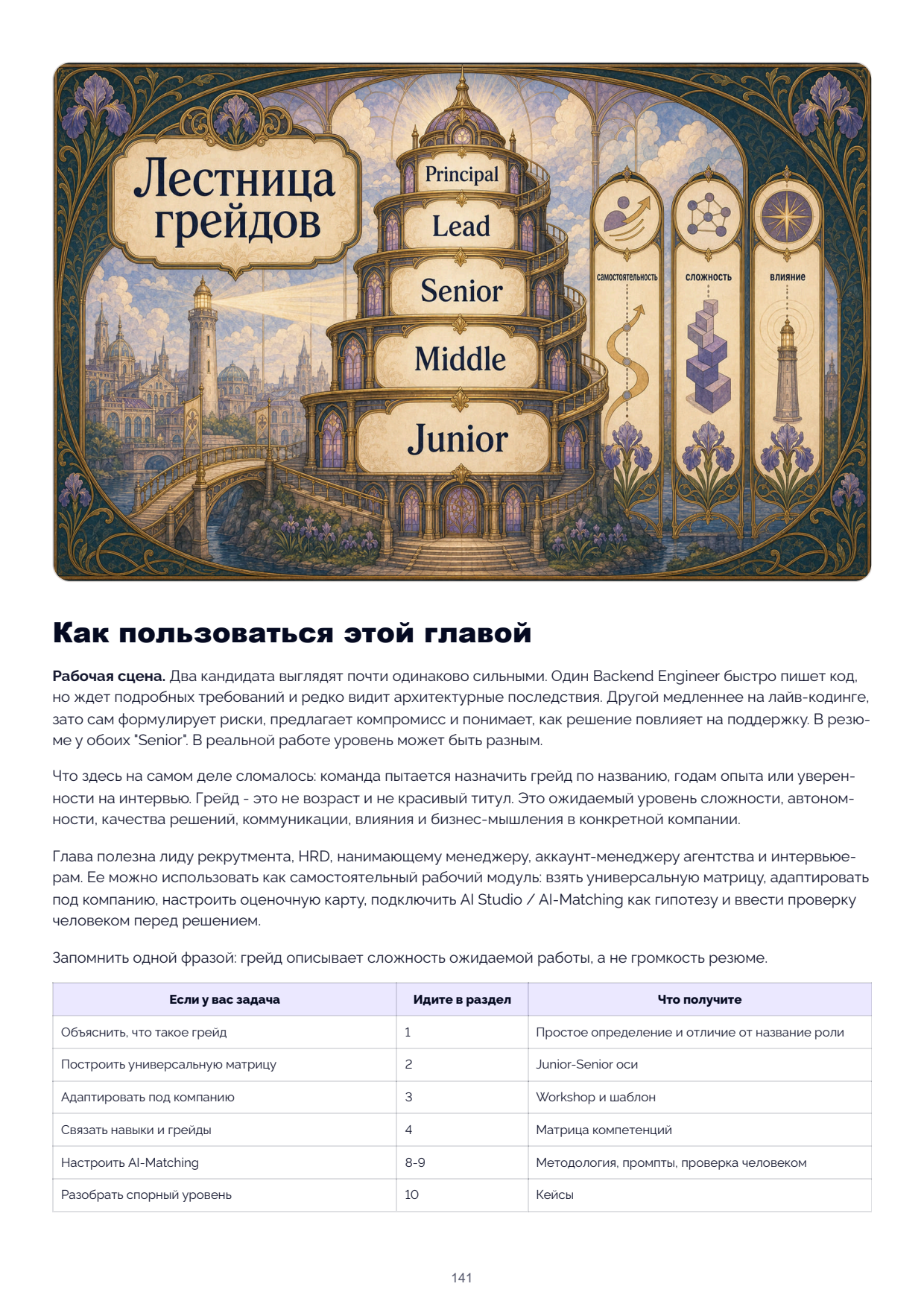
How to use this chapter
Working scenario. Two candidates look almost equally strong. One Backend Engineer writes code quickly,
but waits for detailed requirements and rarely considers architectural consequences. The other is slower at live
coding, but identifies risks independently, proposes trade-offs and understands how a decision affects support. Both
CVs say "Senior". In practice, their levels may differ greatly.
What has actually gone wrong here: the team tries to assign a level by job title, years of experience or confidence
in the interview. A level is not seniority or a fancy title. It is the expected complexity of work, autonomy, quality of
decisions, communication, influence and business thinking in a specific company.
This chapter is useful to the recruitment lead, HRD, hiring manager, agency account manager and interviewers.
It can be used as a standalone working module: take the universal matrix, adapt it to your company, set up a scorecard,
bring in AI Studio / AI-Matching as a hypothesis and introduce a human check before the final decision.
Remember in one phrase: a level describes the expected complexity of the work, not the impressiveness of the CV.
| If your task is | Go to section | What you will get |
|---|---|---|
| Explain what a level is | 1 | Simple definition and difference from a job title |
| Build a universal matrix | 2 | Junior–Senior axes |
| Adapt to your company | 3 | Workshop and template |
| Link skills and levels | 4 | Competency matrix |
| Set up AI-Matching | 8–9 | Methodology, prompts, human check |
| Resolve a disputed level | 10 | Cases |
| Implement the process | 11–13 | SOP, metrics, maturity model |
Example type How to use it What to record
External candidate Check market language against internal Past job title vs actual scope
level
Internal mobility case Compare internal and external Same criteria, different assessment fact
standards sources
Workshop: 90-minute level calibration workshop
The workshop is not for HR to "bring a ready-made matrix" but for hiring managers to agree on what the levels
mean. If the matrix has not been walked through on real examples, it quickly becomes a pretty table that
only gets opened before a performance review.
Time Block What the facilitator does What the team does Output
0–10 min Role scope Reminds the team of role Clarifies which roles fall inside / Boundary of the matrix
families and the business task outside
10–25 min Real tasks Asks for 8–12 real tasks of Groups tasks by complexity Task complexity map
the role
25–40 min Level scale anchors Shows the universal Describes Junior / Middle / Draft scale anchors
axes through work Senior via examples
examples
40–55 min Calibration profiles Gives 3 anonymised Rates level along each axis Discrepancy log
profiles
55–70 min Threshold Asks what cannot be Compensates identifies Threshold list
compensated must-have criteria and
trainable gaps
70–82 min Interview assessment Links scale anchors to Decides where to check each Assessment facts plan
facts questions and assignments axis
82–90 min Decision rule Records the responsible Records the approval rule Level decision rule
person and review cycle
A ready-to-use agenda for the invitation:
Subject: level calibration for [role family].
Objective: agree on how Junior / Middle / Senior differ in practice so that recruitment, interviews and offer decisions are
based on the same criteria.
Preparation required: each participant brings 2 Middle-level task examples and 1 example of an error when a candidate's /
employee's level was assessed inaccurately.
Meeting outcome: draft level matrix, thresholds, assessment facts plan for interviews and the decision owner.
Facilitation rule: if a participant says "a Senior should be strong", the facilitator returns to the question "in
which task is that visible?". If it sounds like "we just feel it here", the facilitator asks for observable behaviour.
If the argument turns on years of experience, the facilitator redirects the debate to autonomy, complexity,
influence and business impact.
Level calibration across different functions
The universal matrix must be consistent in logic but alive with examples. What follows is not a "market truth" but a
way to explain to managers that a level is defined by the real scope of the work.
Function Middle looks like this Senior looks like this Typical assessment mistake
IT / software engineering Owns a feature / service area, Considers system trade-offs, Considers someone a Senior because
understands edge cases, writes influences engineering they know more technologies but
maintainable solutions practice does not hold architectural decisions
| Function | Middle looks like this | Senior looks like this | Typical assessment mistake |
|---|---|---|---|
| Marketing | Leads a channel / campaign, reads funnel metrics, runs clear experiments | Connects positioning, channel mix, unit economics and revenue impact | Promotes for creativity without proven impact |
| Sales | Runs the full cycle of typical deals, qualifies, manages the funnel | Builds account strategy, handles complex stakeholders, protects value | Assesses only by charisma and past revenue without checking deal quality |
| Finance | Runs the process, finds errors, prepares management reporting | Designs controls, risk model, decision-ready insights | Considers someone a Senior because they execute accurately but lack decision maturity under uncertainty |
| Recruitment | Manages the vacancy, funnel, hiring manager discipline, scorecard | Builds the hiring system, calibrates interviewers, reads analytics, changes processes | Confuses closing speed for individual vacancies with systemic level |
| For each function it is useful to answer three questions separately: | |||
| Question | Purpose | Example answer | |
| Which errors at this level are costly? | Helps to see thresholds | A finance Senior cannot ignore controls; a sales Senior cannot sell through over-promising | |
| Which decisions does the person make without manager approval? | Shows autonomy | A Middle chooses the tactic within a task; a Senior proposes direction and consequences | |
| Whose work does the role affect? | Shows influence | A Junior affects their own task; a Senior changes the team's process or customer outcomes |
4. Competencies: how to link skills and levels
A competency is a measurable work behaviour or skill that can be observed through assessment facts. In Chapter 6, skills are described via output, assessment facts and scale anchors. Here we add the level: at which level a person should demonstrate the skill.
| Competency | Junior | Middle | Senior |
| Communication | Reports status and asks questions | Manages expectations and risks in their zone | Creates shared clarity among stakeholders |
| Accountability | Carries out tasks and reports problems | Delivers results in their zone | Changes the system so failures do not recur |
| Judgement | Follows clear rules | Chooses a reasonable compromise | Makes decisions under uncertainty and explains the consequences |
| Ability to learn | Learns from feedback | Builds their own learning cycle | Helps others learn and refreshes practices |
| Domain professional skill | Applies basic methods | Solves routine and moderately complex tasks | Designs approaches for complex tasks |
| Business thinking | Understands the task | Sees impact on the team / customer | Links decisions to capacity, risk, revenue or quality |
4. Competencies: how to link skills and levels
A competency is a measurable work behaviour or skill that can be observed through assessment facts. In
Chapter 6, skills are described via output, assessment facts and scale anchors. Here we add the level: at which level
a person should demonstrate the skill.
Competency Junior Middle Senior
Communication Reports status and asks Manages expectations and risks Creates shared clarity among
questions in their zone stakeholders
Accountability Carries out tasks and reports Delivers results in their zone Changes the system so failures
problems do not recur
Judgement Follows clear rules Chooses a reasonable Makes decisions under
compromise uncertainty and explains the
consequences
Ability to learn Learns from feedback Builds their own learning cycle Helps others learn and refreshes
practices
Domain professional skill Applies basic methods Solves routine and moderately Designs approaches for complex
complex tasks tasks
Business thinking Understands the task Sees impact on the team / Links decisions to capacity,
customer risk, revenue or quality
Rule: not all competencies need to be equally strong. For an expert individual contributor, deep professional skill
may carry more weight; for a manager, it is decision maturity, feedback, conflict maturity and influence.
But reliability and ethical behaviour cannot be fully compensated by strong expertise.
Examples by role family
Role family More important at Junior More important at Middle More important at Senior
Software engineering Basic coding discipline, learning, Independently delivers features, Designs trade-offs, improves
asking for debrief debugs, sees local risks systems, mentors, handles
ambiguity
Sales Follows process, learns Runs discovery, manages funnel, Builds account strategy, handles
product, qualifies simple leads negotiates typical deals complex stakeholders, protects
value
Marketing Executes campaigns and basic Reads funnel, runs Connects positioning, channels,
reports experiments, adjusts budget analytics and business
or content results
Finance / operations Follows control procedures, Owns the process, finds Design controls, risk model and
executes work accurately errors, improves reporting decision-ready insights
Recruitment Screens per rubric, keeps Manages role funnel, criteria Design hiring process, calibrates
notes and SLA and hiring manager discipline managers, reads analytics
Customer success Handles work instructions and Owns client portfolios, Builds retention system, escalation
tasks and customer notes diagnoses adoption and risk and stakeholder strategy
Assessment facts by level
Axis Junior assessment facts Middle assessment facts Senior assessment facts
Autonomy Knows when to ask for help Structures own tasks and Defines ambiguous work for
dependencies self and others
Complexity Handles known cases with Handles mixed constraints and Handles unclear problems with
exceptions system impact
Influence Cooperates within a task Coordinates adjacent Changes process, mentors or
stakeholders aligns groups
Judgement Follows rules Explains trade-offs Chooses approaches under uncertainty
Business thinking Understands the immediate goal Connects work to team Connects work to customer, revenue,
outcomes risk or quality
How to distinguish "ready for the level" from "can grow into the level"
One of the most common hiring mistakes is to hire a candidate as a Senior because they could potentially become
a Senior. Potential matters, but the offer, compensation, onboarding and expectations must match the currently
proven readiness.
Signal Ready for the level Can grow into the level Decision risk
Autonomy Has previously led a similar scope Reasons well but has not held Needs a responsible onboarding and
without constant oversight responsibility lower initial scope
Complexity Worked on real complex cases Worked on academic / limited Must not be sold to the hiring
examples manager as a proven Senior
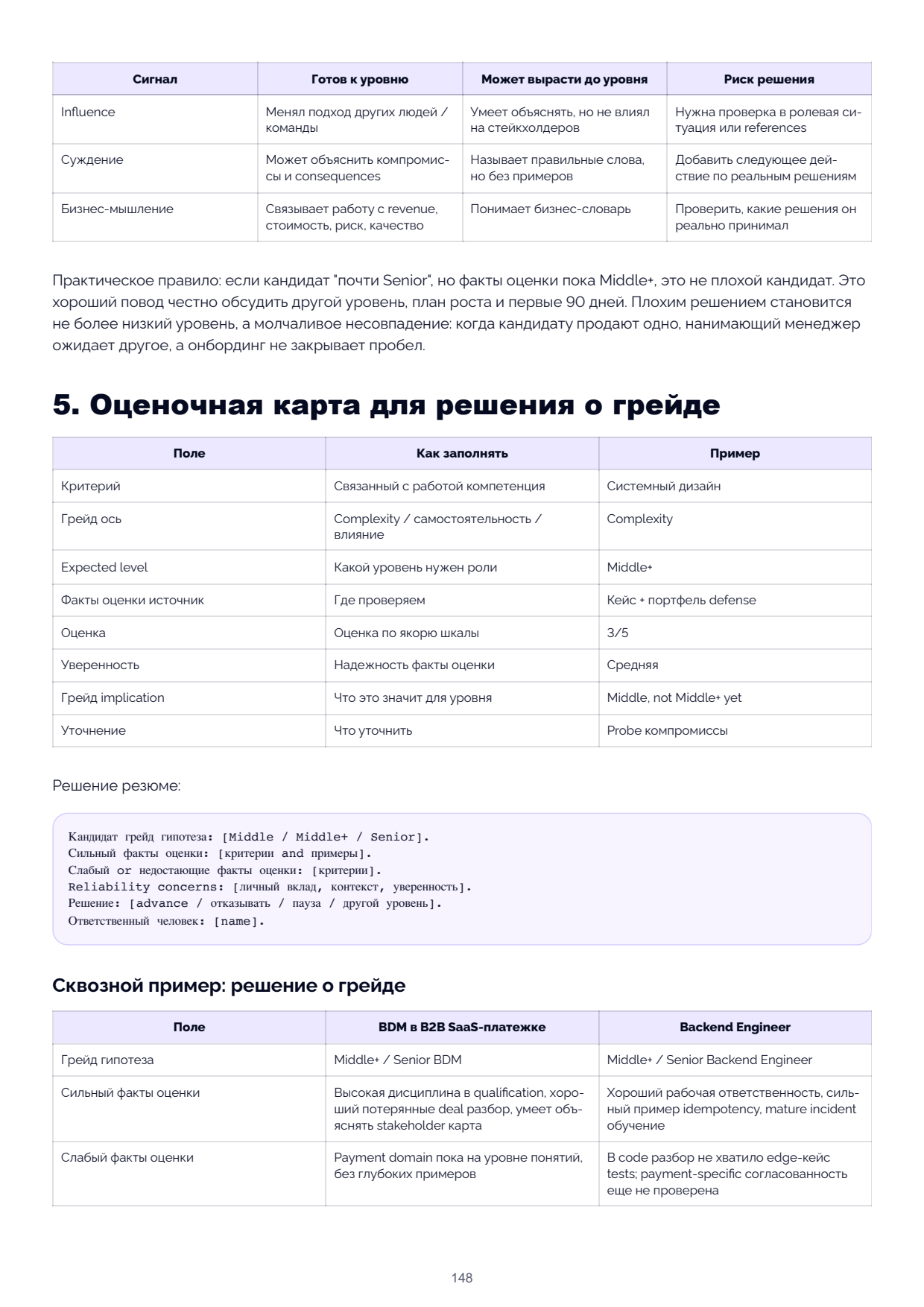
| Signal | Ready for the level | Can grow into the level | Decision risk |
|---|---|---|---|
| Influence | Has changed the approach of others / a team | Can explain but has not influenced stakeholders | Needs checking via a role-play or references |
| Judgement | Can explain trade-offs and consequences | Uses the right words but without examples | Add a next-step for real decisions |
| Business thinking | Links work to revenue, cost, risk, quality | Understands the business vocabulary | Check which decisions they actually made |
Practical rule: if a candidate is "almost a Senior" but the assessment facts still show Middle+, this is not a bad candidate. It is a good reason to honestly discuss a different level, a growth plan and the first 90 days. The bad decision is not the lower level itself, but a silent mismatch: when the candidate is sold one thing, the hiring manager expects another and onboarding does not close the gap.
5. Scorecard for level decisions
| Field | How to fill in | Example |
| Criterion | Work-related competency | System design |
| Level axis | Complexity / autonomy / influence | Complexity |
| Expected level | What level does the role need? | Middle+ |
| Assessment facts source | Where are we checking? | Case + portfolio defence |
| Rating | Rating against the scale anchor | 3/5 |
| Confidence | Reliability of the assessment facts | Medium |
| Level implication | What this means for the level | Middle, not Middle+ yet |
| Follow-up | What to clarify | Probe trade-offs |
| Decision summary: |
Candidate level hypothesis: [Middle / Middle+ / Senior]. Strong assessment facts: [criteria and examples]. Weak or missing assessment facts: [criteria]. Reliability concerns: [personal contribution, context, confidence]. Decision: [advance / reject / pause / different level]. Responsible person: [name].
| End-to-end example: level decision | ||
| Field | BDM in B2B SaaS payments | Backend Engineer |
| Level hypothesis | Middle+ / Senior BDM | Middle+ / Senior Backend Engineer |
| Strong assessment facts | High discipline in qualification, good lost-deal analysis, can explain stakeholder map | Good work accountability, strong idempotency example, mature incident learning |
| Weak assessment facts | Payment domain knowledge still at a conceptual level, no deep examples | Code review lacked edge-case tests; payment-specific consistency not yet verified |
Candidate level hypothesis: [Middle / Middle+ / Senior].
Strong assessment facts: [criteria and examples].
Weak or missing assessment facts: [criteria].
Reliability concerns: [personal contribution, context, confidence].
Decision: [advance / reject / pause / different level].
Responsible person: [name].
End-to-end example: level decision
Field BDM in B2B SaaS payments Backend Engineer
Level hypothesis Middle+ / Senior BDM Middle+ / Senior Backend Engineer
Strong assessment facts High discipline in qualification, good lost- Good work accountability, strong
deal analysis, can explain stakeholder map idempotency example, mature incident
learning
Weak assessment facts Payment domain knowledge still at a Code review lacked edge-case
conceptual level, no deep examples tests; payment-specific consistency
not yet verified
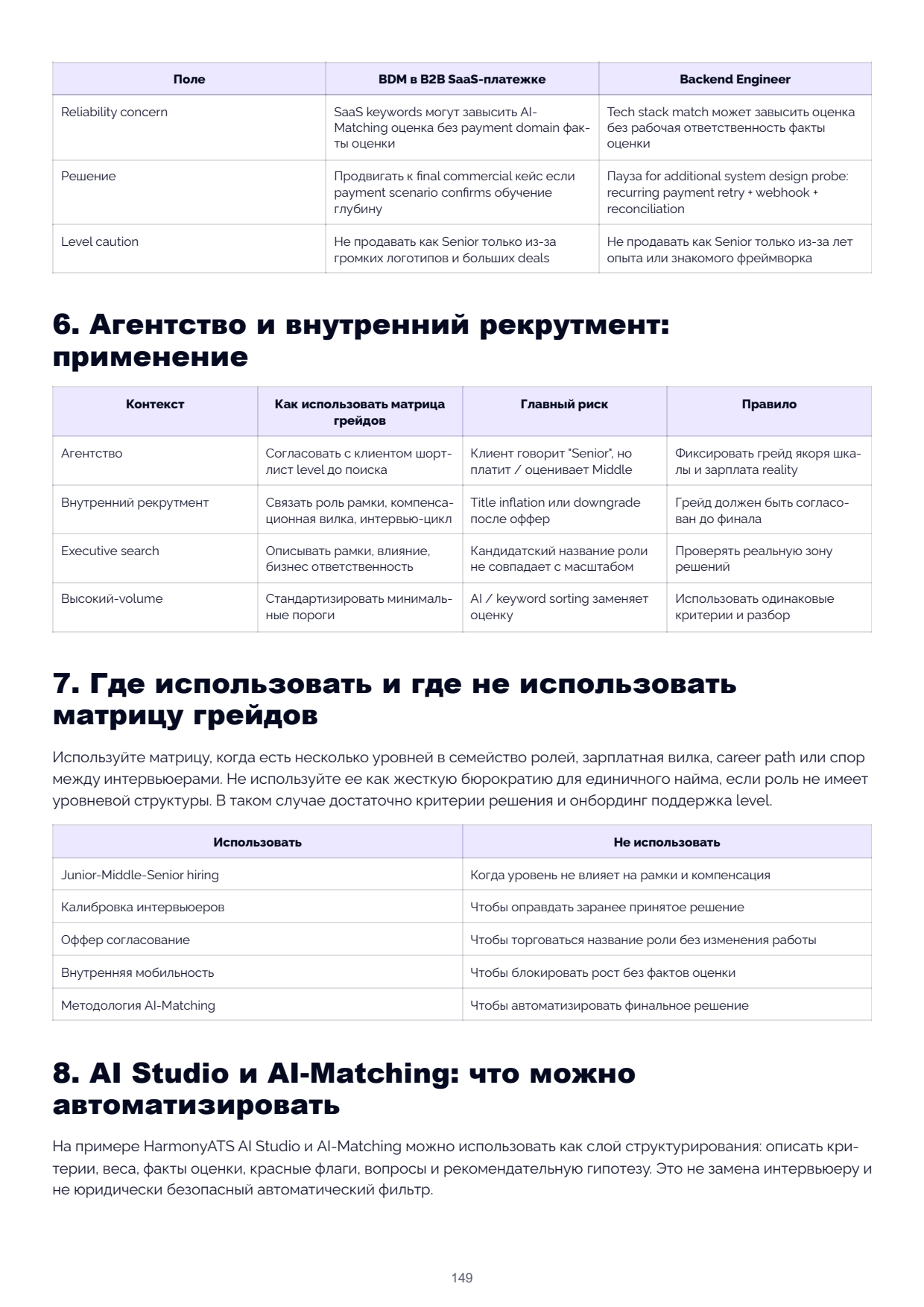
| Field | BDM in B2B SaaS payments | Backend Engineer | |
|---|---|---|---|
| Reliability concern | SaaS keywords may inflate the AI-Matching score without payment domain assessment facts | Tech stack match may inflate the score without work-accountability assessment facts | |
| Decision | Advance to final commercial case if the payment scenario confirms learning depth | Pause for additional system design probe: recurring payment retry + webhook + reconciliation | |
| Level caution | Do not sell as Senior just because of well-known logos and large deals | Do not sell as Senior just because of years of experience or a familiar framework | |
| 6. Agency and in-house recruitment: application | |||
| Context | How to use the level matrix | Main risk | Rule |
| Agency | Align shortlist level with the client before the search | Client says "Senior" but pays / assesses at Middle | Record level anchors and salary reality |
| In-house recruitment | Link role scope, pay band, interview cycle | Title inflation or downgrade after offer | The level must be agreed before the final stage |
| Executive search | Describe scope, influence, business responsibility | Candidate's job title does not match the scale | Check the real zone of decisions |
| High-volume | Standardise minimum thresholds | AI / keyword sorting replaces assessment | Use the same criteria and review |
7. Where to use and where not to use the level matrix
Use the matrix when there are several levels within a role family, a pay band, a career path or disagreement
between interviewers. Do not use it as rigid bureaucracy for a single hire if the role does not have a tiered structure.
In that case, decision criteria and onboarding support level are sufficient.
| Use | Do not use |
| Junior-Middle-Senior hiring | When the level does not affect scope and compensation |
| Interviewer calibration | To justify a decision already taken |
| Offer alignment | To haggle over a job title without changing the work |
| Internal mobility | To block progression without assessment facts |
| AI-Matching methodology | To automate the final decision |
8. AI Studio and
AI-Matching: what can be automated Using HarmonyATS as an example, AI Studio and AI-Matching can serve as a structuring layer: describe criteria, weights, assessment facts, red flags, questions and a recommendation hypothesis. This is not a replacement for the interviewer, nor is it a legally safe automatic filter.
High-volume Standardise minimum AI / keyword sorting replaces Use the same
thresholds assessment criteria and review
7. Where to use and where not to use
the level matrix
Use the matrix when there are several levels within a role family, a pay band, a career path or disagreement
between interviewers. Do not use it as rigid bureaucracy for a single hire if the role does not have a tiered
structure. In that case, decision criteria and onboarding support level are sufficient.
Use Do not use
Junior-Middle-Senior hiring When the level does not affect scope and compensation
Interviewer calibration To justify a decision already taken
Offer alignment To haggle over a job title without changing the work
Internal mobility To block progression without assessment facts
AI-Matching methodology To automate the final decision
8. AI Studio and AI-Matching: what can be
automated
Using HarmonyATS as an example, AI Studio and AI-Matching can serve as a structuring layer: describe criteria, weights,
assessment facts, red flags, questions and a recommendation hypothesis. This is not a replacement for the interviewer,
nor is it a legally safe automatic filter.
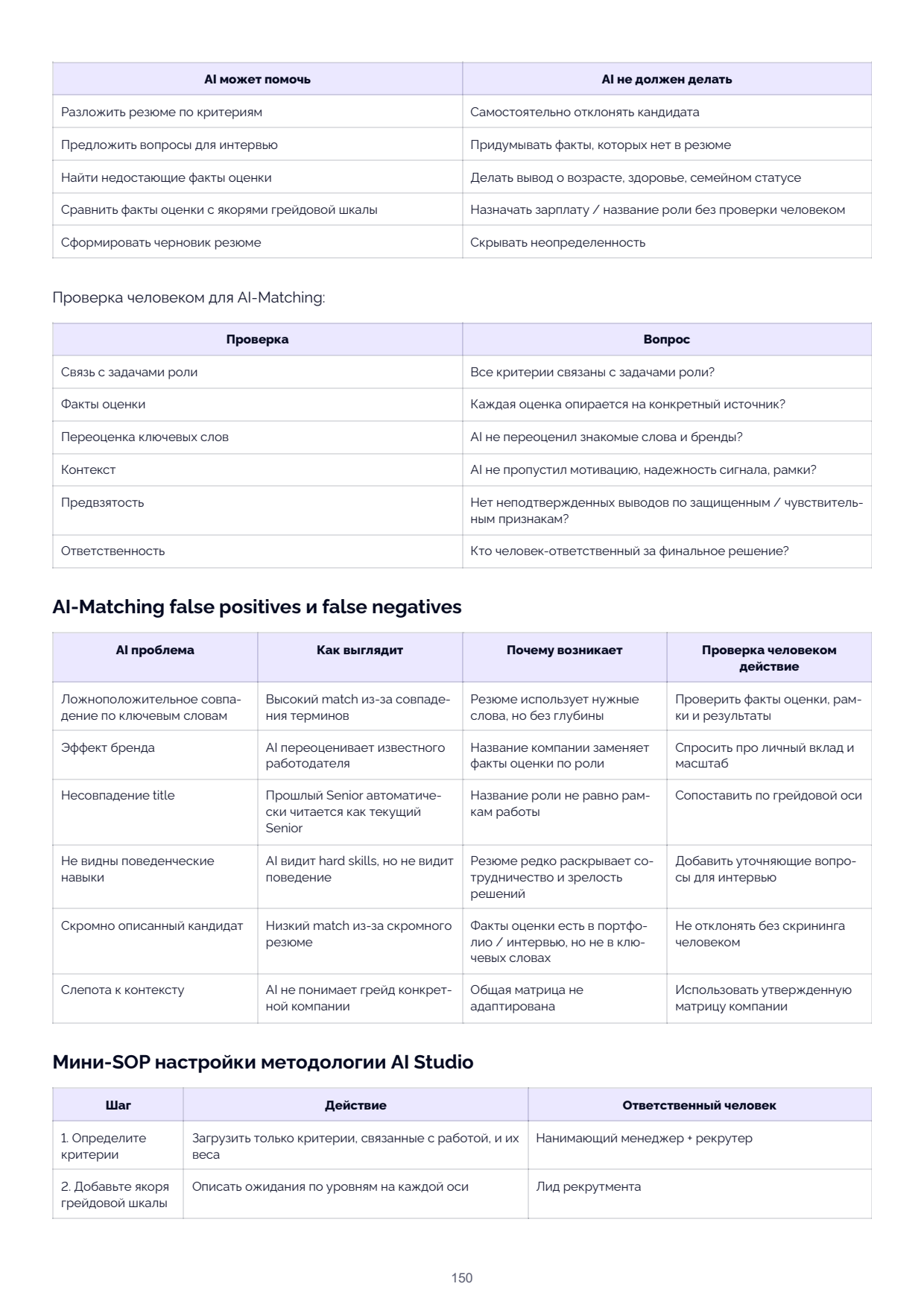
| AI can help | AI must not do | ||
|---|---|---|---|
| Break down a CV by criteria | Reject a candidate autonomously | ||
| Suggest interview questions | Invent facts not present in the CV | ||
| Find missing assessment facts | Draw conclusions about age, health, family status | ||
| Compare assessment facts against level scale anchors | Set salary / job title without human verification | ||
| Generate a CV summary draft | Hide uncertainty | ||
| Human check for AI-Matching: | |||
| Check | Question | ||
| Link to role tasks | Are all criteria linked to the role's tasks? | ||
| Assessment facts | Does each rating rely on a specific source? | ||
| Keyword overvaluation | Has the AI not overvalued familiar words and brands? | ||
| Context | Has the AI not missed motivation, signal reliability, scope? | ||
| Bias | Are there unverified conclusions about protected / sensitive characteristics? | ||
| Accountability | Who is the person responsible for the final decision? | ||
| AI-Matching false positives and false negatives | |||
| AI issue | What it looks like | Why it happens | Human check action |
| False positive keyword match | High match due to matching terms | CV uses the right words but lacks depth | Check assessment facts, scope and results |
| Brand effect | AI overvalues a well-known employer | Company name substitutes for assessment facts about the role | Ask about personal contribution and scale |
| Title mismatch | A previous Senior is automatically read as a current Senior | Job title does not equal the scope of work | Compare along the level axis |
| Behavioural skills invisible | AI sees hard skills but not behaviour | CV rarely reveals collaboration and decision maturity | Add probing questions for the interview |
| Modestly described candidate | Low match due to a modest CV | Assessment facts exist in portfolio / interview but not in keywords | Do not reject without a human screen |
| Context blindness | AI does not understand a specific company's level | The universal matrix is not adapted | Use the company's approved matrix |
| Mini-SOP for setting up the AI Studio methodology | |||
| Step | Action | Responsible person | |
| 1. Define criteria | Upload only work-related criteria and their weights | Hiring manager + recruiter | |
| 2. Add level scale anchors | Describe expectations for each level on each axis | Recruitment lead |
1. Define Upload only work-related criteria and their Hiring manager + recruiter
criteria weights
2. Add level scale Describe expectations for each level on each axis Recruitment lead
anchors
| Step | Action | Responsible person |
|---|---|---|
| 3. Set assessment-fact rules | State which sources are permitted | HR / recruitment lead |
| 4. Generate questions | Ask the AI to suggest probing questions for missing assessment facts | Recruiter |
| 5. Review the output | Check unverified claims and risk of bias | Human reviewer |
| 6. Record the decision | The final decision is recorded by a person | Hiring manager |
AI-Matching governance checklist AI-Matching is especially useful in two cases: when you need to quickly break down a CV by criteria and when interviewers find it difficult to keep the level matrix in mind. But the higher the decision impact, the tighter the control must be. The AI output must be visible, verifiable and correctable.
| Control | What it looks like in the process | What happens if it is skipped |
| Criteria fix | AI receives only approved, work-related criteria | The model will start rating "similarity" to an ideal candidate |
| Assessment-fact references | Each conclusion is linked to the CV, a note, an assignment or an interview fact | Confident but unverified conclusions will appear |
| Reason for diverging from AI | Any human deviation from the AI is recorded briefly | The team does not learn from false-positive and false-negative results |
| Exclusion of sensitive characteristics | Age, health, family, nationality and similar characteristics are not used | Bias and legal risk |
| Calibration sample | Once a month, 5–10 candidates are reviewed alongside their AI results | The methodology ages and begins to skew decisions |
AI-Matching hypothesis: Middle+ / 78%. Verified claims: domain experience in B2B SaaS; pipeline accountability; stakeholder communication examples. Unverified claims removed: "strong leadership" — not confirmed by CV. Missing assessment facts: enterprise negotiations, conflict handling, forecast discipline. Human decision: advance to a case interview to verify negotiations and forecast quality. Responsible: recruiter + sales hiring manager.
Chapter AI prompts The full prompts are in Appendix H to keep the chapter readable while the working instructions are collected in one place. AI helps to structure data and drafts but does not make decisions on hiring, rejection, level, compensation or legal obligations.
Exclusion of sensitive characteristics Age, health, family, nationality Bias and legal risk
and similar characteristics are not used
Calibration sample Once a month, 5–10 candidates are The methodology ages and begins to
reviewed alongside their AI results skew decisions
Candidate communication rule The candidate is never told "AI did not Automation looks like an irresponsible
pick you" decision
Example human-check record:
AI-Matching hypothesis: Middle+ / 78%.
Verified claims: domain experience in B2B SaaS; pipeline accountability; stakeholder communication
examples.
Unverified claims removed: "strong leadership" — not confirmed by CV.
Missing assessment facts: enterprise negotiations, conflict handling, forecast discipline.
Human decision: advance to a case interview to verify negotiations and forecast quality.
Responsible: recruiter + sales hiring manager.
Chapter AI prompts
The full prompts are in Appendix H to keep the chapter readable while the working instructions are collected in one
place. AI helps to structure data and drafts but does not make decisions on hiring, rejection, level, compensation or
legal obligations.
| Task | Full prompt | Human check | |||
|---|---|---|---|---|---|
| Set up a level matrix for a role | Appendix H, H4.13 | Check facts, privacy, tone and decision owner before using the result. | |||
| Check AI-Matching output | Appendix H, H4.11 | Check facts, privacy, tone and decision owner before using the result. | |||
| Prepare a level debrief | Appendix H, H6.2 | Check facts, privacy, tone and decision owner before using the result. | |||
| 9. Cases | |||||
| Situation | Risk | What to check | Recommended action | How to document | Metric / next step |
| Candidate was a Senior at a small company | Title mismatch | Scope, autonomy, complexity, influence | Compare along the axis, not the job title | "Previous job title not used as an independent level fact" | Level-revision reason |
| Candidate is technically strong but weak in communication | Wrong level for a cross-functional role | Whether the communication threshold is met | Propose a lower level or reject if it is a threshold | "Threshold gap: communication" | Probation risk |
| AI-Matching gives 92% | Automation bias | Assessment facts against the criterion | Human check before advancing | "AI result verified; unverified claims removed" | Share of AI reviews that passed the check |
| Hiring manager wants Senior, budget is Middle | Expectation mismatch | Scope, compensation, market | Renegotiate the role or the pay band | "Level–band mismatch escalated" | Offer decline reason |
| Internal candidate requests promotion | Assessment fairness risk | Readiness for the role and assessment facts | Assess using the same matrix | "Internal candidate assessed on the same criteria" | Internal mobility conversion |
| Agency provides a shortlist of the wrong level | Weak calibration | Client's level anchors | Run calibration on 3 profiles | "Level calibration with client updated" | Shortlist acceptance |
| 10. Regulation fragment: level decision and AI-Matching |
10. Regulation fragment: level decision and AI-
Matching
A candidate's level is determined by the approved role matrix and confirmed by assessment facts against the criteria.
Years of experience, a previous job title, employer brand, charisma or an AI score are not an independent basis for
assigning a level.
AI-Matching is used as a supporting hypothesis: criteria assessment, facts from the CV, risks and interview questions.
Every AI output undergoes a human check before a debrief or decision. The final decision is recorded by a responsible
person with the assessment facts, confidence, level implications and unresolved risks.
11. Measuring the quality of the level process
Metric What it shows How to use it
Level-disagreement rate How often interviewers disagree about a level Improve scale anchors and calibration
Level change at offer rate How often the level changes at the final stage Check calibration earlier
New hire productivity by onboarding level Whether the level matched reality Update the matrix
Unverified AI claim rate Share of AI claims without assessment facts Adjust the prompt and review