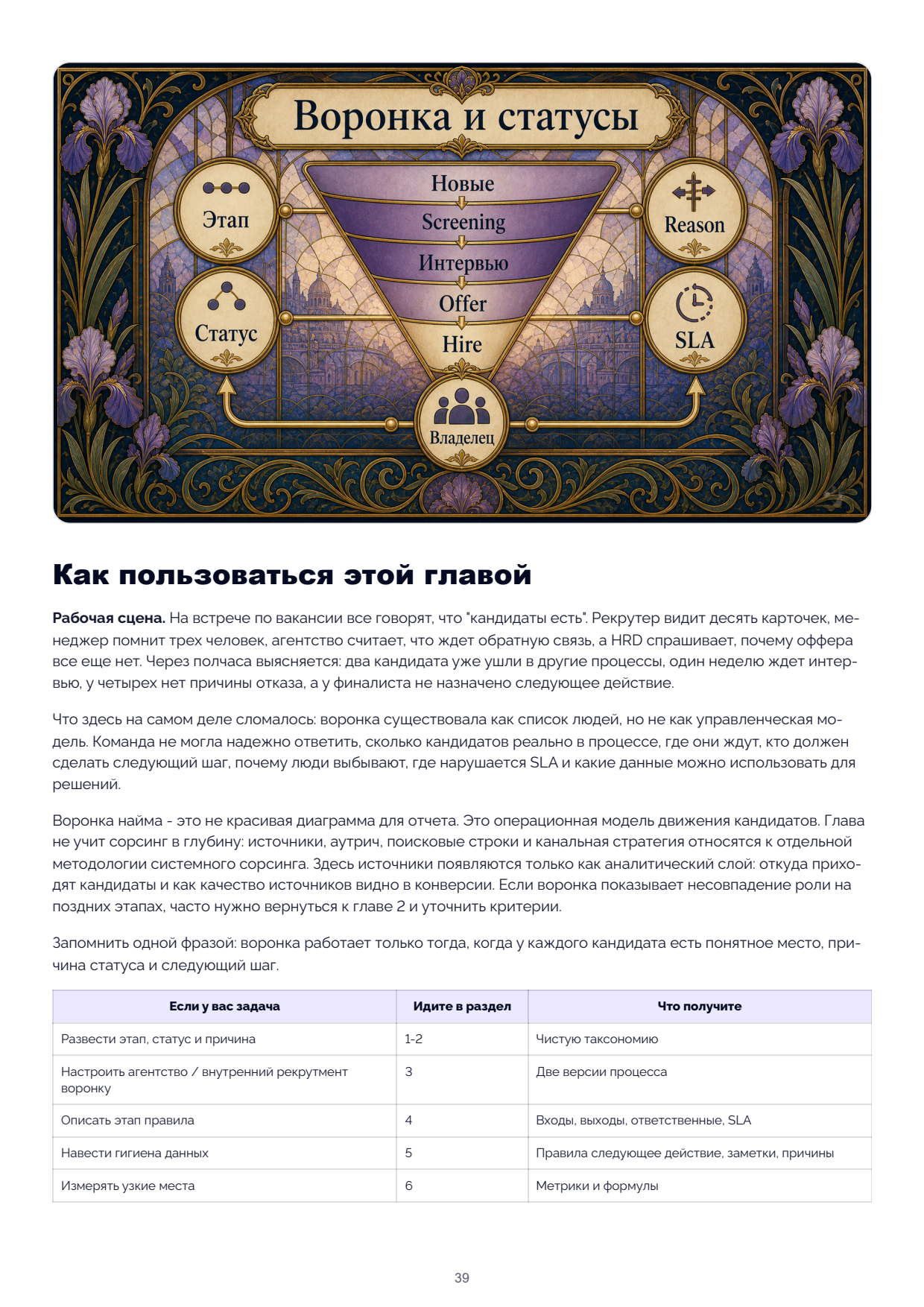
Chapter 3. Funnel, Statuses and Operational Discipline

How to use this chapter
A working scenario. At a vacancy review meeting everyone says "candidates exist." The recruiter sees ten cards, the manager remembers three people, the agency says it is waiting for feedback, and the HR director asks why there is still no offer. After half an hour it turns out: two candidates have already moved to other processes, one has been waiting a week for an interview, four have no rejection reason, and the finalist has no next action assigned.
What actually broke here: the funnel existed as a list of people, but not as a management
model. The team could not reliably answer how many candidates were genuinely in process, where they were waiting, who needed to take the next step, why people were dropping out, where SLA was being breached, and what data could be used for decisions.
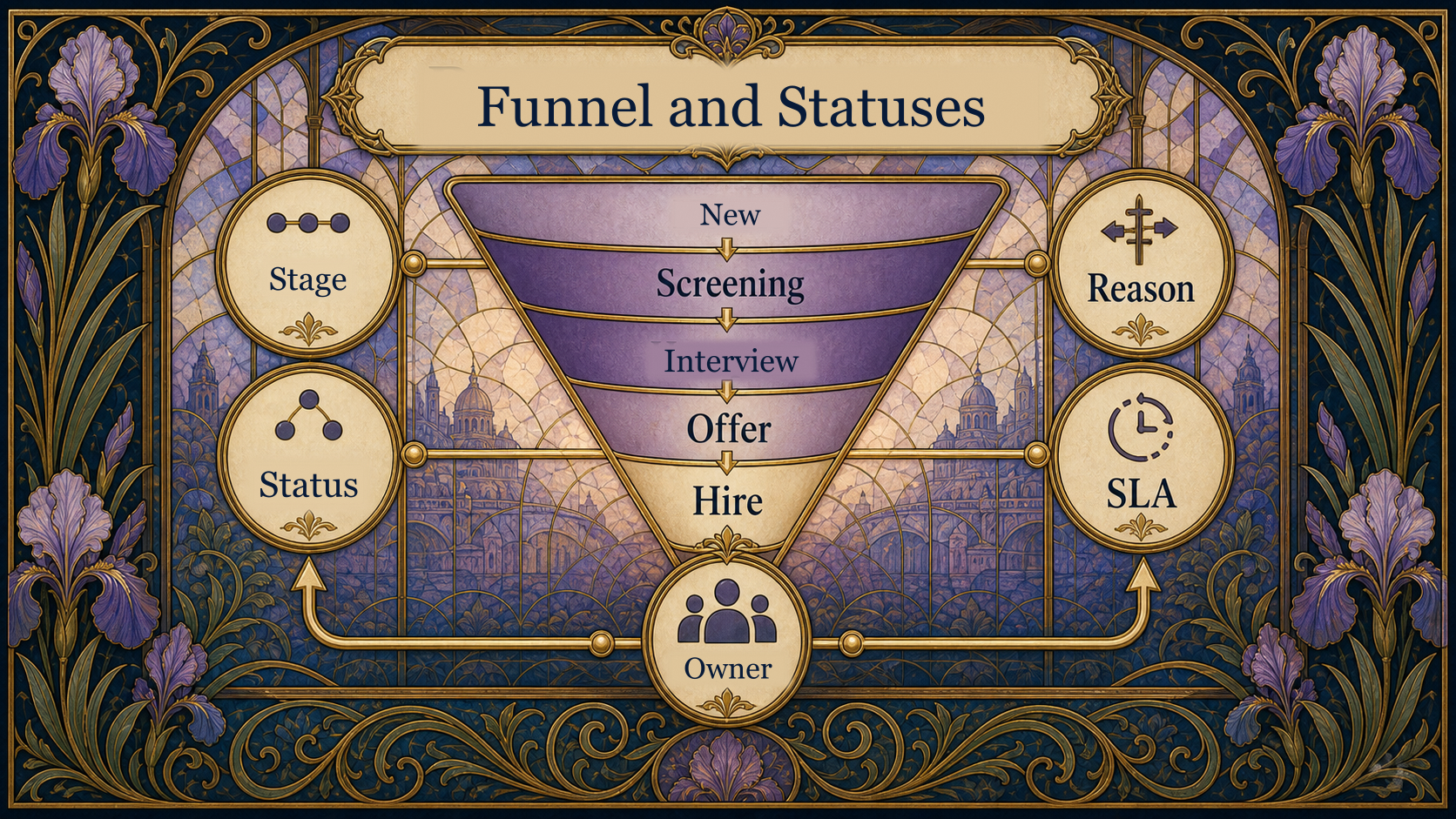
The hiring funnel is not a pretty diagram for a report. It is the operational model of candidate movement. This chapter does not teach sourcing in depth — sources, outreach, search strings and channel strategy belong to a separate systematic sourcing methodology. Here sources appear only as an analytical layer: where candidates come from and how source quality shows up in conversion. If the funnel shows a role mismatch at later stages, you often need to go back to Chapter 2 and refine the criteria.
Remember in one sentence: the funnel works only when every candidate has a clear position, a reason
for their status, and a next step.
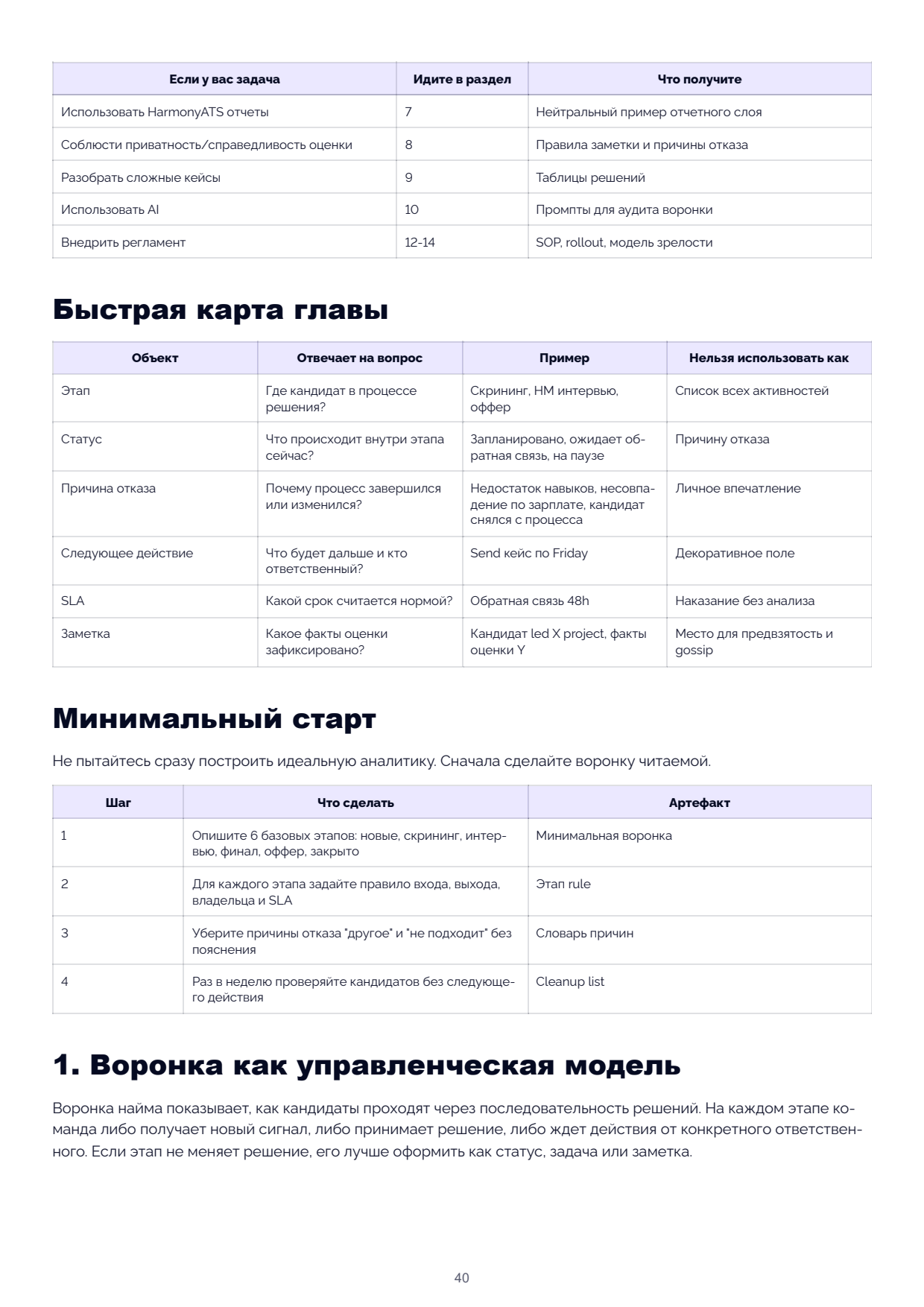
| If your task is | Go to section | What you will get |
|---|---|---|
| Separate stage, status and rejection reason | 1–2 | A clean taxonomy |
| Set up agency / in-house recruitment funnel | 3 | Two versions of the process |
| Define stage rules | 4 | Inputs, outputs, owners, SLA |
| Establish data hygiene | 5 | Next-action rules, notes, reasons |
| Measure bottlenecks | 6 | Metrics and formulas |
| Use HarmonyATS reports | 7 | Neutral reporting-layer example |
| Maintain privacy / fair assessment | 8 | Notes and rejection-reason rules |
| Handle complex cases | 9 | Decision tables |
| Use AI | 10 | Funnel audit prompts |
| Roll out procedures | 12–14 | SOP, rollout, maturity model |
Rule Why it matters How to verify
Every active candidate has a next Otherwise the process is Weekly list of empty / overdue next
action unmanageable actions
Stage changes on the day of decision ATS reflects reality Candidate movement review
Rejection reason is mandatory Otherwise you cannot improve the Rejection report completeness
process
"Other" requires a comment Otherwise the reason taxonomy Reason taxonomy audit
degrades
Rule Why it matters How to verify
Notes separate fact / assessment / Bias and noise are reduced Random notes audit
decision
Consent / privacy status is checked Privacy risk is reduced PD consent / storage review
before contact / storage
Data hygiene must not be punitive. Its purpose is to preserve manageability and respect for the candidate. If the fields are too complex and recruiters cannot fill them in on time, the problem is in the process design, not only in people's discipline.
The most sustainable way to maintain hygiene is to make "dirty data" visible in a short data-cleanup rhythm. There is no need to wait for a big audit. Once a day or every other day, the recruiter looks only at exceptions: overdue, empty next action, missing reason, stalled on pause, missing consent status.
This takes less time than restoring the process before a report.
Exception How to find it What to do When to escalate
Empty next action field Active candidates without a next Assign an action or close If the owner is unknown
action the process
Overdue feedback Interview stage beyond SLA Remind interviewer / HM, If overdue 2+ working days
record the risk
Stale on pause On pause without a review date Confirm pause, move If pause linked to business
or older than rule forward or close freeze
Missing rejection reason Closed candidates without a Add an approved reason and If the taxonomy does not cover
reason assessment facts the situation
Weak reason "Other", "not a fit", "did not Rewrite via criterion or Decision may pose fair
like them" candidate decision assessment risk
Missing privacy status Contact scheduled but consent Contact is paused until If candidate data has already
or status missing verification been shared
Data hygiene must also account for different levels of detail. For executive search there may be fewer candidates but more decision notes and confidentiality. For high-volume hiring there may be more automated reminders, but the reasons and status taxonomy must be especially strict because errors multiply across hundreds of cards.
Hiring type What is especially important What not to over-complicate
Executive / confidential Access control, decision log, Too many public statuses
client / candidate confidentiality, cautious notes
High-volume Clear reasons, bulk data hygiene Long free-text comments without
checks, fast SLA, fair assessment taxonomy
review
Technical roles Case status, reviewer SLA, assessment Minor sub-stages of every action
facts, reviewer notes
Agency retained search Client status, presentation Consent, shortlist assessment Reporting without real candidate
facts state
In-house mobility Current manager timelines, transition Backroom statuses without transparent
status, fair assessment notes rules
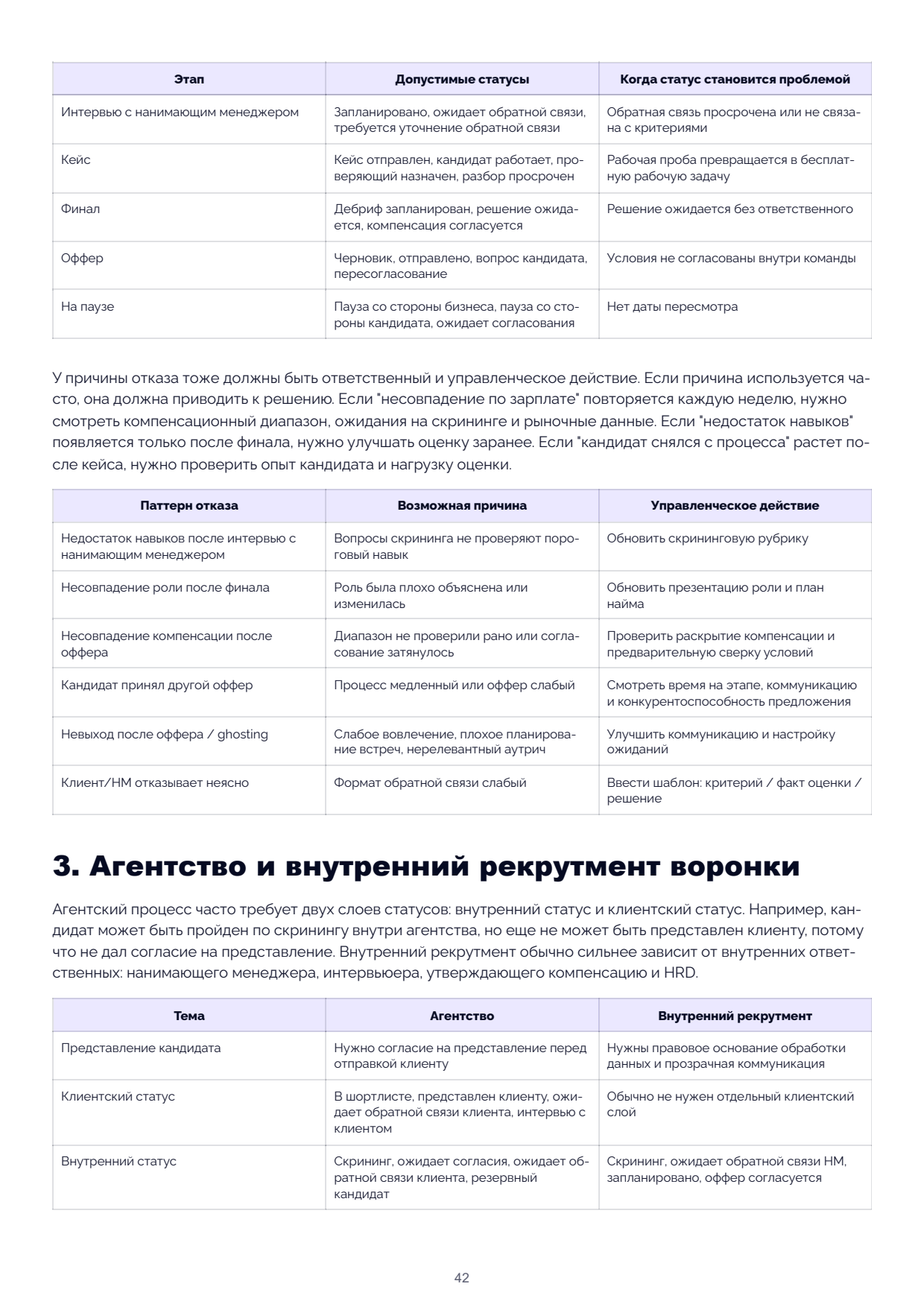
6. Funnel metrics
Funnel metrics help find a bottleneck but do not automatically explain it. Low conversion after screening can mean weak sourcing, rigid criteria, a poor pitch, an inappropriate compensation range, or normal filtering. Therefore every metric should lead to a question, not an immediate blame.
Metric Formula What it shows Follow-up question
Stage conversion Moved to next stage / entered Is this quality, criteria, market
stage or process?
Time at stage Exit date – entry date Who is accountable for the delay?
SLA breach rate Overdue candidates / candidates Is the issue systemic or a one-off?
with SLA
Candidate drop-off share Candidate withdrew / active Where is candidate interest lost? Communication, timelines, offer,
candidates motivation?
Rejection reason share Reason count / total rejections Is the reason specific enough?
Source-to-stage conversion Candidates from source reaching Is source quality low for this Not deep-diving into sourcing here,
stage / candidates from source role family but seeing the signal
Offer acceptance Accepted / extended Final alignment match Pre-offer alignment, comp,
timelines, competing offers?
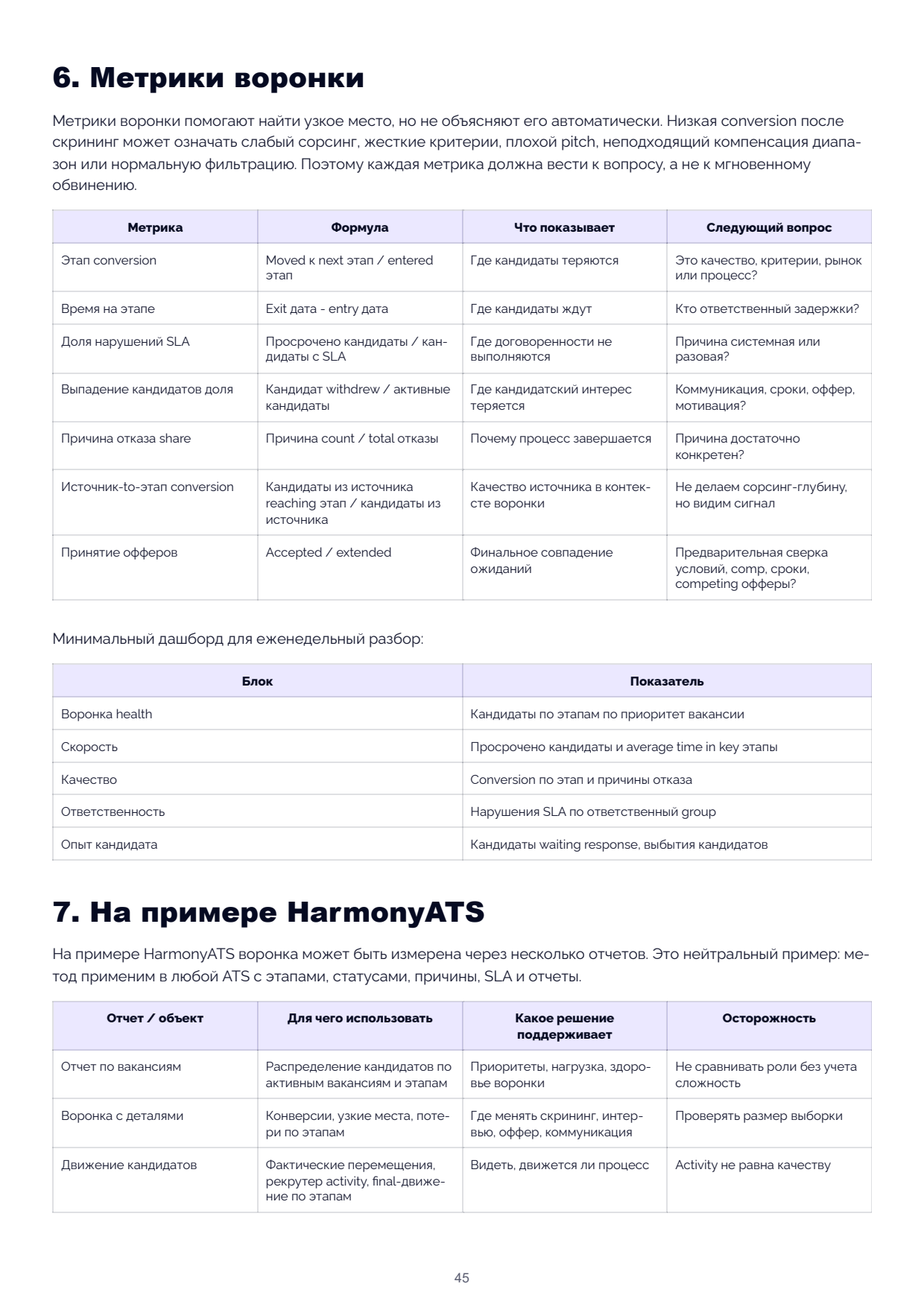
Minimum dashboard for the weekly debrief:
Block Indicator
Funnel health Candidates by stage by vacancy priority
Speed Overdue candidates and average time in key stages
Quality Conversion by stage and rejection reasons
Accountability SLA breaches by owner group
Candidate experience Candidates waiting response, candidate drop-offs
7. HarmonyATS example
Using HarmonyATS as an example, the funnel can be measured through several reports. This is a neutral example: the method applies to any ATS with stages, statuses, reasons, SLA and reports.
Report / object What to use it for What decision does it Caution
support
Vacancy report Distribution of candidates across Priorities, workload, funnel Do not compare roles without
active vacancies and stages health accounting for complexity
Funnel with details Conversions, bottlenecks, Where to improve screening, Check the sample size
losses by stage interview, offer, communication
Candidate movement Actual moves, recruiter Activity does not equal
activity, stage-to-stage movement quality
| Report / object | What to use it for | What decision it supports | Caution |
|---|---|---|---|
| Rejection report | Rejection reasons by stage and source | Improve criteria, pitch, compensation, evaluation | Reasons must be specific |
| SLA report | Candidates beyond stage limits, days overdue | Escalation and manager support | Do not use as a punishment dashboard |
| CV source report | Source quality and source-to-stage conversion | Understand which sources deliver signals | Does not replace sourcing strategy |
| Data consent report | Consent status and storage gaps | Privacy hygiene | Do not contact without a permissible basis |
Best practice: review reports together. For example, Funnel with details shows a drop at HM interview, the rejection report shows a role mismatch, the SLA report shows feedback delays. Together this may mean that screening criteria do not match the hiring manager's expectations and feedback arrives late. Example of linked analysis:
| Observation | Report / data | Possible hypothesis | Verification |
| Many candidates in Screening, few HM interviews | Funnel with details, screening notes | Screening is too broad or criteria are unclear | Read 10 rejected/proceeded CVs |
| HM interview conversion is low | Funnel + Rejections | Hiring manager is looking for a different profile | Calibrate on rejected examples |
| Offer acceptance is low | Offer outcomes, time-to-hire, candidate notes | Compensation, delay, weak pre-offer alignment | Check motivation notes and competing offers |
| Source A gives many candidates but few cases | CV sources + stage conversion | Source quality is low for this role family | Do not deep-dive into sourcing here; pass the signal to the sourcing debrief |
| SLA breaches at one stage | SLA report | Owner overloaded or stage is redundant | Check calendar load and stage value |
This analysis is more useful than a blanket "the funnel is bad". It turns a report into a specific question: which stage, which reason, which owner, which action. If data is sparse, do not pretend the report proves a trend. For a small sample, use "signal to investigate" rather than "problem proven". For example, two rejections on compensation for an executive role may be an important signal, but not statistics. Ten similar screening rejections on a high-volume role are closer to a process pattern. In both cases it is useful to look not only at the number but also at specific cards, notes, timelines, candidate communication and operational context. This is how the team preserves accuracy, trust in data and speed of management decisions.
8. Personal data, fair assessment and ethics of notes / reasons
The funnel contains not only operational data but also personal data. Notes and rejection reasons can become a source of legal and ethical risk if they include personal traits, rumours, age hints, family circumstances, health, or subjective labels.
feedback arrives late.
Example of linked analysis:
Observation Report / data Possible hypothesis Verification
Many candidates in Screening, Funnel with details, screening Screening is too broad Read 10
few HM interviews notes or criteria are unclear rejected/proceeded CVs
HM interview conversion Funnel + Rejections Hiring manager is looking for Calibrate on rejected
low a different profile examples
Offer acceptance is low Offer outcomes, time-to-hire, Compensation, delay, weak Check motivation notes
candidate notes pre-offer alignment and competing offers
Source A gives many CV sources + stage Source quality is low for Do not deep-dive into
candidates but few cases conversion this role family sourcing here; pass the
signal to the sourcing debrief
SLA breaches at one stage SLA report Owner overloaded or Check calendar load
stage is redundant and stage value
This analysis is more useful than a blanket "the funnel is bad". It turns a report into a specific question: which
stage, which reason, which owner, which action.
If data is sparse, do not pretend the report proves a trend. For a small sample, use "signal to investigate"
rather than "problem proven". For example, two rejections on compensation for an executive role may be an
important signal, but not statistics. Ten similar screening rejections on a high-volume role are closer to a process
pattern. In both cases it is useful to look not only at the number but also at specific cards, notes, timelines,
candidate communication and operational context.
This is how the team preserves accuracy, trust in data and speed of management decisions.
8. Personal data, fair assessment
and ethics of notes / reasons
The funnel contains not only operational data but also personal data. Notes and rejection reasons can become a source of legal and ethical risk if they include personal traits, rumours, age hints, family circumstances, health, or subjective labels.
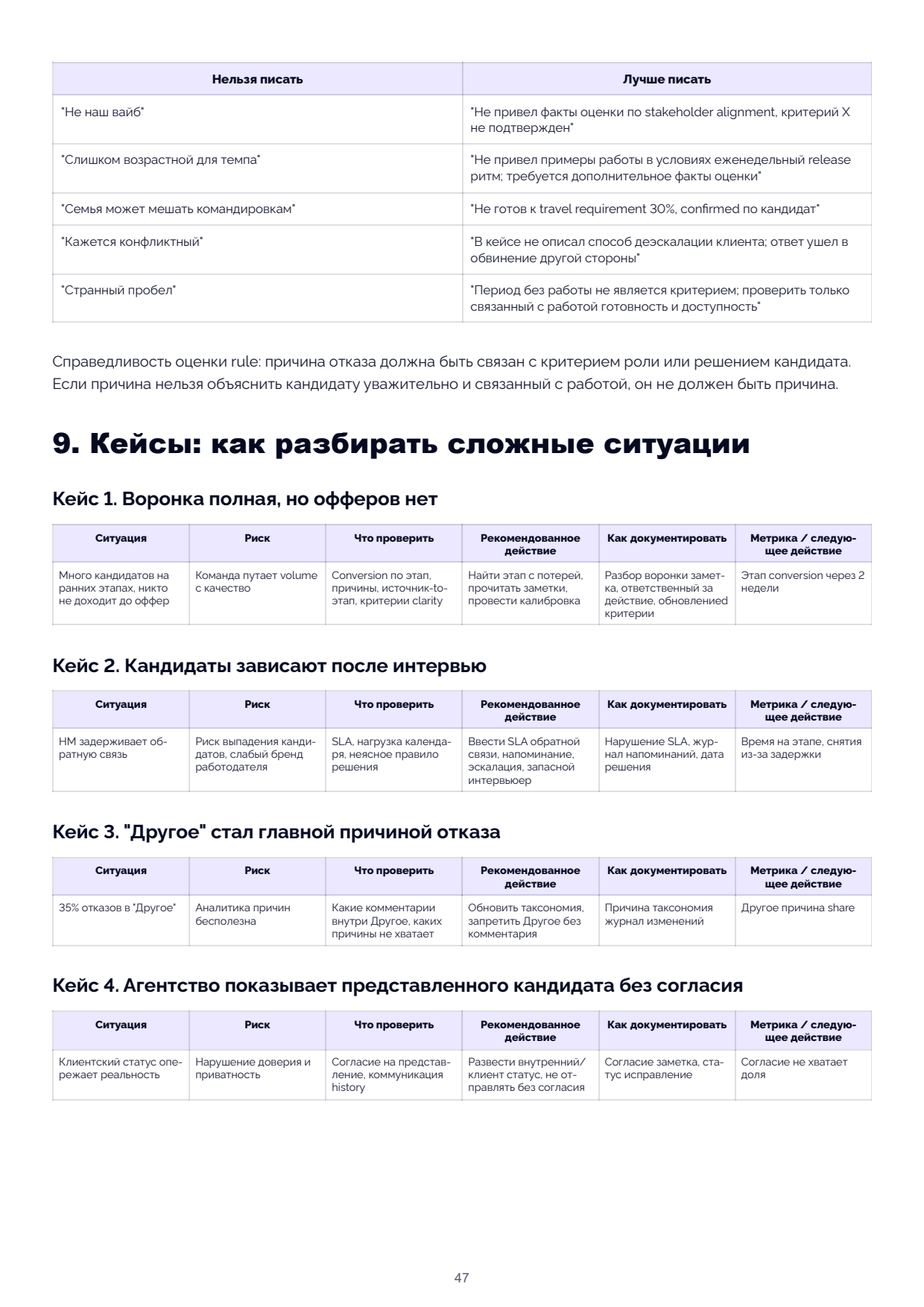
| Must not write | Better to write |
|---|---|
| "Not our vibe" | "Did not present assessment facts for stakeholder alignment; criterion X not confirmed" |
| "Too old for the pace" | "Did not provide examples of working in a weekly release rhythm; additional assessment facts required" |
| "Family may get in the way of travel" | "Not ready for 30% travel requirement, confirmed by candidate" |
| "Seems conflict-prone" | "In the case study, did not describe a client de-escalation approach; answer turned into blaming the other party" |
| "Odd gap" | "Period of unemployment is not a criterion; check only work-related readiness and availability" |
10. When to use and when not to use
Use Why
Regular hiring Without a funnel you cannot see bottlenecks
High-volume roles Small taxonomy errors scale
Executive / senior roles Decision log and privacy discipline needed
Agency delivery Client status and feedback SLA needed
Distributed teams Single source of truth needed
Do not over-complicate Why What to do instead
Very small one-off hire 20 statuses are not needed 4–5 stages, next action, reason
Process without clear criteria Funnel will show noise Go back to Chapter 2 and refine the role
Sourcing channel problem Funnel will show signals on sources, Go back to sourcing and channel strategy
but not fix sourcing strategy
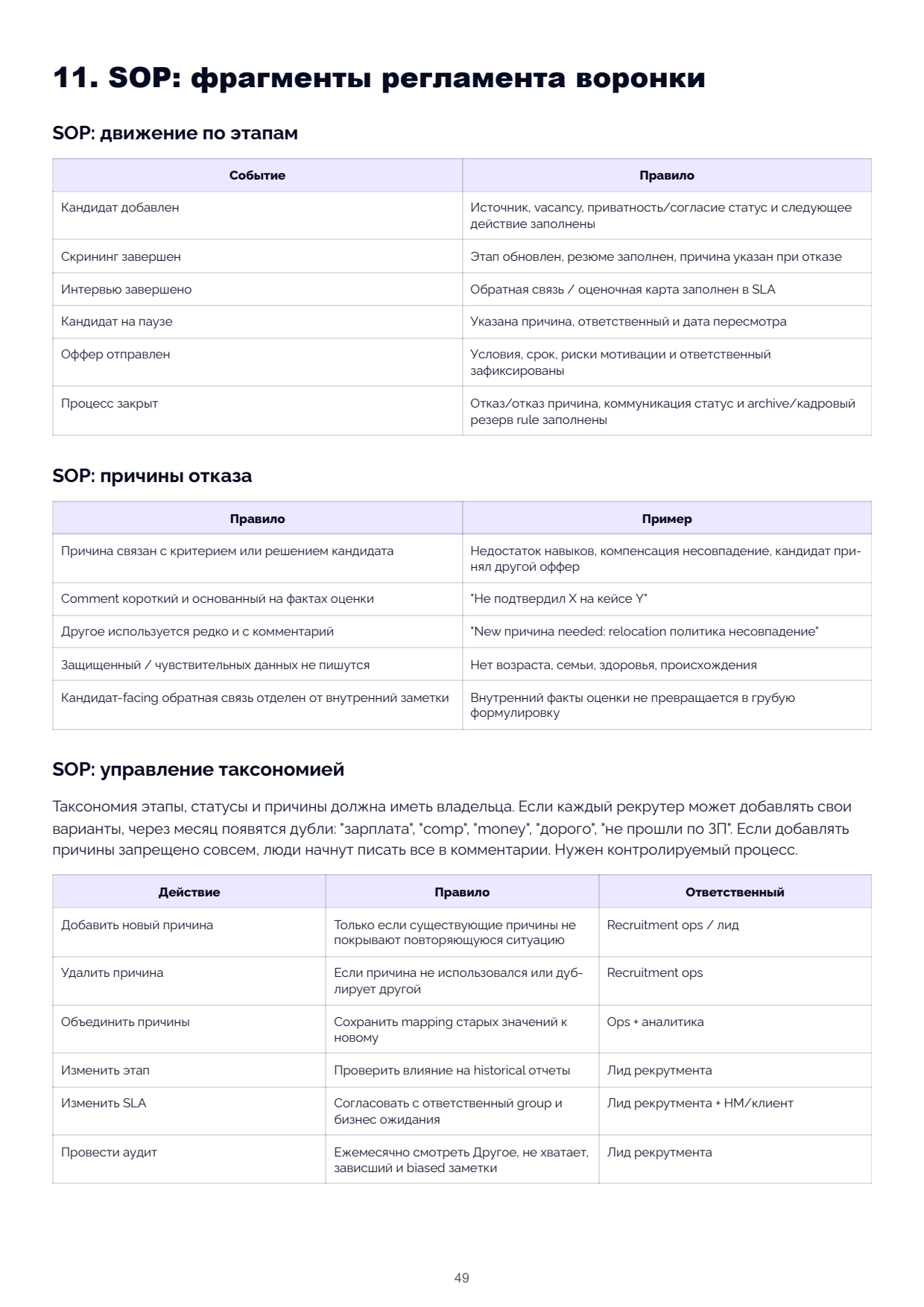
11. SOP: funnel procedure fragments
SOP: stage movement
Event Rule
Candidate added Source, vacancy, privacy / consent status and next action filled in
Screening completed Stage updated, CV completed, reason noted on rejection
Interview completed Feedback / assessment scorecard completed within SLA
Candidate on pause Reason stated, owner and review date set
Offer sent Terms, deadline, motivation risks and owner documented
Process closed Rejection / rejection reason, status communication and archive / talent pool rule filled in
SOP: rejection reasons
Rule Example
Reason linked to a criterion or candidate decision Skills gap, compensation mismatch, candidate accepted
another offer
Comment is short and assessment-based "Did not demonstrate X in case Y"
"Other" used rarely and with comment "New reason needed: relocation policy mismatch"
Protected / sensitive data is not written No age, family, health, origin
Candidate-facing feedback is separated from internal notes Internal assessment facts are not turned into blunt
language
SOP: taxonomy management
The stage, status and reason taxonomy must have an owner. If every recruiter can add their own options, duplicates will appear within a month: "salary", "comp", "money", "too expensive", "did not meet salary requirements". If adding reasons is entirely forbidden, people will start writing everything in comments. A controlled process is needed.
Action Rule Owner
Add a new reason Only if existing reasons do not cover a Recruitment ops / lead
recurring situation
Delete a reason If the reason is unused or duplicates Recruitment ops
another
Merge reasons Preserve old-to-new value mapping Ops + analytics
Change a stage Check impact on historical reports Recruitment lead
Change SLA Agree with the owner group and Recruitment lead + HM / client
business expectations
Run an audit Monthly review of "Other", missing, Recruitment lead
stalled and biased notes
SOP: weekly funnel cleanup
The data-cleanup meeting differs from the recruitment debrief. The debrief answers "what is happening with hiring." Cleanup answers "are the data clean enough to trust".
Block Question Action
No next action Which active candidates do not have a Assign, close or pause with date
next step?
Overdue SLA Where is the overdue and who is Reminder or escalation
accountable?
Weak reasons Which rejection reasons are useless? Rewrite and update taxonomy if
needed
Stale stages Who has been at a stage too long Confirm status or close
without movement?
Privacy gaps Where is there no consent / status / Stop processing and run a review
storage clarity?
Report trust Which data cannot be used in a Mark caveat and fix source
dashboard?
12. Implementation plan
Horizon What to do Result
1 day List current stages / statuses / reasons Team sees the mixing of entities
and remove obvious duplicates
1 week Introduce stage rules, SLA and weekly Active candidates receive a next action
cleanup
1 month Review conversion, SLA, reasons and Funnel becomes an improvement tool
update taxonomy
1 quarter Connect the funnel debrief with economics Hiring is managed through business
and the operating rhythm impact
13. Maturity model
Level How it looks Next step
1. Chaos Candidates in chats, statuses are stale Make ATS the single source
of truth
2. Basic discipline Stages and reasons exist but notes have gaps Introduce next action and
SLA cleanup
3. Managed funnel Conversion, SLA, reasons reviewed weekly Improve criteria and
interview design
4. Data-driven management Bottlenecks linked to owners and actions Add economics and
quality review
5. AI-assisted hygiene AI helps find dirty data Strengthen privacy, fair
assessment and
| Level | How it looks | Next step |
|---|---|---|
| human oversight | ||
| What to take from this chapter / where to go next | ||
| What you need | Where to find it | |
| Terms and short definitions | Appendix B. Mini-glossary | |
| Ready-made procedures and SLA | Appendix D. Ready-made procedures and processes | |
| Working templates | Appendix E. Template library | |
| BDM and Backend end-to-end examples | Appendix F. BDM and Backend end-to-end cases | |
| Full AI prompts for this chapter | Appendix H. AI prompt library, section H3. Process diagnostics and operating rhythm |