Chapter 16. Operational Rhythm


| Action | Result |
|---|---|
| Assign responsibility for each segment | Accountability emerges |
| Check consent/storage for legacy database | Privacy risk reduces |
| Confirm that referral source does not affect assessment | Assessment fairness is protected |
| Select 3 metrics | Team sees what will be measured |
| 1 week | |
| Action | Result |
| Clean up 50-100 records | A live taxonomy example appears |
| Set up referral intake form | Referrals become manageable |
| Document internal mobility manager agreement | Risk of blockers reduces |
| Create reactivation message templates | Communication becomes respectful |
| Run first warm reserve review | Warm reserve begins working for open roles |
| 1 month | |
| Action | Result |
| Measure reactivation and conversion | See which segments are active |
| Run referral source review | Quality and concentration risks become visible |
| Review 3 internal mobility cases | Transition rules improve |
| Clean up expired/invalid consent records | Database becomes safer |
| Embed reserve into weekly hiring review | Warm hiring becomes part of the process |
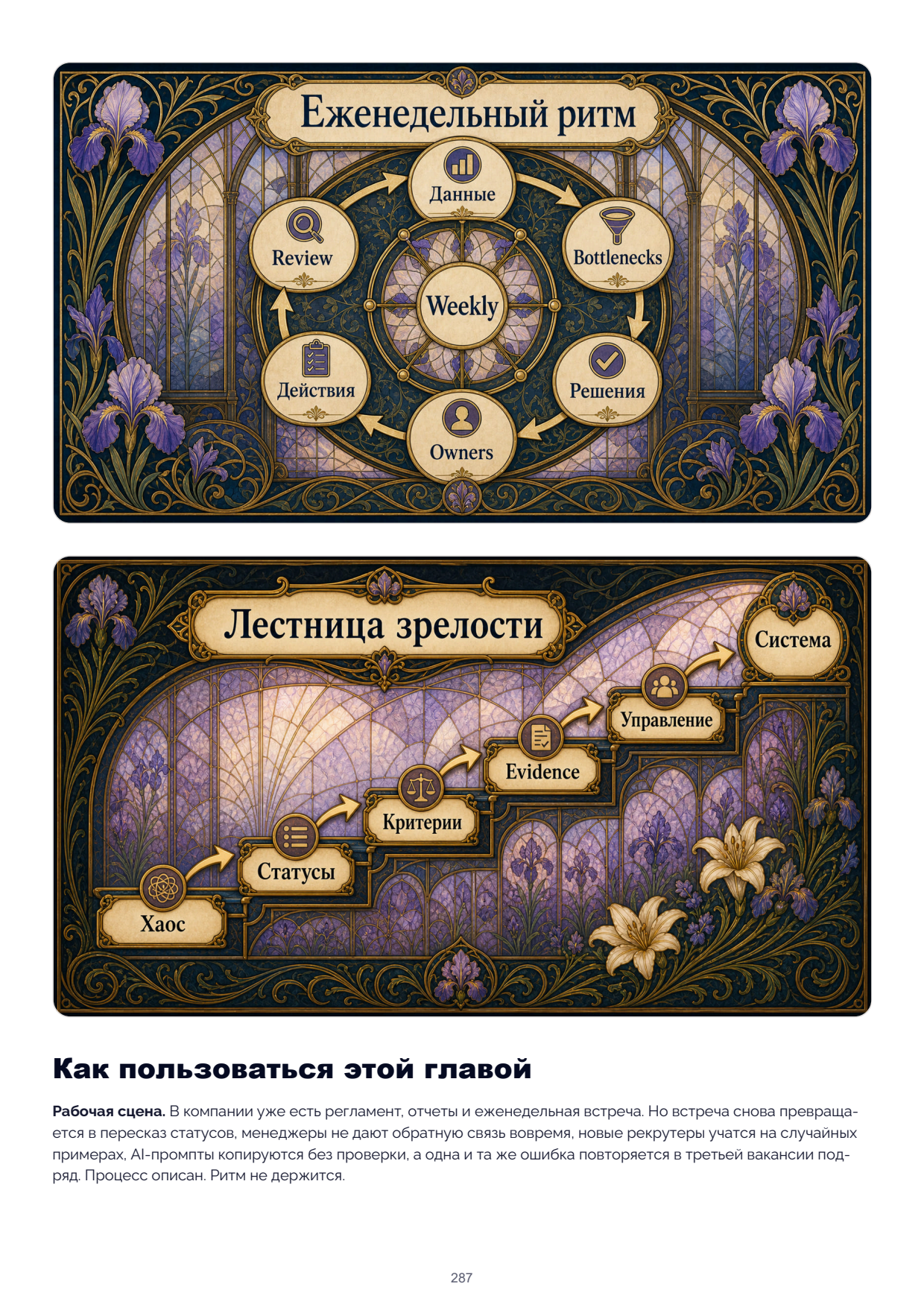
| Maturity model | |
| Level | What it looks like |
| Chaos | Reserve is an old spreadsheet, referrals come through personal connections, internal moves happen behind closed doors |
| Managed process | Segments exist, responsibilities assigned, consent managed, referral rules defined, internal mobility policy in place |
| Data-driven management | Reactivation, referral conversion, internal fill rate, storage and source concentration are measured |
| Business partner | Reserve and mobility linked to cost of vacancy, storage and workforce planning |
| AI-supported operations | AI helps segment the reserve and draft messages; human verifies consent, assessment fairness and relevance |
| What to take from this chapter / where to go next | |
| What you need | Where to find it |
| Terms and short definitions | Appendix B. Mini-glossary |
How to use this chapter
Work scenario. The company already has procedures, reports and a weekly meeting. But the meeting turns into a
status readout again, managers don’t give feedback on time, new recruiters learn from random examples,
AI prompts are copied without checks, and the same mistake repeats in the third vacancy in a
row. The process is documented. The rhythm doesn’t hold.
What has actually broken here: the team created rules but not a learning mechanism. Operational
rhythm is not a calendar of meetings for the sake of control. It is a set of repeatable loops: weekly debrief,
hiring manager meeting, monthly analytics audit, calibration, QA checks, onboarding of
new recruiters, SOP updates, AI scenario reviews and an improvement backlog.
Read this chapter as a toolkit. To quickly bring order, start with the weekly meeting and action log.
To develop the team, use the onboarding and QA loops. To show the HRD or CEO that
the process is improving, take the monthly audit, maturity model and improvement backlog. Agencies benefit from the rhythm
of client debriefs and shortlist quality checks. Internal teams need to link recruitment rhythm with
managers, business priorities and capacity planning.
Remember in one phrase: the system improves only where process lessons feed back into next week’s rules.
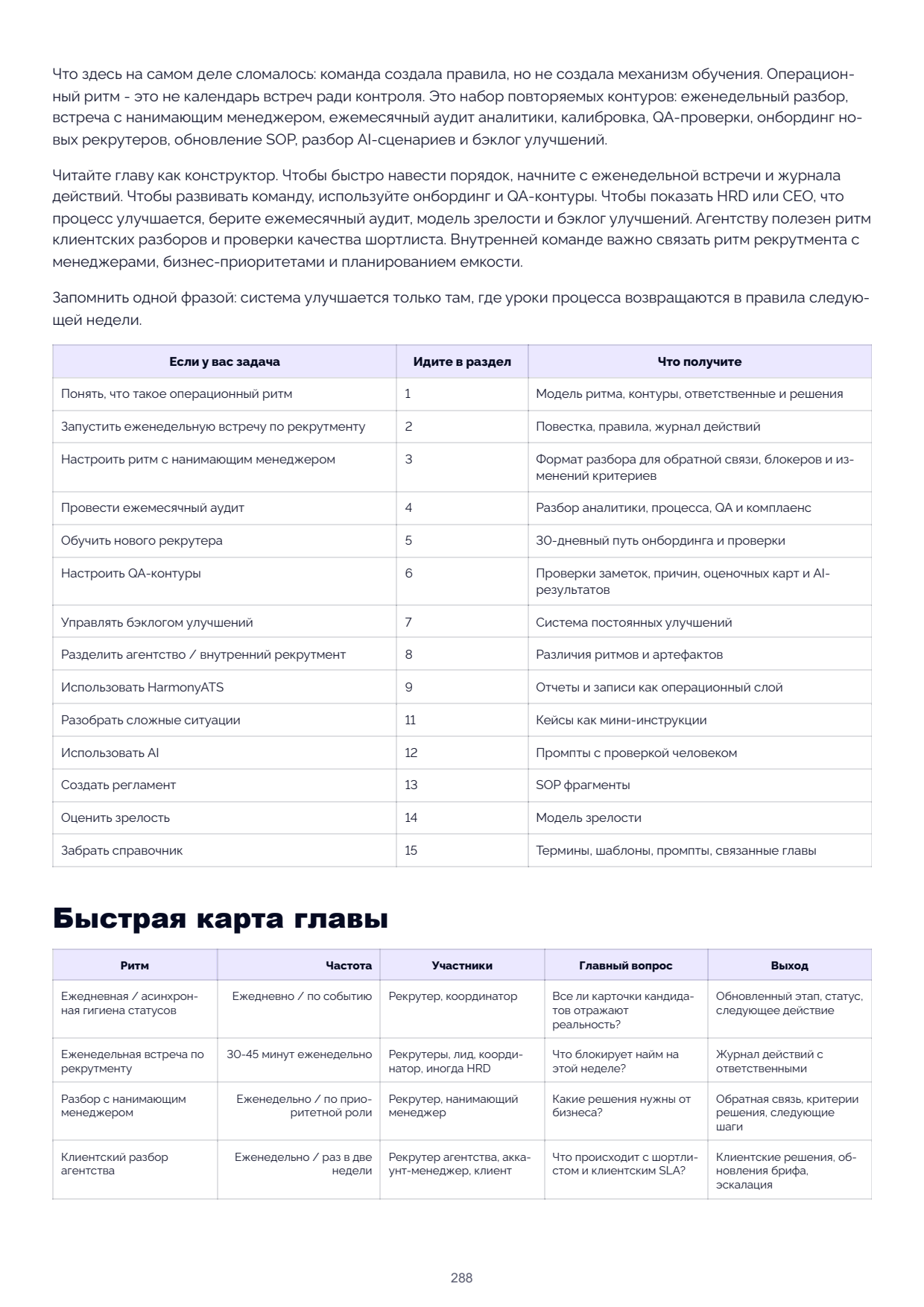
If your task Go to What you will get section
Understand what operational rhythm is 1 Rhythm model, loops, responsibilities and decisions
Launch a weekly recruitment meeting 2 Agenda, rules, action log
Set up rhythm with the hiring manager 3 Debrief format for feedback, blockers and criteria
changes
Run a monthly audit 4 Review of analytics, process, QA and compliance
Onboard a new recruiter 5 30-day onboarding and verification path
Set up QA loops 6 Checks on notes, reasons, assessment cards and AI
results
Manage the improvement backlog 7 Continuous improvement system
Agency vs internal recruitment 8 Differences in rhythms and artefacts
Use HarmonyATS 9 Reports and records as the operational layer
Handle complex situations 11 Cases as mini-instructions
Use AI 12 Prompts with human verification
Create procedures 13 SOP fragments
Assess maturity 14 Maturity model
Take the reference guide 15 Terms, templates, prompts, related chapters
Quick chapter map
| Rhythm | Frequency | Participants | Key question | Output |
|---|---|---|---|---|
| Monthly analytics audit | Monthly | HRD, recruitment lead, ops, business owner | Which problems are repeating? | Improvement backlog |
| Calibration meeting | Monthly / per hiring cycle | Recruiters, interviewers, hiring managers | Are we assessing evaluation facts consistently? | Updated assessment cards and training notes |
| QA loop | Weekly / monthly | Lead, ops, process owner | Are data and decisions sufficiently high-quality? | Issues found and fixes applied |
| New recruiter onboarding | First 30 days | New recruiter, lead, mentor | Can the recruiter run the process to standard? | Verified artefacts and plan for independent work |
| Quarterly operational review | Quarterly | HRD, leadership, recruitment lead | Which rules, resources and tools need changing? | Decisions on strategy and capacity |
Minimum start Operational rhythm can be launched without a complex meeting system, if every meeting has a decision and an owner.
| Step | What to do | Artefact |
| 1 | Introduce a weekly 30-45 minute debrief focused only on blockers, risks and decisions | Weekly agenda |
| 2 | Keep an action list with owner, deadline and verification metric | Action log |
| 3 | Once a month, pick 1-3 recurring process defects | Monthly audit note |
| 4 | Update SOP only after real cases and record what changed | Change log |
1. Operational rhythm as a learning system
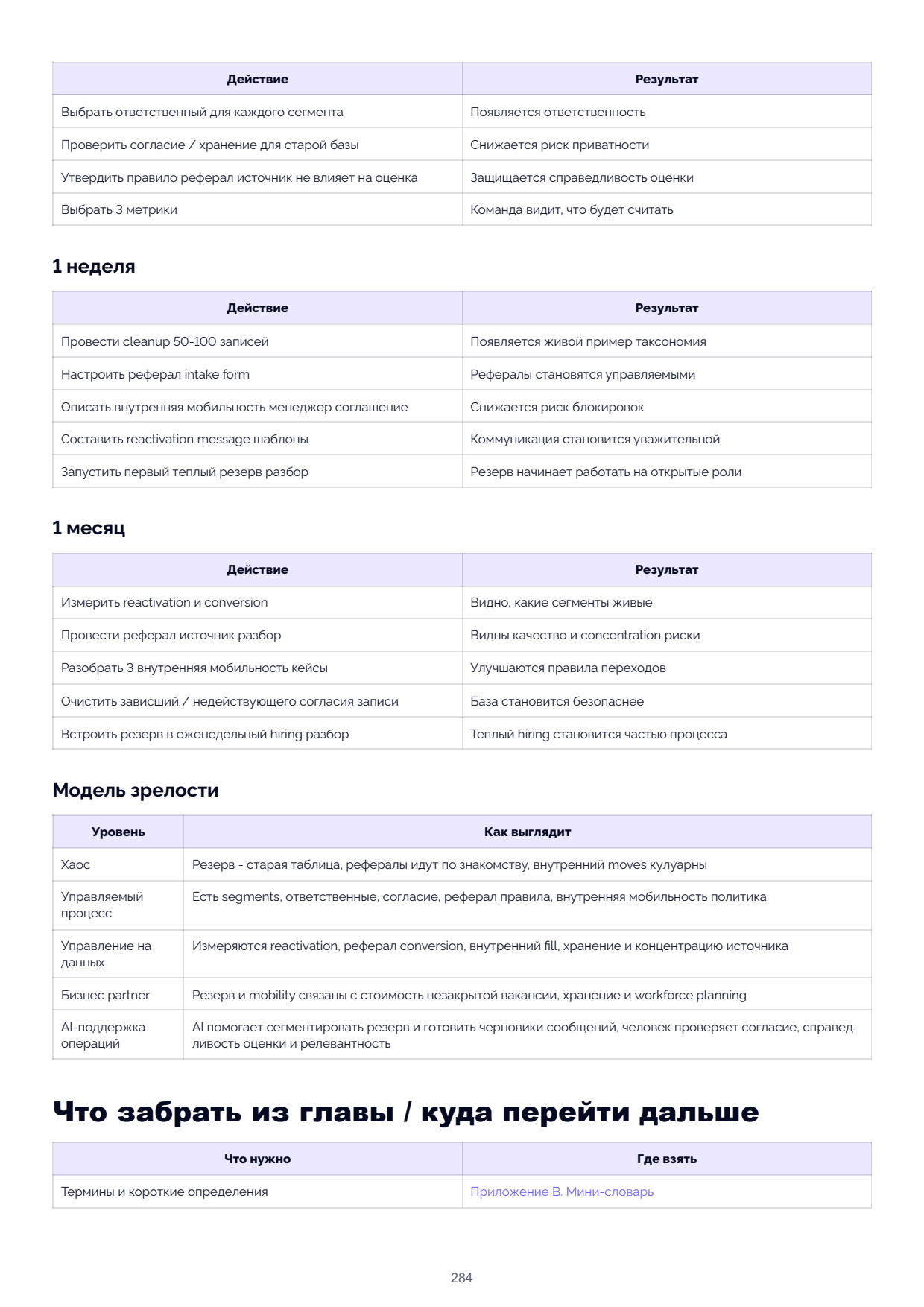
Operational rhythm is a repeatable structure that helps the team see reality, make decisions and improve the process. It does not replace the recruiter’s work. It reduces the likelihood that work fragments into chats, personal spreadsheets and memory. A good rhythm consists of four loops:
| Loop | What it does | Example |
| Control loop | Keeps current vacancies and candidates on track | Weekly SLA debrief, stalled candidates, offer risks |
| Learning loop | Extracts lessons from cases and metrics | Monthly audit of rejection reasons and stage conversion |
| Quality loop | Checks the quality of artefacts and decisions | QA of assessment cards, notes audit, AI result review |
| Development loop | Trains people and updates the working handbook | New recruiter onboarding, interviewer calibration |
If there is only a control loop, the team is firefighting. If there is only a learning loop, discussions become abstract. If there is only QA, people perceive the process as inspection. A mature rhythm connects all four questions: what is happening now, why it repeats, what quality is needed and what we are learning next.
verification metric
3 Once a month, pick 1-3 recurring process defects Monthly audit note
4 Update SOP only after real cases and Change log
record what changed
1. Operational rhythm as a learning system
Operational rhythm is a repeatable structure that helps the team see reality, make decisions and improve the process. It does not replace the recruiter’s work. It reduces the likelihood that work fragments
into chats, personal spreadsheets and memory.
A good rhythm consists of four loops:
Loop What it does Example
Control loop Keeps current vacancies and candidates on Weekly SLA debrief, stalled
track candidates, offer risks
Learning loop Extracts lessons from cases and metrics Monthly audit of rejection reasons and stage
conversion
Quality loop Checks the quality of artefacts and QA of assessment cards, notes audit, AI
decisions result review
Development loop Trains people and updates the working New recruiter onboarding, interviewer
handbook calibration
If there is only a control loop, the team is firefighting. If there is only a learning loop, discussions become abstract. If there is only QA, people perceive the process as inspection. A mature rhythm connects all four questions: what is happening now, why it repeats, what quality is needed and what we are learning
next.
2. Weekly recruitment meeting: 30-45
minutes without status swamp
The weekly recruitment meeting is not for reading out all vacancies. Statuses should be updated
before the meeting. The meeting only discusses decisions, blockers, risks and actions.
Agenda
Time Block Question Output
5 min Vacancy priority Which roles matter for the business Priority list
now?
10 min SLA and stalled candidates Who is waiting for a decision or Feedback owner and deadline
feedback?
10 min Funnel bottlenecks Where is the funnel weak or Hypothesis and action
stuck?
5 min Offer / final stage risks Which candidates might fall Preliminary check /
through? action on offer
5 min Source / market signal Where do we need to change Source action
sourcing?
5 min Consent / QA risks Are there data / notes / AI QA action
problems?
5 min Commitments What are we closing before the Action log
next meeting?
Rules
Rule Why it matters
Statuses are updated before the meeting The meeting doesn’t waste time reading the ATS aloud
We discuss exceptions, not every card Attention goes to risk and decision
Every blocker gets an owner Without an owner, a blocker remains an observation
Actions have a deadline Otherwise the meeting doesn’t manage the process
Old actions are checked first Rhythm teaches accountability
Metrics are read with context We don’t turn numbers into punishment
Weekly action log
Field Example
Date 2026-06-18
Vacancy Head of Customer Implementation
Signal 6 candidates are waiting for feedback from the manager, average delay
is 3 days
Hypothesis No protected slot for feedback delivery
| Field | Example | |
|---|---|---|
| Action | Schedule two debrief blocks this week and assign a backup reviewer | |
| Owner | Hiring manager + recruiter | |
| Deadline | Friday 15:00 | |
| Verification metric | Feedback delay and number of SLA breaches next week | |
| End-to-end example: weekly role debrief | ||
| Field | BDM in B2B SaaS payments | Backend Engineer |
| Priority question | Does the funnel yield candidates who understand B2B SaaS qualification and can quickly master the payment domain? | Does the funnel yield engineers with real production responsibility, not just familiarity with the stack? |
| Current signal | Screening passes but hiring manager rejects for weak discovery or insufficient domain depth | Technical screening pass rate is low; some candidates don’t demonstrate thinking about reliability |
| Hypothesis | Screening too lenient on qualification discipline | Screening and JD are too broad on backend without production criteria |
| Action | Add targeted follow-up questions: lost deal review, payment blocker, stakeholder map | Add follow-up questions: production incident, idempotency, monitoring, rollback |
| Owner | Recruiter + Head of Sales | Technical recruiter + Tech Lead |
| Verification metric | Proportion of candidates reaching manager interview, rejection reasons after first interview, compensation mismatch | Technical screening pass rate, assessment card confidence, interviewer workload |
3. Debrief with hiring manager: business must not be an invisible bottleneck
The debrief with the hiring manager differs from the weekly recruitment debrief. The focus is not on the whole team, but on a specific role or group of roles. Its purpose is to get decisions from the business: criteria, feedback, interviewer availability, offer package, priorities, trade-offs.
| Block | Question | Data | Decision |
| Role priority | Is this vacancy still high priority? | Vacancy report, business context | Continue, pause, re-brief, escalate |
| Criteria drift | Have criteria changed after candidates? | Rejections, manager feedback | Update criteria or confirm existing ones |
| Feedback backlog | Who is waiting for feedback? | SLA report | Assign feedback to owner with deadline |
| Interview capacity | Are there slots available? | Calendar / stage workload | Add interviewers or block time |
| Shortlist quality | Do candidates match the brief? | Funnel, notes, assessment cards | Change sourcing / screening |

3. Debrief with hiring manager: business must
not be an invisible bottleneck
The debrief with the hiring manager differs from the weekly recruitment debrief. The focus is not on the whole
team, but on a specific role or group of roles. Its purpose is to get decisions from the business: criteria, feedback,
interviewer availability, offer package, priorities, trade-offs.
Block Question Data Decision
Role priority Is this vacancy still high Vacancy report, business Continue, pause,
priority? context re-brief, escalate
Criteria drift Have criteria changed after Rejections, manager feedback Update criteria or confirm
candidates? existing ones
Feedback backlog Who is waiting for feedback? SLA report Assign feedback to owner
with deadline
Interview capacity Are there slots available? Calendar / stage workload Add interviewers or
block time
Shortlist quality Do candidates match the Funnel, notes, assessment Change sourcing / screening
brief? cards
| Block | Question | Data | Decision |
|---|---|---|---|
| Offer risk | What is preventing offer acceptance? | Motivation, compensation, time to hire | Decision on package / preliminary terms check |
| Practical wording for recruiter: |
| Field | What to write |
|---|---|
| Owner | One accountable person |
| Check date | When we review |
| Success metric | How we will know it has improved |
5. New recruiter onboarding: learning through artefacts
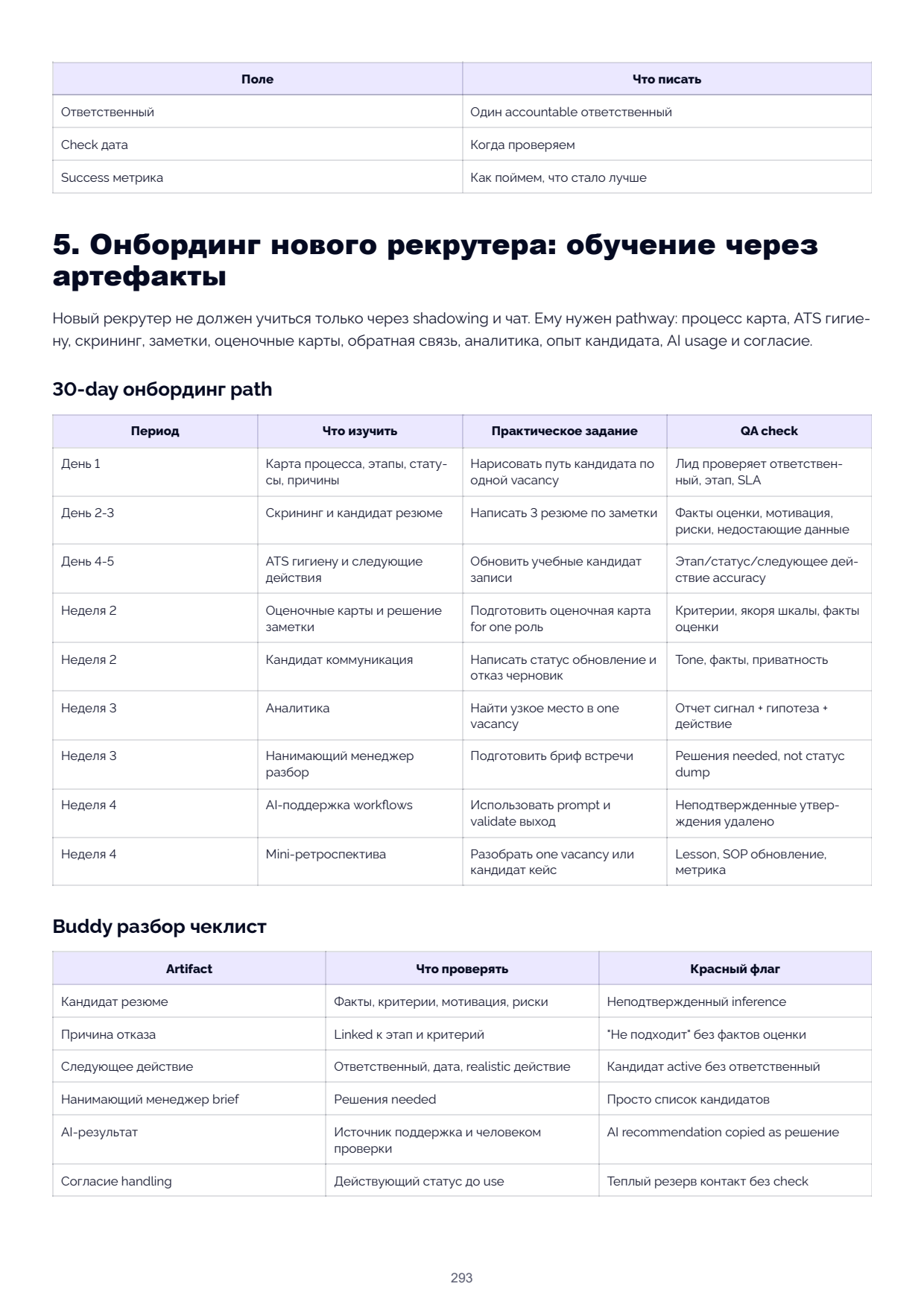
A new recruiter must not learn only through shadowing and chat. They need a pathway: process map, ATS hygiene, screening, notes, assessment cards, feedback, analytics, candidate experience, AI usage and consent. 30-day onboarding path
| Period | What to learn | Practical task | QA check |
| Day 1 | Process map, stages, statuses, reasons | Draw a candidate journey for one vacancy | Lead checks owner, stage, SLA |
| Day 2-3 | Screening and candidate summaries | Write 3 summaries from notes | Assessment facts, motivation, risks, missing data |
| Day 4-5 | ATS hygiene and next actions | Update training candidate records | Stage/status/next action accuracy |
| Week 2 | Assessment cards and decision notes | Prepare an assessment card for one role | Criteria, scale anchors, assessment facts |
| Week 2 | Candidate communication | Write a status update and rejection draft | Tone, facts, privacy |
| Week 3 | Analytics | Find a bottleneck in one vacancy | Report: signal + hypothesis + action |
| Week 3 | Hiring manager debrief | Prepare a meeting brief | Decisions needed, not status dump |
| Week 4 | AI-supported workflows | Use a prompt and validate output | Unverified claims removed |
| Week 4 | Mini-retrospective | Review one vacancy or candidate case | Lesson, SOP update, metric |
| Buddy review checklist | |||
| Artefact | What to check | Red flag | |
| Candidate summary | Facts, criteria, motivation, risks | Unverified inference | |
| Rejection reason | Linked to stage and criterion | "Doesn’t fit" without assessment facts | |
| Next action | Owner, date, realistic action | Candidate active with no owner | |
| Hiring manager brief | Decisions needed | Just a list of candidates | |
| AI result | Source support and human verification | AI recommendation copied as decision | |
| Consent handling | Current status before use | Warm reserve contact without consent check |
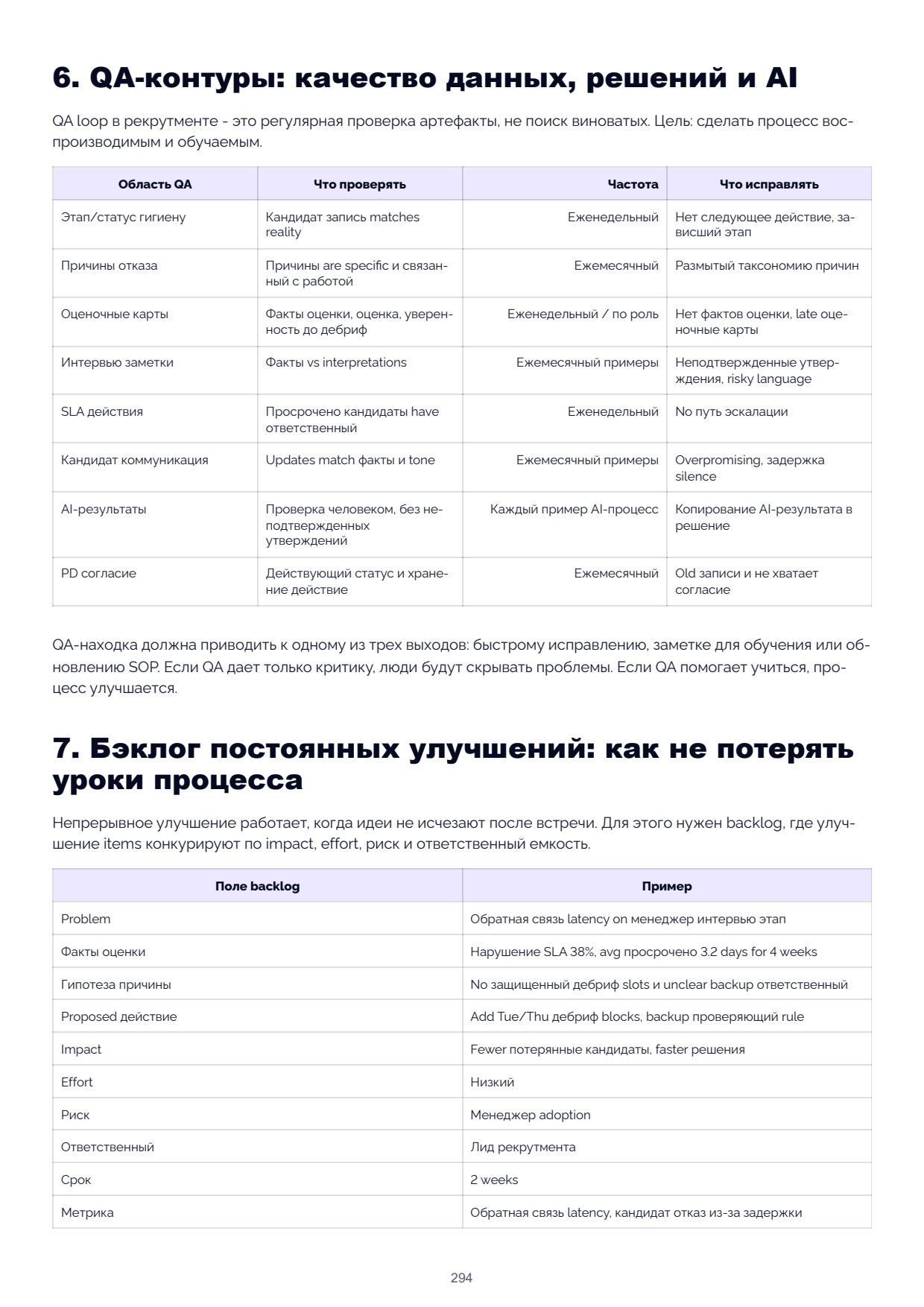
6. QA loops: quality of data, decisions and AI
The QA loop in recruitment is regular artefact verification, not blame-finding. The aim: make the process
reproducible and learnable.
QA area What to check Frequency What to fix
Stage/status hygiene Candidate record matches Weekly No next action, stalled
reality stage
Rejection reasons Reasons are specific and job- Monthly Vague rejection taxonomy
linked
Assessment cards Assessment facts, rating, confidence Pre-debrief weekly / per role No assessment facts, late
assessment cards
Interview notes Facts vs interpretations Monthly examples Unverified claims, risky
language
SLA actions Overdue candidates have an Weekly No escalation path
owner
Candidate communication Updates match facts and tone Monthly examples Overpromising, silence
delays
AI results Human verification, no unverified Every example AI process Copying AI result into
claims
unverified decision
GDPR consent Current status and storage action Monthly Old records, missing
consent
A QA finding should lead to one of three outputs: a quick fix, a training note, or an
SOP update. If QA only provides criticism, people will hide problems. If QA helps people learn, the
process improves.
7. Continuous improvement backlog: how not to lose
process lessons
Continuous improvement works when ideas do not disappear after the meeting. For this you need a backlog where improvement
items compete by impact, effort, risk and owner capacity.
Backlog field Example
Problem Feedback latency on manager interview stage
Assessment facts SLA breach 38%, avg overdue 3.2 days for 4 weeks
Hypothesis root cause No protected debrief slots and unclear backup owner
Proposed action Add Tue/Thu debrief blocks, backup reviewer rule
Impact Fewer lost candidates, faster decisions
Effort Low
Risk Manager adoption
Owner Recruitment lead
Deadline 2 weeks
Metric Feedback latency, candidate rejection due to delay