Appendix B. Mini-Dictionary and Term Policy
Term policy
The Russian wording is used wherever it does not distort the meaning. The English term is kept if it is stable in HR/ATS/AI practice, is the name of a metric or function, or often appears in interfaces. If a newcomer needs the term, we place a simple explanation next to it, and a link from the chapter leads here.
| Keep | Why | Plain Russian meaning |
|---|---|---|
| ATS | Category of systems and interfaces | System for managing vacancies and candidates |
| SLA | Operational standard | Agreed response, decision, or feedback time |
| Scorecard | Stable in assessment/ATS | Evaluation card by criteria |
| Shortlist | Stable in agency and in-house recruitment | A short list of candidates worth discussing further |
| Screening | Stable recruiting term | Primary qualification |
| Offer | Stable recruiting term | Job offer |
| Preboarding | Stable HR term | The period from offer acceptance to the first working day |
| AI-Matching | Name of a function or approach | An AI fit hypothesis against criteria, verified by a human |
Process terms
| Term | Meaning | Example |
|---|---|---|
| Managed recruitment | Hiring as a system of roles, stages, data, SLA, decisions, and regular reviews. | Every candidate has a stage, an owner, and a next step. |
| Hiring manager | The owner of the business need and the final decision for the role. | Confirms criteria and participates in the debrief. |
| Next action | A concrete step, owner, and deadline. | The HM gives feedback by Thursday. |
| Stage | A major point in the process where a new signal appears or a decision is made. | Screening, interview, offer. |
| Status | The candidate’s state within the stage. | Waiting for feedback, interview scheduled, on hold. |
| Rejection reason | A classified explanation of why the process is not continuing. | Not “other,” but “mandatory criterion not confirmed.” |
| Data hygiene | The habit of recording precise, necessary, and ethical data. | Do not write impressions instead of facts. |
| Scope change | A recorded change in requirements, stages, budget, or role conditions. | After the first interviews, a new mandatory criterion was added. |
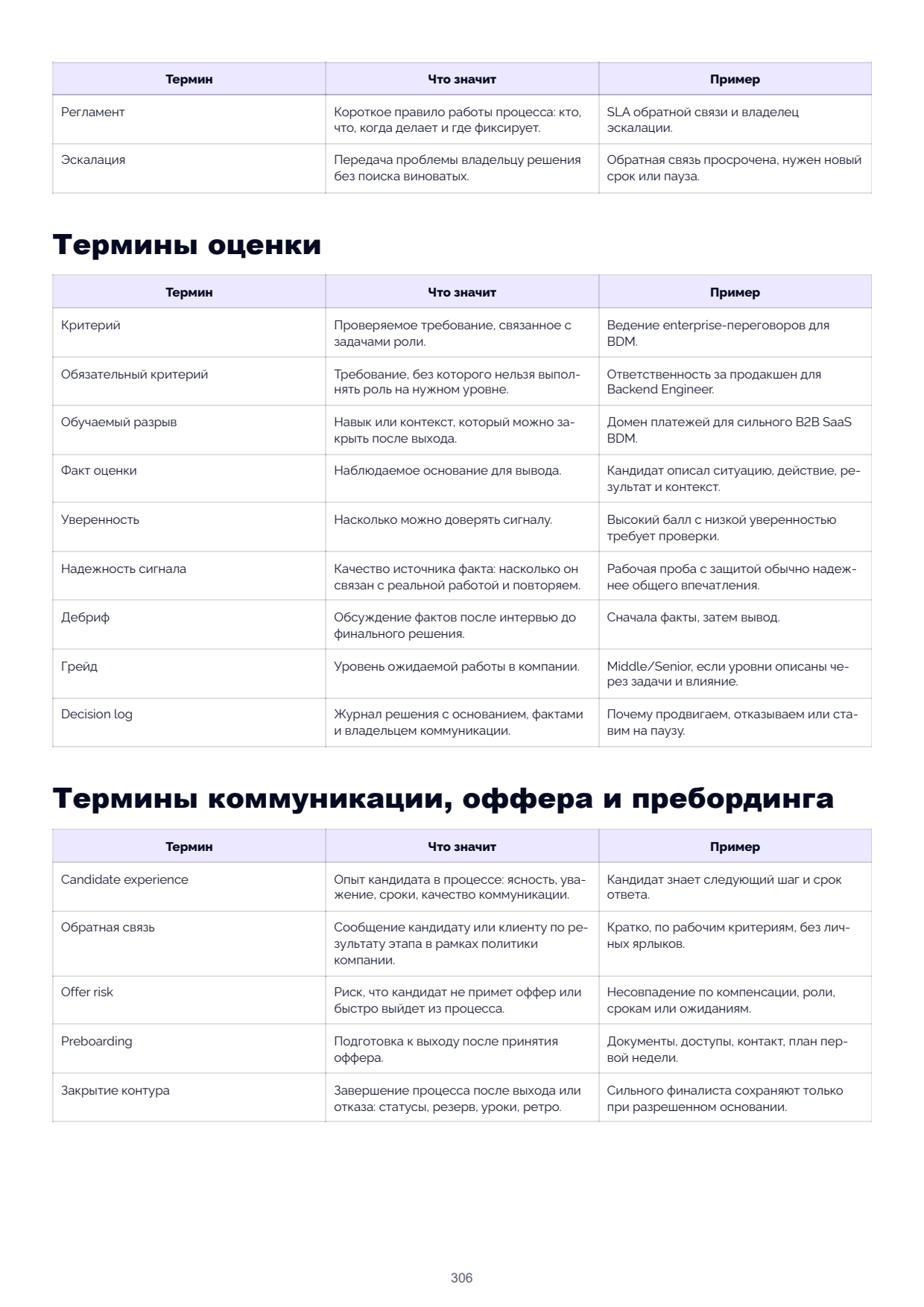
| Regulation | A short rule for how the process works: who does what, when, and where it is recorded. | Feedback SLA and escalation owner. |
| Escalation | Passing the problem to the decision owner without looking for blame. | Feedback is overdue; a new deadline or a pause is needed. |
Assessment terms
| Term | Meaning | Example |
|---|---|---|
| Criterion | A verifiable requirement linked to the role’s tasks. | Running enterprise negotiations for a BDM. |
| Mandatory criterion | A requirement without which the role cannot be performed at the needed level. | Production ownership for a Backend Engineer. |
| Trainable gap | A skill or context that can be closed after the person joins. | Payments domain knowledge for a strong B2B SaaS BDM. |
| Assessment fact | An observable basis for a conclusion. | The candidate described the situation, action, result, and context. |
| Confidence | How much the signal can be trusted. | A high score with low confidence requires verification. |
| Signal reliability | The quality of the fact source: how closely it is tied to real work and how repeatable it is. | A work sample with defense is usually more reliable than a general impression. |
| Debrief | A discussion of facts after the interview and before the final decision. | Facts first, then the conclusion. |
| Grade | The level of expected work in the company. | Middle/Senior, if levels are described through tasks and impact. |
| Decision log | A record of the decision with rationale, facts, and the communication owner. | Why we advance, reject, or put on hold. |
Communication, offer, and preboarding terms
| Term | Meaning | Example |
|---|---|---|
| Candidate experience | The candidate’s experience in the process: clarity, respect, timing, and communication quality. | The candidate knows the next step and the response deadline. |
| Feedback | A message to the candidate or the client about the stage outcome within company policy. | Short, based on work criteria, without personal labels. |
| Offer risk | The risk that the candidate will not accept the offer or will leave the process quickly. | A mismatch in compensation, role, timing, or expectations. |
| Preboarding | Preparation for the start after the offer is accepted. | Documents, access, contact, plan for the first week. |
| Closing the loop | Completing the process after a start or a rejection: statuses, reserve, lessons, retro. | A strong finalist is kept only on a permitted basis. |
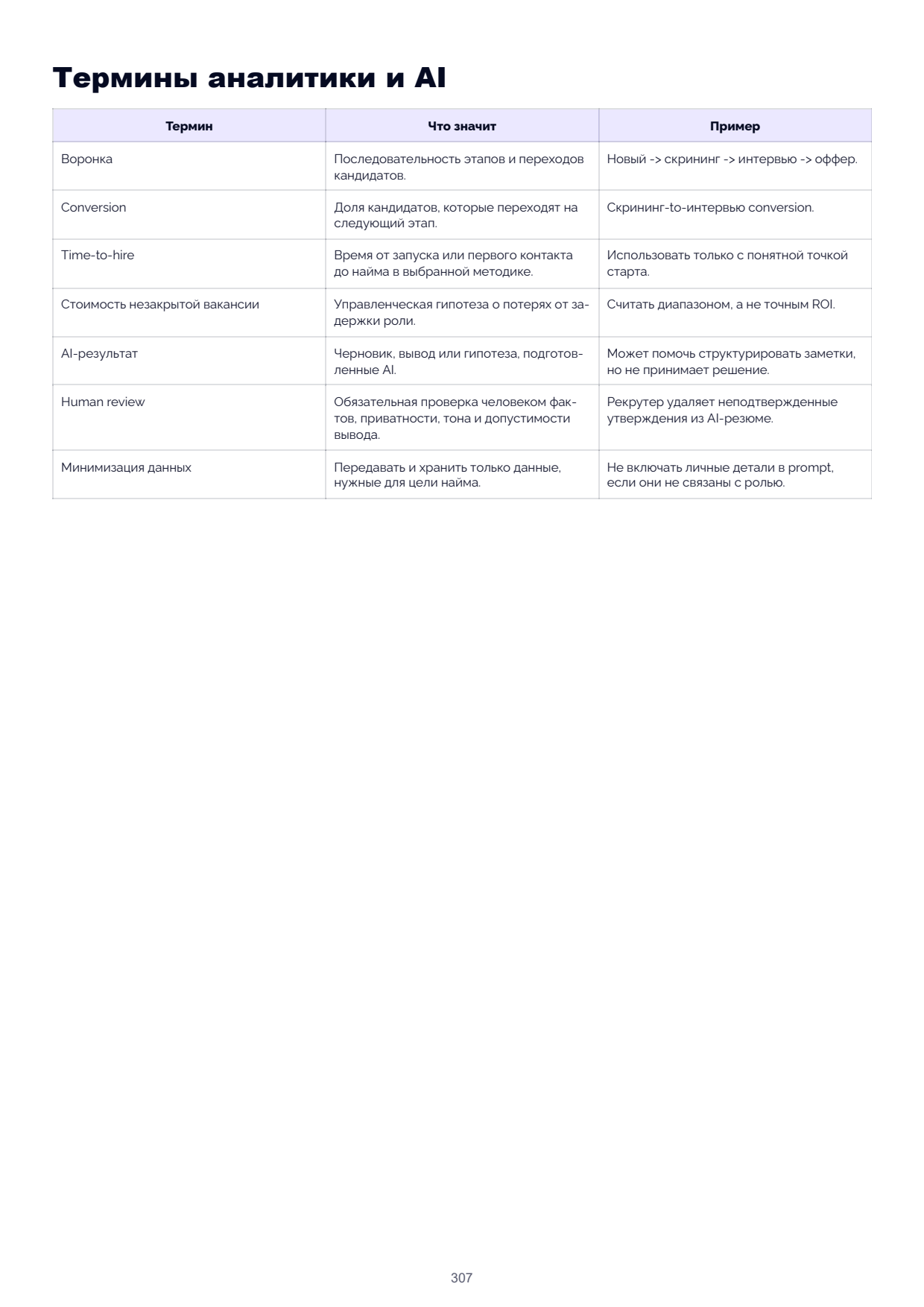
Analytics and AI terms
| Term | Meaning | Example |
|---|---|---|
| Funnel | The sequence of stages and candidate transitions. | New -> screening -> interview -> offer. |
| Conversion | The share of candidates who move to the next stage. | Screening-to-interview conversion. |
| Time-to-hire | The time from launch or first contact to hiring in the chosen methodology. | Use only with a clearly defined starting point. |
| Cost of an unfilled vacancy | A management hypothesis about losses from delaying the role. | Calculate it as a range, not an exact ROI. |
| AI output | A draft, conclusion, or hypothesis prepared by AI. | It can help structure notes but does not make the decision. |
| Human review | A required human check of facts, privacy, tone, and output admissibility. | The recruiter removes unverified claims from the AI summary. |
| Data minimization | Pass and store only the data needed for the hiring purpose. | Do not include personal details in a prompt if they are unrelated to the role. |