Harmony HR
1 How recruitment works2 Role, criteria, plan3 Funnel, statuses
4 Screening5 Interview process6 What we assess7 Motivation and signal8 Assessment, levels, AI9 Decisions and feedback10 Candidate experience
11 Offer management12 Preboarding
13 Metrics and analytics14 Economics of hiring15 Talent pipeline16 Operational rhythm
Home/Appendix D

Appendix D. Regulations

pp. 300–312
Appendix visual

Use the regulation chooser to pick the right operating rule-set before applying the SOPs below.

Regulation chooser for recruitment operations
Regulation chooserA quick decision map for selecting the right regulation and process variant by team setup, delivery model, and management maturity.
FieldProcess description
documented actions.
ScopeAll active vacancies, candidate processes, recruiter team rhythm, agency and client reviews where applicable.
RolesThe recruitment lead owns the rhythm. Recruiters own candidate records and actions. Hiring managers own business decisions and feedback. HRD owns escalations and resources. Recruiting ops owns reports and QA samples.
InputsVacancy report, SLA report, funnel with details, candidate movement, rejection report, source report, time-to-hire, recruiter report, consent report, action log.
Steps1. Update statuses before the weekly meeting. 2. Review previous actions. 3. Discuss priority blockers. 4. Assign owner and deadline. 5. Escalate unresolved business questions. 6. Conduct the monthly audit. 7. Record the improvement backlog. 8. Update SOP and onboarding when the process changes.
Mandatory fieldsMeeting date, signals reviewed, decision, action, owner, deadline, verification metric, escalation if needed.
MetricsAction closure rate, recurring bottlenecks, SLA trend, feedback latency, QA pass rate, regulation drift instances found.
SOP: Recruitment artefact QA loop
FieldProcess description
PurposeVerify the quality of candidate CVs, rejection reasons, scorecards, AI outputs, and consent-sensitive actions.
ScopeWeekly samples from active roles, monthly cross-team audit, mandatory review of new recruiter artefacts and new AI processes.
RolesLead or designated reviewer examines samples. Recruiter corrects the artefact. Ops updates templates. HR/legal review privacy or assessment fairness risks.
InputsCandidate CVs, interview notes, scorecards, rejection reasons, AI outputs, consent status, signal reports.
Steps1. Select a sample. 2. Check source verification. 3. Separate facts from interpretations. 4. Check reason specificity. 5. Check AI checks. 6. Check consent-sensitive actions. 7. Record the finding as a correction, training note, or SOP update.
Mandatory fieldsArtefact, issue, risk, mandatory correction, owner, deadline, impact on training or SOP.
MetricsQA pass rate, unverified claims removed, vague reason share, AI checks share, consent issues count.
SOP: New recruiter onboarding
FieldProcess description
PurposeGive the new recruiter practical ability to run the process to standard before independent responsibility.
ScopeFirst 30 days for new recruiters, internal transitions, and agency recruiters joining the delivery team.
RolesLead owns onboarding. Buddy reviews artefacts. New recruiter completes exercises. Hiring manager joins the role context session.
InputsProcess map, stage/status/reason glossary, screening templates, scorecards, meeting agenda, analytics reports, AI policy, personal data consent rules.
Steps1. Study the process map. 2. Complete the candidate card exercise. 3. Write a screening summary. 4. Join the weekly meeting. 5. Prepare a hiring manager brief. 6. Complete an analytics exercise. 7. Pass the QA sample. 8. Receive independent responsibility for a vacancy.
Mandatory fieldsTraining module, exercise, reviewer, pass criteria, feedback, next development action.
MetricsTime to independence, QA pass rate, missing data share, hiring manager feedback on briefs, independent responsibility date.
13. Maturity model: from chaos to AI-assisted operations
DimensionChaosManaged processData-driven managementAI-assisted operations
Weekly rhythmMeetings happen only during crisesWeekly meeting with agendaAction closure and blockers trackedAI prepares brief, lead reviews
Monthly auditNo regular reviewMonthly metrics reviewImprovement backlog based on trendsAI prepares hypotheses, people decide
QAIssues found by chanceSpot checks existQA metrics and training notesQA of AI outputs and policy audit
OnboardingNew recruiter learns randomly and without a plan30-day plan and templatesArtefacts verified against standardsAI prepares exercises, human reviews
Hiring manager rhythmManagers respond irregularlyRole review and SLAHiring manager bottlenecks visibleMeeting briefs highlight needed decisions
Agency/client rhythmClient asks for more CVsClient review and feedback SLAShortlist quality and market signals trackedAI drafts client note, human edits
SOP maintenanceRules live in memorySOPs documentedSOP updates linked to process lessonsChange log includes AI process control
Consent/data managementOld records used casuallyConsent status checkedPD consent audit rhythmAI does not bypass consent policy

13. Maturity model: from chaos to AI-assisted

operations

Dimension Chaos Managed process Data-driven management AI-assisted operations

Weekly rhythm Meetings happen only Weekly meeting with Action closure and blockers AI prepares brief, lead

during crises agenda tracked reviewed

Monthly audit No regular review Monthly metrics Improvement backlog based AI prepares hypotheses, people

review on trends decide

QA Issues found by chance Spot checks exist QA metrics and training QA of AI outputs and policy

notes audit

Onboarding New recruiter learns 30-day plan and Artefacts verified AI prepares exercises,

randomly and without a plan templates against standards human reviews

Hiring manager Managers respond Role review and SLA Hiring manager bottlenecks Meeting briefs highlight needed

rhythm irregularly visible decisions

Agency/client rhythm Client asks for more Client review and feedback Shortlist quality and market AI drafts client note, human

CVs SLA signals tracked edits

SOP maintenance Rules live in memory SOPs documented SOP updates linked to Change log includes AI process

process lessons control

Consent/data Old records used casually Consent status checked PD consent audit rhythm AI does not bypass consent

management policy

Maturity checklist
QuestionIf no, next action
Does every weekly meeting end with an owner and a deadline?Add an action log and review previous actions first
Do recurring monthly issues become improvement tasks?Create an improvement backlog with P0–P3 priorities
Are new recruiters checked on real artefacts?Add buddy-QA and pass criteria
Are rejection reasons audited?Hold a monthly review of vague reasons
Are AI outputs verified before use?Add a "human checks AI" field and spot audit
Are SOPs updated after process changes?Add a change log and quarterly SOP review
What to take from the chapter / where to go next
What you needWhere to find it
Terms and short definitionsAppendix B. Mini-Dictionary
Ready-made regulations and SLAAppendix D. Ready-Made Regulations and Processes
Working templatesAppendix E. Template Library
End-to-end BDM and Backend casesAppendix F. End-to-End BDM and Backend Cases
Full chapter AI promptsAppendix H. AI Prompt Library, section H3. Process Diagnostics and Operational Rhythm

of materials and artefact index

How to use the appendices

The appendices are not meant to be read cover to cover — they are for work: find the right artefact, pick a regulation, check a term, assemble a process in ATS, and verify that the decision remains evidence-based. If you are reading the book for the first time, start with the route at the beginning. If you are implementing the system, start with Appendix D.

Navigator by task

Task Where to read What you can take into work

Launch a vacancy without chaos Chapters 1–2, Appendix D Minimum funnel, roles, SLA, one-

page hiring plan

Set up the funnel and rejection reasons Chapter 3 Stages, statuses, reasons, next-step rules

Run screening Chapter 4, Appendix E Screening script, CV screening,

fact checklist

Prepare for interviews Chapters 5–6, Appendix F Interview cycle, scorecard,

anchors, evidence chain

Make a decision Chapters 8–9 Decision rule, debrief, decision log,

feedback caveats

Protect candidate experience Chapters 10–12 Communications, offer, preboarding,

loop closure

Manage recruitment Chapters 13–16 Dashboards, role economics, weekly

and monthly rhythm

Choose a ready-made regulation Appendix D 6 variants for agency, in-house, and

team size

Find a full AI prompt Appendix H Prompt library by task: process,

criteria, screening, debrief, offer,

analytics, pipeline

Artefact Index

Artefact For whom Where to adapt Minimum ATS fields

One-page hiring plan Recruiter, HM, HRD Chapter 2, Appendix E Role, outcome, criteria,

stages, SLA, owner

Funnel map Recruiter, ops, agency Chapter 3 Stage, status, reason, next

step, owner

CV screening summary Recruiter Chapter 4 Criterion, fact, risk, motiva-

tion, next step

Scorecard Interviewers, HM Chapter 6 Criterion, method, fact, score,

confidence

ArtefactFor whomWhere to adaptMinimum ATS fields
Decision logRecruiter, HM, HRDChapter 9Decision, reason, facts, commu-
Communication templateRecruiter, agencyChapter 10, Appendix EStage, promised deadline, tone, permitted feedback scope
Offer noteRecruiter, HRD, financeChapter 11Terms, risks, approvals, owner, deadline
Pre-start context handoverRecruiter, HR, HMChapter 12Start date, terms, context, risks, first day
Weekly noteLead, HRD, agency accountChapter 16, Appendix DBlocker, action, owner, deadline, metric
AI promptRecruiter, lead, HRD, HMAppendix HTask, inputs, constraints, human review

Appendix B. Mini-Dictionary and

terminology policy

Terminology policy

The Russian form is used wherever it does not distort meaning. The English term is kept where it is established in HR/ATS/AI practice, is the name of a metric or function, or appears frequently in interfaces.

If a term is needed by a newcomer, a simple explanation is given nearby and the in-chapter link leads here.

We keep Why Russian explanation

ATS Category of systems and interfaces Vacancy and candidate management

system

SLA Operational standard Agreed response, decision, or feedback

deadline

Scorecard Established in assessment/ATS Assessment card by criteria

Shortlist Established in agency and in-house Shortlist of candidates worth discussing

recruitment further

Screening Established recruitment term Initial qualification

Offer Established recruitment term Job offer

Preboarding Established HR term Period from offer acceptance to first

working day

AI-Matching Function/approach name AI hypothesis of criteria match, verified

by a human

Process terms

Term What it means Example

Managed recruitment Hiring as a system of roles, stages, data, Every candidate has a stage, owner, and

SLA, decisions, and regular reviews. next step.

Hiring manager Owner of the business need and final Confirms criteria and participates in

decision for the role. debrief.

Next step Concrete action, owner, and deadline. HM provides feedback by Thursday.

Stage Major process point where a new Screening, interview, offer.

signal appears or a decision is made.

Status Candidate's state within a stage. Awaiting feedback, interview scheduled,

on hold.

Rejection reason Classified explanation of why the Not "other", but "mandatory criterion

process does not continue. not confirmed".

Data hygiene Habit of recording accurate, necessary, and Do not record impressions instead of

ethical data. facts.

Scope change Recorded change in requirements, stages, After the first interviews a new mandatory

budget, or role conditions. criterion was added.

TermWhat it meansExample
RegulationA short working rule for the process: who does what, when, and where it is recorded.Feedback SLA and escalation owner.
EscalationPassing a problem to the decision owner without blaming anyone.Feedback overdue, new deadline or pause needed.
Assessment terms
TermWhat it meansExample
CriterionA verifiable requirement linked to role tasks.Running enterprise negotiations for BDM.
Mandatory criterionA requirement without which the role cannot be performed at the required level.Production ownership for Backend Engineer.
Learnable gapA skill or context that can be closed after start date.Payments domain for a strong B2B SaaS BDM.
Assessment factAn observable basis for a conclusion.Candidate described a situation, action, result, and context.
ConfidenceHow much the signal can be trusted.A high score with low confidence requires verification.
Signal reliabilityQuality of the fact's source: how closely it relates to actual work and is repeatable.A work sample with defence is usually more reliable than a general impression.
DebriefDiscussion of facts after an interview, before the final decision.Facts first, then conclusion.
LevelExpected work level within the company.Middle/Senior, where levels are described through tasks and impact.
Decision logDecision record with rationale, facts, and communication owner.Why we advance, decline, or pause.
Communication, offer, and preboarding terms
TermWhat it meansExample
Candidate experienceThe candidate's experience throughout the process: clarity, respect, timelines, communication quality.The candidate knows the next step and response deadline.
FeedbackMessage to the candidate or client on the stage outcome within company policy.Concise, based on work criteria, no personal labels.
Offer riskRisk that the candidate will not accept the offer or will leave the process quickly.Mismatch on compensation, role, timeline, or expectations.
PreboardingPreparation after offer acceptance, before start date.Documents, access, contact, first-week plan.
Loop closureCompleting the process after start date or rejection: statuses, pipeline, lessons, retrospective.A strong finalist is retained only with a permitted justification.
Analytics and AI terms
TermWhat it meansExample
FunnelSequence of stages and candidate transitions.New → screening → interview → offer.
ConversionShare of candidates who advance to the next stage.Screening-to-interview conversion.
Time-to-hireTime from launch or first contact to hire, using the chosen methodology.Only use with a clear start point.
Cost of an unfilled vacancyManagement hypothesis about losses from a delayed role.Calculate as a range, not exact ROI.
AI outputDraft, conclusion, or hypothesis prepared by AI.Can help structure notes but does not make decisions.
Human reviewMandatory human verification of facts, privacy, tone, and permissibility of the conclusion.Recruiter removes unverified claims from AI CV summary.
Data minimisationShare and store only data needed for the hiring purpose.Do not include personal details in prompt if not relevant to the role.

Appendix C. Sources,

methodological notes, and

legal caveats

How to read the sources

This book is a practical handbook, not an academic review or legal advice.

The sources below serve as a methodological anchor for careful formulations: structured interview, criteria-based assessment, human review, privacy, and non-discrimination.

Methodological sources

Topic Source / direction How it is used in the book

Validity of selection methods Schmidt & Hunter, 1998; research on Supports the idea that assessment methods

validity and practical utility of selection differ in reliability and must be linked

methods to role tasks.

Structured interviews McDaniel et al., 1994; Campion et al., Supports predetermined criteria, uniform

1997; Google re:Work materials on structured questions, and comparable candidate

interviews assessment.

Assessment fairness and EEOC materials, EU Equal Treatment Supports the prohibition on sensitive

non-discrimination Directive 2000/78/EC as general context assumptions and the requirement for

work-related criteria.

Personal data GDPR as a well-known example of data Supports the principles of data minimisation,

regulation; local data policies, consent, consent, retention periods, and access

companies restriction.

AI governance NIST approaches to AI risk management Supports the rule: AI assists but does not

and human review practices make sensitive decisions without human

verification.

HarmonyATS reference materials

Topic Where to look

Personal data consent HarmonyATS documentation / personal data and

consent section

Source report HarmonyATS / reports / source report

Rejection report HarmonyATS / reports / rejection reasons

Candidate movement HarmonyATS / reports / candidate movement

Funnel with details HarmonyATS / reports / funnel with details

Time-to-hire HarmonyATS / reports / time-to-hire

SLA report HarmonyATS / reports / SLA

AI Studio and AI-Matching HarmonyATS / AI Studio and AI-Matching

Caveats

Check applicable employment, anti-discrimination, and privacy regulations in your

jurisdiction.

External feedback to the candidate depends on company policy, note quality, and the legal

context.

The economic models in this book are management hypotheses, not financial forecasts or

ROI guarantees.

AI outputs must not be used without verification of facts, privacy, tone, and permissibility

of wording.

Appendix D. Ready-Made Regulations

and Processes

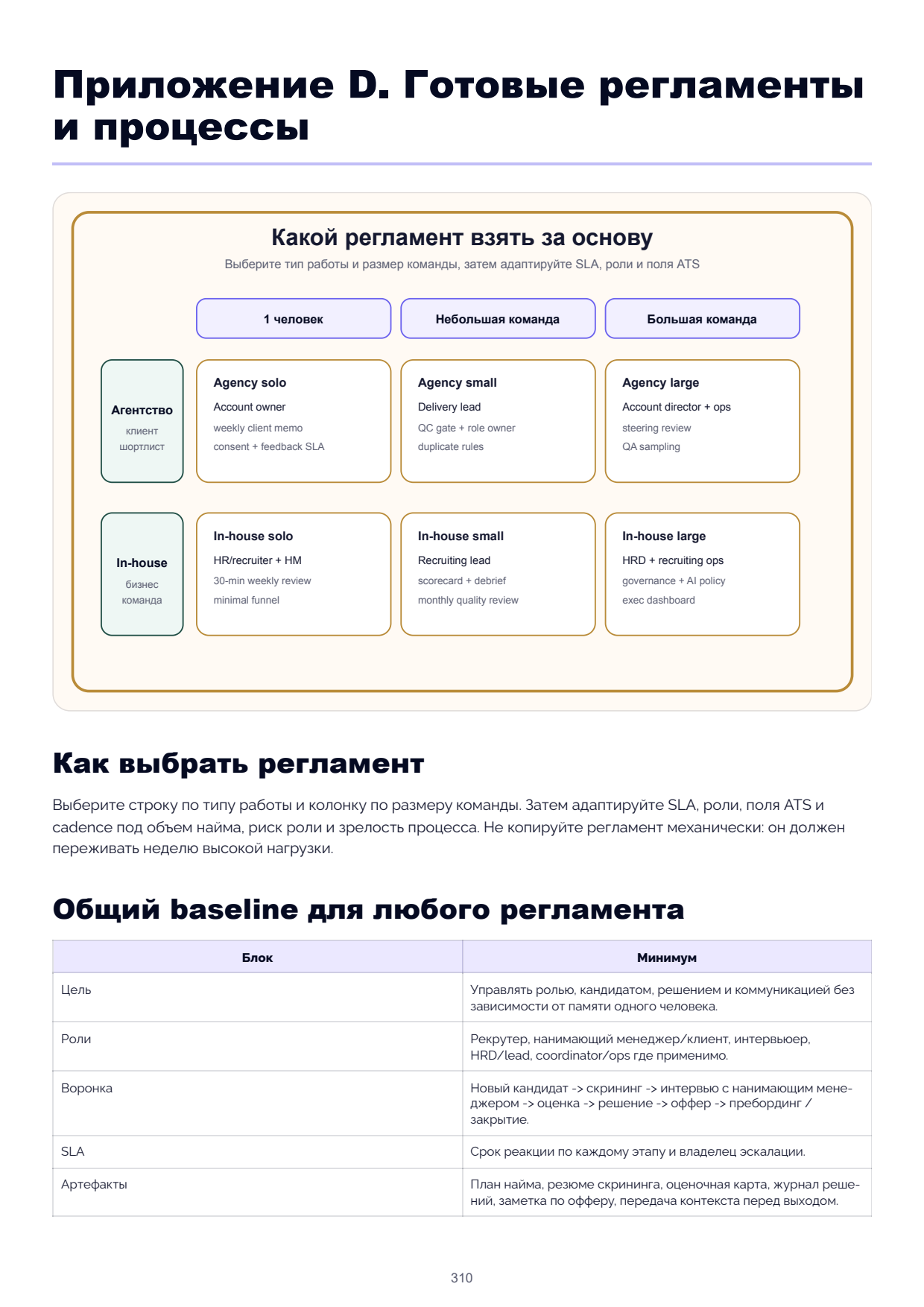
Which regulation to use as a base

Select your work type and team size, then adapt SLA, roles, and ATS fields

1 person Small team Large team

Agency solo Agency small Agency large

Agency Account owner Delivery lead Account director + ops

client weekly client memo QC gate + role owner steering review

shortlist consent + feedback SLA duplicate rules QA sampling

In-house solo In-house small In-house large

In-house HR/recruiter + HM Recruiting lead HRD + recruiting ops

business 30-min weekly review scorecard + debrief governance + AI policy

team minimal funnel monthly quality review exec dashboard

How to choose a regulation

Select the row by work type and column by team size. Then adapt SLA, roles, ATS fields, and

cadence to the hiring volume, role risk, and process maturity. Do not copy the regulation mechanically — it must

survive a high-load week.

Common baseline for any regulation

Block Minimum

Purpose Manage the role, candidate, decision, and communication without

relying on one person's memory.

Roles Recruiter, hiring manager/client, interviewer,

HRD/lead, coordinator/ops where applicable.

Funnel New candidate → screening → interview with hiring manager →

assessment → decision → offer → preboarding /

closure.

SLA Response deadline for each stage and escalation owner.

Artefacts Hiring plan, CV screening summary, scorecard, decision log,

offer note, pre-start context handover.

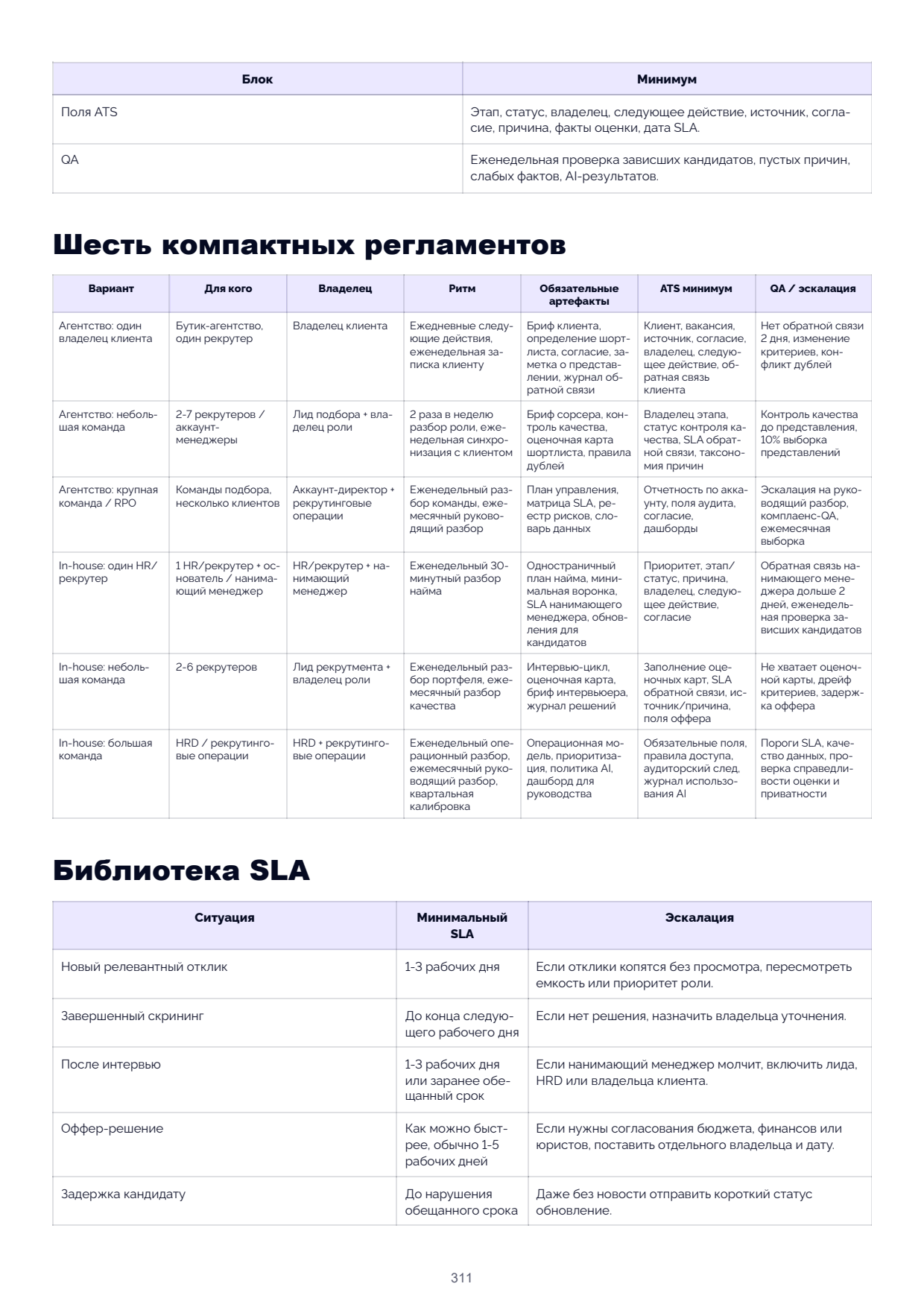
BlockMinimum
ATS fieldsStage, status, owner, next action, source, consent, reason, assessment facts, SLA date.
QAWeekly check of stalled candidates, empty reasons, weak facts, AI outputs.
Six compact regulations
VariantFor whomOwnerRhythmMandatory artefactsATS minimumQA / escalation
Agency: single client ownerBoutique agency, one recruiterClient ownerDaily next actions, weekly client noteClient brief, shortlist definition, consent, submission note, feedback logClient, vacancy, source, consent, owner, next action, client feedbackNo feedback for 2 days, criteria change, duplicate conflict
Agency: small team2–7 recruiters / account managersRecruitment lead + role ownerTwice-weekly role review, weekly client syncSourcer brief, quality control, shortlist scorecard, duplicate rulesStage owner, quality control status, feedback SLA, reason taxonomyQC before submission, 10% submission sample
Agency: large team / RPORecruitment teams, multiple clientsAccount director + recruiting opsWeekly team review, monthly leadership reviewManagement plan, SLA matrix, risk register, data glossaryAccount reporting, audit fields, consent, dashboardsEscalation to leadership review, compliance QA, monthly sample
In-house: one HR/recruiter1 HR/recruiter + founder / hiring managerHR/recruiter + hiring managerWeekly 30-minute hiring reviewOne-page hiring plan, minimum funnel, hiring manager SLA, candidate updatesPriority, stage/status, reason, owner, next action, consentHiring manager feedback over 2 days, weekly stalled candidate check
In-house: small team2–6 recruitersRecruitment lead + role ownerWeekly portfolio review, monthly quality reviewInterview cycle, scorecard, interviewer brief, decision logScorecard completion, feedback SLA, source/reason, offer fieldsMissing scorecard, criteria drift, offer delay
In-house: large teamHRD / recruiting opsHRD + recruiting opsWeekly operational review, monthly leadership review, quarterly calibrationOperating model, prioritisation, AI policy, leadership dashboardMandatory fields, access rules, audit trail, AI usage logSLA thresholds, data quality, assessment fairness and privacy checks
SLA Library
SituationMinimum SLAEscalation
New relevant application1–3 working daysIf applications pile up without review, reassess capacity or role priority.
Screening completedBy end of next working dayIf no decision, assign a clarification owner.
After interview1–3 working days or the previously promised deadlineIf hiring manager is silent, involve the lead, HRD, or client owner.
Offer decisionAs soon as possible, typically 1–5 working daysIf budget, finance, or legal approvals are needed, set a separate owner and date.
Candidate delayBefore the promised deadline is breachedEven without news, send a brief status update.
Escalation Library
FailureWhat to do
Criteria changed after interviewPause new decisions, update hiring plan, flag affected candidates.
Client/manager does not provide feedbackShow SLA breach, assign owner, agree new deadline or pause.
Rejection reason is empty or weakDo not close a stage without a reason; use the taxonomy and assessment facts.
AI output contains unverified conclusionsRemove conclusions, keep only verifiable facts and questions for the human.
Candidate is stalled without a next stepAssign an owner, a promised update date, and the next step.
Page 300 Page 301 Page 302 Page 303 Page 304 Page 305 Page 306 Page 307 Page 308 Page 309 Page 310 Page 311 Page 312