Chapter 15. Talent Pipeline, Mobility, Referrals


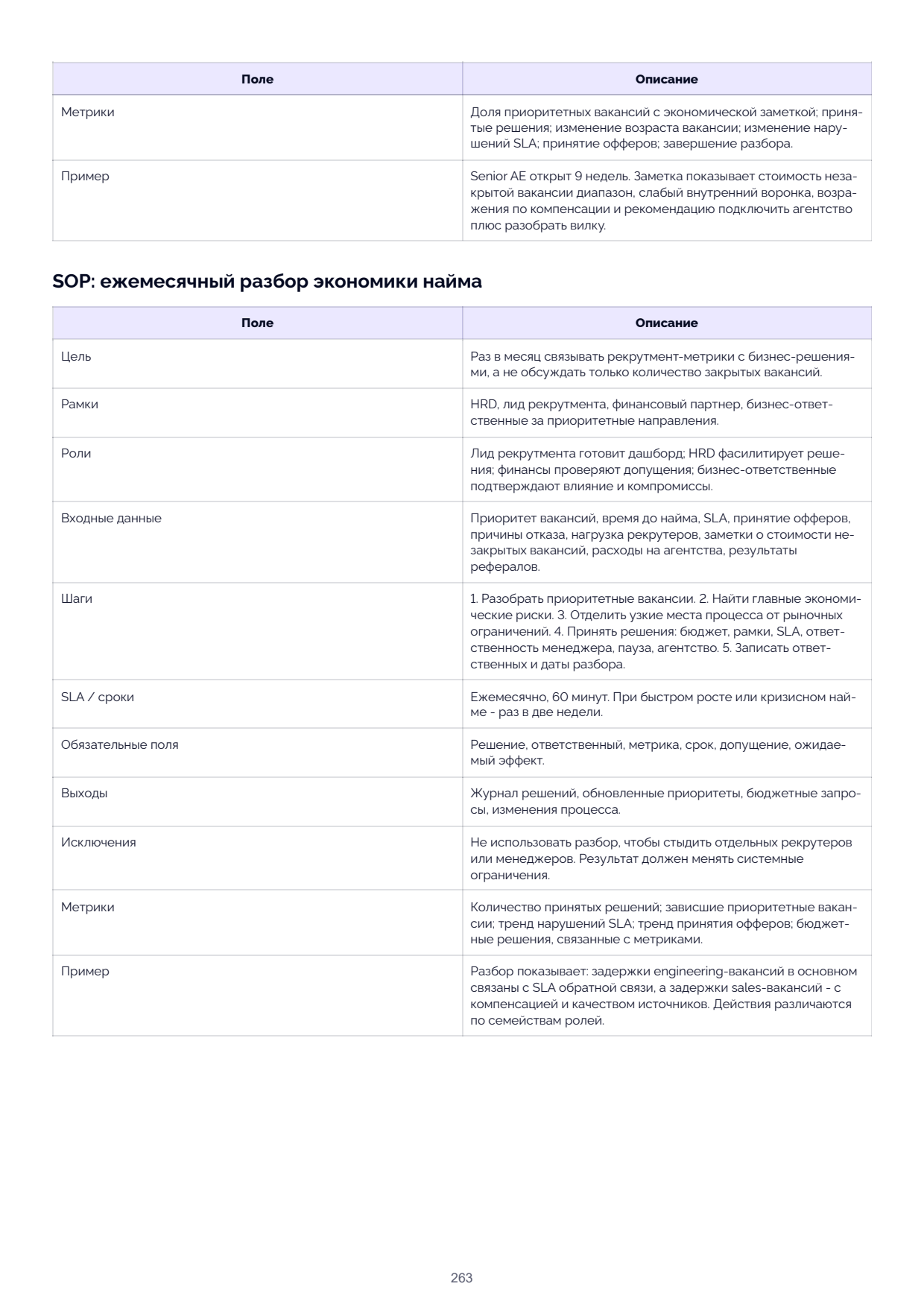
| Field | Description |
|---|---|
| Metrics | Share of priority vacancies with an economics note; decisions taken; change in vacancy age; change in SLA breaches; offer acceptance; debrief completion. |
| Example | Senior AE open for 9 weeks. The note shows the cost of an unfilled vacancy, a weak internal funnel, compensation objections, and a recommendation to engage an agency plus review the pay band. |
| SOP: monthly hiring economics review | |
| Field | Description |
| Purpose | Once a month, link recruitment metrics to business decisions, rather than discussing only the number of vacancies filled. |
| Scope | HRD, recruitment lead, finance partner, business owners of priority areas. |
| Roles | Recruitment lead prepares the dashboard; HRD facilitates decisions; finance reviews assumptions; business owners confirm impact and trade-offs. |
| Inputs | Vacancy priority, time-to-hire, SLA, offer acceptance, rejection reasons, recruiter workload, notes on the cost of unfilled vacancies, agency spend, referral results. |
| Steps | 1. Review priority vacancies. 2. Identify key economic risks. 3. Separate process bottlenecks from market constraints. 4. Decide: budget, scope, SLA, manager accountability, pause, agency. 5. Record owners and review dates. |
| SLA / timeframes | Monthly, 60 minutes. During rapid growth or crisis hiring — fortnightly. |
| Mandatory fields | Decision, owner, metric, deadline, assumption, expected impact. |
| Outputs | Decision log, updated priorities, budget requests, process changes. |
| Exceptions | Do not use the review to shame individual recruiters or managers. The outcome must change systemic constraints. |
| Metrics | Number of decisions taken; stalled priority vacancies; SLA breach trend; offer acceptance trend; budget decisions linked to metrics. |
| Example | The review reveals: engineering vacancy delays are mainly linked to feedback SLA, while sales vacancy delays relate to compensation and source quality. Actions differ by role family. |
Example: The review reveals: engineering vacancy delays are mainly
linked to feedback SLA, while sales vacancy delays relate to
compensation and source quality. Actions differ by
role family.
14. Implementation checklist and maturity model
1 day
Action Result
Select 3 priority vacancies The team does not try to calculate the economics of everything at once
For each role, describe the business impact It is clear what the vacancy is blocking
Gather vacancy age, stage, SLA, rejection reasons There is a factual basis
Write a cautious hypothesis about the cost of an There is an initial management estimate
unfilled vacancy
Assign an owner and a review date The calculation is linked to a decision
1 week
Action Result
Prepare a one-page business case for one decision Budget or process change is discussed substantively
Agree confidence levels The team does not pretend to be more precise than it is
Add metrics to the weekly recruitment review Economics becomes part of the rhythm
Check salary / offer rejection reasons It is visible where money is lost at the end of the process
Select one process bottleneck There is action, not just calculation
1 month
Action Result
Launch the monthly hiring economics review HRD and the business see the link between hiring and capacity
Compare actions with metric movement It is clear which investments worked
Update decisions on referrals, agencies and recruitment Budgets are linked to assessment facts
capacity
Add a learning cycle on hiring mistakes Hiring mistakes become material for improvement
Prepare a glossary and formulas for management Metrics are explained consistently
Maturity model
Level What it looks like
Chaos Hiring is discussed as "we need to fill it faster"; budget decisions are reactive
Managed process There is a cost of hire, time-to-hire, SLA and vacancy priority
Data-driven management Priority roles have economic notes, decisions are linked to metrics, bottlenecks are reviewed
monthly
Business partner Recruitment defends budget, agencies, salary decisions and process changes through capacity and risk
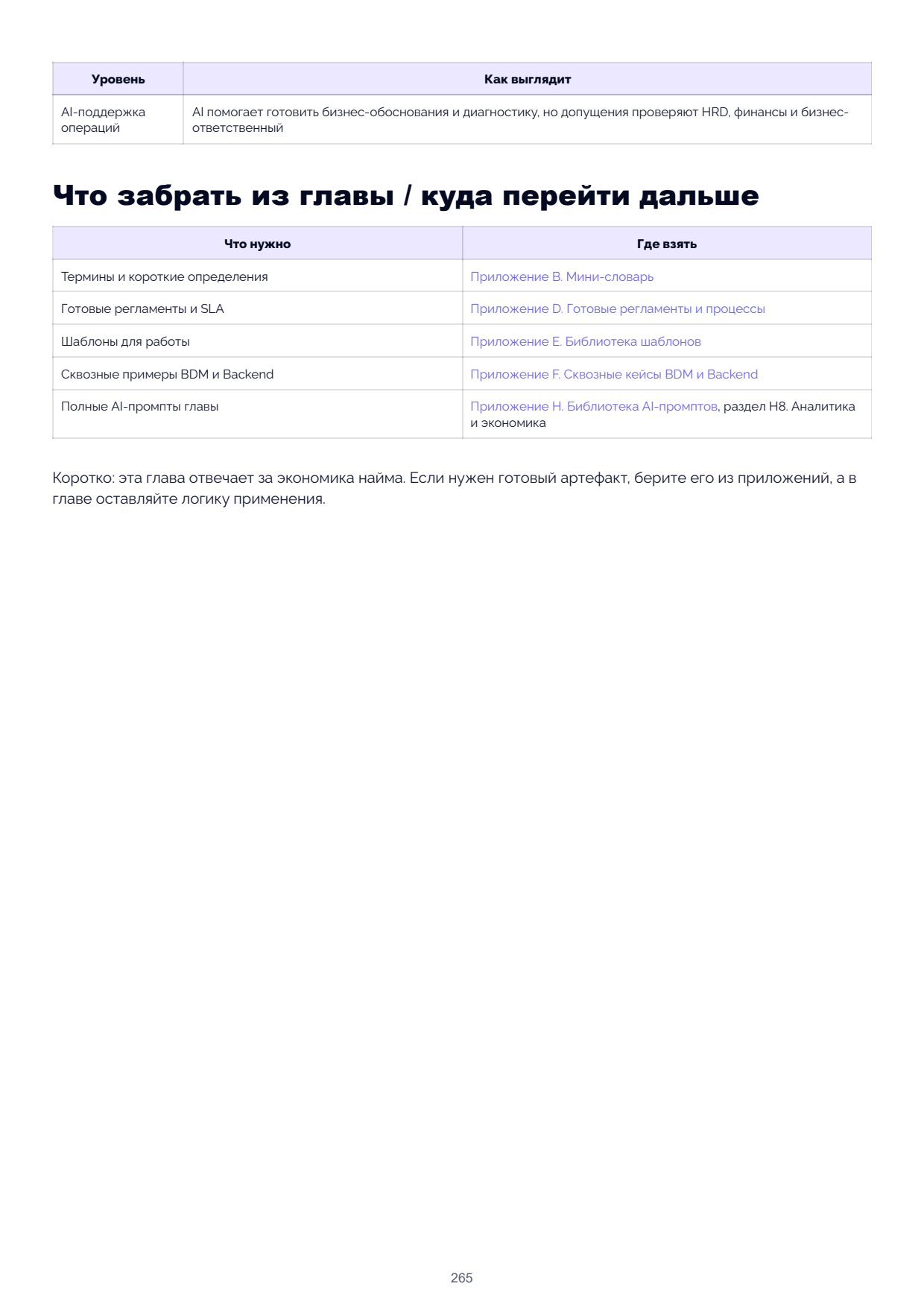
| Level | What it looks like |
|---|---|
| AI-supported operations | AI helps prepare business cases and diagnostics, but assumptions are reviewed by HRD, finance and the business owner |
| What to take from this chapter / where to go next | |
| What you need | Where to find it |
| Terms and short definitions | Appendix B. Mini-glossary |
| Ready-made policies and SLA | Appendix D. Ready-made policies and processes |
| Templates for use | Appendix E. Template library |
| End-to-end BDM and Backend examples | Appendix F. End-to-end BDM and Backend case studies |
| Full AI prompts for the chapter | Appendix H. AI prompt library, section H8. Analytics and economics |
Internal Mobility and
Referrals
How to use this chapter
A working scenario. A new role opens, and the recruiter starts from scratch. The next day, someone remembers: "We had a
strong finalist six months ago." The day after that, a manager says there is someone in a neighbouring team with
potential. Then a referral comes in, but it is unclear whether consent exists, whether expectations are still relevant, and who
owns the relationship. The company had memory, but no system.
What actually broke down here: warm connections existed as the memories of individual people, not as
a managed loop. In any company with steady hiring, memory gradually accumulates: strong finalists,
former employees, people from professional networks, employees with the potential to move into a different
role, recommendations from the team. If you manage that memory, it becomes a system.
But a talent pipeline easily descends into chaos: an old database without consent, tags without rules, referrals "by
acquaintance", internal moves via backroom agreements, managers who block strong
employees, and AI that suggests contacting people without checking data protection. That is why this chapter is not
about "filing CVs". It is about a managed loop: whom you can hold in the pipeline, why, for how long, who
is responsible, how to keep data current, how to maintain fair assessment, and how to measure quality.
This chapter is especially useful for companies with 50–500 employees, where hiring is already regular but often still
relies on the memory of recruiters and managers. It is also useful for recruitment agencies: for an agency, a warm database
and long-term candidate relationships can be a commercial asset, but only if there is trust, data
currency, transparent ownership and respect for the candidate.
Remember in one phrase: a talent pipeline only works where every warm contact has consent,
a purpose and a next step.
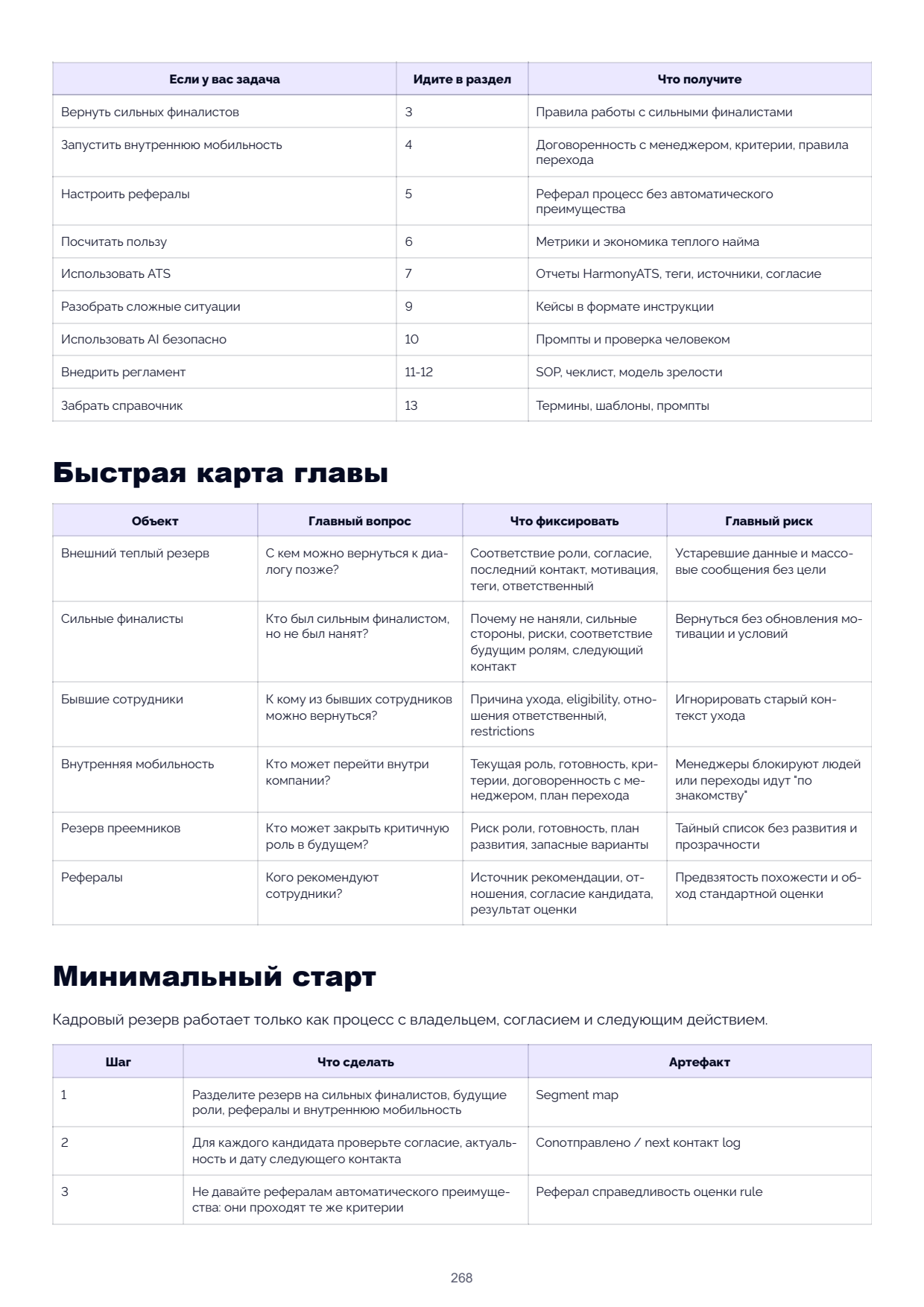
| If your task is | Go to section | What you will get |
|---|---|---|
| Understand what a talent pipeline is | 1 | Talent pipeline model as a system, not a database |
| Differentiate pipeline types | 2 | Segments: strong finalists, former employees, referrals, internal mobility, succession |
| Re-engage strong finalists | 3 | Rules for working with strong finalists |
| Launch internal mobility | 4 | Manager agreement, criteria, move rules |
| Set up referrals | 5 | Referral process without automatic advantage |
| Calculate the benefit | 6 | Metrics and economics of warm hiring |
| Use ATS | 7 | HarmonyATS reports, tags, sources, consent |
| Handle complex situations | 9 | Case studies in how-to format |
| Use AI safely | 10 | Prompts and human review |
| Implement a policy | 11–12 | SOP, checklist, maturity model |
| Get the reference guide | 13 | Terms, templates, prompts |
Minimum starting point
A talent pipeline only works as a process with an owner, consent and a next action.
| Step | What to do | Artefact |
|---|---|---|
| 1 | Divide the pipeline into strong finalists, future roles, referrals and internal mobility | Segment map |
| 2 | For each candidate, check consent, currency and the date of next contact | Consent sent / next contact log |
| 3 | Do not give referrals automatic advantage: they go through the same criteria | Referral fair assessment rule |
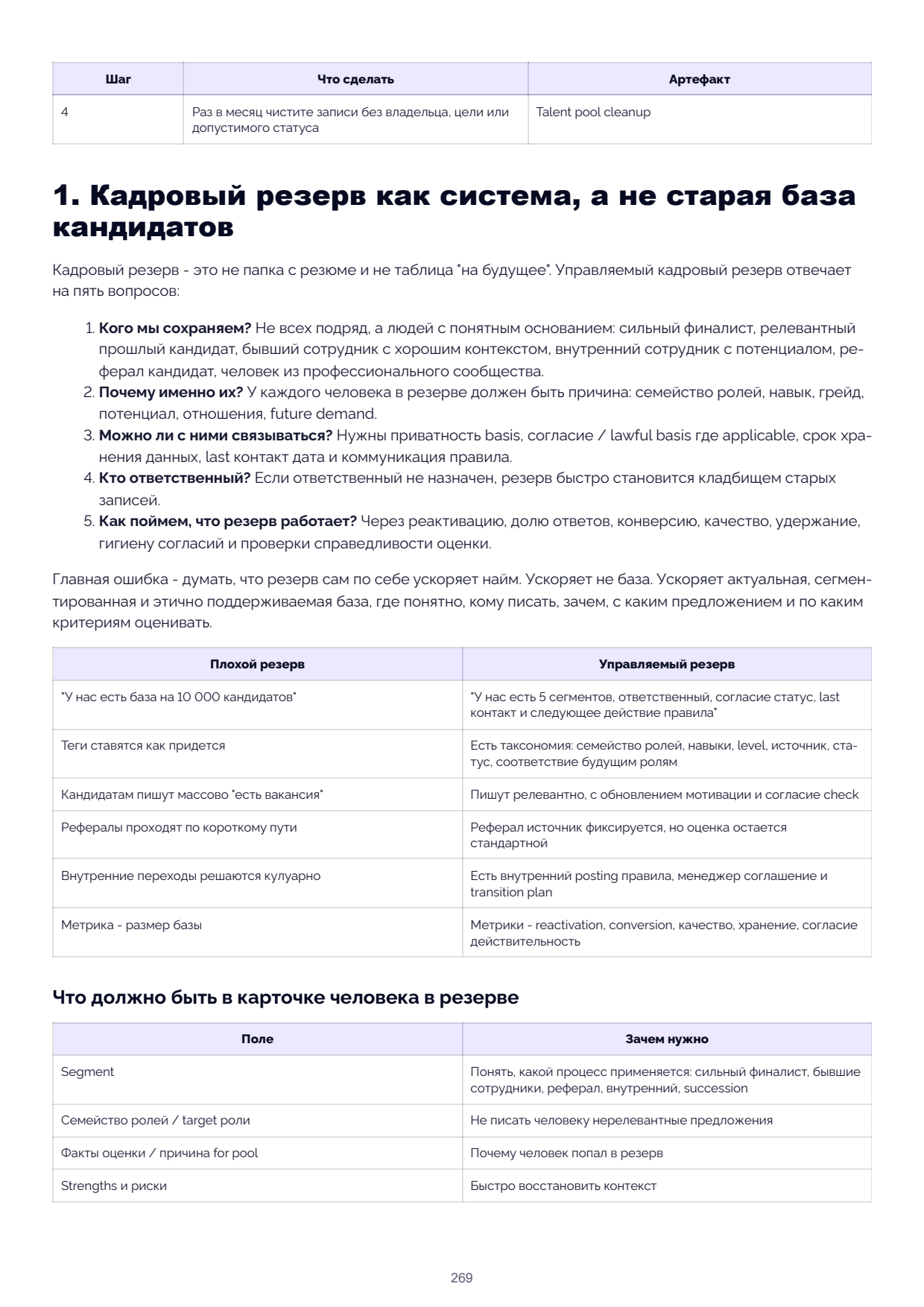
| 4 | Once a month, clean up records without an owner, purpose or permissible status | Talent pool cleanup |
1. Talent pipeline as a system, not an old candidate database
A talent pipeline is not a folder of CVs and not a "for later" spreadsheet. A managed talent pipeline answers five questions:
1. Who are we keeping?
Not everyone, but people with a clear rationale: a strong finalist, a relevant past candidate, a former employee with good context, an internal employee with potential, a referral candidate, someone from a professional network.
2. Why them?
Every person in the pipeline must have a reason: role family, skill, level, potential, relationship, future demand.
3. Can we contact them?
You need a privacy basis, consent / lawful basis where applicable, a data retention period, last contact date and communication rules.
4. Who is responsible? If no one is assigned, the pipeline quickly becomes a graveyard of old records.
5. How will we know the pipeline works?
Through reactivation, response rate, conversion, quality, retention, consent hygiene and fair assessment checks. The biggest mistake is thinking that a pipeline alone speeds up hiring. It is not the database that accelerates hiring. It is a current, segmented and ethically maintained database where it is clear whom to contact, why, with what proposition, and by what criteria to assess.
| Poor pipeline | Managed pipeline |
| "We have a database of 10,000 candidates" | "We have 5 segments, an owner, a consent status, a last contact date, and next-action rules" |
| Tags are applied haphazardly | There is a taxonomy: role family, skills, level, source, status, fit for future roles |
| Candidates receive mass messages saying "we have a vacancy" | Messages are relevant, with updated motivation and a consent check |
| Referrals go through a short-cut process | The referral source is recorded, but assessment remains standard |
| Internal moves are settled behind closed doors | There are internal posting rules, a manager agreement and a transition plan |
| The metric is database size | Metrics are reactivation, conversion, quality, retention, consent validity |
| What should be in a person's pipeline record | |
| Field | Why it is needed |
| Segment | To understand which process applies: strong finalist, former employee, referral, internal, succession |
| Role family / target roles | Not to send irrelevant offers to the person |
| Assessment facts / reason for pipeline | Why the person entered the pipeline |
| Strengths and risks | To quickly restore context |
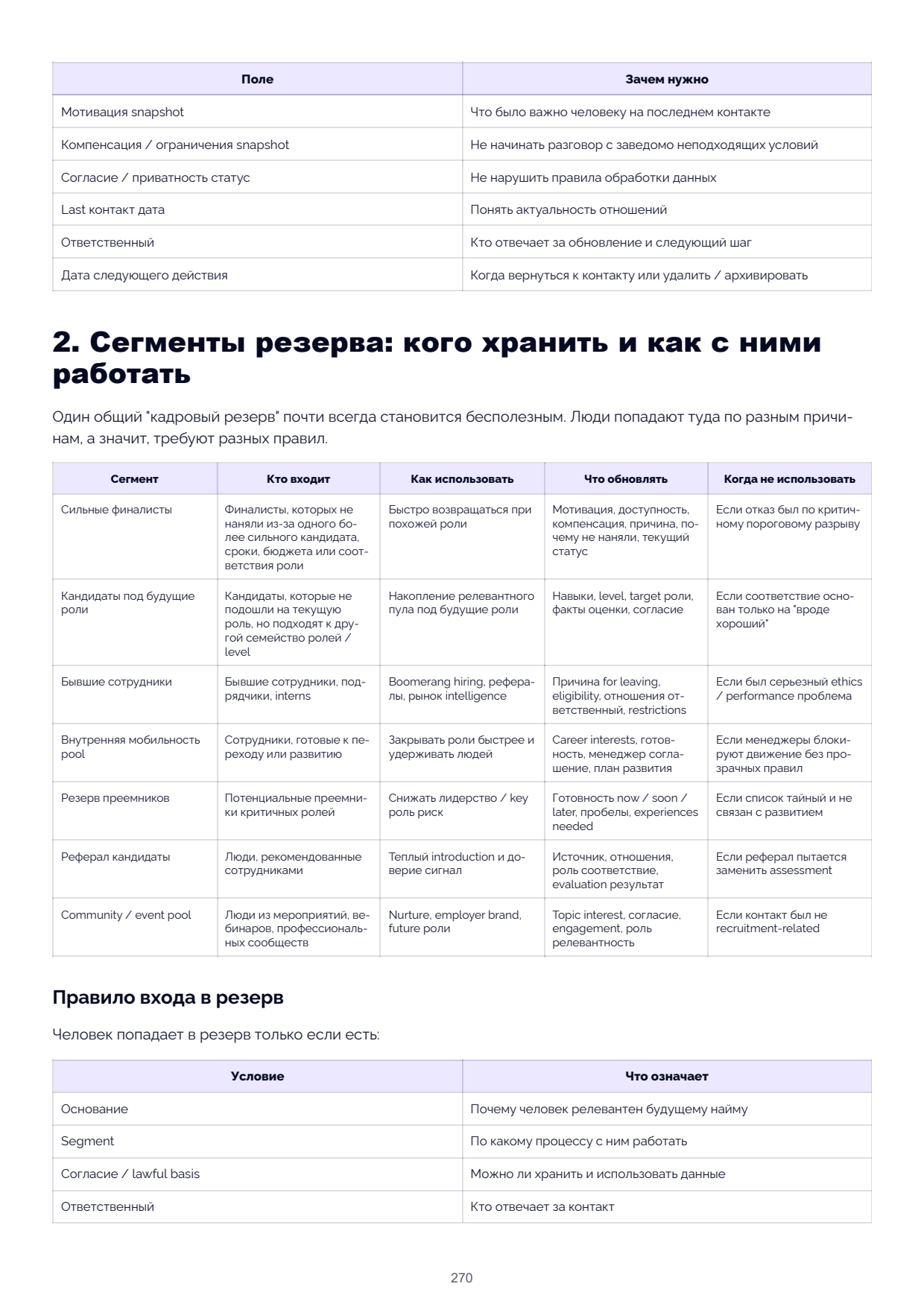
| Field | Why it is needed |
|---|---|
| Motivation snapshot | What mattered to the person at last contact |
| Compensation / constraints snapshot | Not to start the conversation with manifestly unsuitable terms |
| Consent / privacy status | Not to breach data processing rules |
| Last contact date | To understand the currency of the relationship |
| Owner | Who is responsible for updates and the next step |
| Next action date | When to return to the contact or delete / archive |
2. Pipeline segments: whom to hold and how to work with them
A single generic "talent pipeline" is almost always useless. People enter it for different reasons, which means they require different rules.
| Segment | Who it includes | How to use it | What to update | When not to use it |
| Strong finalists | Finalists who were not hired because one other candidate was stronger, or due to timing, budget, or role fit | Quickly re-engage for a similar role | Motivation, availability, compensation, reason they were not hired, current status | If there was a critical threshold gap |
| Candidates for future roles | Candidates who did not fit the current role but fit another role family / level | Build a relevant pool for future roles | Skills, level, target roles, assessment facts, consent | If the fit is based only on "seems good" |
| Former employees | Former employees, contractors, interns | Boomerang hiring, referrals, market intelligence | Reason for leaving, eligibility, relationship owner, restrictions | If there was a serious ethics / performance issue |
| Internal mobility pool | Employees ready for a move or development | Fill roles faster and retain people | Career interests, readiness, manager agreement, development plan | If managers block movement without transparent rules |
| Succession pipeline | Potential successors to critical roles | Reduce leadership / key role risk | Readiness now / soon / later, gaps, experiences needed | If the list is secret and not linked to development |
| Referral candidates | People recommended by employees | Warm introduction and trust signal | Source, relationship, role fit, assessment outcome | If the referral attempts to replace assessment |
| Community / event pool | People from events, webinars, professional networks | Nurture, employer brand, future roles | Topic interest, consent, engagement, role relevance | If the contact was not recruitment-related |
| Pipeline entry rule A person enters the pipeline only if: | ||||
| Condition | What it means | |||
| Rationale | Why the person is relevant to future hiring | |||
| Segment | Which process applies to working with them | |||
| Consent / lawful basis | Whether you may store and use their data | |||
| Owner | Who is responsible for the relationship |
Pipeline entry rule
A person enters the pipeline only if:
Condition What it means
Rationale Why the person is relevant to future hiring
Segment Which process applies to working with them
Consent / lawful basis Whether you may store and use their data
Owner Who is responsible for the relationship
| Condition | What it means |
|---|---|
| Retention rule | When to review, update or delete the data |
| Next action | What the next step will be |
If any of these fields is missing, it is not a pipeline. It is an unmanaged record.
3. Strong finalists: how to re-engage strong finalists
A strong finalist is a candidate who was strong enough for an offer or the final stage but was not selected for a reason that does not prevent future hiring. For example, the company chose another finalist with more precise experience, the role was put on hold, the budget changed, the candidate could not start within the required timeframe, or the role level turned out to be slightly above or below. Strong finalists are often the highest-quality warm segment: they already know the company, have passed part of the assessment, the team has assessment facts, and the recruiter understands the motivation. But that is precisely why they must be handled carefully: a poor rejection or irrelevant follow-up message destroys trust. When to keep a strong finalist
| Keep | Do not keep |
| The candidate is strong but another person was selected | There was a serious ethics, reliability or integrity concern |
| The gap relates to role level, not baseline ability | The scorecard showed a must-have criteria gap |
| The candidate has retained interest in the company | The candidate clearly does not want future contact |
| There is a clear fit for future roles | No role exists where their assessment facts could be a strength |
| Consent / privacy status permits future contact | No lawful basis to store or use the data |
| How to send a rejection to a strong finalist | |
| Message element | Why |
| Gratitude and respect for the process | Maintain trust |
| Honest reason without excessive detail | Do not create false expectations |
| Acknowledgement of strengths, if policy allows | Shows that the assessment was thorough |
| Offer to stay in touch | Obtain permission for future contact |
| Clear next-contact principle | Do not promise vacancies that do not exist |
| Example wording: |
Thank you for your time and the strong conversation about the role. On this occasion, we chose a candidate whose experience more closely matched the team's current needs. That said, we were interested in your experience in [area] and approach to [criteria]. If you are comfortable, we will keep the contact and return when a role arises where your experience would be a better fit for the requirements. Before any new process, we will definitely update your expectations and the currency of your interest.
Gratitude and respect for the process Maintain trust
Honest reason without excessive detail Do not create false expectations
Acknowledgement of strengths, if policy allows Shows that the assessment was thorough
Offer to stay in touch Obtain permission for future contact
Clear next-contact principle Do not promise vacancies that do not exist
Example wording:
Thank you for your time and the strong conversation about the role. On this occasion, we chose a candidate whose experience more closely matched the team's current
needs. That said, we were interested in your experience in [area] and approach to [criteria]. If you are comfortable, we will keep the contact and
return when a role arises where your experience would be a better fit for the requirements. Before any new process, we will definitely
update your expectations and the currency of your interest.
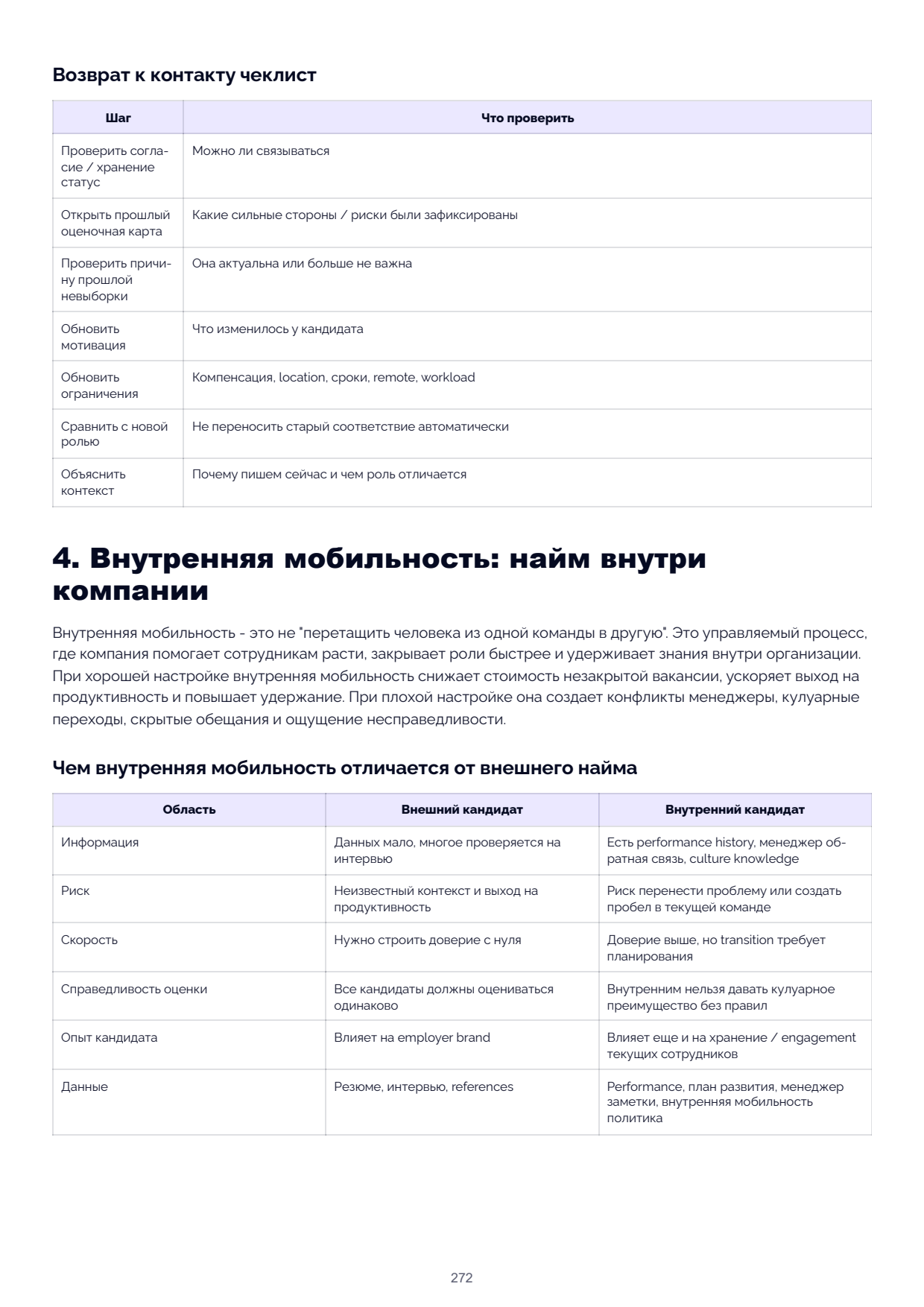
| Return-to-contact checklist | |
|---|---|
| Step | What to check |
| Check consent / retention status | May you make contact |
| Open the previous scorecard | What strengths / risks were recorded |
| Check the reason for past non-selection | Is it still relevant or no longer important |
| Update motivation | What has changed for the candidate |
| Update constraints | Compensation, location, timings, remote, workload |
| Compare with the new role | Do not carry over the old fit automatically |
| Explain the context | Why you are writing now and how the role differs |
4. Internal mobility: hiring within the company
Internal mobility is not "pulling a person from one team to another". It is a managed process where the company helps employees grow, fills roles faster and retains knowledge within the organisation. Well configured, internal mobility reduces the cost of an unfilled vacancy, accelerates time to productivity and improves retention. Poorly configured, it creates manager conflicts, backroom moves, hidden promises and a sense of unfairness. How internal mobility differs from external hiring
| Area | External candidate | Internal candidate |
| Information | Data is limited; much is verified at interview | There is a performance history, manager feedback, culture knowledge |
| Risk | Unknown context and time to productivity | Risk of transferring a problem or creating a gap in the current team |
| Speed | Trust must be built from scratch | Trust is higher, but transition requires planning |
| Fair assessment | All candidates must be assessed equally | Internal candidates must not receive preferential backroom treatment without rules |
| Candidate experience | Affects employer brand | Also affects retention / engagement of current employees |
| Data | CV, interview, references | Performance, development plan, manager notes, internal mobility policy |
4. Internal mobility: hiring within
the company
Internal mobility is not "pulling a person from one team to another". It is a managed process
where the company helps employees grow, fills roles faster and retains knowledge within the organisation.
Well configured, internal mobility reduces the cost of an unfilled vacancy, accelerates time to
productivity and improves retention. Poorly configured, it creates manager conflicts, backroom
moves, hidden promises and a sense of unfairness.
How internal mobility differs from external hiring
Area External candidate Internal candidate
Information Data is limited; much is verified at There is a performance history, manager
interview feedback, culture knowledge
Risk Unknown context and time to Risk of transferring a problem or creating
productivity a gap in the current team
Speed Trust must be built from scratch Trust is higher, but transition requires
planning
Fair assessment All candidates must be assessed Internal candidates must not receive
equally preferential backroom treatment without rules
Candidate experience Affects employer brand Also affects retention / engagement of
current employees
Data CV, interview, references Performance, development plan, manager
notes, internal mobility policy
Manager agreement
Internal mobility does not work if every manager can quietly block a strong employee.
But it also does not work if people are moved without accounting for the current team's obligations. There needs to be a
manager agreement: rules on when an employee may apply, who sees the application, how assessment is conducted, when the
current manager is involved, and how the transition is planned.
Rule Recommendation
Eligibility Minimum time in role, performance status, absence of
critical unresolved issues
Transparency The employee understands when the current manager will be
notified
Assessment Internal candidates are assessed against role criteria, not by
reputation
Transition There is a handover period and a designated owner
No retaliation The manager does not penalise the person for showing interest
in a move
Documentation The decision is recorded as a hiring decision, not a backroom
arrangement
Internal mobility scorecard
Criteria What to check Assessment facts Common error
Role readiness Is the person ready to perform Past performance, work sample, Assuming a good employee in one role
the duties of the new role interview, manager feedback is automatically good in another
Motivation Why they want to move Career goals, role realism, Accepting the desire to leave their
energy for new work current manager as motivation
for the new role
Transfer risk What will the current team lose Coverage plan, handover, timelines Ignoring the cost of backfill
Growth potential What can be developed in 30–90 Development assessment facts, Promising growth without capacity
days manager development plan
Fair assessment Was access to the opportunity Internal posting, criteria, Giving a chance only to "insiders"
transparent transparent evaluation notes
5. Succession pipeline: a pipeline for critical
roles
The succession pipeline is needed for roles whose departure creates significant risk: leadership, key client
portfolios, critical operations, financial control, architectural responsibility, security, rare
expertise. This is not a list of "favourites" or a secret successor board. It is a risk-reduction loop: which roles
are critical, who may be ready now, soon or later, what gaps need to be closed and what experience will help
a person grow.
Difference between succession planning and backfill planning
Backfill planning Succession planning
"Who will replace the person if they leave tomorrow?" "How do we develop people for future critical roles?"
| Backfill planning | Succession planning | |
|---|---|---|
| Narrow emergency focus | Development and risk-management focus | |
| Often a secret list | Must be linked to development conversations | |
| Can be reactive | Requires regular review | |
| Succession readiness | ||
| Readiness | What it means | How to act |
| Ready now | Can fill the role with minimal support | Check motivation, transition risk, compensation, stakeholder trust |
| Ready soon | Can fill the role within 3–12 months of development | Assign stretch assignments, mentoring, exposure, feedback |
| Ready later | Has potential but needs significant growth | Development plan and periodic review |
| Emergency backup | Can temporarily cover the critical function | Prepare working guides and handover docs |
| Succession pipeline risks | ||
| Risk | How to mitigate | |
| Secret list without transparency | Separate confidential risk planning from transparent development principles | |
| Similarity bias | Assess against criteria, not the current leader's style | |
| Manager hoarding | Make talent mobility part of managerial accountability | |
| False promise | Do not promise a role; discuss development and readiness | |
| Single successor | Plan multiple scenarios: internal, external, interim |
6. Referrals: a warm introduction is not an automatic advantage
A referral is a recommendation of a candidate by an employee or trusted contact. A good referral accelerates trust, provides context and may improve response rates. But a referral does not prove that the candidate is a good fit. It only explains why the person is worth talking to. The key rule: the referral source is recorded but does not affect assessment against role criteria. What a referral does and does not give you
| A referral gives you | A referral does not give you |
| A warm introduction | Automatic passage through screening |
| Relationship context | Confirmation of professional skills |
| A higher chance of a response | A guarantee of motivation |
| An additional source of information | The right to bypass the scorecard |
| A referral gives you | A referral does not give you | |
|---|---|---|
| A trust signal toward the referrer | A basis for ignoring fair assessment | |
| Referral process | ||
| Step | What the recruiter / HR does | What the referrer does |
| Referral intake | Checks role fit, consent, duplicate profile, conflict of interest | Explains the relationship and context |
| Candidate contact | Sends a transparent message to the candidate | May make a warm introduction if the candidate agrees |
| Screening | Applies standard criteria | Is not present at assessment unless needed |
| Interview | The candidate goes through the same process | Does not pressure the interviewers |
| Decision | Decision based on the scorecard | Receives status per programme rules |
| Reward | Bonus paid per rules | Understands eligibility conditions |
7. Personal data, consent and retention
A talent pipeline almost always involves personal data. Different countries have different rules on processing, storage, consent, deletion and candidate rights. In the EU, GDPR applies; in many CIS countries and other regions there are also their own rules. This chapter is not legal advice, so the practical rule is: store only what is needed, with a clear purpose, a limited retention period, role-based access and the ability to delete / update data per company policy.
Privacy by default for the pipeline
Principle How to apply
Purpose limitation Do not store "just in case"; record the purpose: future roles,
referrals, former employees, internal mobility
Data minimisation Do not collect unnecessary data; do not store sensitive details
in notes
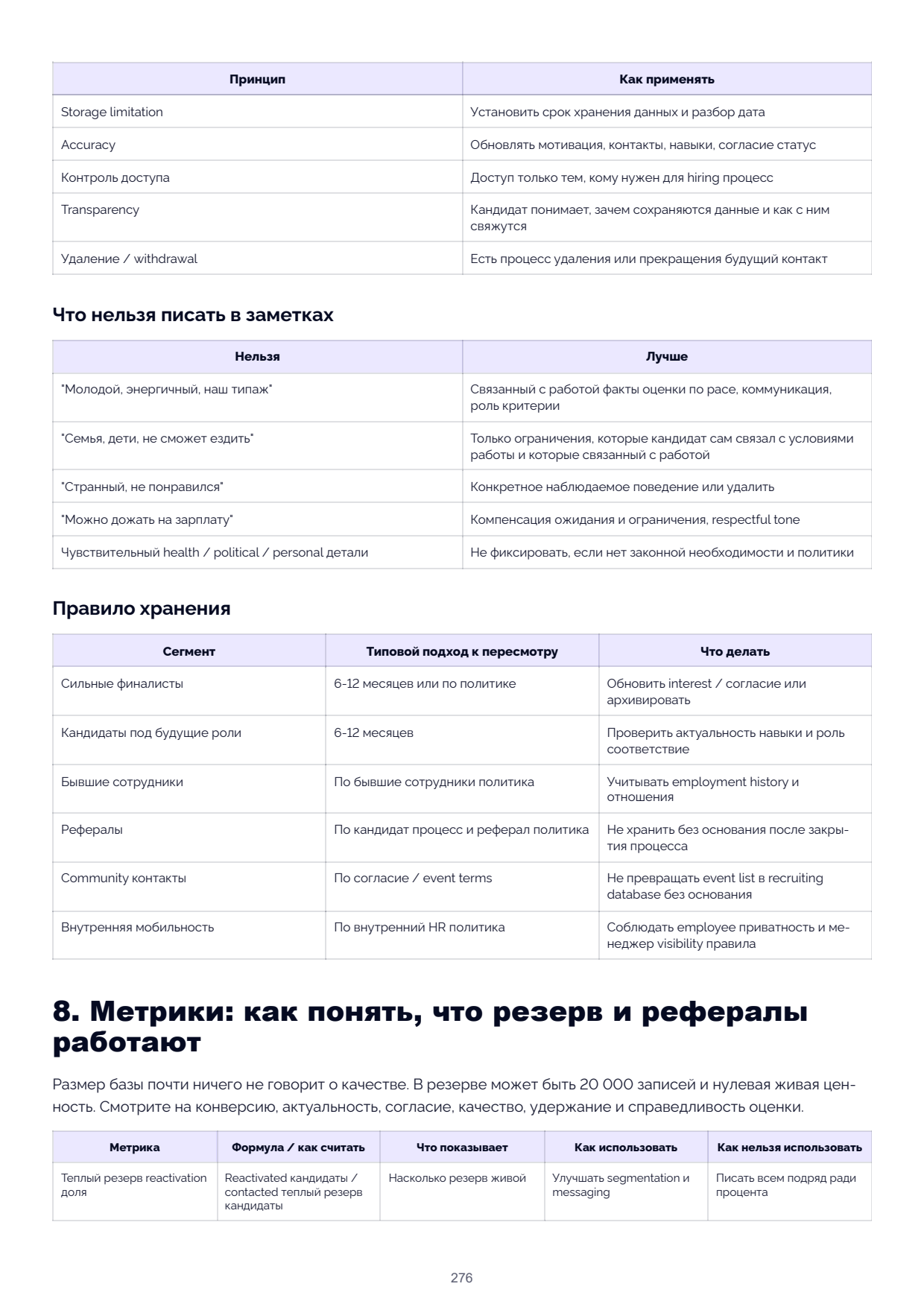
Principle How to apply
Storage limitation Set a data retention period and review date
Accuracy Keep motivation, contacts, skills, consent status current
Access control Restrict access to those who need it for the hiring process
Transparency The candidate understands why data is held and how they
will be contacted
Deletion / withdrawal There is a process for deleting or ceasing future contact
What you must not write in notes
Do not write Better to write
"Young, energetic, our type" Work-related assessment facts on pace, communication,
role criteria
"Family, children, cannot travel" Only constraints the candidate themselves linked to working
conditions and which are work-related
"Odd, didn't like them" Specific observable behaviour, or delete
"Can squeeze them on salary" Compensation expectations and constraints, respectful tone
Sensitive health / political / personal details Do not record unless there is a lawful necessity and policy
Retention rules
| Segment | Typical review approach | What to do |
|---|---|---|
| Strong finalists | 6–12 months or per policy | Update interest / consent or archive |
| Candidates for future roles | 6–12 months | Check currency of skills and role fit |
| Former employees | Per former-employee policy | Account for employment history and relationships |
| Referrals | Per candidate process and referral policy | Do not retain without a rationale after the process closes |
| Community contacts | Per consent / event terms | Do not turn an event list into a recruiting database without a rationale |
| Internal mobility | Per internal HR policy | Observe employee privacy and manager visibility rules |
8. Metrics: how to tell whether the pipeline and referrals
are working
Database size tells you almost nothing about quality. A pipeline may have 20,000 records and zero living value. Look at conversion, currency, consent, quality, retention and fair assessment.
Metric Formula / how to calculate What it shows How to use it How not to use it
Warm pipeline reactivation Reactivated candidates / Improving segmentation Warm pipeline messaging percentage of contacted warm pipeline candidates
| Metric | Formula / how to calculate | What it shows | How to use it | How not to use it |
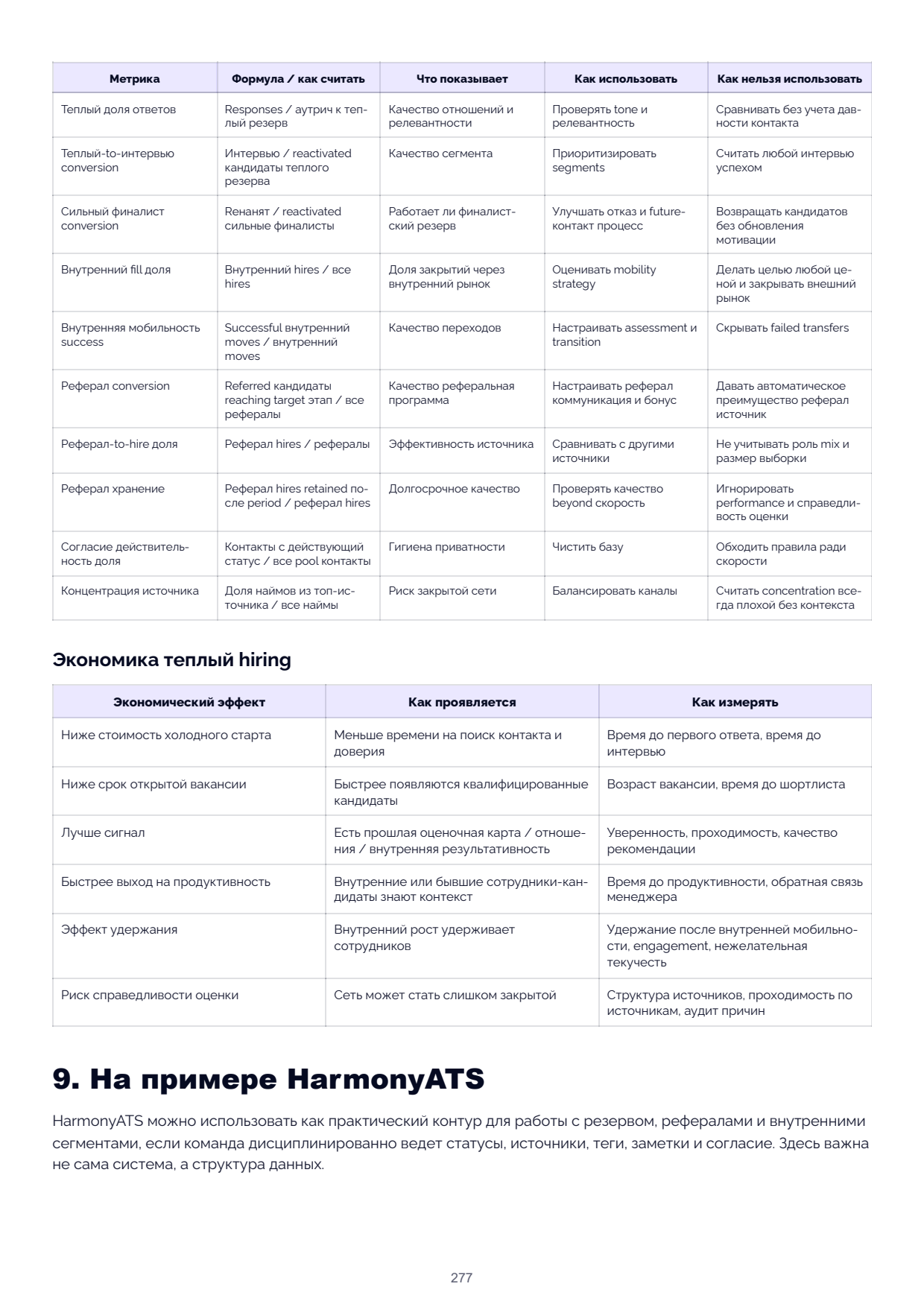
|---|---|---|---|---|
| Warm response rate | Responses / outreach to warm pipeline | Quality of relationships and relevance | Check tone and relevance | Compare without accounting for contact age |
| Warm-to-interview conversion | Interviews / reactivated warm pipeline candidates | Segment quality | Prioritise segments | Count any interview as a success |
| Strong finalist conversion | Rehired / reactivated strong finalists | Whether the finalist pipeline works | Improve the rejection and future-contact process | Re-engage candidates without updating motivation |
| Internal fill rate | Internal hires / all hires | Share of fills through the internal market | Evaluate the mobility strategy | Make it a target at any cost and shut out the external market |
| Internal mobility success | Successful internal moves / internal moves | Quality of transitions | Tune assessment and transition | Hide failed transfers |
| Referral conversion | Referred candidates reaching target stage / all referrals | Referral programme quality | Tune referral communication and bonus | Give automatic advantage to a referral source |
| Referral-to-hire rate | Referral hires / referrals | Source effectiveness | Compare with other sources | Ignore role mix and sample size |
| Referral retention | Referral hires retained after period / referral hires | Long-term quality | Check quality beyond speed | Ignore performance and fair assessment |
| Consent validity rate | Contacts with current status / all pipeline contacts | Privacy hygiene | Clean the database | Bend the rules for speed |
| Source concentration | Share of hires from top source / all hires | Closed-network risk | Balance channels | Assume concentration is always bad without context |
| Warm hiring economics | ||||
| Economic effect | How it manifests | How to measure | ||
| Lower cold-start cost | Less time to find contact and build trust | Time to first response, time to interview | ||
| Shorter vacancy duration | Qualified candidates appear faster | Vacancy age, time to shortlist | ||
| Better signal | There is a past scorecard / relationship / internal performance data | Confidence, pass-through, quality of recommendation | ||
| Faster time to productivity | Internal or former employee candidates know the context | Time to productivity, manager feedback | ||
| Retention effect | Internal growth retains employees | Retention after internal mobility, engagement, regretted attrition | ||
| Fair assessment risk | The network can become too closed | Source structure, pass-through by source, reason audit |
9. Using HarmonyATS
HarmonyATS can serve as a practical loop for working with the pipeline, referrals and internal segments, provided the team maintains statuses, sources, tags, notes and consent with discipline. What matters here is not the system itself, but the data structure.
Referral retention Referral hires retained Long-term quality Check quality beyond Ignore performance
after period / referral hires speed and fair assessment
Consent validity rate Contacts with current status Privacy hygiene Clean the database Bend the rules for
/ all pipeline contacts speed
Source concentration Share of hires from top Closed-network risk Balance channels Assume concentration
source / all hires is always bad without context
Warm hiring economics
Economic effect How it manifests How to measure
Lower cold-start cost Less time to find contact and Time to first response, time to
build trust interview
Shorter vacancy duration Qualified candidates appear Vacancy age, time to shortlist
faster
Better signal There is a past scorecard / Confidence, pass-through, quality of
relationship / internal performance data recommendation
Faster time to productivity Internal or former employee Time to productivity, manager
candidates know the context feedback
Retention effect Internal growth retains Retention after internal mobility,
employees engagement, regretted attrition
Fair assessment risk The network can become too Source structure, pass-through by
closed source, reason audit
9. Using HarmonyATS
HarmonyATS can serve as a practical loop for working with the pipeline, referrals and internal
segments, provided the team maintains statuses, sources, tags, notes and consent with discipline. What
matters here is not the system itself, but the data structure.
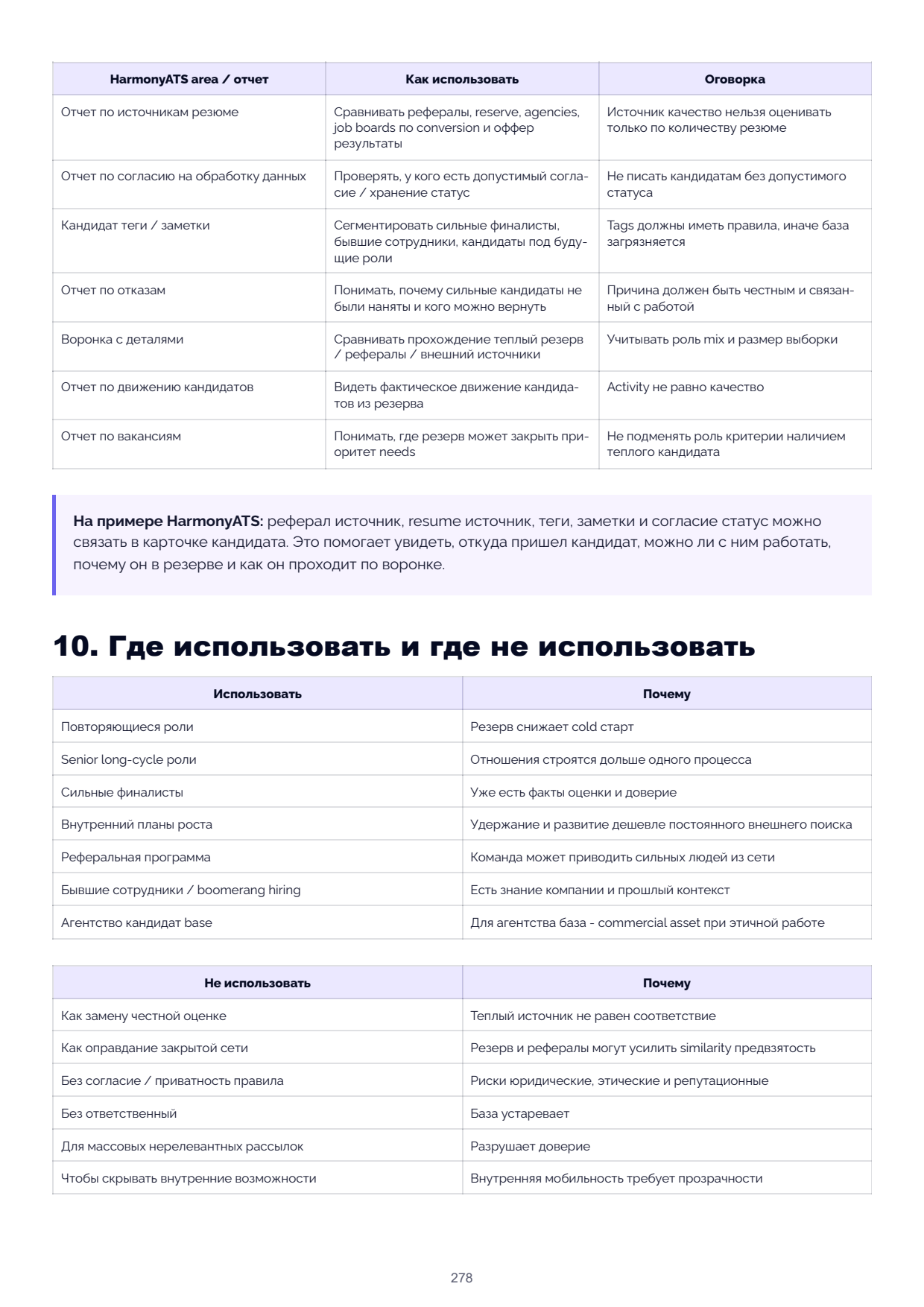
| HarmonyATS area / report | How to use it | Caveat |
|---|---|---|
| CV source report | Compare referrals, pipeline, agencies, job boards by conversion and offer outcomes | Source quality cannot be judged by volume of CVs alone |
| Data consent report | Check who has a valid consent / retention status | Do not contact candidates without a valid status |
| Candidate tags / notes | Segment strong finalists, former employees, candidates for future roles | Tags must have rules, otherwise the database becomes polluted |
| Rejection report | Understand why strong candidates were not hired and whom you can re-engage | The reason must be honest and work-related |
| Funnel with detail | Compare passage through warm pipeline / referrals / external sources | Account for role mix and sample size |
| Candidate movement report | See actual candidate movement from the pipeline | Activity does not equal quality |
| Vacancy report | Understand where the pipeline can close priority needs | Do not substitute role criteria with the availability of a warm candidate |
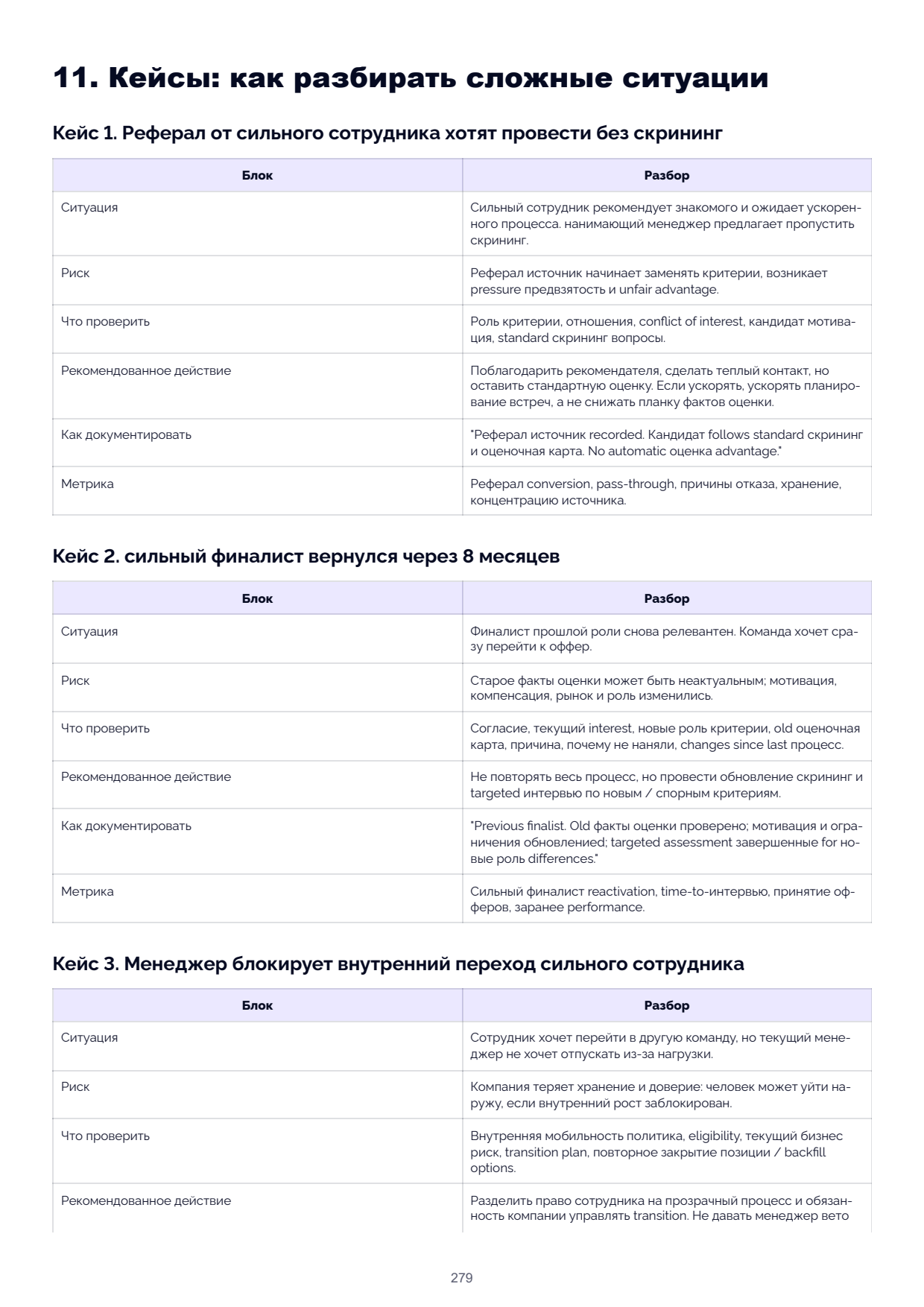
11. Case studies: how to handle complex situations
Case 1. A referral from a strong employee is pushed through without screening
Block Analysis
Situation A strong employee recommends someone they know and expects an accelerated process. The hiring manager suggests skipping screening.
Risk The referral source begins to replace criteria, creating pressure, bias and unfair advantage.
What to check Role criteria, relationship, conflict of interest, candidate motivation, standard screening questions.
Recommended action Thank the referrer, make a warm contact, but keep the standard assessment. If you accelerate, accelerate scheduling of meetings, not the lowering of assessment standards.
How to document "Referral source recorded. Candidate follows standard screening and scorecard. No automatic assessment advantage."
Metric Referral conversion, pass-through, rejection reasons, retention, source concentration.
Case 2. A strong finalist returns after 8 months
Block Analysis
Situation A finalist from a past role is relevant again. The team wants to move straight to an offer.
Risk Old assessment facts may be outdated; motivation, compensation, market and the role have changed.
What to check Consent, current interest, new role criteria, old scorecard, reason for non-hire, changes since the last process.
Recommended action Do not repeat the entire process, but conduct an updated screening and targeted interview on new / disputed criteria.
How to document "Previous finalist. Old assessment facts verified; motivation and constraints updated; targeted assessment completed for new role differences."
Metric Strong finalist reactivation, time-to-interview, offer acceptance, prior performance.
Case 3. A manager blocks an internal move by a strong employee
Block Analysis
Situation An employee wants to move to another team, but the current manager does not want to let them go due to workload.
Risk The company loses retention and trust: the person may leave externally if internal growth is blocked.
What to check Internal mobility policy, eligibility, current business risk, transition plan, backfill / replacement options.
Recommended action Separate the employee's right to a transparent process from the company's obligation to manage the transition. Do not give the manager a veto
| Block | Analysis |
|---|---|
| without a business rationale and escalation. | |
| How to document | "Internal candidate eligible. Current manager impact recorded. Transition plan mandatory if selected. Decision based on role criteria, not manager preference." |
| Metric | Internal applications, internal fill rate, blocked moves, regretted attrition. |
| Case 4. The talent pipeline is stale and dangerous for outreach | |
| Block | Analysis |
| Situation | The ATS has a large database of past candidates, but it is unclear who has current data and consent. |
| Risk | Mass outreach may breach privacy rules and damage employer brand. |
| What to check | Consent status, last contact date, retention policy, source, purpose, unsubscribe / deletion process. |
| Recommended action | Run a pipeline cleanup: segments, valid consent, archive/delete, update campaigns only for eligible contacts. |
| How to document | "Warm pipeline cleanup completed: eligible / update needed / archived. No outreach without a valid status." |
| Metric | Consent validity rate, stale contacts, response rate, complaints / unsubscribes. |
| Case 5. The referral programme delivers quick hires but the network becomes closed | |
| Block | Analysis |
| Situation | Referrals produce many hires, but most come from one social / professional network. |
| Risk | Similarity bias, reduced diversity of thought, limited access to opportunities. |
| What to check | Source concentration, pass-through by source, rejection reasons, role family, retention, fair assessment review where permitted. |
| Recommended action | Do not shut down referrals, but add source-mix targets, equal assessment, broader communities and transparent communication. |
| How to document | "Referral source is effective but concentrated. We retain standard assessment, broaden the source mix and audit results further down the funnel." |
| Metric | Referral source concentration, conversion, quality proxy, retention, source mix. |
| Case 6. A former employee candidate wants to return | |
| Block | Analysis |
| Situation | A former employee wants to return to a new role after 1–2 years outside the company. |
| Block | Analysis |
|---|---|
| Risk | The team remembers the old person, but the role, company and motivation have changed. There may also be unresolved context from their previous employment. |
| What to check | Reason for leaving, performance history, rehire eligibility, new motivation, role criteria, manager relationships, compensation expectations. |
| Recommended action | Use the past context as input, not as a final decision. Run a structured re-engagement process. |
| How to document | "Former employee candidate: prior context verified, rehire eligibility checked, new role criteria assessed, current motivation updated." |
| Metric | Former employee rehire conversion, time to productivity, retention, manager satisfaction. |
12. SOP: how to implement the pipeline, internal
mobility and referrals
SOP: talent pipeline management
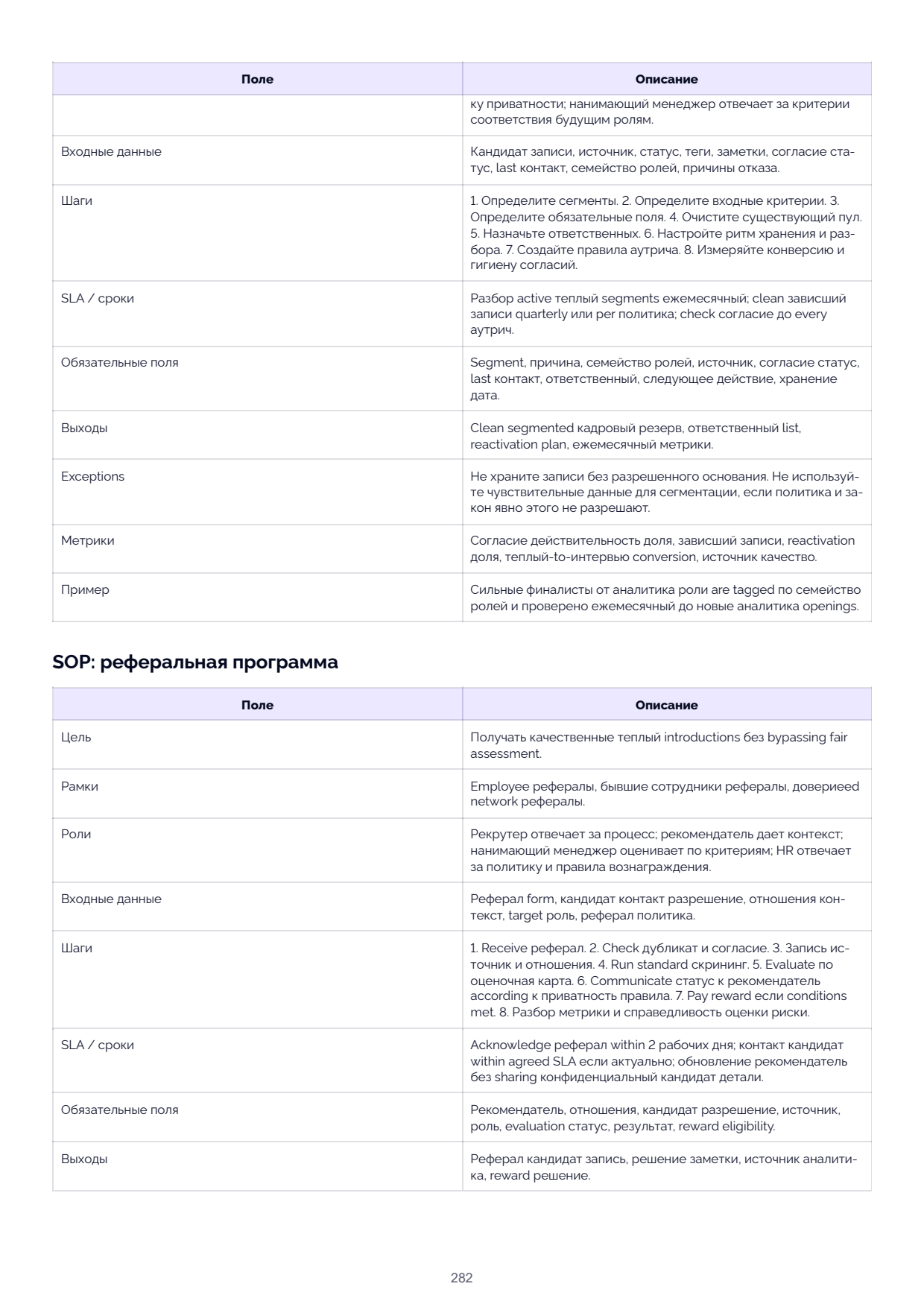
Field Description
Purpose Make the talent pipeline managed, current, privacy-safe and useful for hiring.
Scope External warm pipeline, strong finalists, candidates for future roles, former employees, referrals, community contacts. Internal employees follow the internal mobility policy.
Roles The recruitment lead owns the taxonomy; the recruiter owns the candidate segment; HR / legal own the privacy policy; the hiring manager owns future-role fit criteria.
| Field | Description |
|---|---|
| The recruitment lead owns the taxonomy; the recruiter owns the candidate segment; HR / legal own the privacy policy; the hiring manager owns future-role fit criteria. | |
| Inputs | Candidate records, source, status, tags, notes, consent status, last contact, role family, rejection reasons. |
| Steps | 1. Define segments. 2. Define entry criteria. 3. Define mandatory fields. 4. Clean the existing pool. 5. Assign owners. 6. Set a retention and review rhythm. 7. Create outreach rules. 8. Measure conversion and consent hygiene. |
| SLA / timeframes | Review active warm segments monthly; clean stale records quarterly or per policy; check consent before every outreach. |
| Mandatory fields | Segment, rationale, role family, source, consent status, last contact, owner, next action, retention date. |
| Outputs | Clean segmented talent pipeline, owner list, reactivation plan, monthly metrics. |
| Exceptions | Do not keep records without a permitted rationale. Do not use sensitive data for segmentation unless policy and law explicitly permit it. |
| Metrics | Consent validity rate, stale records, reactivation rate, warm-to-interview conversion, source quality. |
| Example | Strong finalists for an analyst role are tagged by role family and reviewed monthly against new analyst openings. |
| SOP: referral programme | |
| Field | Description |
| Purpose | Obtain quality warm introductions without bypassing fair assessment. |
| Scope | Employee referrals, former employee referrals, trusted-network referrals. |
| Roles | The recruiter owns the process; the referrer provides context; the hiring manager assesses against criteria; HR owns the policy and reward rules. |
| Inputs | Referral form, candidate contact permission, relationship context, target role, referral policy. |
| Steps | 1. Receive referral. 2. Check for duplicates and consent. 3. Record source and relationship. 4. Run standard screening. 5. Assess against the scorecard. 6. Communicate status to the referrer in accordance with privacy rules. 7. Pay reward if conditions are met. 8. Review metrics and fair assessment risks. |
| SLA / timeframes | Acknowledge referral within 2 working days; contact candidate within agreed SLA if applicable; update the referrer without sharing confidential candidate details. |
| Mandatory fields | Referrer, relationship, candidate permission, source, role, assessment status, result, reward eligibility. |
| Outputs | Referral candidate record, decision notes, source analytics, reward decision. |
| Field | Description |
|---|---|
| Exceptions | Conflicts of interest, direct reporting lines, family relationships or sensitive cases require review with HR. |
| Metrics | Referral conversion, referral-to-hire, referral retention, source concentration, rejection reasons. |
| Example | A strong employee refers a friend. The recruiter logs the referral, runs normal screening, the candidate advances because criteria are confirmed, not because the source is strong. |
| SOP: internal mobility | |
| Field | Description |
| Purpose | Give employees a transparent path to internal roles and protect business continuity. |
| Scope | Internal applications, role changes, cross-functional transfers, succession-related moves. |
| Roles | The employee owns their interest; the hiring manager owns role criteria; the current manager owns transition facts; the HRBP owns the policy; the designated recruitment/talent lead coordinates the process. |
| Inputs | Role scorecard, employee profile, performance assessment facts approved by policy, mobility policy, manager agreement, transition constraints. |
| Steps | 1. Publish the role and eligibility conditions. 2. The candidate expresses interest. 3. Confirm policy and manager visibility. 4. Assess against role criteria. 5. Review transition risk. 6. Make a decision. 7. Communicate the outcome respectfully. 8. Create a transition plan if the candidate is selected. |
| SLA / timeframes | Internal candidates receive a response within the stated candidate SLA. The transition plan should be agreed before announcement. |
| Mandatory fields | Role, criteria, employee interest, current role, eligibility, assessment notes, decision, transition owner, date. |
| Outputs | Internal candidate decision, transition plan, development feedback if not selected. |
| Exceptions | Critical business continuity or unresolved performance issues may affect timeframes, but require a documented rationale and HR review. |
| Metrics | Internal fill rate, internal applicant experience, blocked moves, transition success, retention after move. |
| Example | A CSM applies for an implementation role. The hiring manager assesses project planning and client communication; the current manager provides transition constraints; the HRBP coordinates the move. |
| 13. Implementation plan and maturity model 1 day | |
| Action | Result |
| Define 4–6 pipeline segments | The pipeline stops being a single undifferentiated pile |
Example: A CSM applies for an implementation role. The hiring manager
assesses project planning and client communication; the current
manager provides transition constraints; the HRBP coordinates the move.
13. Implementation plan and maturity model
1 day
Action Result
Define 4–6 pipeline segments The pipeline stops being a single undifferentiated pile