Appendix E. End-to-End Cases
Use these cases as learning starters. They help you see how the same method changes for different roles.
E1. Backend Engineer for B2B SaaS
| Element | Example |
|---|---|
| Business problem | Strengthen the team responsible for the reliability of the payment or transaction circuit. |
| Mandatory work | Designing backend services, working with load, incidents, observability, and data quality. |
| Observable signs | Mentions of distributed systems, reliability, observability, high-load, transaction processing, PostgreSQL, and Kafka. |
| Donor companies | B2B SaaS, fintech infrastructure, billing, logistics platforms, and marketplace core teams. |
| Risk | The profile may be strong on the stack but lack ownership of the production zone. |
| Message angle | Not “we have an interesting vacancy,” but “the role is about reliability and scaling a critical circuit.” |
| Primary evaluation criterion | Facts about service ownership, incident response, performance, and architectural decisions. |
How to apply across the chapters:
- In the brief, clarify what “senior” means: service ownership, architecture, mentoring, or delivery speed.
- In the portrait, separate the language of technology from the work actually performed.
- In the market map, look not only at direct competitors but also at teams with a similar operational load.
- In the message, speak about the technical problem, not just the stack.
- In the evaluation, do not infer fit from the company name alone without facts about the person’s role.
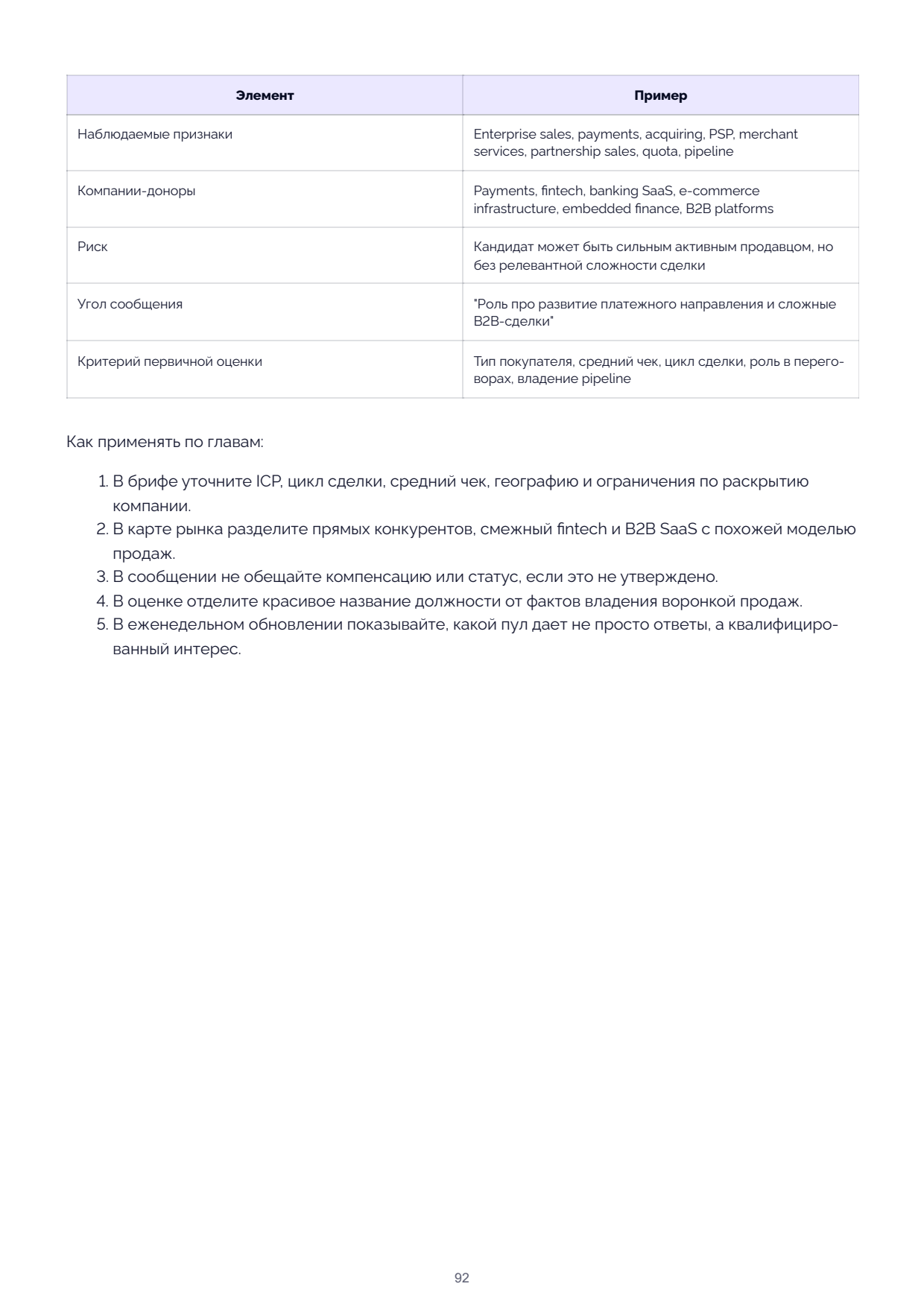
E2. BDM for B2B SaaS payments
| Element | Example |
|---|---|
| Business problem | Open or strengthen sales of a payment product in the B2B segment. |
| Mandatory work | Complex product sales, a long cycle, several stakeholders, and an understanding of the payments or fintech environment. |
| Observable signs | Enterprise sales, payments, acquiring, PSP, merchant services, partnership sales, quota, and pipeline. |
| Donor companies | Payments, fintech, banking SaaS, e-commerce infrastructure, embedded finance, and B2B platforms. |
| Risk | The candidate may be a strong active seller but without relevant deal complexity. |
| Message angle | “The role is about growing the payments direction and handling complex B2B deals.” |
| Primary evaluation criterion | Buyer type, average deal size, sales cycle, role in negotiations, and pipeline ownership. |
How to apply across the chapters:
- In the brief, clarify the ICP, sales cycle, average deal size, geography, and disclosure constraints.
- In the market map, separate direct competitors, adjacent fintech, and B2B SaaS companies with a similar sales model.
- In the message, do not promise compensation or status unless it is approved.
- In the evaluation, separate a polished title from actual ownership of the sales pipeline.
- In the weekly update, show which pool brings not just responses but qualified interest.