Harmony HR
01 1. Sourcing as a System02 2. The Client Brief Before Search03 3. Candidate Portrait04 4. Market Map05 5. Boolean, X-Ray06 6. LinkedIn07 7. Beyond LinkedIn08 8. GitHub and Technical Traces09 9. First Contact10 10. Candidate Evaluation11 11. Working with Clients12 12. Metrics13 13. Tools and AI14 14. Operational Model15 15. Practical Exercises
A Materials NavigatorB Mini GlossaryC RegulationsD Template LibraryE End-to-End CasesF Data, AI, PrivacyG AI Prompt Library
Home/Chapter 10

Chapter 10. Candidate Evaluation


pp. 51–54
Candidate evaluation
Candidate evaluationA structure for turning profile review into defensible evaluation.
Profile evaluation
Profile evaluationA compact way to assess profile quality before passing candidates forward.

Evidence note: structured methods linked to job performance are usually more reliable than informal "gut feel" evaluation. See Schmidt and Hunter: doi:10.1037/0033-2909.124.2.262, and the update by Schmidt, Oh, and Shaffer: doi:10.1111/peps.12164.

How to Use This Chapter

Use this chapter before passing the candidate onward. Its purpose is to turn the profile, message, and screening call notes into a structured evaluation with facts, uncertainties, and a clear recommendation.

Remember in One Phrase

A candidate evaluation should show which fact supports the decision, which risk remains, and who needs to verify the uncertainty.

If Your Task IsGo to SectionWhat You Get
Evaluate a profile before contacting the candidateCandidate relevance mapUniform criteria for decision-making
Record a screening call without chaosCall notes templateA structure for facts and questions
Prepare for calibrationCalibration questionsThe conversation is about criteria, not taste
Reduce bias riskEvaluation bias protectionBoundaries of honest evaluation

Quick Chapter Map

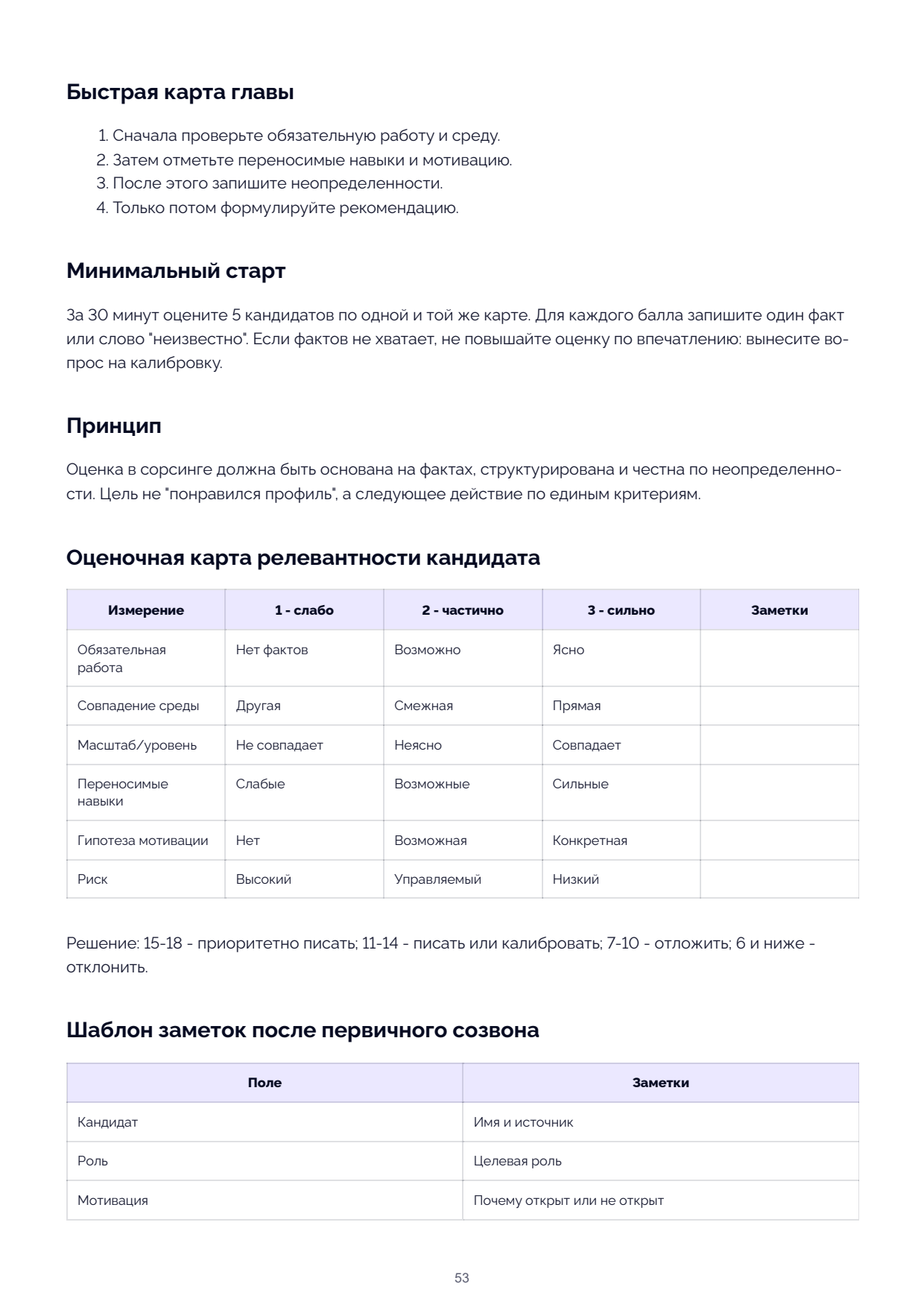
1. First, check mandatory requirements and environment.

2. Then note transferable skills and motivation.

3. After that, record uncertainties.

4. Only then formulate the recommendation.

Minimal Start

In 30 minutes, evaluate five candidates using the same map. For each score, write one fact or the word "unknown." If facts are insufficient, do not raise the score based on impression: flag the question for calibration.

Principle

Evaluation in sourcing must be fact-based, structured, and honest about uncertainty. The goal is not "I liked the profile" but the next action based on uniform criteria.

Candidate Relevance Map

Dimension 1 – Weak 2 – Partial 3 – Strong Notes

Mandatory No facts Possibly Clear

requirements

Environment match Different Adjacent Direct

Scale/level Does not match Unclear Matches

Transferable Weak Possible Strong

skills

Motivation hypothesis None Possible Specific

Risk High Manageable Low

Decision: 15–18 – priority outreach; 11–14 – outreach or calibrate; 7–10 – defer; 6 and below – reject.

Screening Call Notes Template

Field Notes

Candidate Name and source

Role Target role

Motivation Why open or not open

FieldNotes
Mandatory indicatorsSpecific examples
Transferable experienceAdjacent examples
GapsKnown gaps
Compensation/locationExpectations
Questions for the clientCalibration points
RecommendationAdvance, defer, reject, calibrate

Calibration Questions

What facts make the profile relevant or irrelevant?

Is this a blocking gap or a training issue?

Would you interview this candidate if they came via referral?

Which profile is closer to the quality bar: A or B, and why?

What would you change in the next iteration?

Evaluation Bias Protection

Do not use school/university, age, photo, gender, nationality, or name as a substitute for quality evaluation.

Do not overvalue well-known companies without work-related facts.

Do not reject career gaps without context.

Use the same criteria for everyone.

Mark uncertainty explicitly.

AI Prompts for This Chapter

The full prompt for structuring an evaluation is in Appendix G.7. AI can help bring notes to a uniform format, but the decision is made by a human based on pre-agreed criteria and facts.

Key Takeaways / Where to Go Next

Take away the evaluation map as a shared language for the team. If the decision hinges not on the candidate but on client feedback, requirements, or speed, move to Chapter 11.

Page 51 Page 52 Page 53 Page 54