Chapter 05. Boolean, X-Ray, and Query Iteration


How to use this chapter
Read this chapter as an iteration guide, not as an attempt to craft one perfect query. A good Boolean query appears after several small tests and a change log.
Remember in one phrase
A query is good not when it looks clever, but when testing shows more relevant profiles and less manageable noise.
If you have a task
| If you have a task | Go to section | What you get |
|---|---|---|
| Understand the basics | Boolean basics | Simple AND/OR/NOT rules |
| Build a first query | Boolean query worksheet | A query structure from titles, skills, and domain |
| Search through a search engine | X-Ray search principle | An alternative way to find profiles |
| Improve queries | Query testing log | Data for the next iteration |
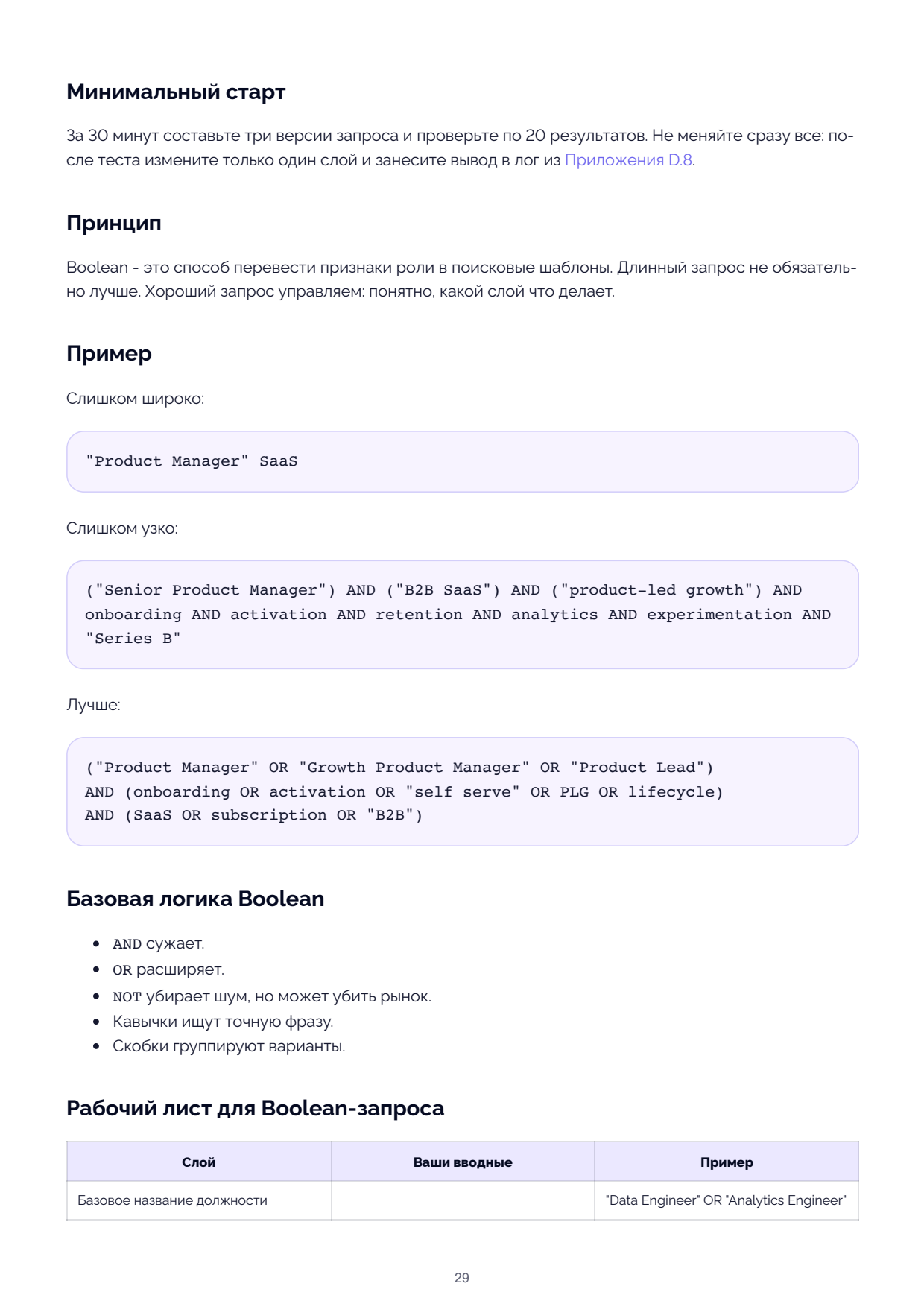
Boolean query worksheet
| Layer | Your inputs | Example |
|---|---|---|
| Base job title | "Data Engineer" OR "Analytics Engineer" | |
| Work signals | pipeline OR orchestration OR "data quality" | |
| Tools | dbt OR Airflow OR Spark | |
| Domain or environment | SaaS OR marketplace OR fintech | |
| Expansion variants | BI Engineer OR Data Platform | |
| Exclusions | NOT intern NOT student |
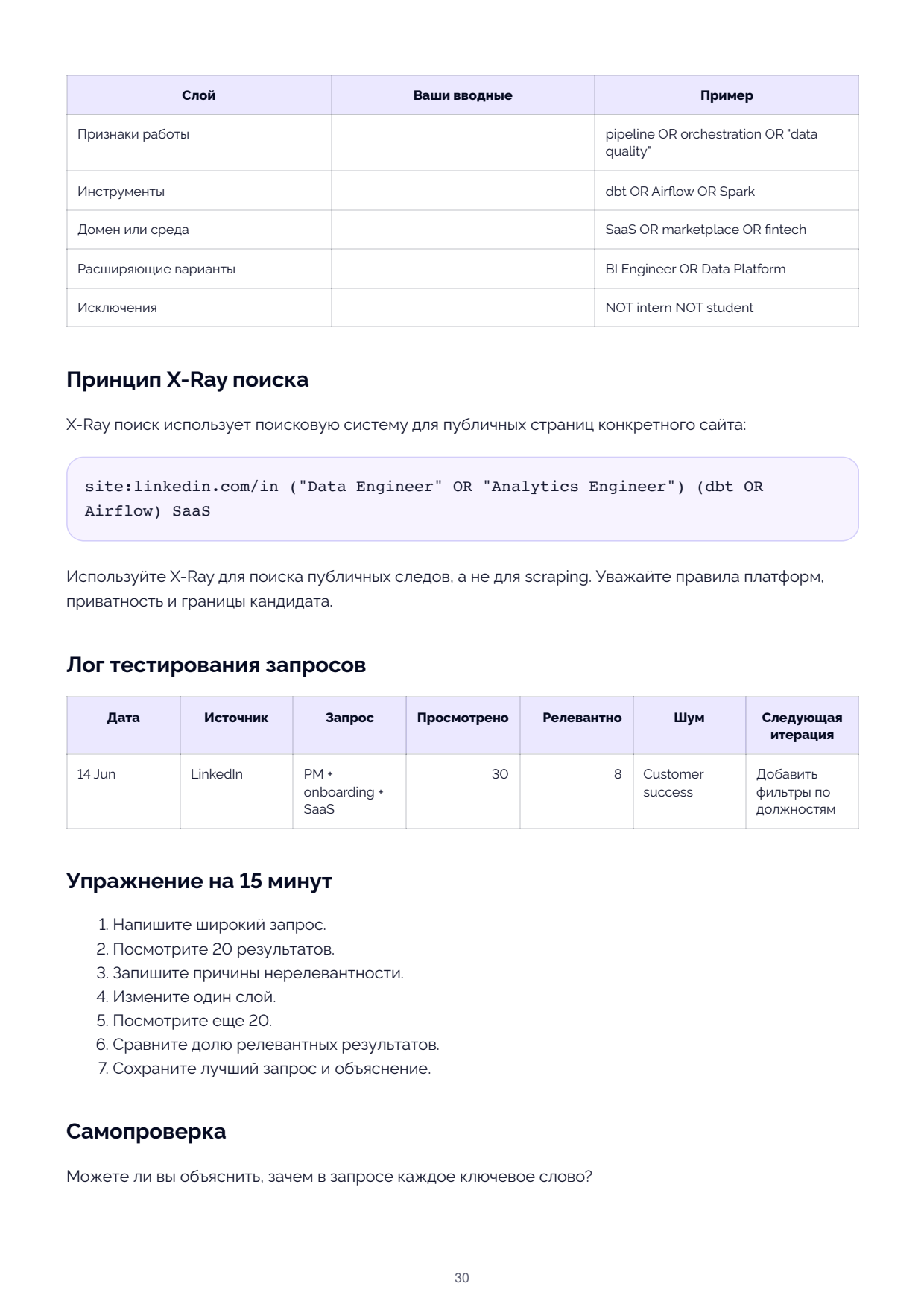
X-Ray search principle
X-Ray search uses a search engine for public pages on a specific site.
site:linkedin.com/in ("Data Engineer" OR "Analytics Engineer") (dbt OR Airflow) SaaS
Query testing log
| Date | Source | Query | Viewed | Relevant | Noise | Next iteration |
|---|---|---|---|---|---|---|
| 14 Jun | PM + onboarding + SaaS | 30 | 8 | Customer success | Add title filters |
What to take from the chapter / where to go next
Take the iteration log: it matters more than a pretty search string. If queries are producing relevant profiles, go to Chapter 6.