Chapter 01. Sourcing as a System

How to use this chapter
Read it as the setup for the whole system. If a specific vacancy is urgent, do not try to fix everything at once: compare your process with the table below, find one weak area, and move to the matching chapter.
Remember in one phrase
Sourcing works when the team manages hypotheses, facts, and feedback instead of simply increasing the number of profiles reviewed.
If you have a task
| If you have a task | Go to section | What you get |
|---|---|---|
| Understand why search is not producing results | Sourcing failure diagnostics | Likely causes before blaming the market |
| Explain systematic sourcing to a client | Random search and systematic sourcing | A short contrast for the conversation |
| Quickly sketch a process for a new role | Process | Steps from brief to iteration |
Quick Chapter Map
- Separate random search from systematic sourcing.
- Walk through the 10-step process.
- Check the sourcing failure diagnostics.
- Choose the next chapter by the weakest area.
Minimum Start
In 30 minutes, collect the current role, the last 10-20 reviewed profiles, 3-5 client rejections, and one recent candidate message. Mark where the process broke: brief, hypothesis, source, message, assessment, feedback, or metrics.
Principle
Sourcing is market research, candidate search, relevant communication, initial qualification, and funnel management. It is not a list of links and not a mass mailing exercise.
Random search and systematic sourcing
| Random search | Systematic sourcing |
|---|---|
| Starts with a tool | Starts with the role and observable signals |
| Uses one job title | Builds variants of titles and skills |
| Scrolls until tired | Works in iterations |
| Assesses by feel | Uses scorecards and calibration |
| Says 'there are no candidates' | Shows the market map and funnel data |
| Sends generic messages | Sends relevant personalised messages |
| Works alone | Closes the feedback loop with the client |
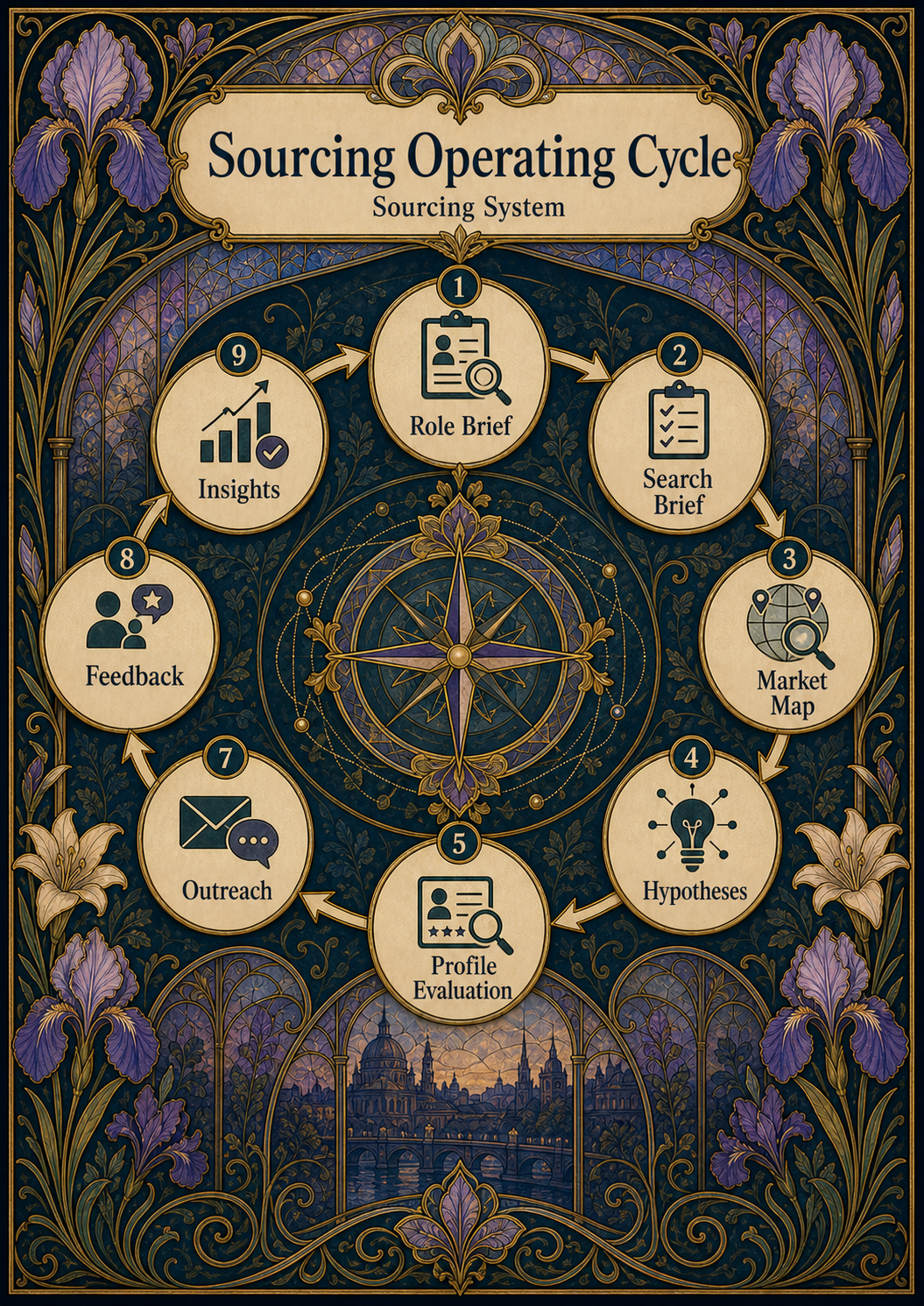
Process
- Define the business problem behind the vacancy.
- Split requirements into must-haves, nice-to-haves, useful signals, and noise.
- Translate requirements into observable profile signals.
- Build 3-5 search hypotheses.
- Map companies, adjacent pools, professional communities, and sources.
- Test queries in short iterations and keep a log.
- Assess profiles before first contact.
- Write briefly, respectfully, and to the point.
- Track replies, interested replies, qualified replies, and rejection reasons.
- Review the funnel and strategy every week.
Sourcing Failure Diagnostics
- The role remains vague.
- A must-have requirement cannot be seen in a profile.
- The client rejects without specific reasons.
- Search is limited to one job title or one source.
- The Boolean query is too narrow or too broad.
- Messages talk about the company, not the reason for the candidate to respond.
- Feedback takes more than 1-2 working days.
- It is unclear who owns candidate contact.
- The team does not track reply rate and qualified candidate rate.
- The recruiter cannot explain the market with facts.
Self-check
Can you explain in five sentences what market you tested, why it is relevant, what you found, what changed after feedback, and what you will test next?
What to take from the chapter / where to go next
Take the maturity criterion: every team member should understand what hypothesis you are testing and what fact will change the next step. If the problem starts before search, go to Chapter 2. If the role is clear but the target profile is not, go to Chapter 3.