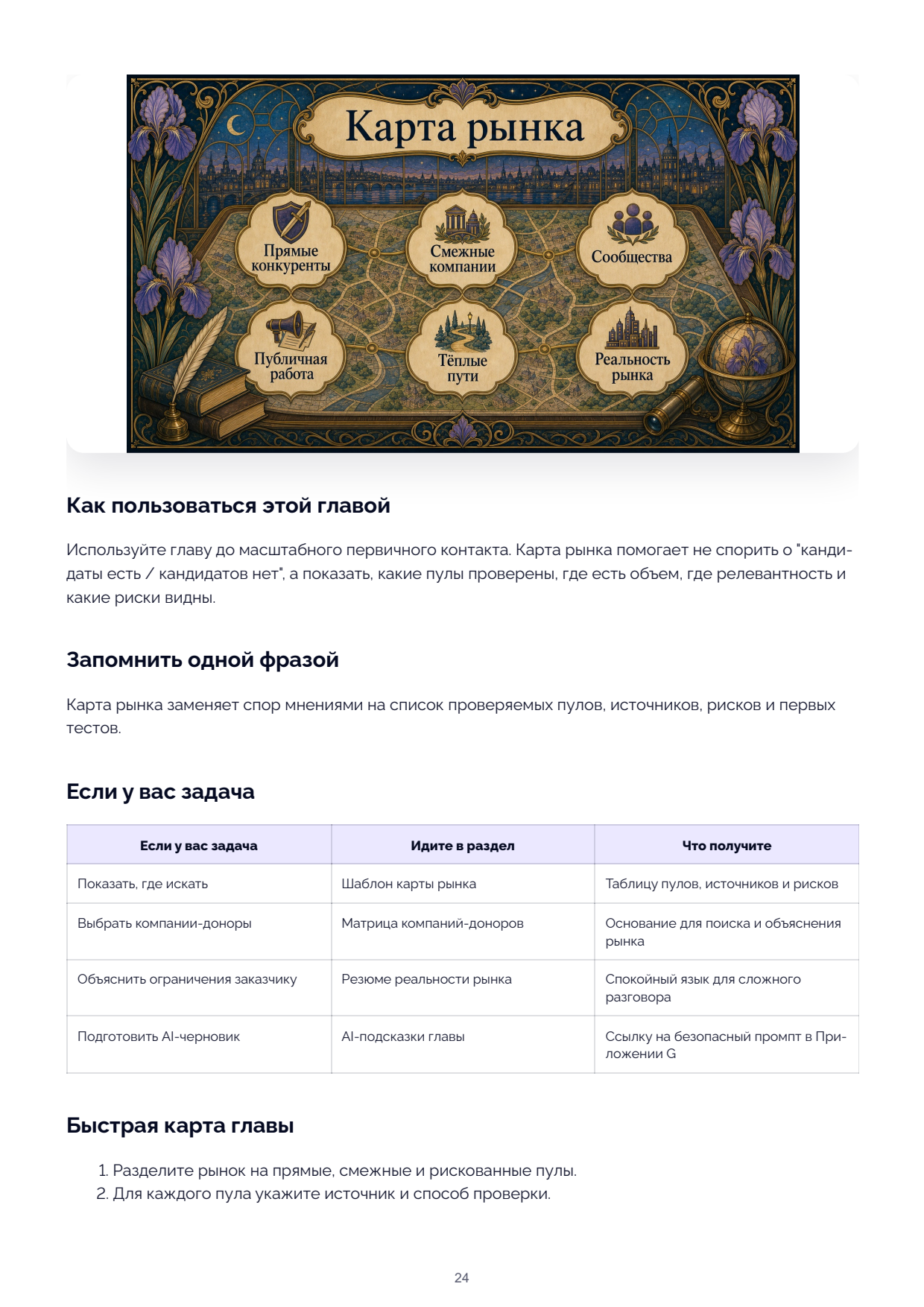
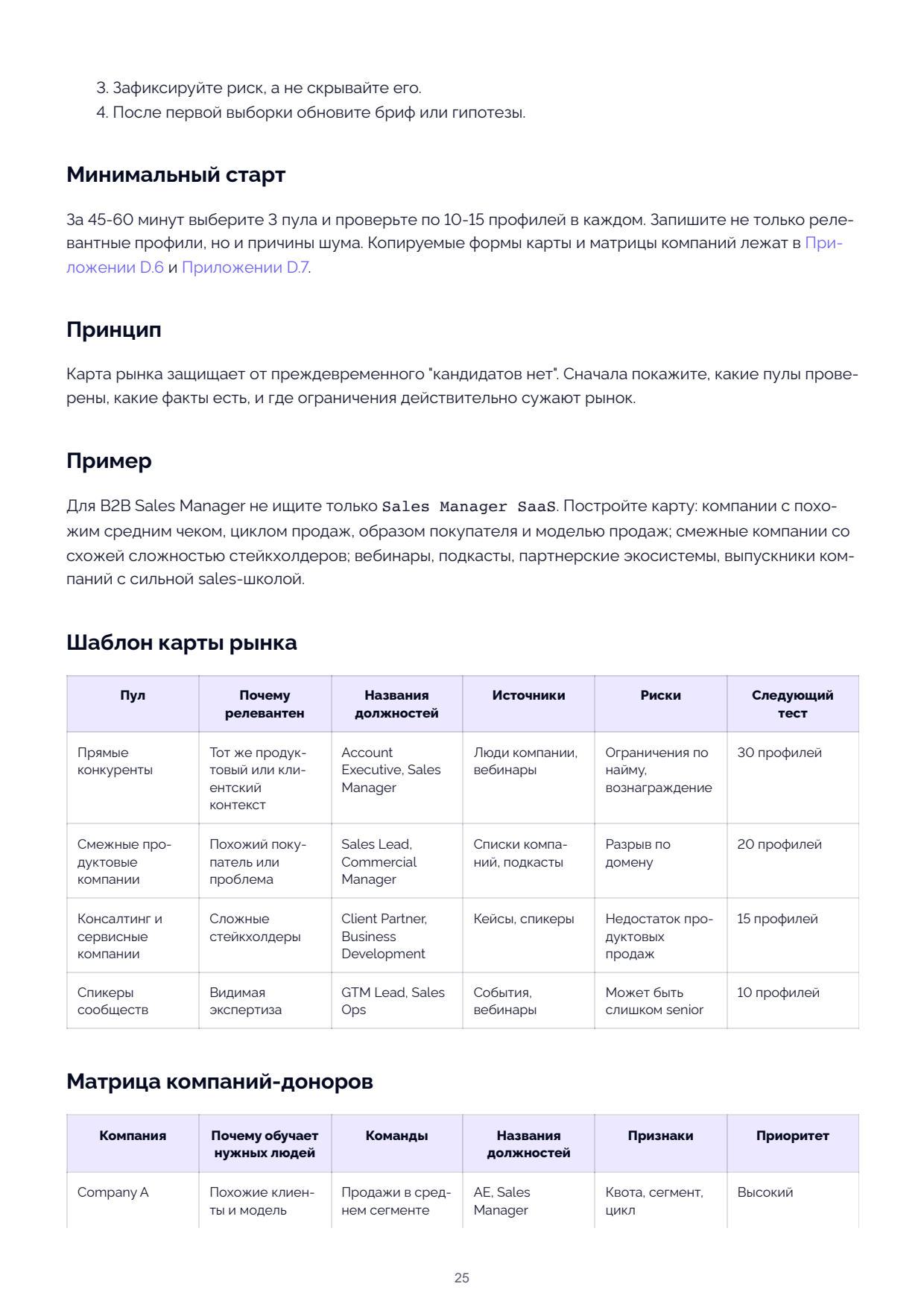
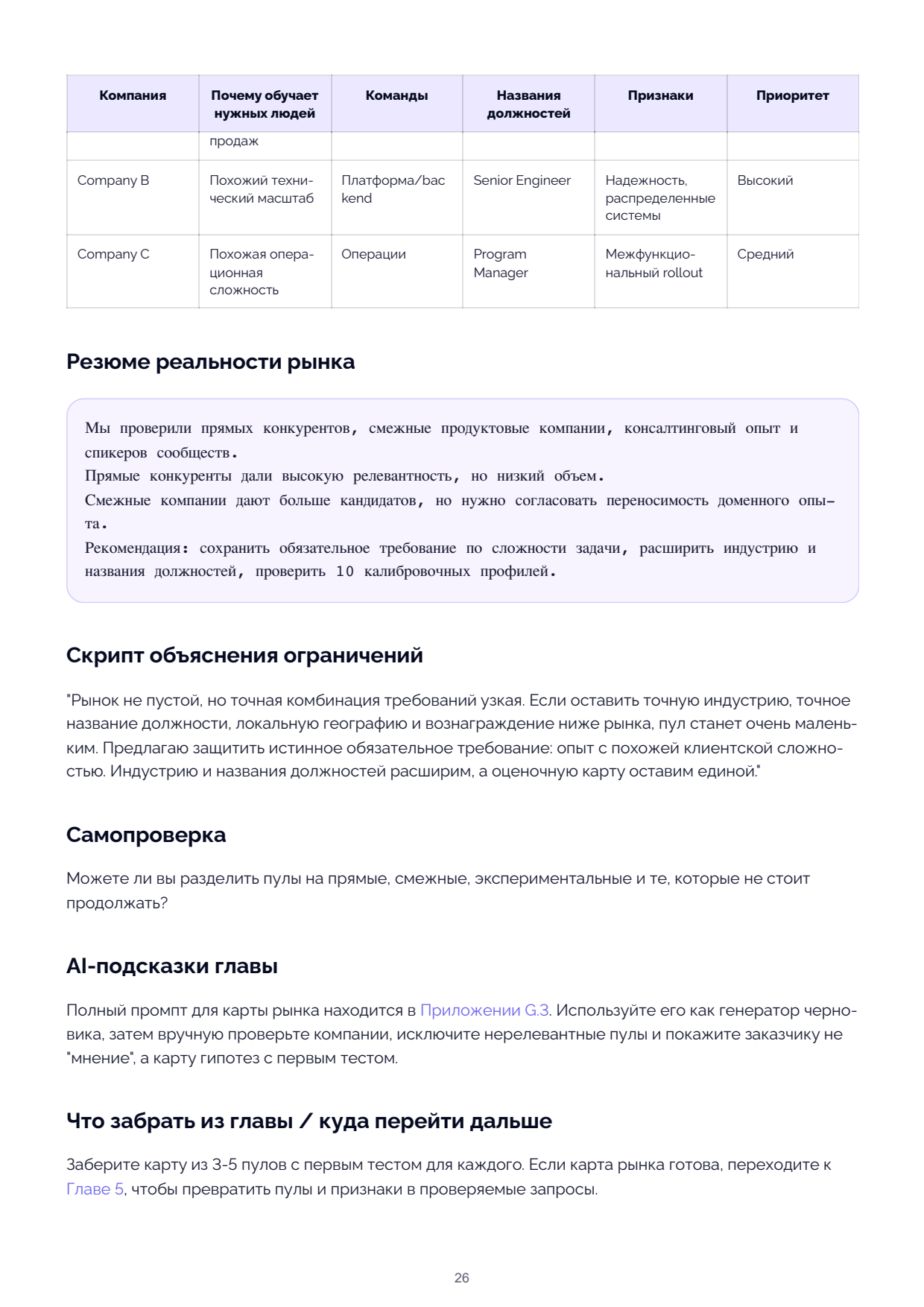
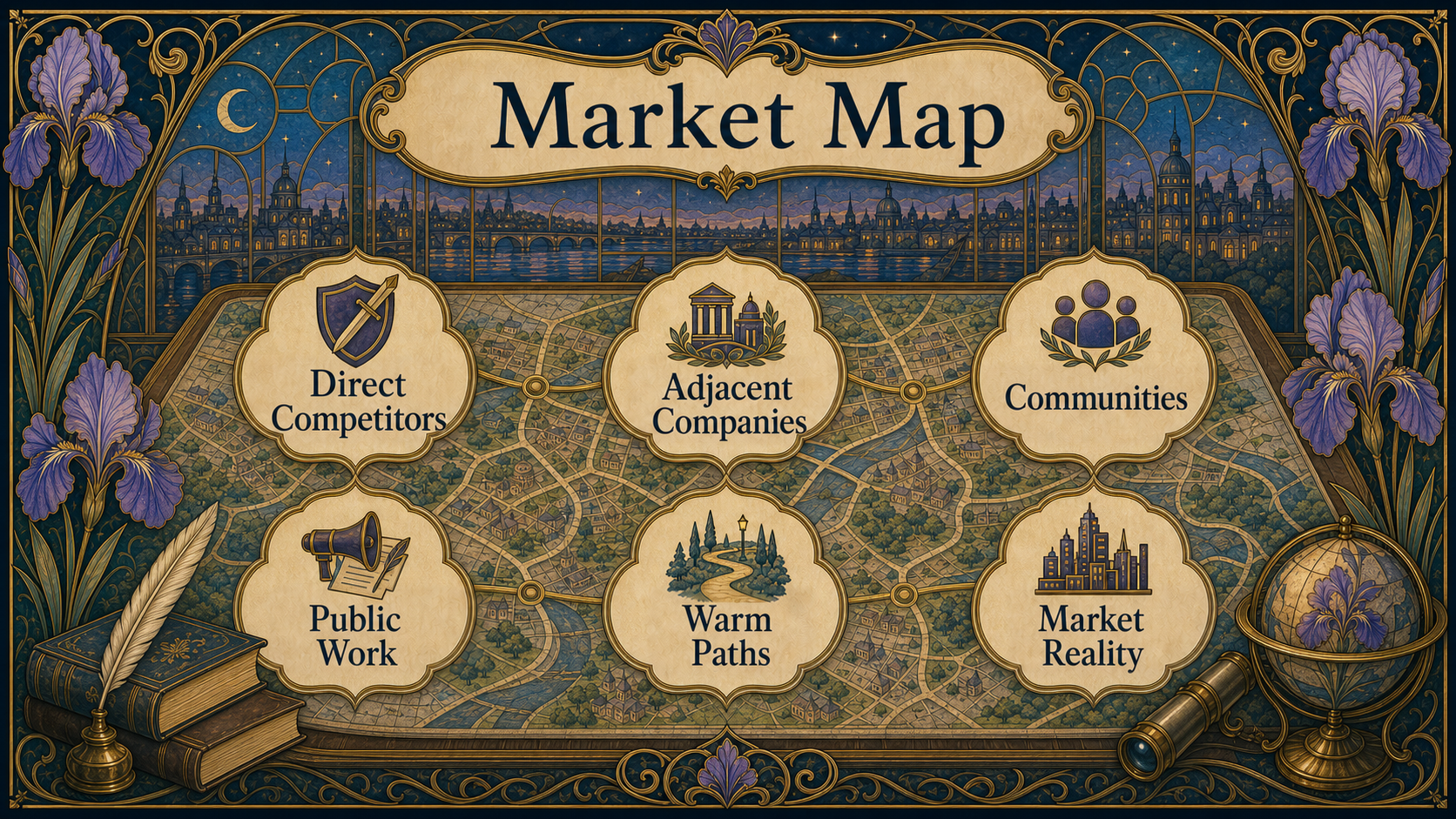
Chapter 04. Market Map

How to use this chapter
Use this chapter before large-scale first contact. A market map helps move the conversation from opinions about whether candidates exist to visible pools, volume, relevance, and risks.
Remember in one phrase
A market map replaces opinion arguments with a list of testable pools, sources, risks, and first tests.
If you have a task
| If you have a task | Go to section | What you get |
|---|---|---|
| Show where to search | Market map template | A table of pools, sources, and risks |
| Choose donor companies | Donor company matrix | A basis for search and market explanation |
| Explain constraints to the client | Market reality summary | Calm language for a difficult conversation |
| Prepare an AI draft | Chapter AI prompts | A link to the safe prompt in Appendix G |
Quick Chapter Map
- Split the market into direct, adjacent, and risky pools.
- For each pool, define the source and validation method.
- Record the risk instead of hiding it.
- After the first sample, update the brief or hypotheses.
Market map template
| Pool | Why relevant | Job titles | Sources | Risks | Next test |
|---|---|---|---|---|---|
| Direct competitors | Same product or customer context | Account Executive, Sales Manager | Company people, webinars | Hiring restrictions, compensation | 30 profiles |
| Adjacent product companies | Similar buyer or problem | Sales Lead, Commercial Manager | Company lists, podcasts | Domain gap | 20 profiles |
| Consulting and service companies | Complex stakeholders | Client Partner, Business Development | Cases, speakers | Lack of product sales | 15 profiles |
| Community speakers | Visible expertise | GTM Lead, Sales Ops | Events, webinars | May be too senior | 10 profiles |
Donor company matrix
| Company | Why it trains the right people | Teams | Job titles | Signals | Priority |
|---|---|---|---|---|---|
| Company A | Similar customers and sales model | Mid-market sales | AE, Sales Manager | Quota, segment, cycle | High |
| Company B | Similar technical scale | Platform/backend | Senior Engineer | Reliability, distributed systems | High |
| Company C | Similar operational complexity | Operations | Program Manager | Cross-functional rollout | Medium |
Market reality summary
Show the client the tested pools, volume, noise reasons, and next test. A strong market map shows which hypotheses have already been checked and what should change next.
What to take from the chapter / where to go next
Take a map of 3-5 pools with a first test for each. If the map is ready, go to Chapter 5 to turn pools and signals into testable queries.