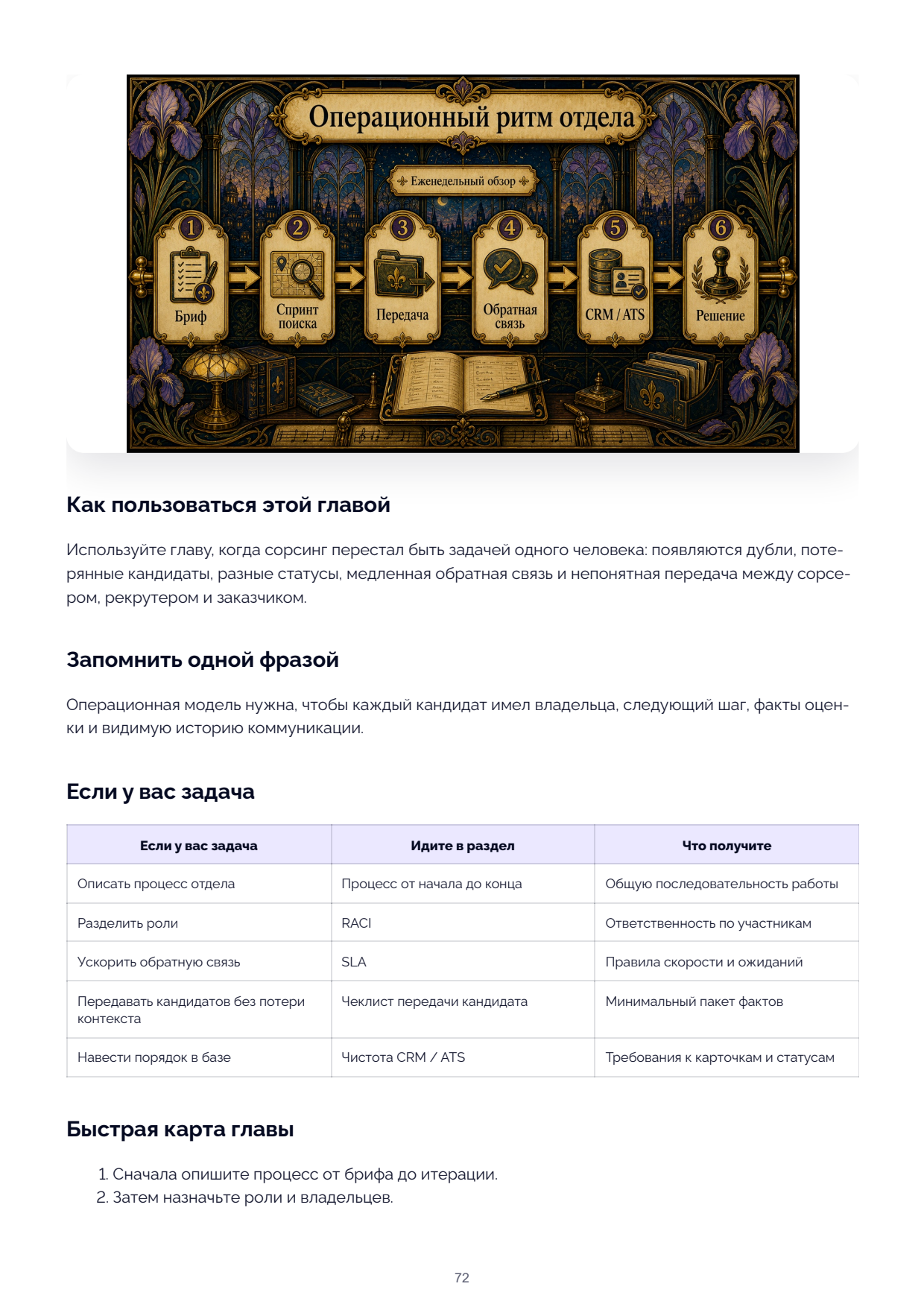
Chapter 14. Sourcing Operational Model


How to use this chapter
Use this chapter when sourcing is no longer one person's task: duplicates, lost candidates, inconsistent statuses, slow feedback, and unclear handoff appear between sourcer, recruiter, and client.
Remember in one phrase
An operating model ensures every candidate has an owner, next step, assessment facts, and visible communication history.
If you have a task
| If you have a task | Go to section | What you get |
|---|---|---|
| Distribute roles | RACI | Clear process owners |
| Lock decision speed | SLA | Minimum feedback norms |
| Handoff candidates without losing context | Candidate handoff checklist | A shared handoff format |
| Keep the database clean | CRM / ATS hygiene | Rules for data and statuses |
| Account for team type | In-house and agency specifics | Operating model differences |
RACI
| Action | Sourcer | Recruiter | Client | Interviewer | Head of recruiting |
|---|---|---|---|---|---|
| Intake | R | A | A | C | C |
| Search brief | R | A | C | C | C |
| Market map | R | C | C | I | A |
| First contact | R | C | I | I | C |
| Initial call | C/R | R/A | C | I | C |
| Feedback after interview | I | A | R | R | C |
| Funnel review | R | R | C | I | A |
| Process improvement | C | R | C | I | A |
SLA
- The client reviews calibration profiles within 24-48 hours.
- The recruiter updates the candidate within one business day after the initial call.
- Interview feedback arrives within 24 hours.
- The contact owner is visible before the first message.
- Duplicate checks happen before every message.
- The weekly update is sent on the same weekday.
- Strategy iteration happens after an agreed sample size, not by mood.
Candidate handoff checklist
- Candidate profile link.
- Source and hypothesis.
- Facts against must-have requirements.
- First message and reply.
- Candidate motivation and concerns.
- Compensation, location, and flexibility notes.
- Initial call notes.
- Open questions.
- Recommended next step.
CRM / ATS hygiene
- Correct role and stage.
- Source recorded.
- Contact history visible.
- Notes are factual and respectful.
- Rejection reason is specific.
- Tags are standardised.
- Next action and owner are clear.
- No private comments that would be inappropriate in an audit.
In-house and agency specifics
| Process | In-house team | Hiring agency |
|---|---|---|
| Candidate ownership | Avoid duplicates between teams and roles inside the company | Avoid duplicates between clients if the candidate is already in process |
| Weekly update | Can be tied to internal business priorities | Should be a compact client report with decisions and risks |
| Feedback SLA | Can be fixed as an internal recruiting rule | Better fixed in writing after the kickoff or agreement |
| CRM hygiene | Needed for a long-term talent base | Needed for service transparency and context protection |
| Candidate experience | Reflects the employer brand directly | Reflects both the agency brand and the client brand |
What to take from the chapter / where to go next
Take the operating norm: the candidate card should be understandable to the next process participant without a call. If the team needs practice, go to Chapter 15.