Chapter 13. Tools and AI

How to Use This Chapter
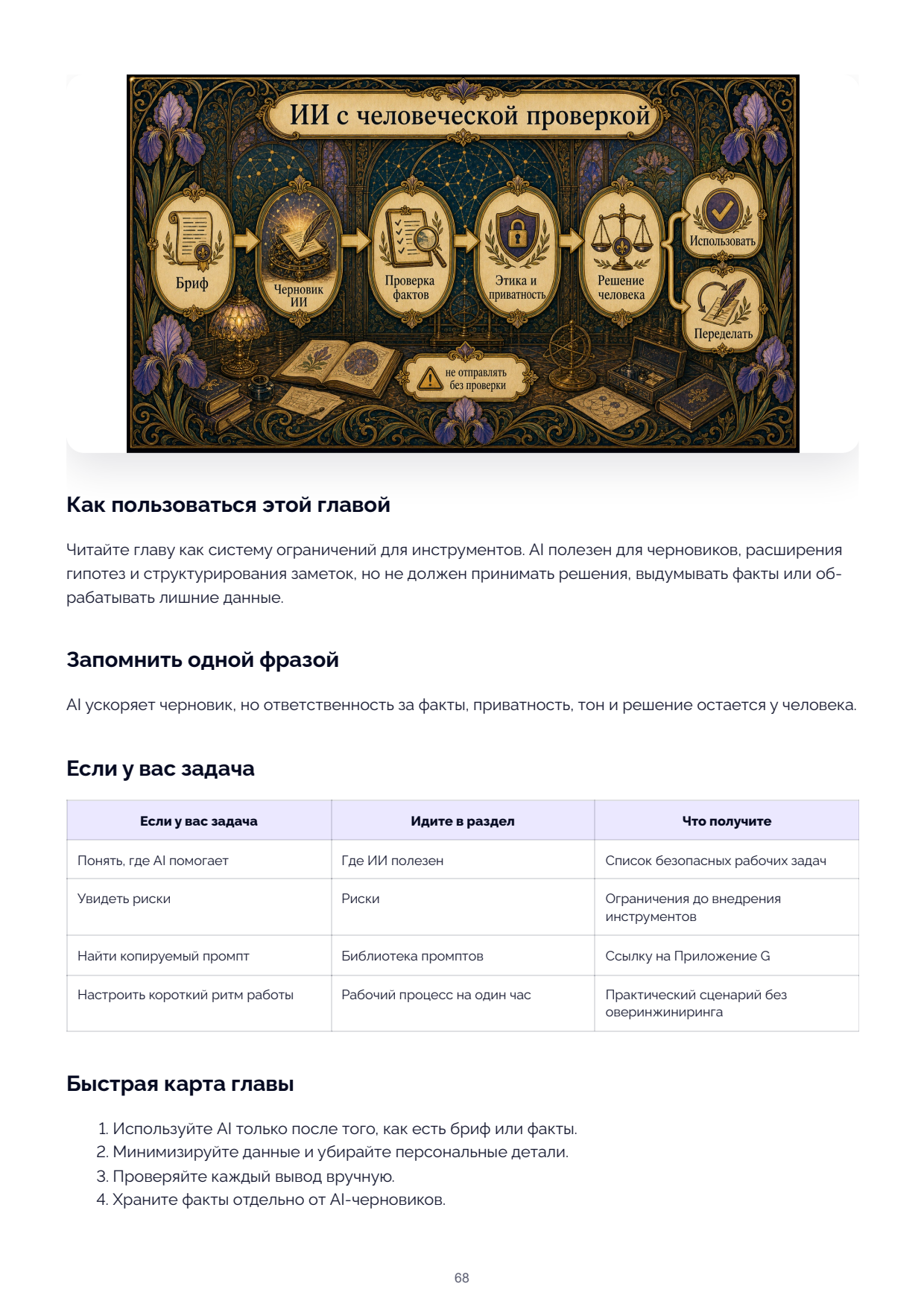
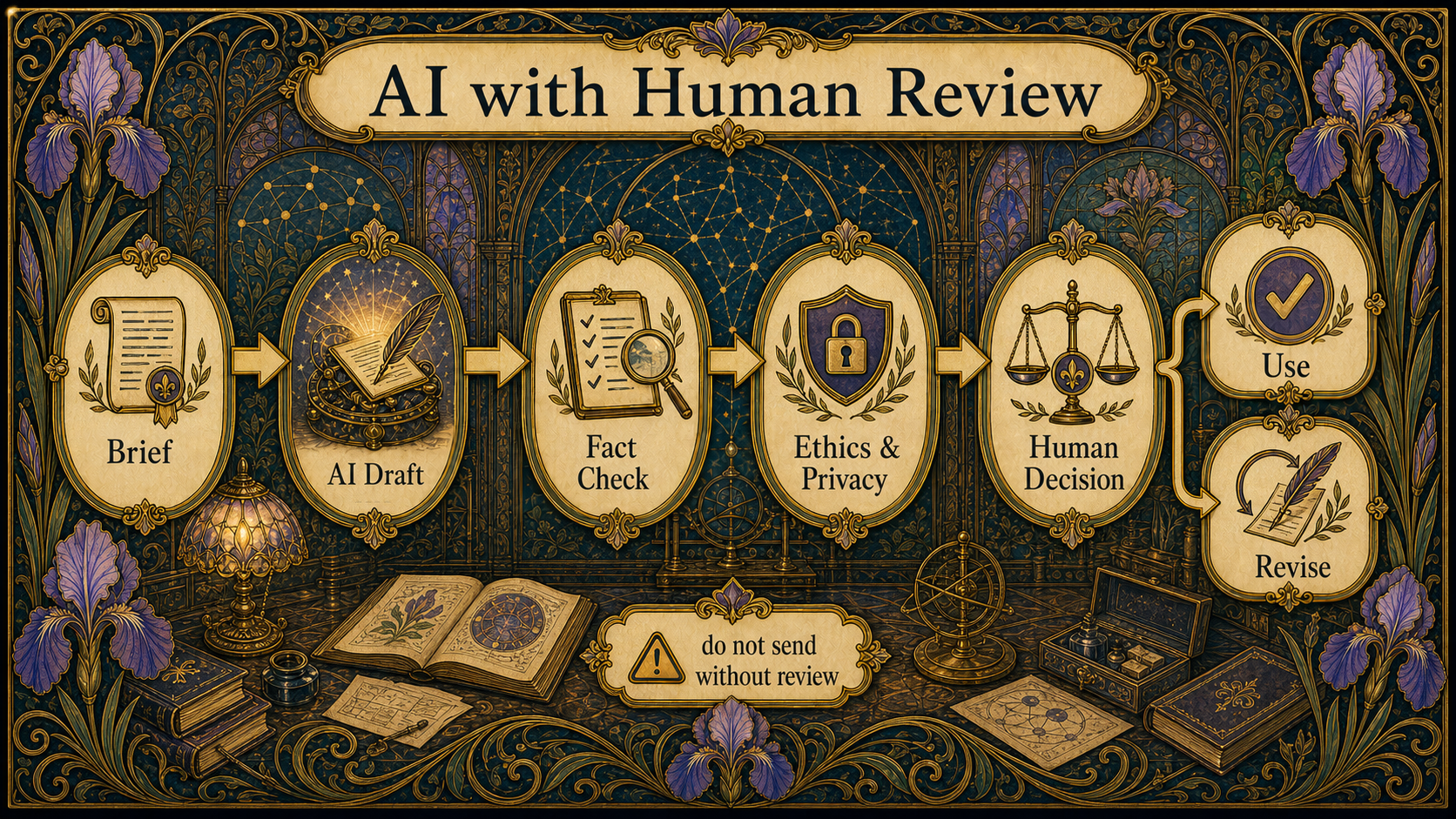
Read this chapter as a constraint system for tools. AI is useful for drafts, expanding hypotheses, and structuring notes, but it should not make decisions, invent facts, or process unnecessary data.
Remember in One Phrase
AI speeds up the draft, but responsibility for facts, privacy, tone, and decisions remains with the human.
If you have a task
| If Your Task Is | Go to Section | What You Get |
|---|---|---|
| Understand where AI helps | Where AI is useful | A list of safe working tasks |
| See the risks | Tool risks | Constraints before implementation |
| Find a copy-paste prompt | Prompt library | Link to Appendix G |
| Set up a short working rhythm | One-hour workflow | A practical scenario without over-engineering |
Quick Chapter Map
1. Use AI only after you have a brief or facts.
2. Minimise data and remove personal details.
3. Verify every output manually.
4. Store facts separately from AI drafts.
Minimal Start
In 30 minutes, choose one safe scenario: expand keywords, structure notes, or rewrite the first message. Take the prompt from Appendix G, remove personal data, and after generation verify the facts against the source. Keep the data rules nearby: Appendix F.
Principle
AI accelerates sourcing but does not own professional judgement, ethics, calibration, privacy, or trust.
The final decision on a candidate, rejection, next step, and communication is always made by a human based on pre-agreed criteria.
Where AI Is Useful
Role analysis.
Requirement classification.
Keyword expansion.
Search hypothesis generation.
Market map draft.
First message variants.
Profile structuring.
Calibration questions.
Funnel diagnostics.
Weekly report draft.
Risks
Mass generic messages.
Invented facts.
Privacy violations.
Evaluation bias and stereotype reinforcement.
Over-automation.
Tool sprawl.
Sending without human review.
Prompt Library
Full copy-paste prompts are collected in Appendix G. The chapters keep only links to avoid duplicating the same safety block and manual verification step.
One-Hour Workflow
1. 5 minutes: review the brief and yesterday's output.
2. 10 minutes: refine one hypothesis.
3. 20 minutes: review profiles and evaluate facts.
4. 10 minutes: prepare or send a small batch of personalised messages.
5. 10 minutes: update the CRM.
6. 5 minutes: record metrics and the next experiment.
Key Takeaways / Where to Go Next
Take away the rule: AI does not replace the brief, evaluation, consent, privacy, or human decision. If the process already requires team discipline, move to Chapter 14 to formalise roles, SLA, and handoffs.