Chapter 08. GitHub and Technical Traces

How to Use This Chapter
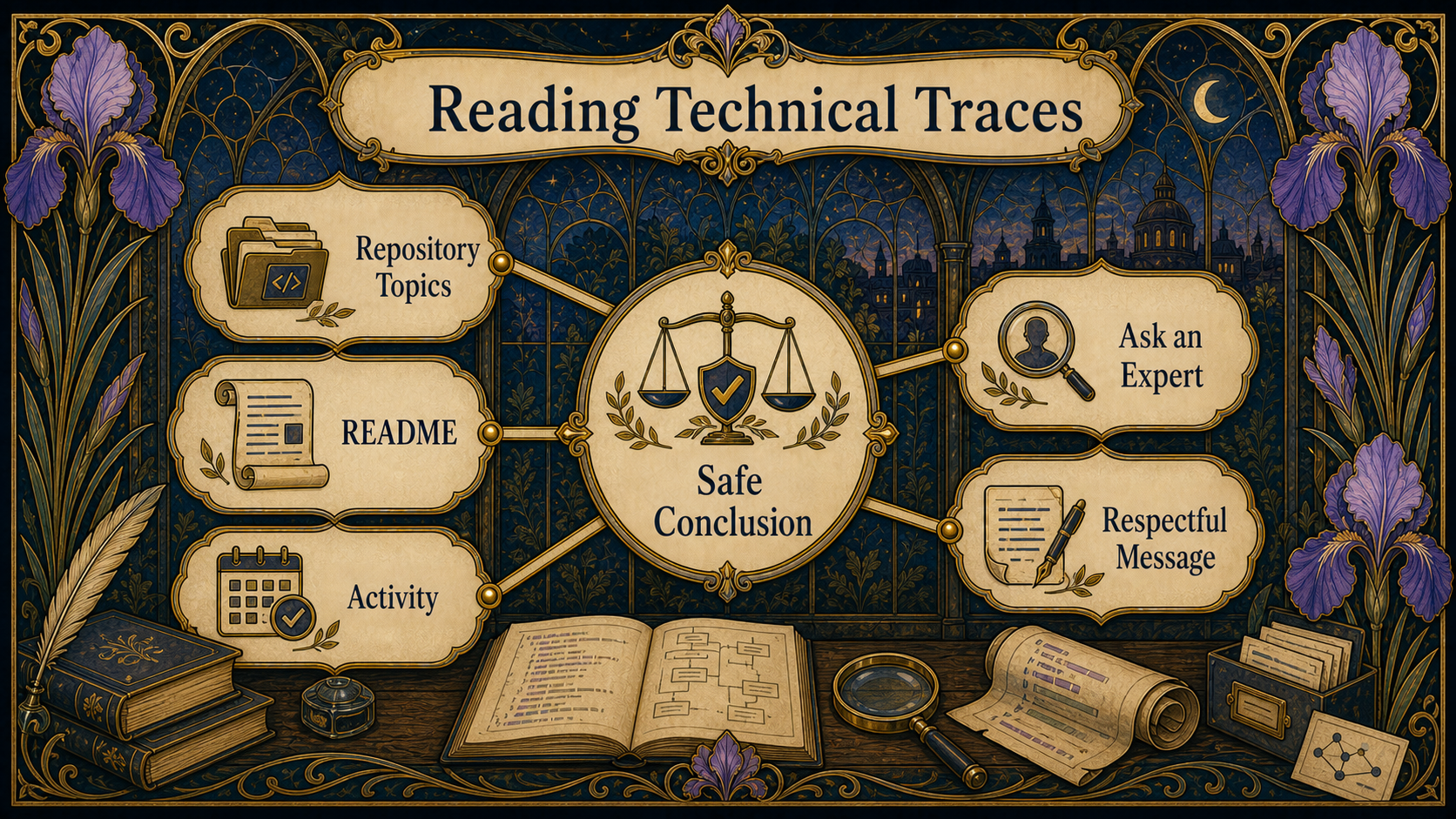
Use this chapter as a safety boundary for technical sourcing. It helps you find a relevant signal
and write a respectful message, but it does not turn a non-technical recruiter into a code
reviewer.
Remember in One Phrase
A public technical trace helps you ask a good question, but it does not prove an engineer's
level without a professional assessment.
If you have a task
| If Your Task Is | Go to Section | What You Get |
|---|---|---|
| Understand what you can safely infer | What can be inferred safely | A list of permissible signals |
| Avoid drawing wrong conclusions | What cannot be inferred confidently | Interpretation boundaries |
| Prepare for calibration | Checklist | Questions for the technical expert |
| Contact the candidate carefully | Respectful wording | A formulation without overconfidence |
Quick Chapter Map
1. Find a public professional fact.
2. Separate the fact from a quality interpretation.
3. Record what the technical expert must verify.
4. Use the fact only for relevant contact or calibration.
Minimal Start
In 30 minutes, pick 5 technical profiles and write one safe line for each: "I see public fact X;
it may be relevant to role Y; quality and level must be verified by Z." If you cannot write that
line, do not use the source as a basis for contact.
Principle
GitHub helps you find technical candidates and write more relevant messages, but it does not
give a non-technical recruiter the right to assess code quality.
What Can Be Inferred Safely
The person uses specific programming languages.
There are public projects or contributions to projects.
There may be interest in a technical domain.
There is a README, documentation, examples, or task discussions.
There is involvement in open-source projects.
What Cannot Be Inferred Confidently
Production development quality.
Team collaboration quality.
A candidate's level based on the number of stars.
Current level based on old activity.
Readiness to be contacted through a public technical profile.
Checklist
Which programming languages appear repeatedly?
Are the repositories personal, educational, corporate, or open-source?
Are the READMEs clear and relevant?
Is the activity recent?
Are there contributions to relevant projects?
Is there a project that genuinely relates to the role?
What Must the Technical Expert Verify?
Safe Interpretation
"The candidate has public work on Python and data tooling, including a repository on workflow
orchestration. I am not assessing code quality, but the topic is relevant for calibration with
the data engineering manager."
Respectful Message
Hi Sam,
I found your public project on workflow orchestration while reviewing data engineering profiles.
I will not pretend to assess code quality, but the topic itself relates to a role focused on
reliable data pipelines and data quality.
If the timing is right, I can send a short brief.
Key Takeaways / Where to Go Next
Take away the discipline of careful interpretation: a technical trace is a reason to ask a
question, not a final assessment. If you are ready to write to candidates, move to Chapter 9
to build a message without pressure.