Chapter 07. Beyond LinkedIn


How to use this chapter
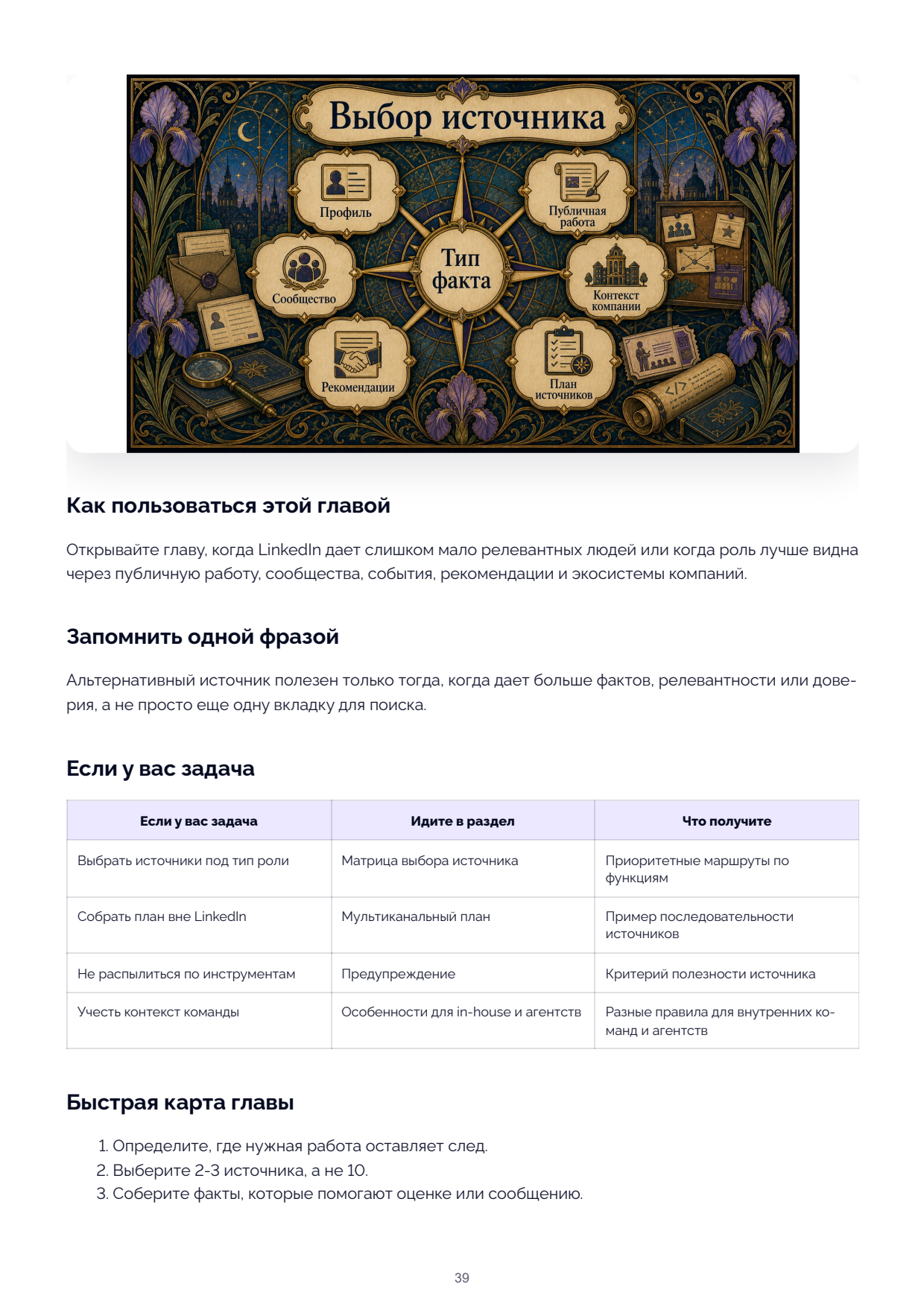
Open this chapter when LinkedIn produces too few relevant people or when the role is more visible through public work, communities, events, referrals, and company ecosystems.
Remember in one phrase
An alternative source is useful only when it adds facts, relevance, or trust, not just another tab to search.
If you have a task
| If you have a task | Go to section | What you get |
|---|---|---|
| Choose sources for a role type | Source selection matrix | Priority routes by function |
| Build a plan beyond LinkedIn | Multichannel plan | An example source sequence |
| Avoid spreading across tools | Warning | A usefulness criterion for sources |
| Account for team context | In-house and agency specifics | Different rules for internal teams and agencies |
Source selection matrix
| Role type | Sources | What facts to look for |
|---|---|---|
| Engineering | GitHub, forums, talks, open-source projects, engineering blogs | Languages, architecture topics, project support |
| Data | Data communities, tool ecosystems, conferences | Pipelines, BI, experiments, data governance |
| Product | Product communities, podcasts, webinars, cases | Product ownership, discovery, metrics, launches |
| Design | Portfolios, design platforms, design-system talks | Process, constraints, outcomes |
| Marketing | Webinars, newsletters, campaigns, communities | Channels, audience, positioning |
| Sales | Podcasts, partner ecosystems, customer stories | Segment, deal cycle, buyer, quota |
| Operations | Associations, transformation cases | Processes, scale, result delivery |
| Leadership | Panels, articles, podcasts, advisory pages | Mandate, scale, team building |
Multichannel plan: Marketing Manager
- LinkedIn titles: demand generation, growth marketing, field marketing, lifecycle marketing.
- List of B2B SaaS companies with similar buyers.
- Webinar pages with campaign speakers.
- Marketing communities and newsletters.
- Cases from marketing tool vendors.
In-house and agency specifics
| Context | In-house team | Hiring agency |
|---|---|---|
| Access to internal referrals | Can quickly involve employees and leaders from adjacent teams | Usually only client recommendations are available if agreed |
| Product knowledge | Can use product details more deeply | Need to ask the client for a safe public brief |
| Working with competitors | Need to account for internal rules and sensitive relationships | Need to agree restricted companies and non-solicit limits in advance |
| Experiment speed | Can quickly test new pools | Each material expansion is better confirmed in writing |
What to take from the chapter / where to go next
Take the source selection rule: a source should strengthen evidence, personalisation, or market expansion. If the source is technical, go to Chapter 8.