Chapter 02. The Client Brief Before Search


How to use this chapter
Use this chapter before the first search. It translates a client request into signals that can be seen in a profile, checked in the market, and explained to a candidate.
Remember in one phrase
A good brief does not describe an ideal person in a vacuum; it captures the work, must-have signals, compromises, and decision speed.
If you have a task
| If you have a task | Go to section | What you get |
|---|---|---|
| Run an intake meeting | Client brief script | Questions before search starts |
| Unpack a difficult request | Difficult client cases | A way to translate conflict into criteria |
| Confirm agreements in writing | Post-brief email template | Confirmation text for the team |
| Separate must-haves from noise | Requirements matrix | A basis for search and calibration |
Quick Chapter Map
- Start with the business problem of the role.
- Split requirements into must-haves, nice-to-haves, signals, and noise.
- Translate must-haves into observable signals.
- Confirm feedback SLA and acceptable compromises.
Brief script for the client
- What business problem should this hire solve in 6-12 months?
- What will the person own, not merely participate in?
- What results will show that the hire is successful?
- Which three requirements are truly mandatory?
- What can be learned after joining?
- Which types of experience worked well before? Which did not?
- How will this be visible in a profile?
- What job titles might these people have?
- Which companies or environments train them well?
- What compromises are acceptable if the market is narrow?
- Which constraints around compensation, location, flexibility, and level are fixed?
- How quickly can you provide feedback?
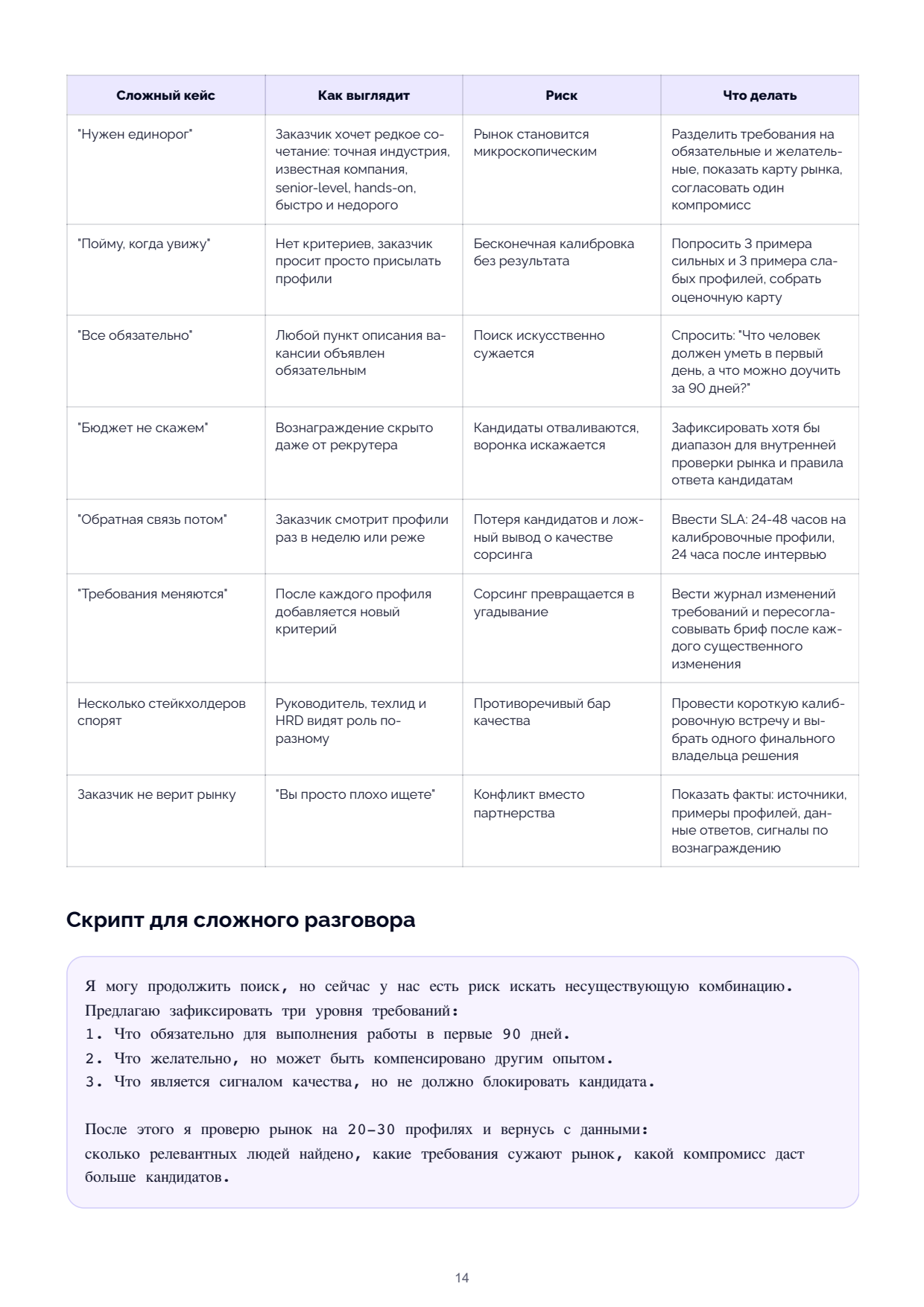
Difficult client cases and how to handle them
| Difficult case | How it looks | Risk | What to do |
|---|---|---|---|
| 'We need a unicorn' | The client wants a rare mix: exact industry, known company, senior-level, hands-on, fast, and inexpensive | The market becomes microscopic | Split requirements into must-haves and nice-to-haves, show the market map, agree on one compromise |
| 'I'll know it when I see it' | There are no criteria; the client just asks for profiles | Endless calibration without progress | Ask for 3 strong and 3 weak profile examples and build a scorecard |
| 'Everything is mandatory' | Every line of the job description becomes a must-have | Search narrows artificially | Ask: what must the person do on day one, and what can be learned in 90 days? |
| 'We won't share budget' | Compensation is hidden even from the recruiter | Candidates drop out and the funnel is distorted | Set at least an internal range for market checking and candidate replies |
| 'Feedback later' | The client reviews profiles once a week or less | Candidate loss and false conclusions about sourcing quality | Introduce SLA: 24-48 hours for calibration profiles, 24 hours after interviews |
| 'Requirements keep changing' | A new criterion appears after each profile | Sourcing turns into guessing | Keep a change log and re-confirm the brief after every material change |
| Several stakeholders disagree | The manager, tech lead, and HRD see the role differently | Conflicting quality bar | Run a short calibration meeting and choose one final decision owner |
| The client does not believe the market | 'You're just not searching well enough' | Conflict instead of partnership | Show facts: sources, profile examples, reply data, and compensation signals |
Script for a difficult conversation
I can continue searching, but right now we risk looking for a combination that may not exist. I suggest we lock three requirement levels:
1. What is required to perform the work in the first 90 days.
2. What is desirable but can be compensated by other experience.
3. What is a quality signal but should not block the candidate.
After that, I will test the market on 20-30 profiles and come back with data: how many relevant people were found, which requirements narrow the market, and which compromise will create more candidates.
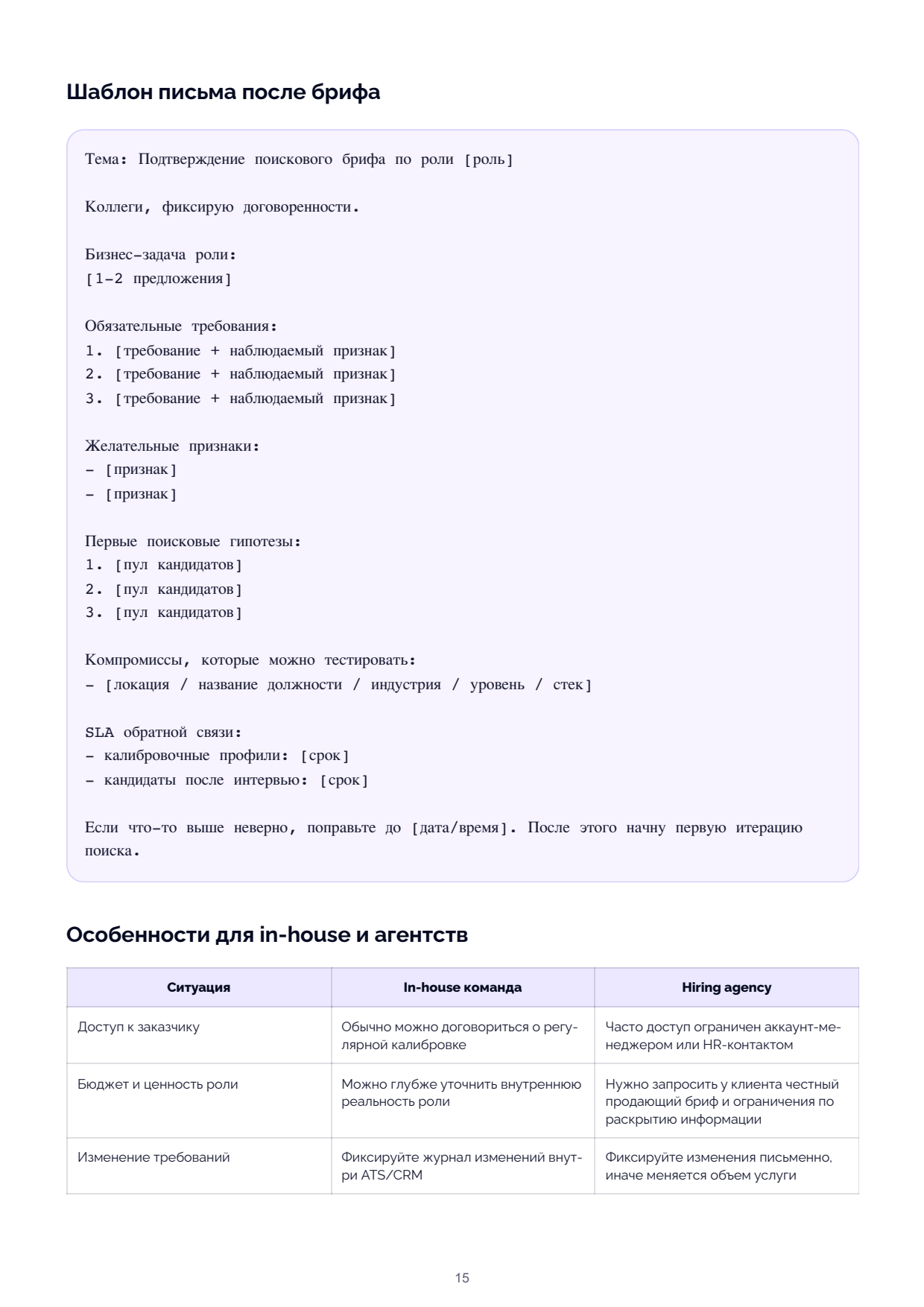
In-house and agency specifics
| Situation | In-house team | Hiring agency |
|---|---|---|
| Access to the client | Regular calibration is usually easier to arrange | Access is often limited through an account manager or HR contact |
| Budget and role value | You can explore the internal reality of the role more deeply | You need a truthful selling brief and disclosure limits from the client |
| Requirement changes | Record the change log inside the ATS/CRM | Record changes in writing, otherwise the service scope changes |
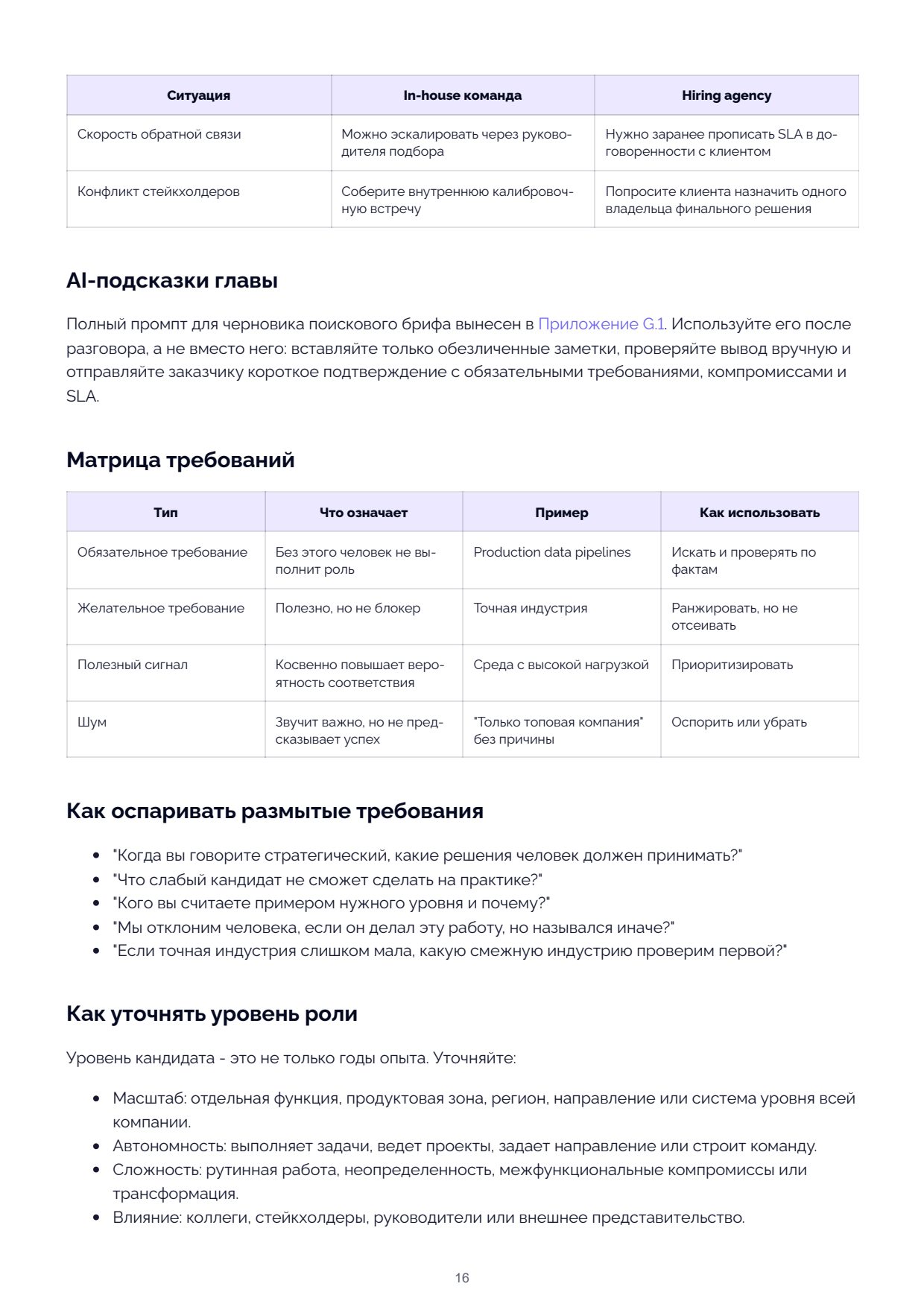
| Feedback speed | You can escalate through the hiring leader | SLA should be agreed with the client in advance |
| Stakeholder conflict | Gather an internal calibration meeting | Ask the client to name one final decision owner |
Requirements Matrix
| Type | What it means | Example | How to use |
|---|---|---|---|
| Must-have requirement | Without this, the person cannot perform the role | Production data pipelines | Search and verify by facts |
| Nice-to-have requirement | Useful, but not a blocker | Exact industry | Rank, but do not filter out |
| Useful signal | Indirectly increases likelihood of fit | High-load environment | Prioritise |
| Noise | Sounds important but does not predict success | 'Top company only' without a reason | Challenge or remove |
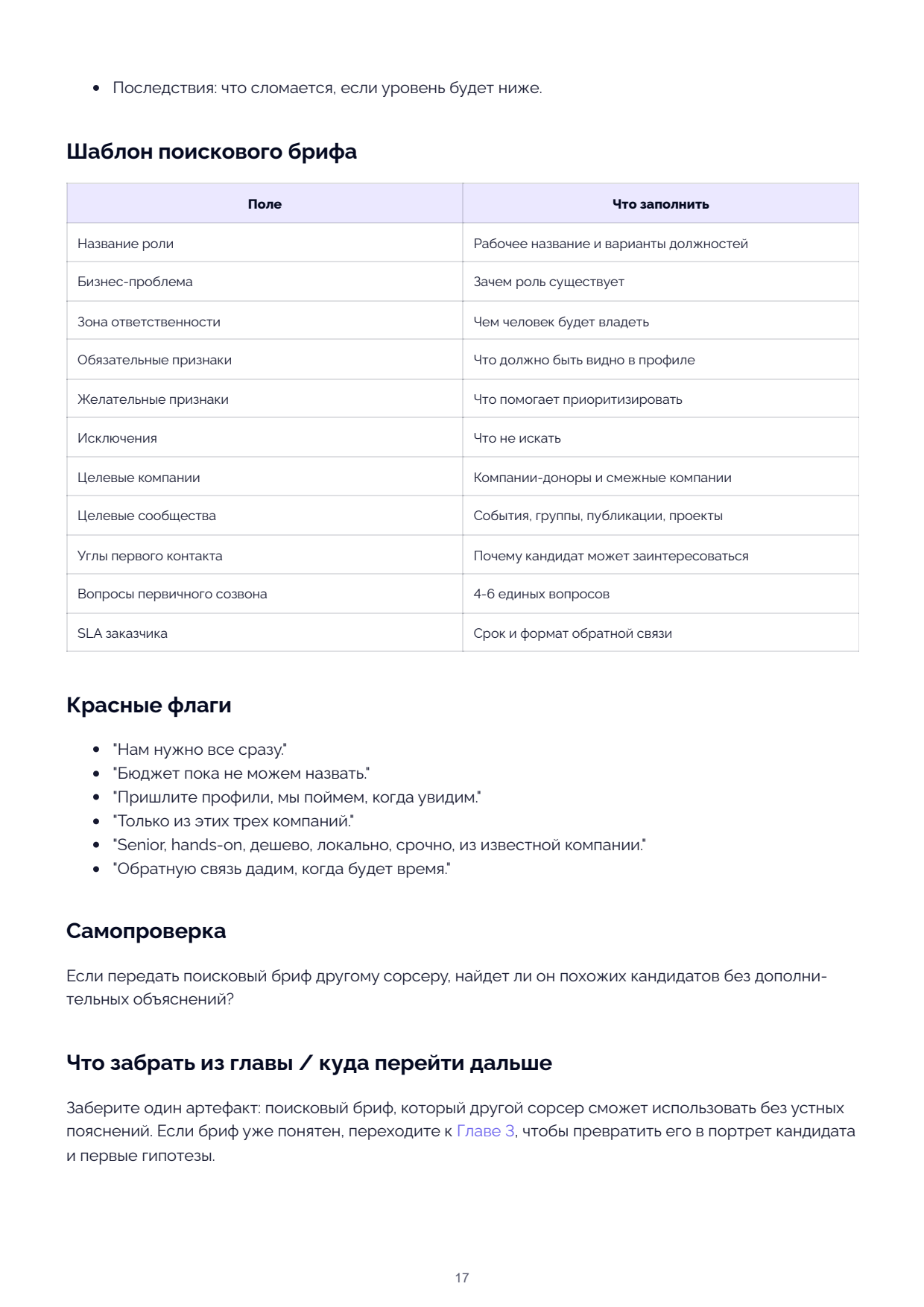
Search brief template
| Field | What to fill in |
|---|---|
| Role name | Working title and title variants |
| Business problem | Why the role exists |
| Ownership area | What the person will own |
| Must-have signals | What must be visible in the profile |
| Nice-to-have signals | What helps prioritise |
| Exclusions | What not to search for |
| Target companies | Donor and adjacent companies |
| Target communities | Events, groups, publications, projects |
| First-contact angles | Why the candidate may be interested |
| Initial call questions | 4-6 consistent questions |
| Client SLA | Feedback timing and format |
Self-check
If you hand the search brief to another sourcer, will they find similar candidates without extra explanation?
What to take from the chapter / where to go next
Take one artifact: a search brief another sourcer can use without verbal explanation. If the brief is clear, go to Chapter 3 to turn it into a candidate portrait and first hypotheses.