Harmony HR
01 1. Sourcing as a System02 2. The Client Brief Before Search03 3. Candidate Portrait04 4. Market Map05 5. Boolean, X-Ray06 6. LinkedIn07 7. Beyond LinkedIn08 8. GitHub and Technical Traces09 9. First Contact10 10. Candidate Evaluation11 11. Working with Clients12 12. Metrics13 13. Tools and AI14 14. Operational Model15 15. Practical Exercises
A Materials NavigatorB Mini GlossaryC RegulationsD Template LibraryE End-to-End CasesF Data, AI, PrivacyG AI Prompt Library
Home/Chapter 12

Chapter 12. Metrics and Forecasting


pp. 60–66
Metrics funnel
Metrics funnelThe main sourcing metrics seen through funnel logic rather than activity counts.
Sourcing funnel
Sourcing funnelA visual structure for understanding pass-through, loss, and search quality.

How to Use This Chapter

Use this chapter when you need to understand exactly where the funnel breaks: market, profile relevance, message, compensation, client speed, or evaluation quality.

Remember in One Phrase

Sourcing metrics exist not to pressure the recruiter but to select the next hypothesis and inform management decisions.

If Your Task IsGo to SectionWhat You Get
Calculate baseline numbersHow to calculate baseline metricsFormulas and meaning of each metric
Explain sourcing value to the businessHow sourcing affects revenueCautious language without fake ROI
Find the bottleneckDiagnosticsA table of signals and actions
Prepare an AI draft of funnel analysisAI prompts for this chapterLink to the diagnostics prompt

Quick Chapter Map

1. First, agree on what is counted at each stage.

2. Then calculate baseline conversions.

3. Find the weakest funnel transition.

4. Formulate one experiment for the next week.

Minimal Start

In 30 minutes, collect five numbers: reviewed, saved, contacted, replies, qualified candidates. Calculate two ratios: saved / reviewed and replies / contacted. If the first is low, fix the search hypothesis; if the second is low, fix the pool, message, or role proposition.

Principle

Metrics are a management tool, not a pressure tool. They show where the funnel breaks and which hypothesis to test.

What Sourcing Metrics Are

Sourcing metrics are operational indicators that show whether the team is finding the right market, writing to the right people, creating candidate interest, and turning that interest into qualified hiring conversations. This is not the same as "recruiter activity." Activity shows that work was done. Metrics show whether that work moved the role closer to closure.

Why They Matter and for Whom

For the recruiter: to understand which hypothesis to test next.

For the client: to see real market constraints and the cost of slow feedback.

For the recruitment lead: to forecast capacity, timelines, and process bottlenecks.

For HRD and the business: to link talent availability to business plan risk.

For the agency: to show the client what has already been tested, where the brief is too narrow, and what decision is needed.

How to Calculate Baseline Metrics

MetricFormulaWhat It Shows
Saved profile ratiosaved profiles / reviewed profilesWhether the search hypothesis is relevant
Reply ratioreplies / candidates contactedWhether the pool and message work
Interested reply ratiointerested replies / candidates contactedWhether there is real interest, not just a polite reply
Qualified reply ratioqualified candidates / repliesHow precise the search is
Client approval ratioapproved profiles / submitted profilesWhether initial evaluation matches the client's bar
Interview conversioninterviews / qualified screening callsHow well calibrated the recruiter is
Offer conversionoffers / interviewsWhether the process and evaluation are competitive
Feedback SLA compliancefeedback on time / feedback requestsWhether the process protects speed and candidates

How Sourcing Affects Revenue

Sourcing and revenue
Sourcing and revenueHow sourcing links to business outcomes through speed, coverage, and quality.

Sourcing affects revenue not directly, but by protecting business capacity and the speed of closing important roles.

1. Fast access to qualified candidates reduces vacancy duration in roles critical to revenue.

2. Market facts help the business adjust requirements in time, before the role stalls.

3. More relevant candidates improve interview quality and reduce wasted stakeholder time.

4. Better input for selection increases the probability of quality hiring, which is linked to productivity, retention, and team performance.

Important

Sourcing does not "create revenue" on its own. It protects revenue potential and operational team capacity by reducing the risk of a long vacancy and increasing the likelihood that a strategic role is filled by someone who can do the job.

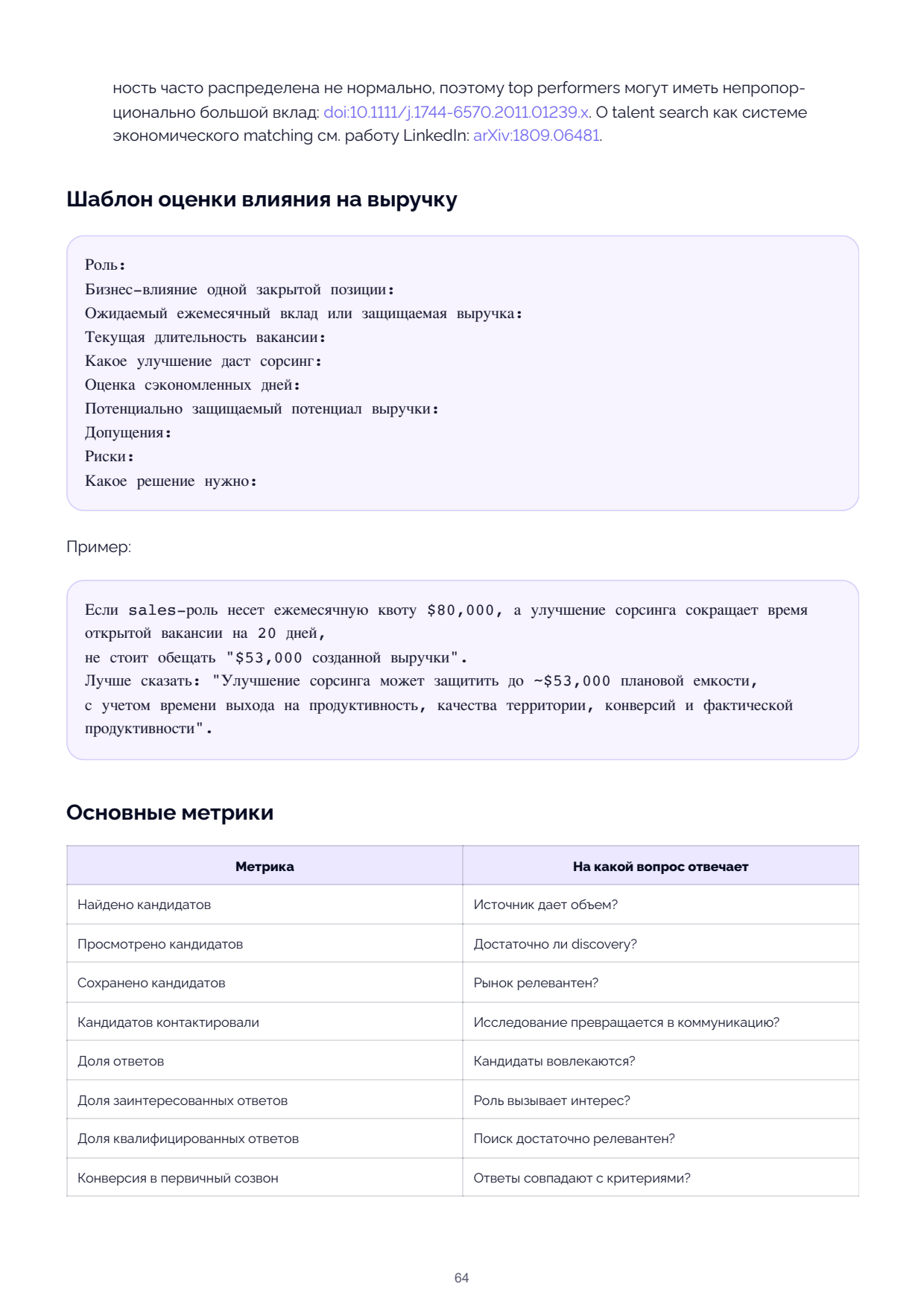
Evidence note: Schmidt and Hunter link valid selection methods to job performance and utility (doi:10.1037/0033-2909.124.2.262). Huselid links HR practices to turnover, productivity, and corporate financial performance (doi:10.2307/256741). O'Boyle and Aguinis show that the contribution of top performers may be disproportionate (doi:10.1111/j.1744-6570.2011.01239.x). On talent search as a system of economic matching, see arXiv:1809.06481.

Revenue Impact Assessment Template

Role:

Business impact of one closed position:

Expected monthly contribution or protected revenue:

Current vacancy duration:

What improvement sourcing will deliver:

Estimated days saved:

Potentially protected revenue potential:

Assumptions:

Risks:

Decision needed:

Example

If a sales role carries a monthly quota of $80,000 and improved sourcing reduces vacancy duration by 20 days, you should not promise "$53,000 of created revenue."

It is better to say: "Improved sourcing could protect up to ~$53,000 of planned capacity, accounting for time to productivity, territory quality, conversions, and actual productivity."

Key Metrics

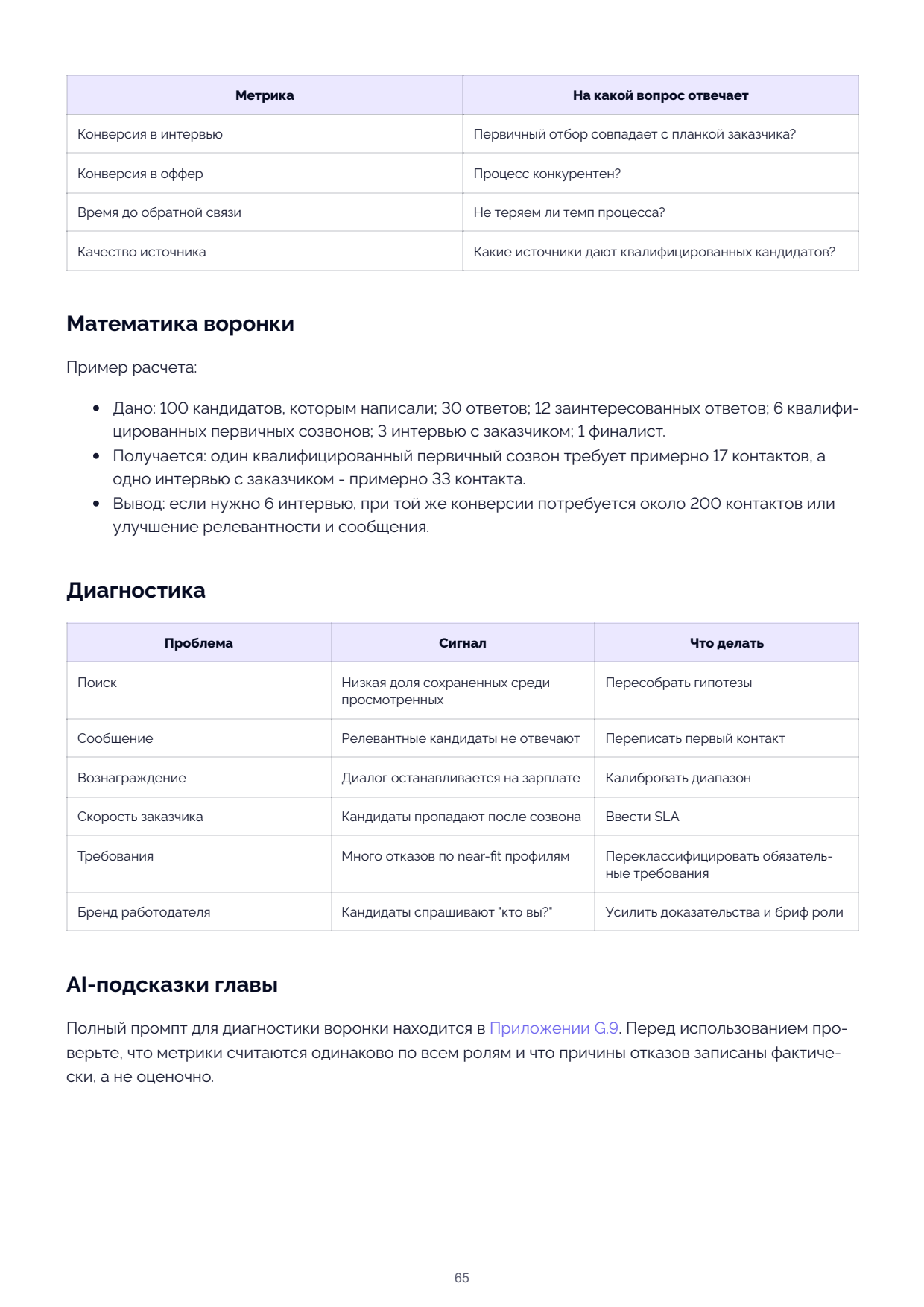
MetricQuestion It Answers
Candidates foundDoes the source provide volume?
Candidates reviewedIs discovery sufficient?
Candidates savedIs the market relevant?
Candidates contactedDoes research convert to communication?
Reply ratioAre candidates engaging?
Interested reply ratioDoes the role generate interest?
Qualified reply ratioIs the search relevant enough?
Screening call conversionDo replies match the criteria?
Interview conversionDoes initial screening match the client's bar?
Offer conversionIs the process competitive?
Time to feedbackAre we losing process momentum?
Source qualityWhich sources deliver qualified candidates?

Key Takeaways / Where to Go Next

Take away the habit of ending every metrics review with a decision: what we test next, what we change in the brief, and which risk we show the client. If you need to bring in AI and tools, move to Chapter 13, but keep to the data rules and manual verification.

Page 60 Page 61 Page 62 Page 63 Page 64 Page 65 Page 66