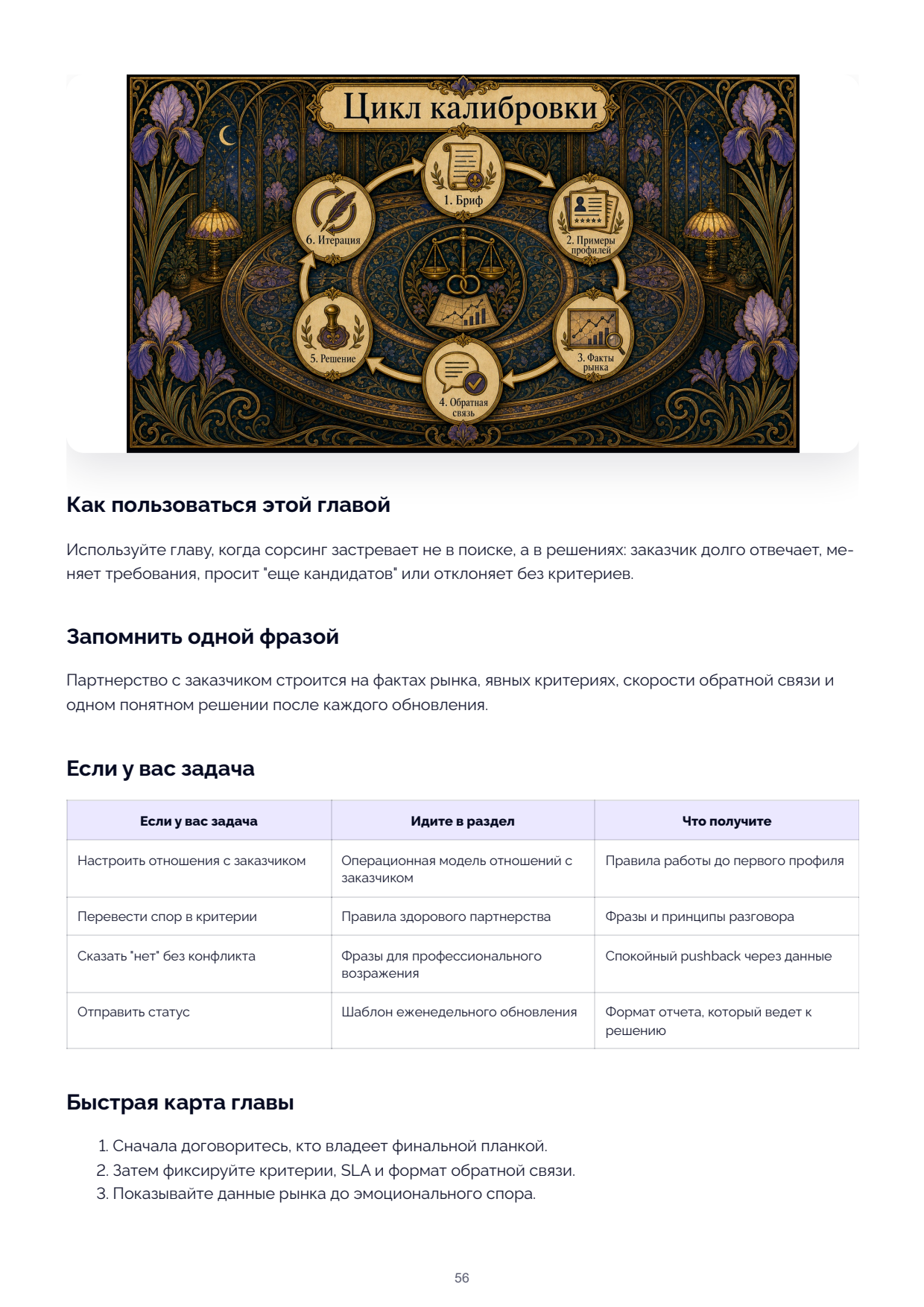
Chapter 11. Working with Clients


How to Use This Chapter
Use this chapter when sourcing stalls not in the search but in decisions: the client takes too long to respond, changes requirements, asks for "more candidates," or rejects without criteria.
Remember in One Phrase
Client partnership is built on market facts, explicit criteria, fast feedback, and one clear decision after each update.
| If Your Task Is | Go to Section | What You Get |
|---|---|---|
| Set up the client relationship model | Operational client relationship | Rules to follow before the first profile |
| Turn arguments into criteria | Healthy partnership rules | Phrases and principles for the conversation |
| Say "no" without conflict | Professional pushback phrases | Calm pushback backed by data |
| Send a status update | Weekly update template | A report format that leads to decisions |
Quick Chapter Map
1. First, agree on who owns the final quality bar.
2. Then lock in criteria, SLA, and feedback format.
3. Show market data before emotional arguments.
4. End each update with the one decision needed.
Minimal Start
In 30 minutes, collect the last 10 rejected profiles and list the specific reason for each rejection. If the reasons cannot be turned into an observable criterion, schedule a short calibration and document the new criterion in writing.
Principle
The recruiter acts as a market advisor, not a passive order-taker. The client owns the business need; the recruiter owns market facts and process discipline.
Operational Client Relationship Model
Effective work is established before the first profile is sent. The recruiter and client must agree not only on who they are looking for, but also on how decisions will be made.
Use this model:
1. Decision owner: one person is responsible for the final quality bar.
2. Calibration sample: the first 8–12 profiles are for training the process, not for volume.
3. Feedback format: every rejection names a missing fact or a trade-off.
4. SLA: calibration feedback within 24–48 hours; post-interview feedback within 24 hours.
5. Change management: new requirements are logged as mandatory, desirable, signal, or noise.
6. Market facts: the recruiter brings data, not opinions.
7. Candidate protection: slow feedback and duplicate messages are treated as candidate experience risk.
8. Weekly decision: each update ends with the needed decision, not just a status.
Healthy Partnership Rules
Rule Why It Matters Phrase
Turn opinions into criteria Eliminates vague rejections "What observable indicator would
demonstrate that?"
Maintain a single quality bar Prevents stakeholder conflict "Who ultimately owns this
compromise?"
Bring data before accusations Preserves the partnership "Here is what the market sample
shows."
Name trade-offs explicitly Removes hidden constraints "If we keep this requirement, the
pool narrows here."
Rule Why It Matters Phrase
Protect candidate speed Preserves trust "We need feedback by tomorrow to
avoid losing the candidate."
Conversation Example
Client: "Send more candidates."
Recruiter: "I can continue, but we need to understand what is not working. We have reviewed 18 profiles from direct competitors and adjacent companies. 12 were rejected for lacking the exact industry, 6 for compensation expectations. This means the constraints are significantly narrowing the pool. I suggest choosing one expansion: adjacent industry with similar buyer complexity, or exact industry with greater compensation flexibility."
Alignment Script
1. "Here is how I understand the role."
2. "Here are the mandatory requirements I will use to screen profiles."
3. "Here are the first three candidate pools."
4. "Here are the trade-offs that may be needed."
5. "I need feedback within [SLA] with specific reasons."
6. "After the first 10 profiles, we do a calibration."
Professional Pushback Phrases
"I can search for that, but I want to show the impact on the market size."
"This looks like a quality signal, not a mandatory requirement."
"If we keep this constraint, we should expect a smaller pool and a longer timeline."
"The data shows: the problem is not search volume but conversion from profiles reviewed to profiles approved."
"Let us test this assumption on 10 profiles."
Weekly Update Template
Role:
Week:
Hypotheses tested:
Profiles reviewed:
Candidates contacted:
Replies:
Interested replies:
Qualified screening calls:
Top rejection reasons:
What we learned about the market:
Decision needed from the client:
Plan for next week:
Difficult Communication Scenarios
Scenario What to Say
Client asks for "more candidates" without feedback "I will send more, but first we need to agree on which profiles are considered relevant. Otherwise we increase volume but not quality."
Client adds a new criterion after a rejection "I will log this as a brief change. Let us decide: is this a new mandatory requirement or a useful signal?"
Client compares with an ideal candidate from the past "Let us break down what exactly made that candidate strong: environment, scale, skills, motivation, or work style."
Client rejects due to "wrong vibe" "Help me translate this into a working criterion: what observable risk do you see?"
Agency client goes silent "To avoid losing market momentum and damaging candidate experience, I suggest pausing active outreach until the feedback SLA is confirmed."
AI Prompts for This Chapter
The full prompt for preparing a difficult conversation is in Appendix G.8. Use it for a neutral conversation structure, but adapt the final phrasing to the real relationship and agreements.
Key Takeaways / Where to Go Next
Take away the principle: the recruiter does not argue with opinions but brings data and asks for a decision. If you need to show process performance numerically, move to Chapter 12.