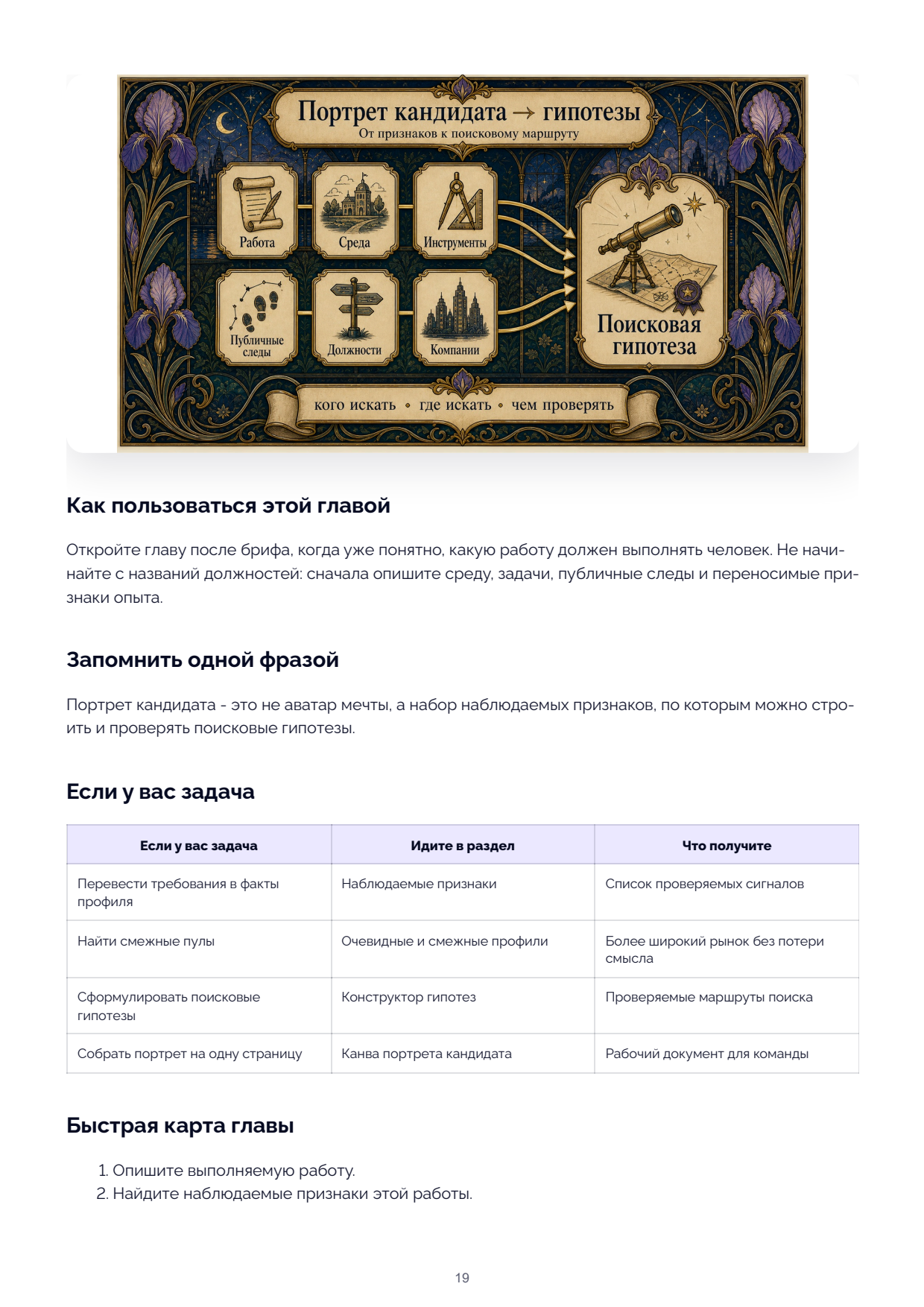
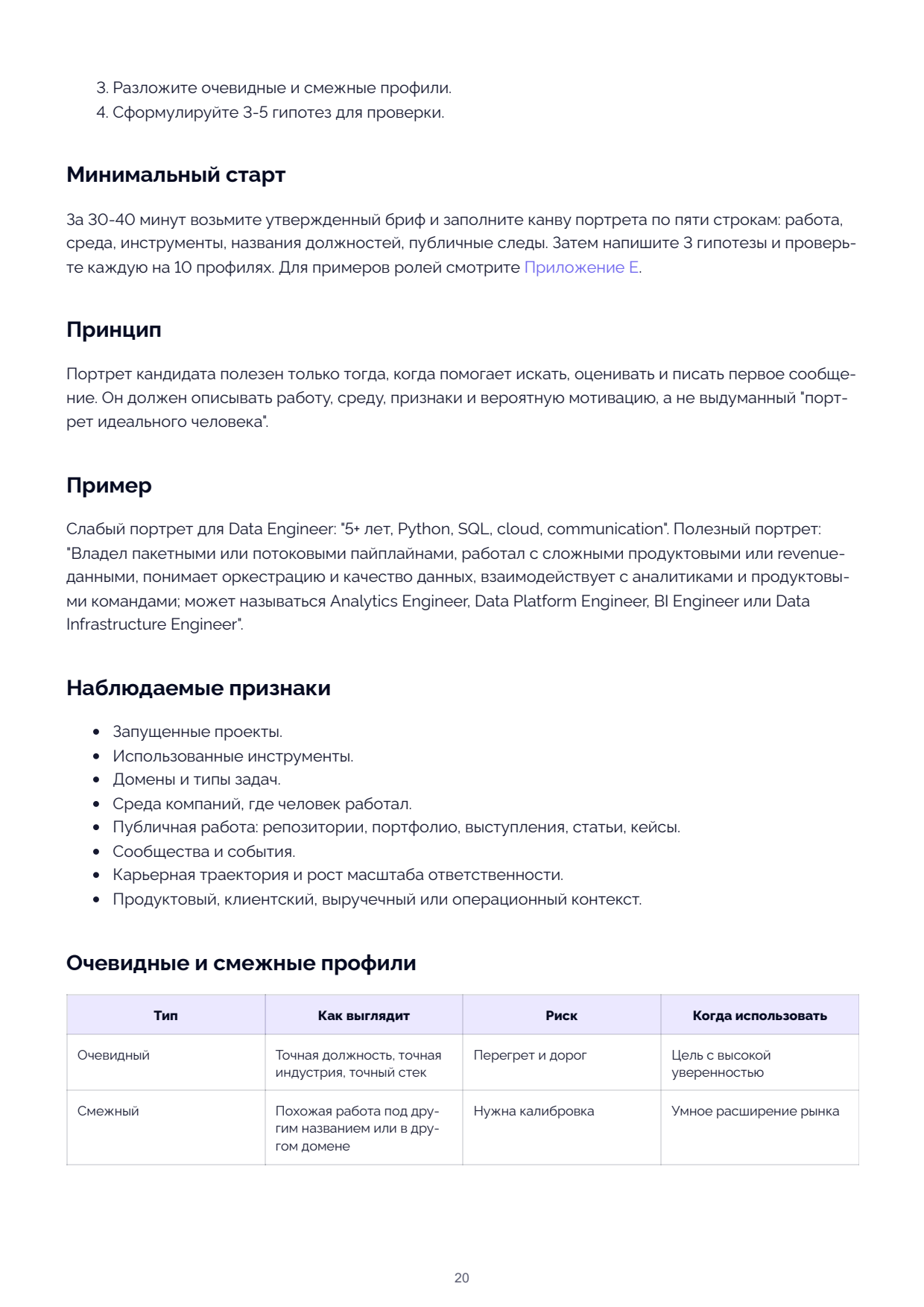
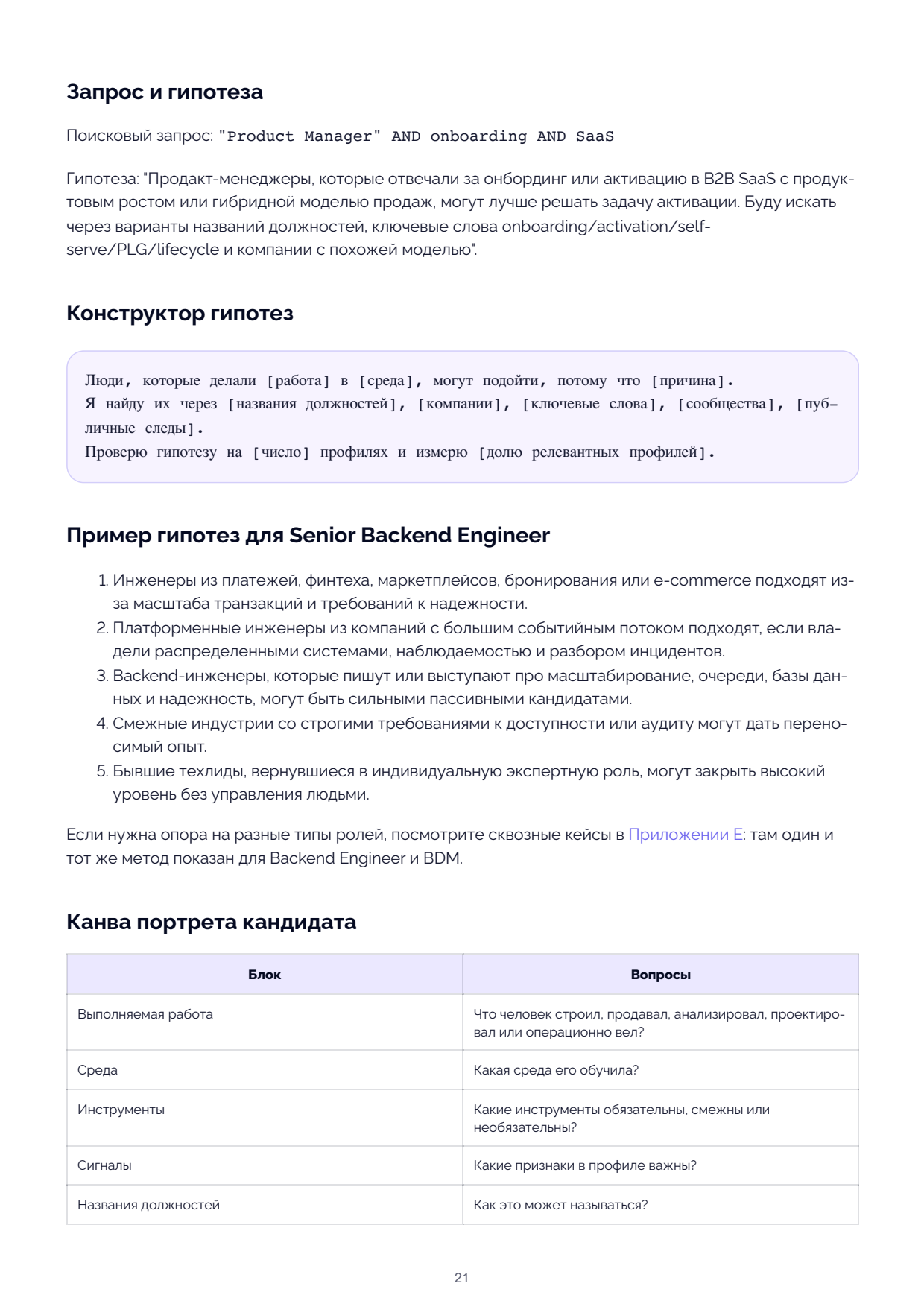
Chapter 03. Candidate Portrait and Search Hypotheses

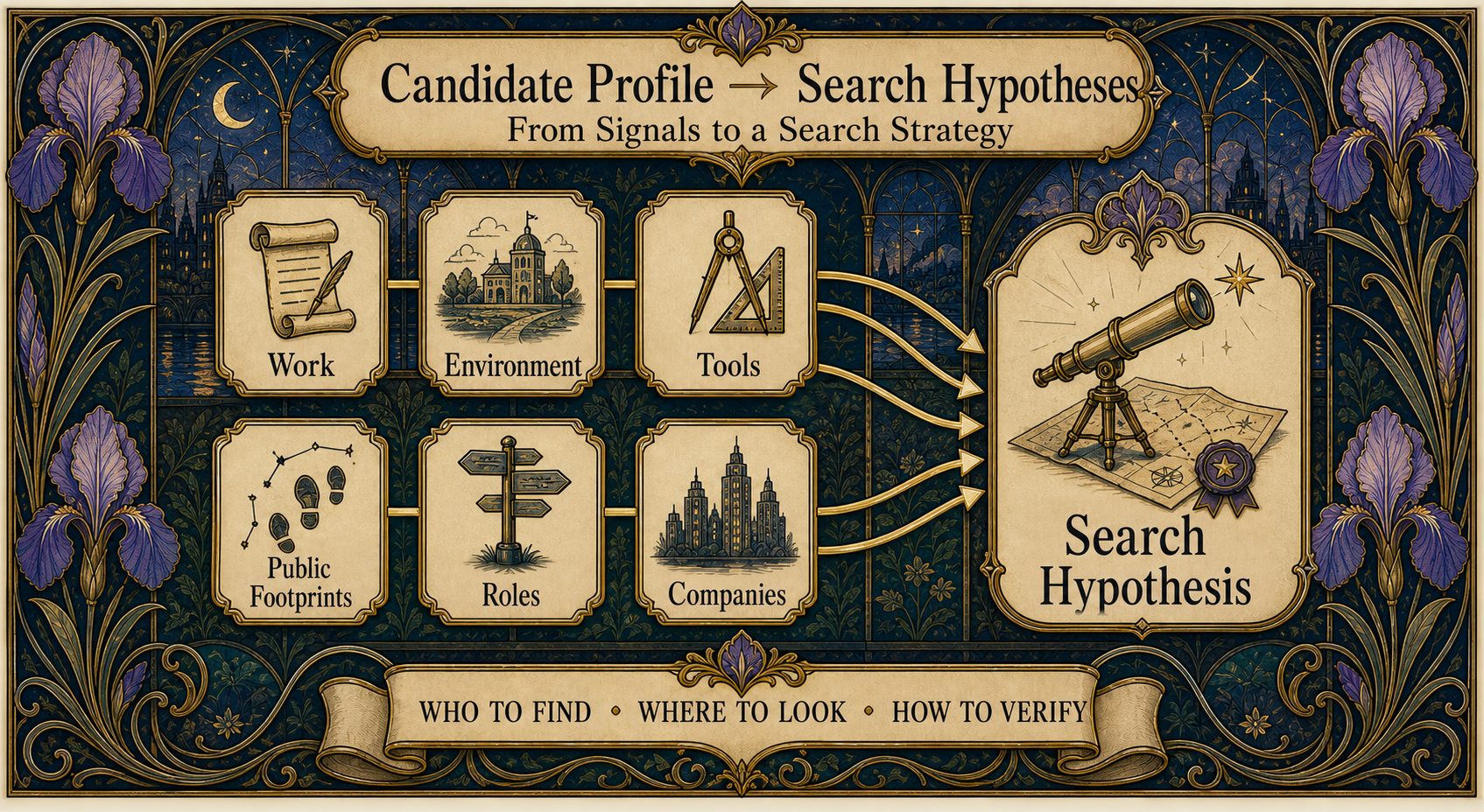
How to use this chapter
Open this chapter after the brief, when it is already clear what work the person must do. Do not start with job titles: first describe the environment, tasks, public traces, and transferable experience signals.
Remember in one phrase
A candidate portrait is not a dream avatar; it is a set of observable signals that can be used to build and test search hypotheses.
If you have a task
| If you have a task | Go to section | What you get |
|---|---|---|
| Translate requirements into profile facts | Observable signals | A list of checkable signals |
| Find adjacent pools | Obvious and adjacent profiles | A broader market without losing meaning |
| Form search hypotheses | Hypothesis builder | Testable search routes |
| Collect a one-page portrait | Candidate portrait canvas | A working document for the team |
Quick Chapter Map
- Describe the work to be done.
- Find observable signals of that work.
- Separate obvious and adjacent profiles.
- Form 3-5 hypotheses to test.
Observable signals
- Projects launched.
- Tools used.
- Domains and task types.
- Company environments where the person worked.
- Public work: repositories, portfolios, talks, articles, cases.
- Communities and events.
- Career trajectory and growth of responsibility.
- Product, customer, revenue, or operational context.
Obvious and adjacent profiles
| Type | How it looks | Risk | When to use |
|---|---|---|---|
| Obvious | Exact title, exact industry, exact stack | Overheated and expensive | High-confidence target |
| Adjacent | Similar work under another title or in another domain | Needs calibration | Smart market expansion |
Query and hypothesis
Search query: "Product Manager" AND onboarding AND SaaS
Hypothesis: product managers who owned onboarding or activation in B2B SaaS with product-led growth or a hybrid sales model may be better suited to solve the activation problem.
Hypothesis builder
Candidate portrait canvas
| Block | Questions |
|---|---|
| Work performed | What did the person build, sell, analyse, design, or operate? |
| Environment | What environment trained them? |
| Tools | Which tools are mandatory, adjacent, or optional? |
| Signals | Which profile signals matter? |
| Job titles | What might this be called? |
| Communities | Where do these people speak, write, or participate? |
| Motivation | Why might the move be interesting? |
| Risk | What looks relevant but is not? |
| First-message angle | Which specific message angle should be used? |
What to take from the chapter / where to go next
Take a set of hypotheses, not one perfect query. If the hypotheses are ready, go to Chapter 4 to check where the market actually contains the right people and what constraints should be shown to the client.