Harmony HR
01 1. Sourcing as a System02 2. Client Brief Before the Search03 3. Candidate Portrait04 4. Market Map05 5. Boolean, X-Ray06 6. LinkedIn07 7. Beyond LinkedIn08 8. GitHub and Tech Traces09 9. First Contact10 10. Candidate Evaluation11 11. Working with Clients12 12. Metrics13 13. Tools and AI14 14. Operational Model15 15. Practical Exercises
A Materials NavigatorB Mini DictionaryC RegulationsD Template LibraryE End-to-End CasesF Data, AI, PrivacyG AI Prompt Library
Home/Appendix G

Appendix G. AI Prompt Library

pp. 94–101

All prompts below produce drafts. Before use, remove personal data, commercial secrets and confidential documents. After generation, verify facts, tone, privacy, absence of discriminatory characteristics and compliance with client agreements.

G1. Search Brief After Intake Meeting

Objective: turn intake meeting notes into a working search brief.

Inputs: anonymised role notes, business problem description, constraints, questions for the client.

Output: brief draft, requirements list, risks and clarification questions.

You are acting as a senior talent sourcing strategist and recruitment operations consultant.

Task: turn intake meeting notes into a sourcing search brief.

Role context:

[insert anonymised vacancy description or notes]

What to do:

1. Summarise the business problem behind the role in one sentence.

2. Split requirements into four groups:

• mandatory requirements;

• desirable requirements;

• useful quality signals;

• noise or unverified assumptions.

3. For each mandatory requirement, write the observable sign visible in a candidate profile.

4. Suggest 5 job title alternatives under which the required experience may appear.

5. Suggest 5 donor company types and explain why they are relevant.

6. Suggest 3 search hypotheses.

7. Formulate 5 questions for the client if the brief has uncertainty.

8. Separately list risks: niche market, compensation, location, level, feedback speed.

Constraints:

• Do not fabricate facts.

• If data is missing, mark it as "requires clarification".

• Do not use candidate personal data.

• Write practically, in a format that can be sent to the recruiter and client after manual review.

Human check: confirm must-have criteria, compromises, constraints and SLA with the client.

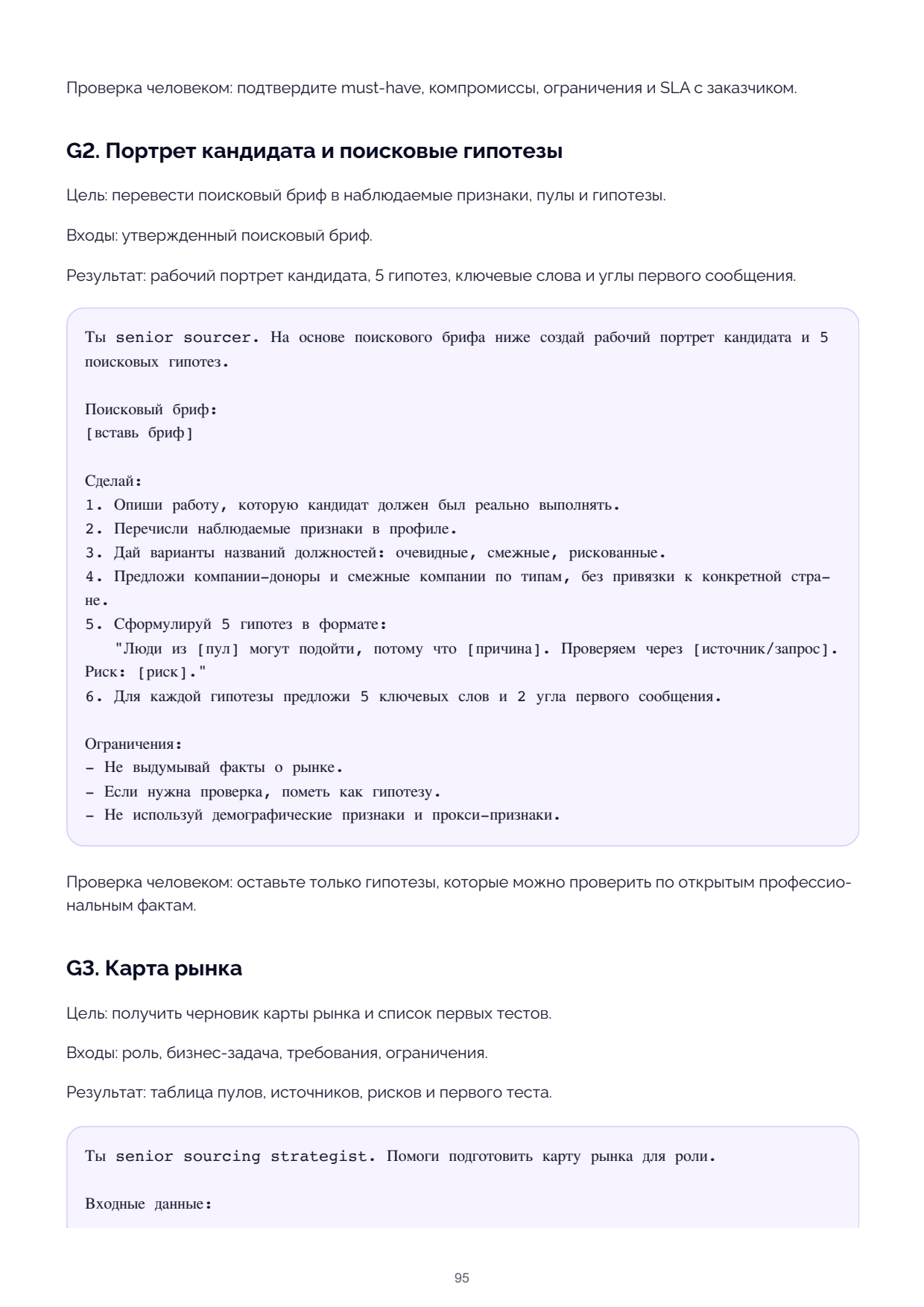
G2. Candidate Portrait and Search Hypotheses

Objective: translate the search brief into observable signs, pools and hypotheses.

Inputs: approved search brief.

Output: working candidate portrait, 5 hypotheses, keywords and first-message angles.

You are a senior sourcer. Based on the search brief below, create a working candidate portrait and 5 search hypotheses.

Search brief:

[insert brief]

Do the following:

1. Describe the work the candidate must have actually performed.

2. List the observable signs in the profile.

3. Provide job title alternatives: obvious, adjacent, high-risk.

4. Suggest donor companies and adjacent companies by type, without tying to a specific country.

5. Formulate 5 hypotheses in this format:

"People from [pool] may be a fit because [reason]. Verified via [source/query]. Risk: [risk]."

6. For each hypothesis, suggest 5 keywords and 2 first-message angles.

Constraints:

• Do not fabricate market facts.

• If verification is needed, mark it as a hypothesis.

• Do not use demographic or proxy characteristics.

Human check: keep only hypotheses that can be verified against open professional facts.

G3. Market Map

Objective: produce a market map draft and a list of first tests.

Inputs: role, business problem, requirements, constraints.

Output: table of pools, sources, risks and the first test.

You are a senior sourcing strategist. Help prepare a market map for a role.

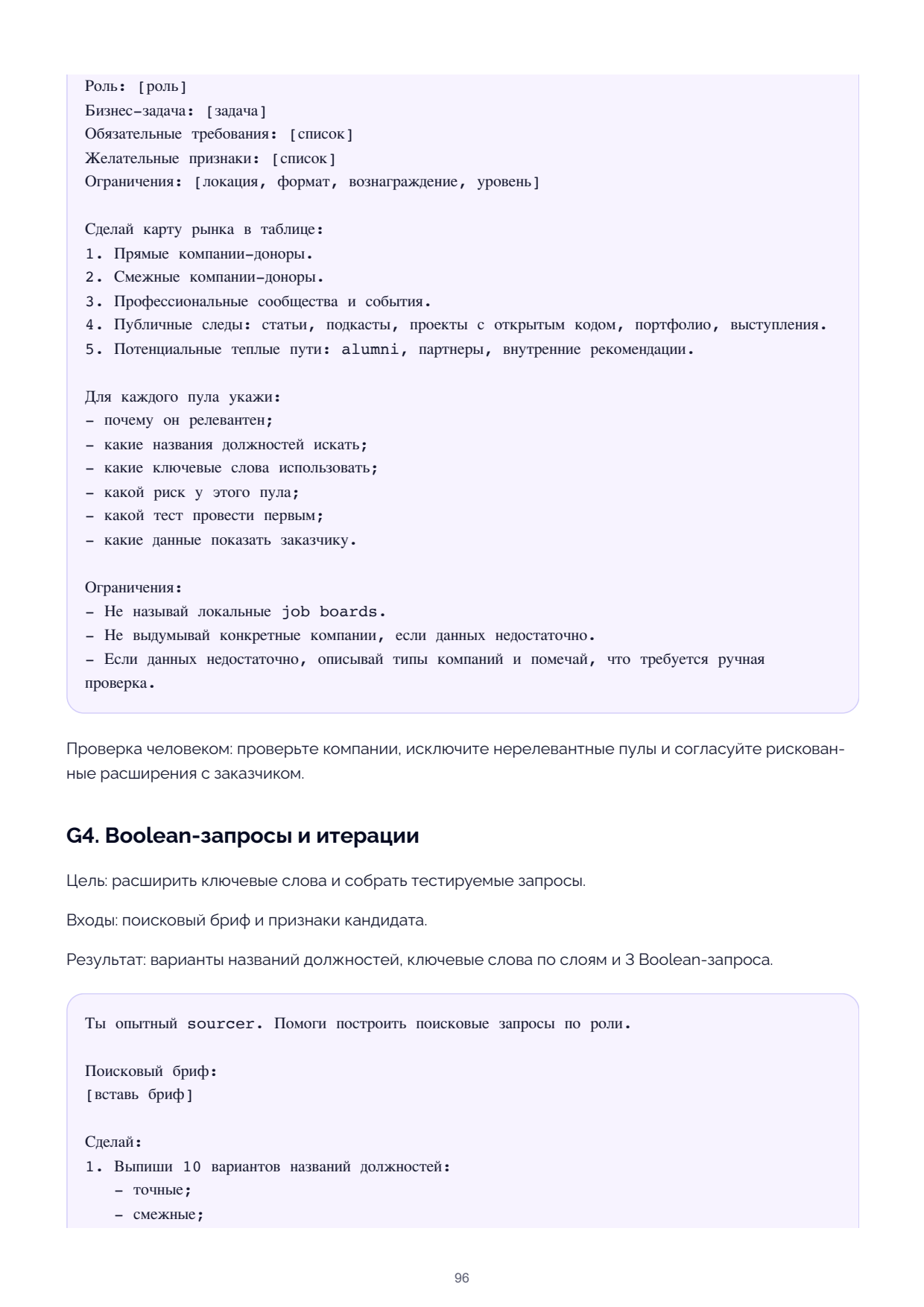
Inputs:

Role: [role]

Business problem: [problem]

Mandatory requirements: [list]

Desirable signs: [list]

Constraints: [location, format, compensation, level]

Build the market map as a table:

1. Direct donor companies.

2. Adjacent donor companies.

3. Professional communities and events.

4. Public traces: articles, podcasts, open-source projects, portfolios, talks.

5. Potential warm paths: alumni, partners, internal referrals.

For each pool, specify:

• why it is relevant;

• which job titles to search for;

• which keywords to use;

• what risk this pool carries;

• which test to run first;

• which data to present to the client.

Constraints:

• Do not name local job boards.

• Do not fabricate specific companies if data is insufficient.

• If data is insufficient, describe company types and note that manual verification is required.

Human check: verify companies, exclude irrelevant pools and agree risky expansions with the client.

G4. Boolean Queries and Iterations

Objective: expand keywords and build testable queries.

Inputs: search brief and candidate signs.

Output: job title alternatives, layered keywords and 3 Boolean queries.

You are an experienced sourcer. Help build search queries for a role.

Search brief:

[insert brief]

Do the following:

1. List 10 job title alternatives:

• exact;

• adjacent;

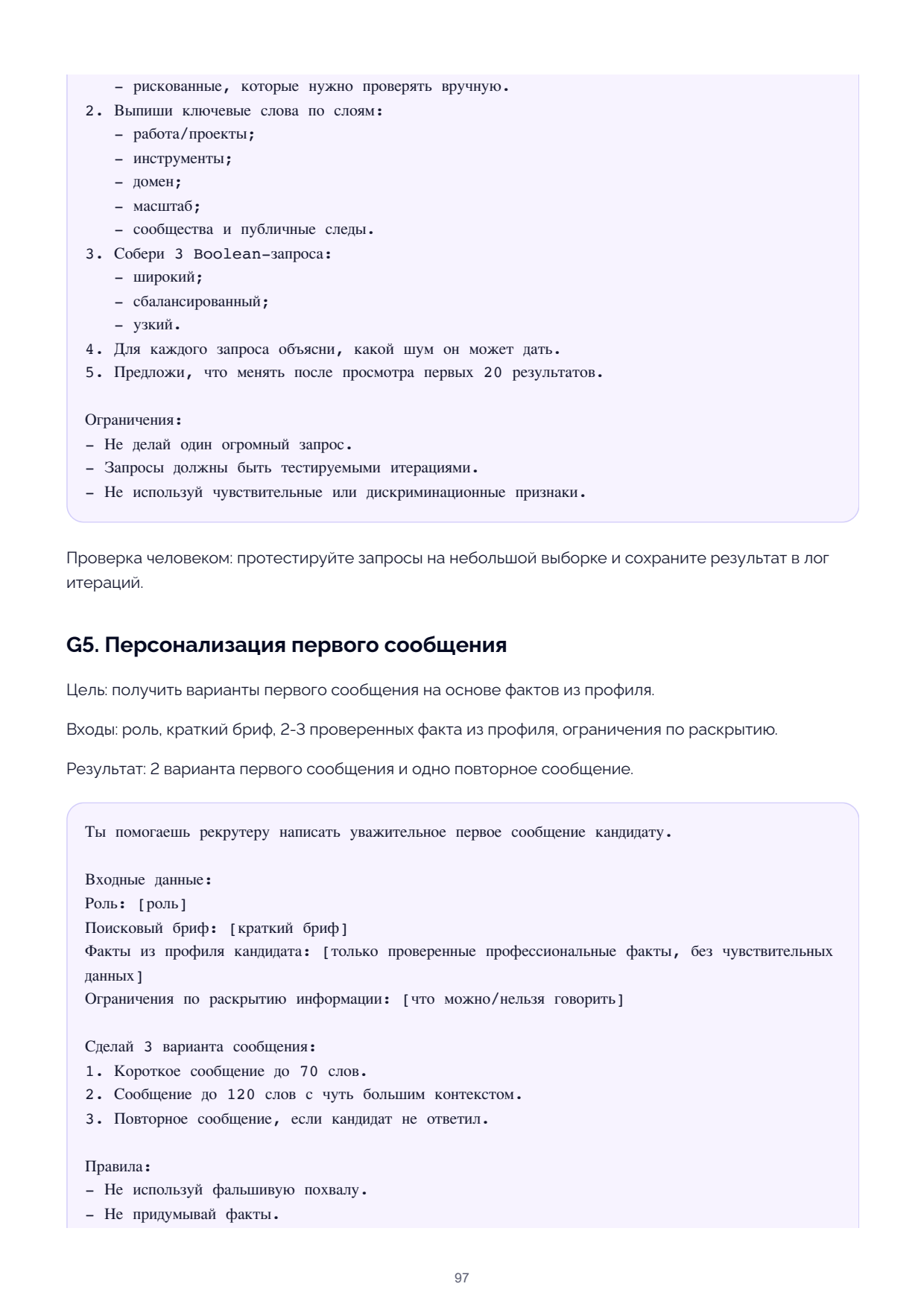
• high-risk, requiring manual verification.

2. List keywords by layer:

• work/projects;

• tools;

• domain;

• scale;

• communities and public traces.

3. Build 3 Boolean queries:

• broad;

• balanced;

• narrow.

4. For each query, explain what noise it may produce.

5. Suggest what to change after reviewing the first 20 results.

Constraints:

• Do not create one enormous query.

• Queries should be testable iterations.

• Do not use sensitive or discriminatory characteristics.

Human check: test queries on a small sample and save the result in an iteration log.

G5. First Message Personalisation

Objective: produce first-message variants based on profile facts.

Inputs: role, brief summary, 2–3 verified profile facts, disclosure constraints.

Output: 2 first-message variants and 1 follow-up message.

You are helping a recruiter write a respectful first message to a candidate.

Inputs:

Role: [role]

Search brief: [brief summary]

Candidate profile facts: [only verified professional facts, no sensitive data]

Disclosure constraints: [what may / may not be said]

Produce 3 message variants:

1. Short message up to 70 words.

2. Message up to 120 words with slightly more context.

3. Follow-up message if the candidate did not respond.

Rules:

• Do not use insincere praise.

• Do not make up facts.

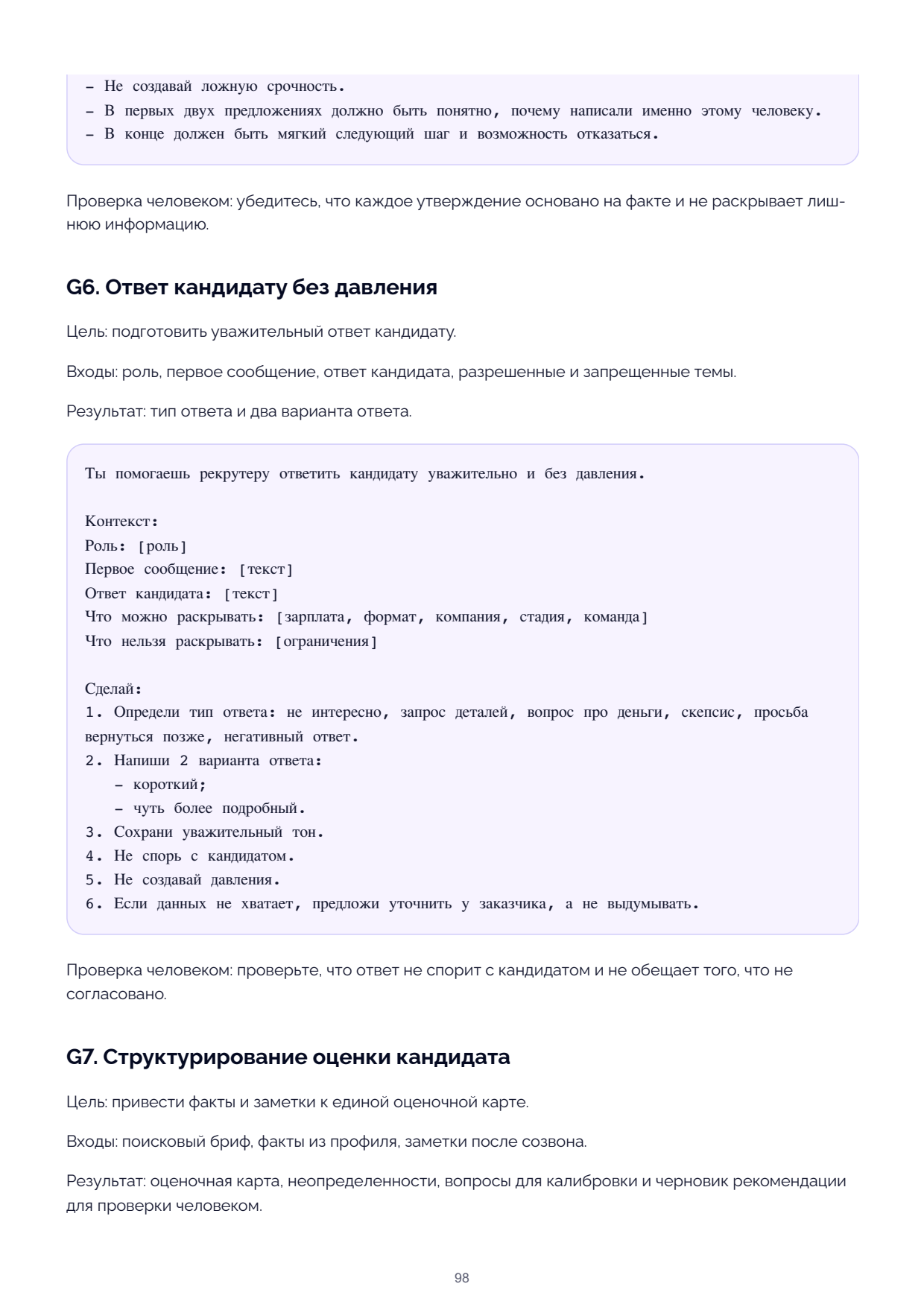
• Do not create false urgency.

• Within the first two sentences it should be clear why you are reaching out to this person specifically.

• At the end there should be a gentle next step and the option to decline.

Human check: ensure every claim is fact-based and does not disclose unnecessary information.

G6. Pressure-Free Candidate Response

Objective: prepare a respectful response to a candidate.

Inputs: role, first message, candidate response, permitted and restricted topics.

Output: response type and two response variants.

You are helping a recruiter respond to a candidate respectfully and without pressure.

Context:

Role: [role]

First message: [text]

Candidate response: [text]

What may be disclosed: [salary, format, company, stage, team]

What may not be disclosed: [constraints]

Do the following:

1. Identify the response type: not interested, requesting details, money question, scepticism, asking to return later, negative response.

2. Write 2 response variants:

• short;

• slightly more detailed.

3. Maintain a respectful tone.

4. Do not argue with the candidate.

5. Do not create pressure.

6. If data is insufficient, offer to clarify with the client rather than making things up.

Human check: ensure the response does not argue with the candidate and does not promise anything unapproved.

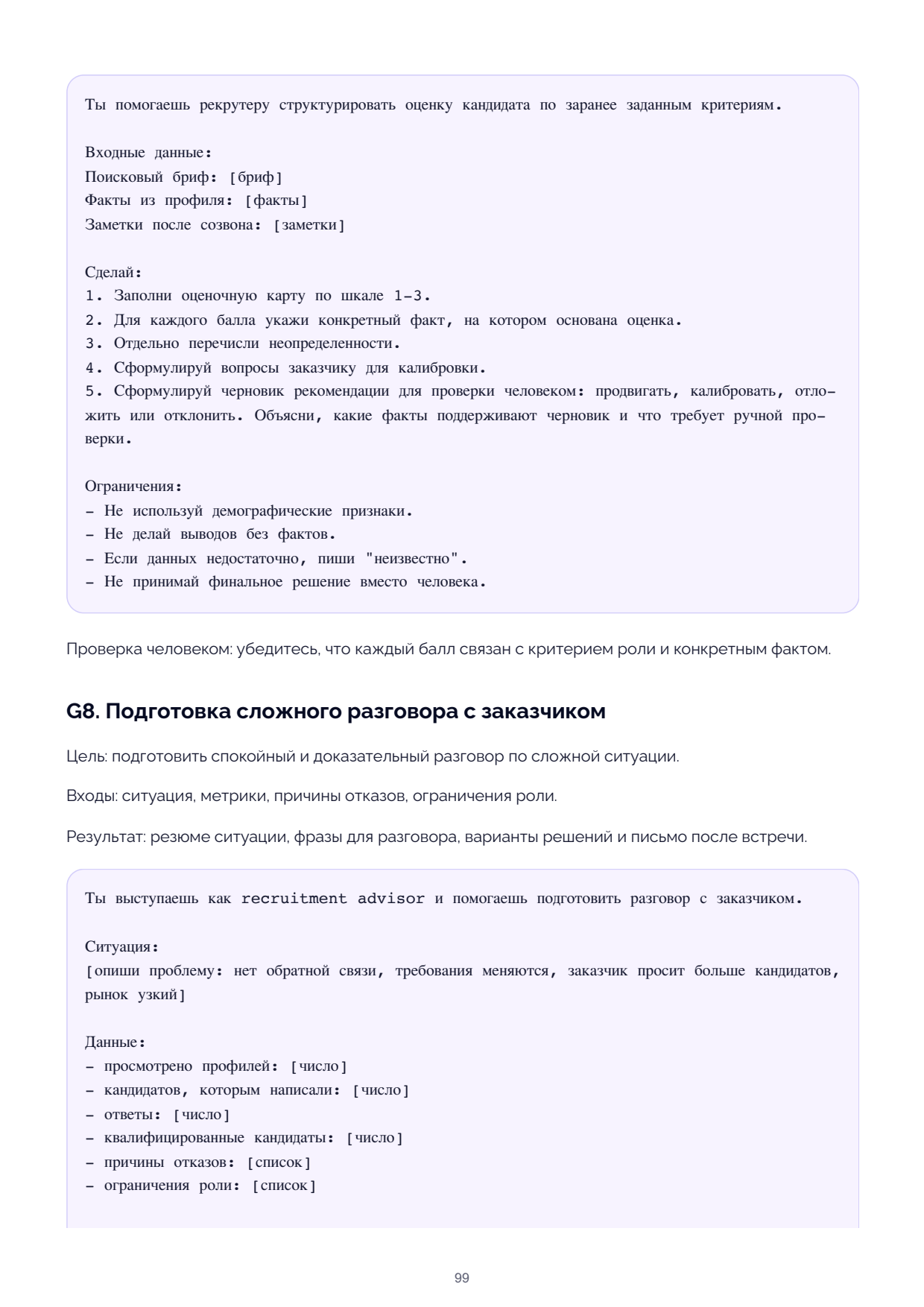
G7. Candidate Evaluation Structuring

Objective: organise facts and notes into a unified assessment map.

Inputs: search brief, profile facts, post-call notes.

Output: assessment map, uncertainties, calibration questions and a recommendation draft for human review.

You are helping a recruiter structure candidate evaluation against pre-set criteria.

Inputs:

Search brief: [brief]

Profile facts: [facts]

Post-call notes: [notes]

Do the following:

1. Fill in the assessment map on a 1–3 scale.

2. For each score, cite the specific fact the assessment is based on.

3. Separately list uncertainties.

4. Formulate calibration questions for the client.

5. Draft a recommendation for human review: advance, calibrate, delay or reject. Explain which facts support the draft and what requires manual verification.

Constraints:

• Do not use demographic characteristics.

• Do not draw conclusions without facts.

• If data is insufficient, write "unknown".

• Do not make the final decision on behalf of a person.

Human check: confirm that every score is linked to a role criterion and a specific fact.

G8. Preparing a Difficult Client Conversation

Objective: prepare a calm, evidence-based conversation on a difficult situation.

Inputs: situation, metrics, rejection reasons, role constraints.

Output: situation summary, conversation phrases, solution options and a post-meeting email.

You are acting as a recruitment advisor and helping prepare a conversation with the client.

Situation:

[describe the problem: no feedback, changing requirements, client asking for more candidates, niche market]

Data:

• profiles reviewed: [number]

• candidates contacted: [number]

• responses: [number]

• qualified candidates: [number]

• rejection reasons: [list]

• role constraints: [list]

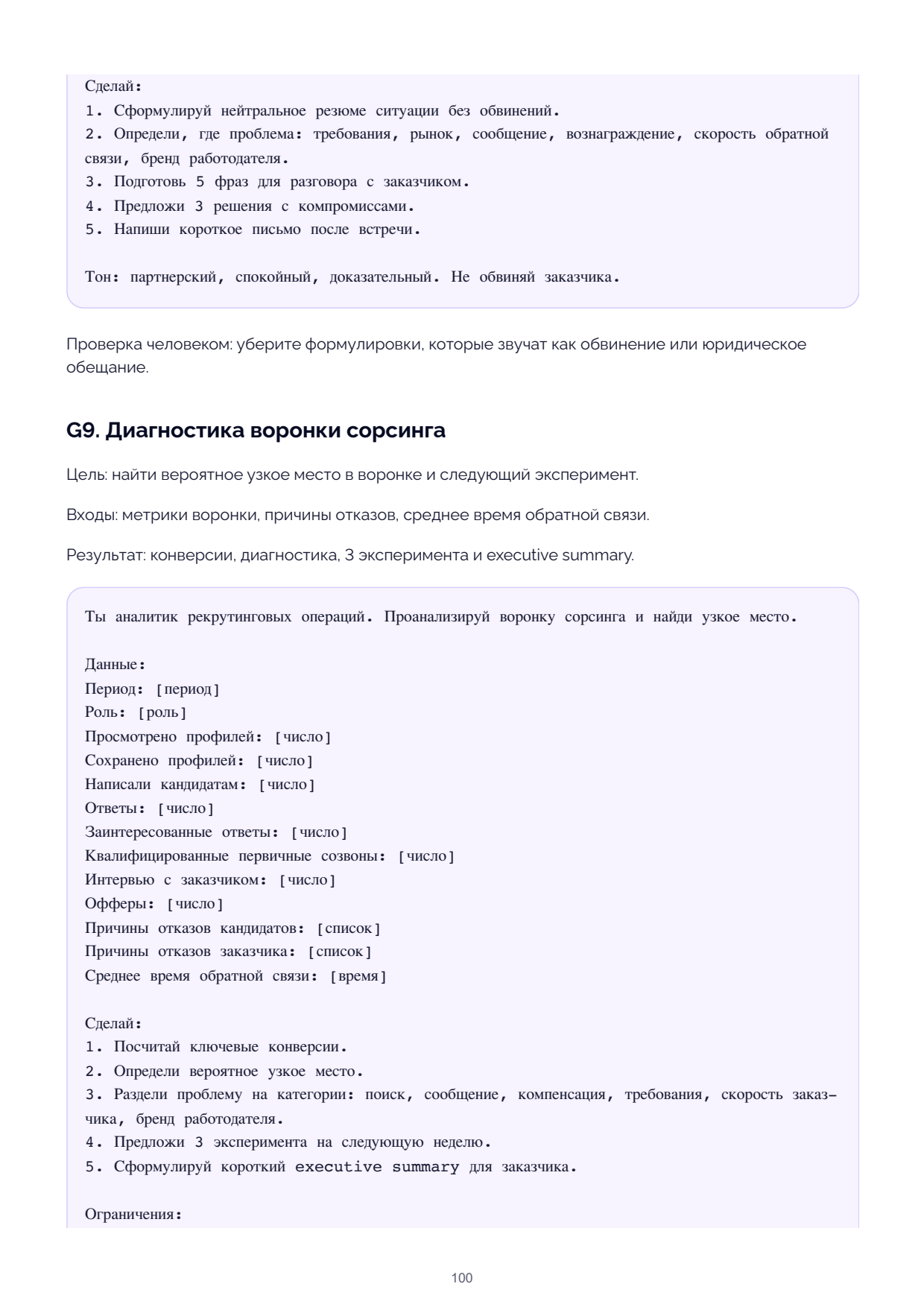
Do the following:

1. Write a neutral situation summary without blame.

2. Identify where the problem lies: requirements, market, message, compensation, feedback speed, employer brand.

3. Prepare 5 phrases for the conversation with the client.

4. Suggest 3 solutions with trade-offs.

5. Write a short post-meeting email.

Tone: partnership-oriented, calm, evidence-based. Do not blame the client.

Human check: remove any phrasing that sounds like blame or a legal commitment.

G9. Sourcing Funnel Diagnostics

Objective: identify the likely funnel bottleneck and the next experiment.

Inputs: funnel metrics, rejection reasons, average feedback time.

Output: conversions, diagnostics, 3 experiments and an executive summary.

You are a recruiting operations analyst. Analyse the sourcing funnel and identify the bottleneck.

Data:

Period: [period]

Role: [role]

Profiles reviewed: [number]

Profiles saved: [number]

Candidates contacted: [number]

Responses: [number]

Interested responses: [number]

Qualified initial calls: [number]

Client interviews: [number]

Offers: [number]

Candidate rejection reasons: [list]

Client rejection reasons: [list]

Average feedback time: [time]

Do the following:

1. Calculate key conversions.

2. Identify the likely bottleneck.

3. Categorise the problem: search, message, compensation, requirements, client speed, employer brand.

4. Suggest 3 experiments for the next week.

5. Write a short executive summary for the client.

Constraints:

• Do not draw conclusions without data.

• Do not promise ROI or an exact role-closing timeframe.

• If data is limited, mark the conclusion as a hypothesis.

Human check: verify formulas, stage definitions and source data quality before sending to the client.

Page 94 Page 95 Page 96 Page 97 Page 98 Page 99 Page 100 Page 101